
Episode 110 · 10 July 2023 · 00:17:41
One passport, or everyone cooking their own soup
EU Battery Regulation - Battery Passport
Circulor's business development director and the European Battery Alliance's policy manager on the content guidance published in April, why a battery passport cannot be a competition, and what a shared carbon methodology would finally make comparable.
Read the article: One passport, or everyone cooking their own soup
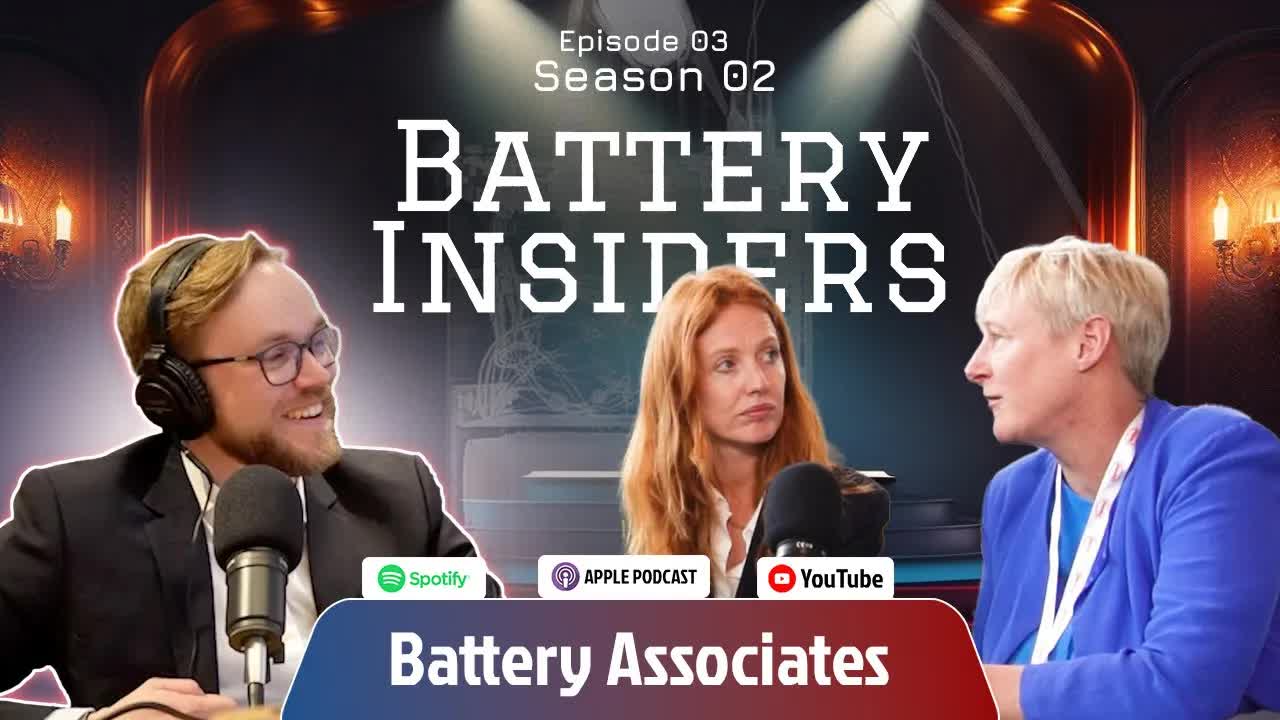
Luise Müller-Hofstede
Business Development Director, Circulor
Müller-Hofstede is also a Catena-X board member.
Ilka von Dalwigk
Policy Manager, European Battery Alliance and EIT InnoEnergy
Von Dalwigk sits on the advisory council of the Battery Pass project.
Recorded in The European Battery Show
What this episode covers
The content guidance from the BMWK-funded battery passport project went public on 17 April, and it is the milestone both guests name first. Müller-Hofstede describes it as guidance in the literal sense: the project read the EU battery regulation, extracted the data points it implies, and set out how companies can start preparing for a battery passport. Von Dalwigk sits on that project's advisory board. A day before this conversation, the Global Battery Alliance published a request for proposal for the second phase of its own battery passport work, following pilots that launched in 2022 and were presented at the World Economic Forum earlier in the year.
Müller-Hofstede has been inside several of these efforts at once: the Global Battery Alliance pilots, direct customer work at Circulor preparing companies for what is coming, and the standardisation strand running out of Catena-X. She sets out the sequence plainly. People were talking about a battery passport three years ago. Last year the first groups formed and agreed to trial and pilot together. Then came three or four months of going back over what had been learned and working out what a next step looks like, which is roughly where things stood when this was recorded.
A European project called CIRPASS is now looking past batteries at digital product passports more broadly, with conversations running into textiles and electronics. Von Dalwigk calls the battery a front runner in that learning process, and later puts it less kindly: the battery was picked first, it has the most complex and most global supply chains, and the hope is that everything after it proves easier. That hope is hedged almost immediately in the recording, on the grounds that a battery is one part of a car among many. Both guests are firm that the passport itself cannot become a contest.
The reason is consensus. Different groups took different approaches at the start, which both think was useful, and the work now is bridging them and taking the best from each so that one scheme survives with agreed standards inside it. Müller-Hofstede's image is cooking: if everyone makes their own soup, you cannot pour it all together and have it taste the same. Von Dalwigk adds interoperability. Plenty of systems already measure different things, so nothing needs reinventing, only packaging into one product with a common language that information can be fed into and pulled back out of.
None of this feels like help to the companies on the receiving end yet. Müller-Hofstede describes something close to panic among cell manufacturers, OEMs and their suppliers: a lot of questions arriving at once, the threat of exclusion from the market, fees to pay. The counter-argument is that several regulatory proposals already demand the same underlying information, with CO2 reporting required by the battery regulation and by mechanisms such as CBAM. One instrument that captures it once and reports into different requirements saves time and money. Built right from the start, von Dalwigk argues, the administrative burden falls rather than rises.
The supply chain case is made without much appeal to sustainability. More visibility means more control, and dark corners, where you do not know what is happening or who is involved, are where the risk sits. No department in a large company wants that instead of resilient supply and resource security. The semiconductor shortage comes up as the precedent: there was little transparency into that supply base before COVID, and the constraint is what forced carmakers to build it. Von Dalwigk's other point is methodology. If everyone calculates a carbon footprint the same way, comparison becomes possible for the first time, and the greenwashing risk to the whole industry drops.
Questions from this episode
- What is the EU battery passport meant to do?
- Von Dalwigk describes it as an instrument for measuring circularity and sustainability, introduced by what she calls a very innovative piece of regulation. In practice it is one place to capture information that several regulations already demand, so a company does the work once and reuses it for reporting and auditing elsewhere. It also puts everyone on the same methodology, which makes carbon footprints comparable. The stated aim is to make life easier for the industry rather than to add another compliance exercise, and both guests accept that it does not feel that way to companies yet.
- What is the battery passport content guidance published in April 2023?
- It came out of the BMWK-funded battery passport project on 17 April and is open to the public. Müller-Hofstede calls it an interpretation of the EU battery regulation, guidance in the literal sense: the project reviewed the regulation, extracted the data points it implies, and described how the industry can begin preparing for battery passports. She treats it as the important milestone that project reached. Von Dalwigk sits on its advisory board. It is one strand among several, alongside the Global Battery Alliance pilots and the standardisation work coming out of Catena-X.
- Will the battery passport mean more reporting work for companies?
- Not if it is built properly, is the argument. Several regulatory proposals already require companies to report on where their raw materials come from, and mechanisms such as CBAM ask for carbon data. If one instrument captures that information and can report into different requirements, the work happens once and satisfies obligations that exist anyway. Müller-Hofstede is candid that it does not feel like that today, with cell manufacturers, OEMs and suppliers being asked a great many questions at once. Alignment between the reporting schemes is what decides whether this ends up easier or harder.
- Why do the guests say the battery passport cannot be competitive?
- Because the end state has to be one scheme that everybody agrees to, with consensus on the standards used inside it. Different groups took different approaches at the start, which both guests think was useful, and the task now is bridging them and taking the best of each. Müller-Hofstede's image is cooking: if everyone makes their own soup, you cannot pour it all together and have it taste the same. Von Dalwigk adds interoperability, since many systems already measure different things and there is no need to invent the wheel again, only to package it into one product.
- How does a battery passport reduce supply chain risk?
- The logic they offer does not rest on sustainability. More visibility means more control. If parts of a supply chain are dark, meaning you do not know what happens there or who is involved, that is where a company is exposed, and large corporates want resilient supply and resource security instead. The passport asks for exactly that visibility. The comparison drawn in the episode is the semiconductor shortage: before COVID there was little transparency into that supply base either, and the constraint is what forced carmakers to go and get it. Batteries can deliver the same shock.
- Can the battery passport prevent greenwashing?
- It helps by making everyone calculate the same way. Von Dalwigk's point is that a common methodology for carbon footprint makes it possible to compare apples with apples for the first time, whereas reporting done voluntarily to promote a product carries a greenwashing risk for the whole industry. She sees the value as collective rather than promotional: it lifts a growing industry rather than serving one company's marketing. Trust matters for the transition as well, since the case for electrification depends on showing that these cars really are better than fossil fuel ones, with ethically and sustainably sourced material behind them.
Listen to this episodeWatch on YouTube
Part of Europe: policy and money
Transcript
About this transcript. Generated automatically from the recording, then corrected against a glossary of company and guest names. It has not been checked line by line. Machine transcription mis-hears technical terms, numbers and names, so treat any figure here as a prompt to check the recording rather than a quotation of record. Spotted something wrong? Tell us.
0:00Introduction
Ilka von Dalwigk
0:00Content Guidance was published on April 17th, which is now open to the public. And I think also from a European perspective, there is currently a project called CIRPASS that is looking not only at the battery passport as one of those tools, but also at other digital product passports.
Luise Müller-Hofstede
0:18GBA just yesterday, I think, published in RFP, so a request for a proposal.
Ilka von Dalwigk
0:24We're looking currently at a lot of use cases because we can now build upon what has been already started in other initiatives.
Luise Müller-Hofstede
0:31This cannot be competitive. It's not like who's doing the better battery passport.
Ilka von Dalwigk
0:36And we need to have a language that we can feed in information and extract information.
Dr Simon Engelke
0:52Hello, Ilka. Hello, Louise.
Ilka von Dalwigk
0:55Hi.
Dr Simon Engelke
0:55Very good to have you here at the European Battery Show.
Ilka von Dalwigk
0:58Thank you so much. Thank you for inviting us.
Dr Simon Engelke
1:01Thanks for coming on. And we're here to have a discussion about the battery relation, especially battery passports. We know there's a lot happening. And I'm really curious to hear your opinion on what are the latest developments, but also, of course, there's a lot of questions about, is it just a new thing we have to add on, people have to comply to, or will it actually do a real change, a real improvement for the battery industry?
Ilka von Dalwigk
1:24Maybe if I can start, I think the battery regulation was a very innovative piece of regulation that was put forward. And especially the battery passport as an instrument to measure circularity, sustainability, really sparked the industry to think about how can they develop this tool to actually make it meaningful for the industry as well. And I think this is currently still being discussed, but maybe, Louise, being more deeper into the subject.
1:57The battery passport initiatives in play
Luise Müller-Hofstede
1:58I mean, I can talk from our experiences in sort of like various battery passport initiatives. So on the one hand, there is the BMWK-funded battery passport project, where ICA is also on the advisory board. And then we were part of the GBA pilots that launched last year and were presented at the World Economic Forum this year. And obviously, what we are doing in our direct customer relationships in order to prepare them for what's coming, and then also to extend that into the efforts that come out of Catena-X in terms of like standardization. And yeah, I'm happy to give some insights on what we've learned so far and where the current status quo is in those.
Dr Simon Engelke
2:51Great. Thanks for sharing. I think that's probably all people would be quite curious because I feel maybe some people have found the battery passport or popping up in one of these different circles. There's not that many people involved in so many of the initiatives at the same time, because I also know from a personal experience, it takes a lot of time to be involved in many of them. So maybe just what are some of the latest developments, content guides, topics? What should people know about listening to this or watching this?
Luise Müller-Hofstede
3:16So out of the BMWK passport, there was a milestone reached. The content guidance was published on April 17th, which is now open to the public. It's basically an interpretation or guidance, as the word says, to the industry and basically reviewed, looked at the regulation and extracted from the regulation sort of like data points and interpretation of how the industry can start to prepare for those battery passports. So that was an important milestone within this project. Then the GBA just yesterday, I think, published an RFP, so a request for a proposal for their second phase of battery passporting.
4:03Consolidating what the pilots learned
Luise Müller-Hofstede
4:04And that is sort of like where we are currently. So it feels like a lot has been done last year. A lot has been initiated last year. So there were talks already three years ago about this. And then last year it really came into life with the first groups that were formed and said, OK, we want to do this together. We want to trial together. We want to pilot together in those things. And now we had a couple of months, three to four months to go back and reconsolidate and understand what have been the learnings and how does how do next step look like?
Ilka von Dalwigk
4:43And I think also from a European perspective, there is currently a project called CIRPASS that is looking not only at the battery passport as one of those tools, but also at other digital product passports. So we have a lot of communication with the textiles and technology sector as well and see how actually the battery passport being a little bit of a front runner in this learning process also can be played to other products, which I think is very interesting. We're looking currently at a lot of use cases because we can now build upon what has been already started in other initiatives and uses for progressing further away. And there's an upcoming European call called CircleBot that I think will take all the learnings that we now have from the battery pass project in Germany, the CIRPASS project, the Global Battery Alliance will have great influence on this and really develop also this European battery passport. So it will be compliant with the European regulation.
Luise Müller-Hofstede
5:44And I think that's a good point because at the moment it's all about bringing the industry into this, right? And bringing it to life.
5:58Why there can only be one passport scheme
Luise Müller-Hofstede
5:59And obviously you can have the smartest standards in the world. You can have the best interpretations of a regulation. But if you don't see a critical mass within the industry starting to adopt, you know, all of this will only be on paper. And obviously with all of those initiatives now, and I think what Iker said is quite important to, I think it was good in the beginning there were different groups. And those different groups started to do their approach to it. And there were definitely different approaches taken. And now it's also the understanding of like how do we bridge this? How can we take the best from each group and create consensus within this group? Because obviously this cannot be competitive. It's not like who's doing the better battery passport. Because in the end it's about having one battery passport scheme that everybody agrees to. And found consensus on standards that are used within that. Because otherwise if everyone is cooking their own soup, you know, then we cannot pour it all together. And it tastes the same.
Ilka von Dalwigk
7:15And I think interoperability is a very important word to bring into the discussion. I think there's a lot of different systems already out there measuring different things. So we do not have to invent the wheel once again, but use what's already out there. But then use this to package into one product like the battery passport. I think that is one common language. And also open, I think the Global Battery Alliance has this more global perspective. But also I think the European Battery Passport is trying to understand it's a global industry we are talking about. And we need to have a language that we can feed in information and extract information.
7:58Reporting once instead of twice
Ilka von Dalwigk
7:59It's not only about compliance, what is in the regulation, but also make it easier for the industry to report and not do the same work twice. So I think in terms of what can be measured, we also have to learn what is necessary to be measured and not exaggerate it. So it's in the same time and effort from an industry perspective that you have to put in to do all the reporting and auditing as well. And we really need to have this product for the industry to make life easier for them, I would say. Because if you build it right, you maybe only have to do the reporting once, and then you can use it for auditing also in other things.
Luise Müller-Hofstede
8:42Yeah, and I think that's a good point you mentioned, because making it easier for the industry, I think currently it doesn't feel like that for cell manufacturers, for the OEMs, and for all suppliers that sit in those supply chains. Because currently I think there's a bit of a panic mode, you know, like, oh my God, I'm being asked so many questions and I need to do all of this, and otherwise I'm being excluded from the market, I have to pay fees. And it's quite important to show the value add and to make sure from an industry perspective, or overarching industry perspective, that these efforts are not being doubled, right? So, I mean, not only the EU battery regulation, and within that the battery password will ask for CO2 reporting, but also other regulations and mechanisms like the CBAM, for example. So, yeah, quite important to find alignment in those reporting schemes and requirements to be able to actually create, it feels actually that this is now being made easier than overcomplicated.
9:55What the industry actually gets out of it
Dr Simon Engelke
9:56I think that's a very important point, right? Because maybe quite a few people are thinking, okay, wait, another regulation, another compliance, something else to fulfill. But what is really, is there anything which will actually help me, right? As an OEM or producer, like what's some advantage, of course, traceability? And I know you work also in the space, right, to make it easier for people to understand where the materials are coming from, be more risk, you know, protected against risk from supply chain changes. We've seen a lot also with events in Europe, et cetera. So, I'm just curious, like maybe what's something which could make some of our listeners also be maybe even more supportive of an initiative like this, rather than seeing it as another burden which is put on top of the table.
Ilka von Dalwigk
10:38Yeah, I think Louise already mentioned, I mean, there are right now a couple of regulatory proposals on the table that require the industry to report, for example, on where their raw material come from. So, you're looking much more deeper into different supply chains. So, if you have one instrument that captures all of this information and can actually report to different regulatory requirements, you only need to do the work once and fulfill different requirements that you are obliged to do anyway. So, this will save time and hence money for the industry. So, in fact, of adding administrative burdens on top of each other, it might actually be lowering, if you build it right from the start.
Luise Müller-Hofstede
11:21Yeah, and I think, you know, you can look at, let's say, visibility into supply chains from different angles. The one angle is the sustainable one or like, let's say, the ethically correct, environmentally friendly one. But, I mean, it all comes down to a very simple logic that everybody should understand. It's like, the more visibility you have into something, the more control you have over something, right? So, I mean, it's pretty easy to understand.
11:52Visibility, control and supply chain risk
Luise Müller-Hofstede
11:53Like, if you have dark corners in your supply chain and you don't know what's happening there or who's involved, you are very open for risk. And I think where we can all agree, one or all also departments within big corporate companies is that they don't want to have risk and they want to have resilient supply and resource security. And getting this visibility into supply chains, just as the battery passport is asking, will support in that. And obviously, that's just the beginning of the journey. And there's a balancing act between, you know, being inviting and ask the industry to come in and it's all not so bad. And why don't you try, you know? And then on the other hand, and I think you mentioned in the beginning, Simon, you know, not only do a marketing purpose-led project, because in the end, this should be relevant and this should enable change.
Ilka von Dalwigk
13:02I think this is one of the beauties that the battery passport is a tool that enforces the industry to report on the same methodology as well. So, when it comes to carbon footprint, for example, everybody will need to calculate it in the same way, making it possible to actually compare apples with apples for the first time. Because right now, if you do it just to promote your product, there's also a risk of greenwashing of the entire industry. And I think we need this transparency also from a trust perspective of the consumers. If we want to do this transition to electrification, we really need to show that we are better than fossil fuel cars, for example. And battery passport can be a tool for actually showing in a transparent way that we source our material from ethically and sustainable sources.
13:57One methodology, and comparing like with like
Ilka von Dalwigk
13:58We have a CO2 footprint calculation and can thereby lift the entire industry to another level. So, I think in terms of improving the sustainability of an entire industry that is currently growing, the battery passport will be a very helpful tool, maybe not so much for an individual company to promote themselves, but for the industry as a whole.
Luise Müller-Hofstede
14:23Yeah, and maybe that's also like looking at it globally, you know, a tide lifts all boats, right? So, it's actually something, I mean, which ultimately will also help downstream players, the OEMs, the car makers, to prove towards their end customers, so us, you know, as individuals, to make an informed decision about which car they actually want to buy. And currently, there is no such scheme in place, you know. You know, you're happily probably buying or paying 50 cents more for biological yogurt or eggs in the supermarket. But it's very complex what to understand if a car is actually sustainable or not. And to your point, I think the awareness that the eyes are on the topic and that there will be checks in the future on those supply chains and on those criteria is just beneficial to us all.
Dr Simon Engelke
15:28I think also maybe one thing to wrap up, because I think it was interesting yesterday, an interesting conversation with someone from an OEM was explaining how before COVID, you know, there wasn't really that much transparency on the semiconductor industry either. There really were not as well, you know, sorted off different supplies, etc. and how really, you know, the COVID and, you know, the supply constraints really made a massive transformation and actually really getting this visibility into their supply chain and the semiconductor space, right, as an automotive.
15:54The semiconductor lesson, and measuring what matters
Dr Simon Engelke
15:55And I think that's just, you know, another level would now be the batteries as well, right, where it's really about visibility. And often people don't maybe care about it enough if you don't need it. If you feel you have your supply, you're okay. But then the one day suddenly you're using a supplier because there is an issue, cobalt or whatever it might be, and suddenly you can't get these cells anymore and you plant them in, you don't have this, you know, great visibility across your supply chain. And I think only then maybe you actually really wake up beyond, of course, regulatory compliance as well. So I think it's interesting to see that I think other tangent industries, you know, or like, you know, other supply also really gives a push for more visibility and transparency in the industry.
Luise Müller-Hofstede
16:32Yeah. And I mean, I mean, there's this little challenge that, I mean, there will digital product passports will be coming also for other products. Unfortunately, we picked the battery first. It's the most complex one with the most complex and difficult and global supply chains. But once we have done this, the rest should be easier.
Ilka von Dalwigk
16:57I hope. I'm not even so sure it is. I'm at the automotive perspective. I mean, the battery is one part, but there's a lot of other components in the car. And I think what we also need to learn is measure what is meaningful, not to overburden because in those complex supply chains, you can measure a lot of things and maybe not all of them are needed. And in order to keep this burden down on the industry, I think it's also important to limit yourself to measure what really makes an impact and a difference.