
Episode 138 · 10 August 2024 · 00:14:26
Overcapacity at home, tariffs abroad, and Europe as the opening
Exploring the Chinese Battery Industry with Wolfgang Bernhart
Wolfgang Bernhart on cell plants in China running at around 40% utilisation, the 25% graphite tariff that raises American prices without closing the cost gap, and the lithium carbonate refining Europe has not planned for.
Read the article: Overcapacity at home, tariffs abroad, and Europe as the opening
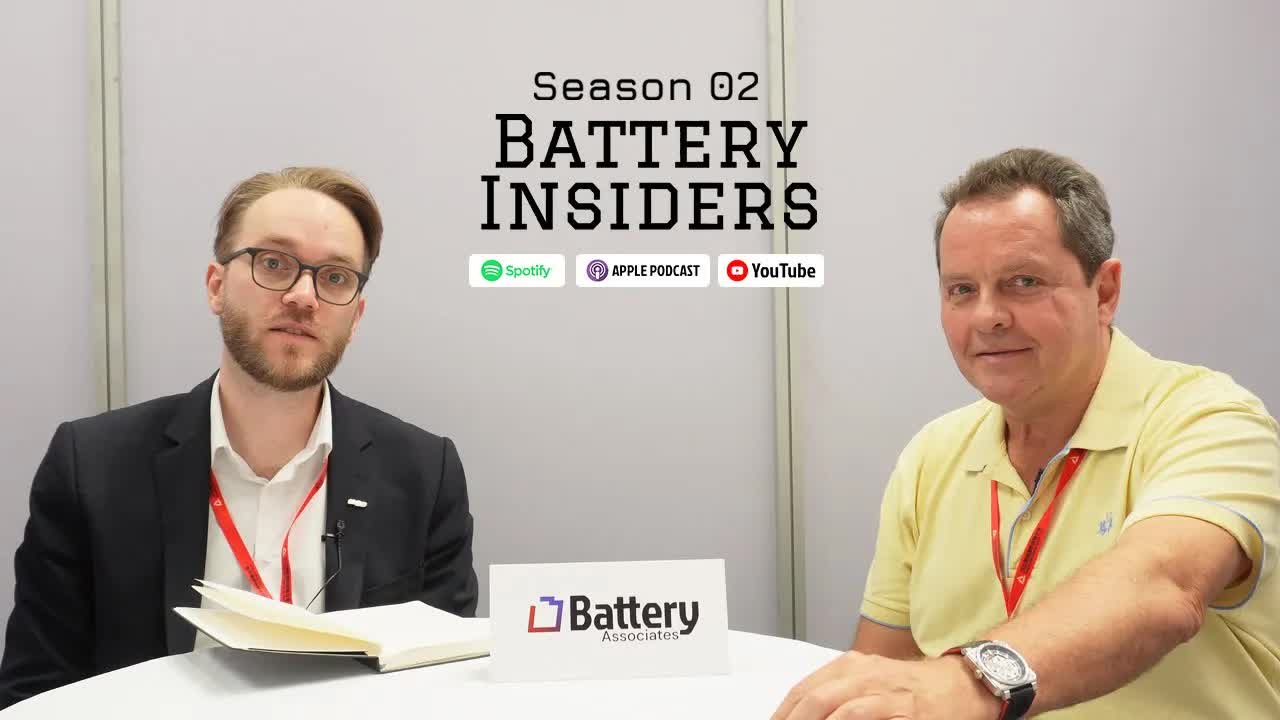
Wolfgang Bernhart
Senior Partner, Roland Berger
Bernhart speaks as an analyst of the battery value chain, referring throughout to his firm's own overviews of European refining and cathode material projects and to conversations with cell manufacturers. Neither the show notes nor the recording gives his job title or employer.
Recorded in China, at SMM's CLNB conference
What this episode covers
Chinese cell manufacturing ran at an average capacity utilisation of around 40% last year, and Wolfgang Bernhart's expectation is that it might get worse. The same pattern shows up one step upstream. Announced capacity in cathode materials, for LFP and for ternary alike, is well above what the market needs, and the capacity already installed is above it too. Graphite has been built out heavily, in his view probably too heavily, with significant price reductions and a few companies already out of the market. That is the backdrop to Beijing's proposed regulation urging companies to spend at least 3% on R&D, improve efficiency and stop adding capacity without real customer orders.
The upstream position is the other half of the picture. More than 90% of the investment in Indonesian nickel comes from China. On lithium, Chinese firms are active in the traditional sources in South America and Australia that European and US companies are also looking at, and they have moved into African resources, with Ganfeng and BYD among the names Bernhart mentions. He treats this as the reason the regulatory conversation in the West has the shape it does, and as the reason redirection matters more than reduction: capacity that cannot sell into one market has to sell into another.
On the US, Bernhart reads the Inflation Reduction Act as having two objectives, raising local value add and pushing Chinese companies out, and he thinks the second one is working. A Chinese company without significant shareholders from outside China, or with connections to the Chinese state, will find it hard to do business there. Where he is sceptical is upstream. There is some lithium the US can mine domestically or source from free trade partners and countries with a critical minerals agreement. Graphite is different. A 25% import tariff raises prices for American EV buyers and for utilities buying stationary storage, and is nowhere near enough to cover the higher cost of producing graphite in the US.
The 100% tariff on Chinese EVs he treats the same way, as a cost passed to customers. His reference point is what you get for the money in China: he has been in vehicles that would cost three times as much in Europe for the same interior, the same equipment and the same options. At 100%, very few Chinese vehicles will be imported, and pressure on Mexico not to incentivise Chinese EV production closes the side door. Since price is a decisive factor for the American buyers most likely to go electric, he expects lower adoption, and more pressure on Chinese firms to export to other markets, Europe first among them.
Europe is where he sees the gap between target and plan most clearly. The Critical Raw Materials Act sets 10% for raw materials mined in Europe, achievable for lithium and impossible for nickel given what is in the ground, and 40% for refining and cathode materials, which the project pipeline broadly supports. Look closer and it comes apart. If LFP reaches the roughly 40% share of European passenger cars he expects, current planning does not provide enough lithium carbonate refining capacity, nor enough LFP or LMFP production. No penalty and no incentive attaches to that, since the value-add requirement that bites applies to NCM cathode material rather than LFP, which is far cheaper to make in China anyway.
The EU Battery Regulation concentrates on two things in his account: tracing material back to the mine so ESG requirements can be evidenced, and recycled content, which starts to bite in 2031 for lithium, nickel and cobalt and steps up in 2036. Production scrap will be the main source until around 2033 or 2034. That creates competition for it, because cell manufacturers have already written these volumes into contracts, sometimes above what the regulation requires, and none of them wants to generate enough scrap to cover the obligation. Today that scrap typically goes to Korea as black mass and comes back recycled, which the regulation currently does not forbid.
Questions from this episode
- How much overcapacity is there in the Chinese battery industry?
- Cell manufacturing in China ran at an average capacity utilisation of about 40% last year, and Bernhart expects it may get worse before it gets better. Cathode materials show the same thing, with announced capacity for both LFP and ternary well above demand and installed capacity already ahead of it, accompanied by significant price decreases. Graphite has been built out to the point where prices have fallen sharply and some companies have already exited. In response, the Chinese government has proposed a regulation pressing companies to spend at least 3% on R&D, improve efficiency, and stop adding capacity without real orders from customers.
- Why does Bernhart think US tariffs will not solve the upstream problem?
- Because tariffs change prices, not geology or cost structures. He accepts that a certain amount of lithium can be mined in the US or in free trade countries and countries with a critical minerals agreement. Graphite is his counter-example. A 25% import tariff raises the price paid by American electric vehicle customers and by utilities buying stationary storage, and it is still far short of covering the higher cost of producing graphite in the US rather than China. The tariff closes the market without creating the domestic alternative it is meant to protect.
- What does the 100% tariff on Chinese EVs actually change?
- It means very few Chinese vehicles will be imported into the US, and that American customers pay more. Bernhart's comparison is what the money buys: he has ridden in Chinese vehicles that would cost three times as much in Europe for the same interior, equipment and options. Washington has also pushed Mexico not to incentivise Chinese EV production, which closes the obvious workaround. Because cost is a decisive factor for the buyers most likely to adopt EVs, he expects lower adoption, and more pressure on Chinese manufacturers to send those vehicles to other markets, with Europe the largest.
- Can Europe meet its Critical Raw Materials Act targets?
- In broad terms, yes on refining and cathode materials, where Bernhart's overview of announced projects suggests the 40% target is reachable. The 10% mining target works for lithium and is impossible for nickel, since Europe does not have the resources. The problem sits in the detail. If LFP takes roughly 40% of European passenger cars, as he expects, current planning does not give Europe enough lithium carbonate refining capacity, nor enough LFP or LMFP cathode production. Nothing forces the issue either, because the value-add requirement that matters applies to ternary NCM material rather than LFP.
- How will Europe's recycled content requirements be met before 2031?
- Mostly with production scrap. The obligations for lithium, nickel and cobalt start in 2031 and rise in 2036, and Bernhart expects manufacturing scrap to be the major source until around 2033 or 2034, after which end-of-life vehicles have to carry it. The practical effect now is competition for that scrap. Cell manufacturers have already committed volumes in contracts, in some cases larger shares than the regulation requires, and no manufacturer wants to produce enough scrap itself to cover them, so material has to come from elsewhere. Cell manufacturing scrap today generally goes to Korea as black mass and returns as recycled material, which the regulation currently does not prevent.
- What does a win-win between Chinese and Western battery companies look like?
- In the US, licensing, royalty and service agreements of the kind already signed between a well-known Chinese cell manufacturer and two American OEMs: shared IP, some technology transfer, royalties back. A few companies may still build US capacity where the majority owners are not Chinese, and Bernhart also expects R&D joint ventures set up outside the US to reduce regulatory exposure. Europe is where the direct investment goes: EV makers such as BYD, several major cell manufacturers, cathode producers heading to France, precursor and electrolyte companies, and the first cell manufacturer joint venture with a European OEM. Every company he has spoken to keeps a plan B and a plan C, because nobody knows what the next elections bring.
Listen to this episodeWatch on YouTube
Part of Europe: policy and money
Transcript
About this transcript. Generated automatically from the recording, then corrected against a glossary of company and guest names. It has not been checked line by line. Machine transcription mis-hears technical terms, numbers and names, so treat any figure here as a prompt to check the recording rather than a quotation of record. Spotted something wrong? Tell us.
0:00Introduction
Dr Simon Engelke
0:00And welcome everyone, thank you so much for joining us live here from China, Shenzhou, CLN and B with SMM at this exciting conference. And I'm really excited to have Wolfgang with us to share some insights on the Chinese market.
Wolfgang Bernhart
0:21Hi Simon, it's great to be here, yes.
Dr Simon Engelke
0:23Yes, and good to see you again. Let's get right into it. Let's get some questions. So maybe if you could just start a bit on an overview of the Chinese market also from an upstream perspective.
Wolfgang Bernhart
0:33Yeah, I mean, the Chinese market is growing significantly. And as we all know, Chinese companies are really dominating the upstream value chain. So there have been a lot of investments in, for example, the nickel industry in Indonesia, more than 90% of all the investment is coming from China. We do see a lot of investments in lithium, not only in the traditional sources, investments in South America or in Australia, where even some of the European or US companies are looking at, but also in Africa, as I've seen here from Ganfeng, for example, also BYD, a couple of others, they invest in Africa and lithium resources. We do see a lot of capacity being built up on the graphite side, maybe too much, with significant price reductions in the market and already a couple of companies going out. So the same is probably true for the cathode materials, both for LFP, but also for ternary materials, where the announced capacities are significantly higher and already the capacities in the market are higher than what's needed. Again, with significant price decreases. Also on the sell side, I think we had in sell manufacturing, we had an overage capacity utilization of only 40%, something like that, in China in the last year.
1:56Overcapacity, falling prices and Beijing's response
Wolfgang Bernhart
1:58And it might even get worse. So too much capacity has been added. That's why the Chinese government added this new regulation or proposed this new regulation to urge Chinese companies to spend at least 3% in R&D, improve efficiency, and don't add capacity without real orders from customers.
Dr Simon Engelke
2:20Excellent. Thank you so much for the overview. And now we can talk a bit about regulation and also incentives. Right in the West, there's a lot happening in Europe, but also US. So how are they impacting Chinese businesses?
Wolfgang Bernhart
2:31Maybe we start with the US. Obviously, the Inflation Reduction Act and all the measures being implemented by the US administration have two objectives. Number one is to increase the local value add. Number two is to get Chinese companies out. So I would say it's really hard for Chinese companies that do not have significant shareholdings from companies outside China and that do have any connections to the Chinese state to make business in the US. So they are being pushed out. Now with the additional tariffs, it also means much more investments that needs to be done in the US. I don't think it really works in the US or it will really work with respect to the upstream materials because there's a certain amount of lithium that you might be able to mine in the US or in other countries that are free trade countries or have a critical minerals agreement. But for example, graphite, now with 25% import tariffs on graphite, that only leads to increasing prices
3:55The IRA, graphite tariffs and closing the US market
Wolfgang Bernhart
3:56for the American customers of electric vehicles or for the utilities that buy stationary energy storage. And on the other hand, the 25% is also by far not enough to compensate the higher cost that you have, for example, for graphite production, most likely in the US than in China. So that's the US basically closing the market. So the biggest market for exports, but also for investments, is probably Europe now. There are other markets as well, India, for example, that are interesting, but Europe is the biggest one. And we do see quite a lot of investments in Europe, but also in Morocco that has a free trade agreement with Europe as well.
Dr Simon Engelke
4:42So then Europe, so you say the US is kind of out and Europe is booming?
Wolfgang Bernhart
4:45Yes, it's kind of out as a target market for Chinese companies because of the tariffs and you can still export. Yeah, but because of the Inflation Reduction Act, the Chinese, the American OEMs need to look for material and intermediate material and raw material sources that are outside China and that are ideally in free trade countries. So, different story in Europe, in Europe, you have the Critical Minerals Act that requires, or it has set a target of 10% for raw materials to be produced or basically mined in Europe, which is possible for lithium. It's impossible for nickel because there are not that many nickel resources in Europe. And then 40% for refining and cathode materials. From our overviews of what we see in refining projects, what we see in cathode material projects, in general, that can be achieved. But if we have a closer look, if we look at the higher share of lithium-ion phosphate batteries that we expect in Europe,
5:52Critical Raw Materials Act targets and where they fall short
Wolfgang Bernhart
5:53roughly 40% on the passenger car side, there will be not enough lithium carbonate refining capacity in Europe, at least from the current planning status. And there will be not enough lithium iron phosphate production or LMFP production in Europe. However, you don't necessarily need that. So, if there is no current, there is no carrot and no stick. So, the only thing that you need to have is, because of the Brexit regulations, you have to have a certain value-add in Europe and that is relevant for ternary materials for NCM-based batteries that do require basically the cathode material to be produced in Europe, not for LFP. And LFP production in China is much cheaper than LFP production can be in Europe.
Dr Simon Engelke
6:46So, you mentioned the Critical Raw Materials Act, but also maybe looking at Europe again from EU battery regulation. Yes. Of course, it's a big framework. And if you could maybe share a bit about how this is impacting also again, training these companies and how ready are they for the EU battery?
Wolfgang Bernhart
6:57I would say the most important topic or the most important topics are centered around the supply chain transparency. So, the requirements to basically be able to trace the requirements coming from the regulation and then the OEMs that will force their cell suppliers and they will force the cathode material suppliers to trace everything back down to the mining side to make sure that certain ESG regulations are met, etc. That's one point. But then the second point is with respect to the amount of recycled material that you would need, specifically starting from 2031 with lithium, nickel and cobalt and then with increased shares in 2036. They can use materials from production scrap and that will be the major source for the next eight,
7:54The EU Battery Regulation, traceability and recycled content
Wolfgang Bernhart
7:55nine years. So, we think until 2033, 2034, it's a major source. So, we think that the materials are required to use the materials from end-of-life vehicles. Now, how is that impacting? It basically means the cell manufacturers, and I had a couple of discussions, they are required to use those amounts of materials and it's already in the contracts, sometimes even larger shares than what's required by the regulation. And that results in a kind of competition for the materials. The cell manufacturing scrap is typically today sent as black mass to Korea and then being recycled and then can be brought back. And I think that's still the case, at least currently there's nothing in the regulation that forbids that. But every cell manufacturer actually would probably only be able to use his own manufacturing scrap and you don't want that much manufacturing scrap. So, you have to get additional material from additional sources and that's a little bit the challenge, I would say.
Dr Simon Engelke
9:02Great, thanks for sharing that. Yeah, also maybe if we can look a bit at the US and also the 100% EV tariffs, right, which just came out. Yeah, maybe we could share a bit more about, you know, how, yeah, how existing material used to offset some of these tariffs for the Chinese market or also overall how do you see the impact of these tariffs from the US, you mentioned already on the 25% of graphite, but also EVs overall maybe for the EV market, how it's impacting the forecast.
Wolfgang Bernhart
9:30I mean, what does it mean? It basically means that the American customers have to pay more than others. And you have experience probably the same when you drive here or ride here with Chinese cars. You get a lot of value for your money.
9:50The 100% EV tariff and what American buyers pay
Wolfgang Bernhart
9:50Yeah, I mean, I've been in a couple of vehicles that probably, where you probably would pay three times the amount of money in Europe for the same for the same interior, for the same equipment, for the same amount of options that you would use. So in 100%, it basically means there will not be a lot of vehicles of Chinese vehicles being imported to the US. They also push out or kind of put pressure on Mexico and not to not to allow production or not to incentivize Chinese EV production in Mexico. That means probably lower adoption because costs of EVs are also a very important topic for the customers that are sitting mainly on the coast. So lower, lower import. Again, more, I would say more pressure for Chinese companies to export these vehicles to other markets, most likely to Europe again.
Dr Simon Engelke
10:56Yeah, that's kind of next, right? Looking at the Chinese companies and their overseas expansion, right? I think there's a lot of plans there. Do you think overall will be a win-win? And what should also Chinese companies do, right? For good partnerships, relationships with the West?
Wolfgang Bernhart
11:08Yeah, let's talk about the, again, about the two different regions, the US first. I would say a win-win situation is what we already see, this kind of licensing royalty service agreements that have been put in place with the famous Chinese cell manufacturer and now two US OEMs. There are also some that still have plans to build capacity in the US and they might be able, because they are, majority owners are not from China. So that's one thing. So basically to share IP, to do some kind of technology transfer and get royalties back.
11:50Licensing in the US, investment and joint ventures in Europe
Wolfgang Bernhart
11:50That's one perspective. Another thing that we probably will see is kind of joint ventures for R&D between Chinese companies and Western companies, not necessarily in the US, but maybe in other places, in order to make it less dependent on the regulations. In Europe, we do see a lot of investment plans from Chinese companies, whether it's EV manufacturers like BYD, that do have plans to go to Europe, probably a couple of other companies, probably a couple of other companies. We do see all the major, or a couple of the major Chinese cell manufacturers going there, even if one just has cancelled one plant because of the lower expectations. And we do see materials companies going there, whether it's cathode materials companies going to France or precursor materials companies, P-CAM companies, whether it's electrolyte companies. So they will invest in Europe, which creates economic value in Europe. They might go in joint ventures, or they will go in joint ventures as well. We will see the first joint venture of a cell manufacturer with an OEM in Europe as well, not only in the US, also in Europe. We will see that. And that's, I would say, the kind of win-win situation. So everybody is making or is gaining economic benefits from that transfer of the probably most advanced economy when it comes to battery and the battery
Dr Simon Engelke
13:23value chain in China here. Okay. To summarize, kind of what I hear from this is in the US, we potentially see more partnerships, more kind of IP agreements, etc, between companies, and maybe some kind of joint venture structures. In Europe, you see more companies going to Europe, expanding,
Wolfgang Bernhart
13:38but also having more local joint ventures and agreements. That's what I see. I see both. I would say in the US it will be very limited with respect to direct investments. And there's a very high risk
13:49Plan B, plan C and political risk
Wolfgang Bernhart
13:50in that as well. But all the companies I've talked to, they have a plan B and a plan C. Because you never know what happens after the next elections.
Dr Simon Engelke
14:00During this, Wolfgang, I really want to appreciate you taking your time out here. Really good to see you again here in China this time. And yeah, I want to thank you all for listening in. My name is Simon from Battery Associates. Please tune in. Another Battery Insiders episode is coming out. And yeah, for now, thanks so much, Wolfgang. Thanks a lot of time.