
Episode 146 · 15 October 2024 · 00:18:01
A 1.4 gigawatt portfolio, and the contracts underneath it
Insights on Greenvolt Power’s BESS Operation Management Strategies
Greenvolt Power on the 1.4 gigawatts of four-hour storage it has secured in Poland, why storage warranties went from three years to more than twenty, and what Hungary's capacity market asks of a battery.
Read the article: A 1.4 gigawatt portfolio, and the contracts underneath it
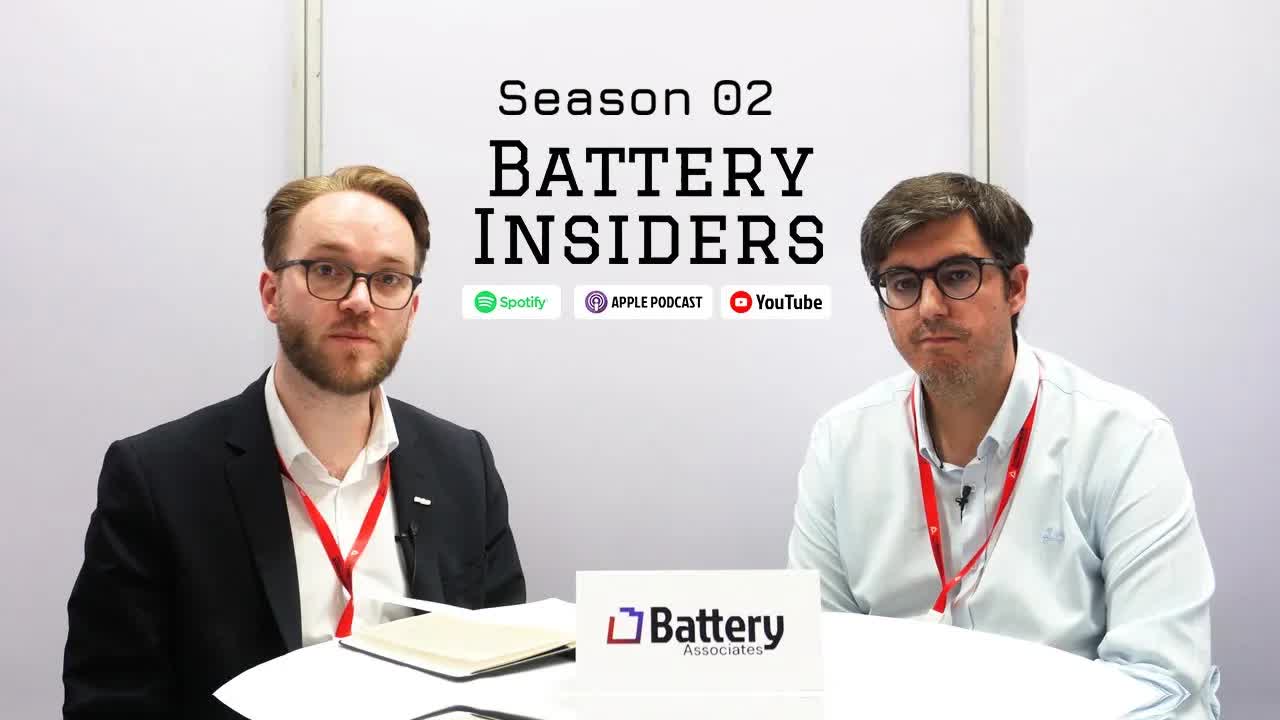
Antonio Montoto Rojo
Head of Storage, Greenvolt Power
Greenvolt is a Portuguese company developing solar, wind and storage projects, with offices across Europe and in the United States, Japan and Indonesia. It is also a leading biomass producer in Portugal and runs facilities in the UK.
Recorded in Near Shanghai, at SMM's CLNB conference
What this episode covers
Greenvolt Power has more than 1.4 gigawatts of four-hour storage lined up in Poland, all of it to be built before 2028 and all of it secured by capacity market contracts. Antonio Montoto Rojo puts the reason plainly: local capacity market conditions, and an economy able to absorb the technology, made the numbers work there first. Hungary followed, with a standalone project awarded in the most recent auction to support the day-ahead and frequency markets. There are projects in the UK as well, and a pipeline in Italy, Germany and Spain for the years after that.
On procurement, his argument is that a long-term strategy has to sit on top of a market that moves constantly, in price and in technology. Ten years ago a utility-scale storage system typically came with a three-year warranty, and extending it was rarely easy. Now the sector accepts that more than twenty years is achievable on certain profiles. Holding accurate capex data, current and forward-looking, and understanding how a supplier's specification lands in real opex, is how Greenvolt decides which countries to enter and in what order. He calls the price movement a roller coaster.
Capex is an enabling factor rather than the deciding one. In high-profitability markets the priority is securing the project quickly, with competitive capex but above all with the most reliable route to first revenue. In other markets nothing moves until the investment cost is well defined. Either way, Greenvolt only works with suppliers considered top tier by the main indexes, whatever the numbers elsewhere look like. For projects around 20 megawatts and below, full supply from a single EPC is simpler. For a large scheduled portfolio, a master supply agreement on the main elements turns volume into better conditions.
Opex is harder to break apart than capex. Annual management costs, taxes, asset managers and local structure costs all vary by country, and they sit alongside the fixed cost of maintaining the facility. The bigger shift is duration. Projects used to be planned as one-offs running 10 to 15 years and then replaced. They are now designed to run beyond twenty, which means land options and grid connection authorisations have to stretch that far too. Degradation follows the revenue scheme: one cycle a day in a two-hour frequency market is a different asset from two cycles in an energy market.
Country differences show up in regulation more than in technology. He describes the UK as clearly separate from the rest of Europe, transparent and comparatively easy to develop in, with more freedom in how a plant is run, while Ireland mixes UK and EU thinking. Poland improved its cable pooling law over the past year, so a developer can oversize capacity behind a connection point provided a control system holds output to what that connection can take. Spain and Italy allow something similar in practice, but without a national rule it becomes a technical negotiation each time.
On revenue he separates two businesses. Early players make money in secondary and ancillary services; the longer, more conservative business is in energy, where the return is fixed and low profile. Ancillary markets are capped by size and often by what a government can budget, so they suit specific projects rather than a whole strategy. He thinks the early US and UK results changed how investors read battery profitability, and puts that period at two or three years. What follows is co-location and hybrid schemes, helped by falling capex, plus the seasonal storage northern Europe will need for the months with neither wind nor sun.
Questions from this episode
- How large is Greenvolt Power's battery storage pipeline in Poland?
- More than 1.4 gigawatts of four-hour storage, to be developed and constructed before 2028, with the capacity secured through capacity market contracts. Montoto Rojo credits the local conditions, in particular the capacity market and an economy able to absorb the technology, for making Poland the first place the portfolio grew to that size. Greenvolt also has a standalone project in Hungary awarded in the last auction, supporting the day-ahead and frequency markets, projects in the UK, and a further pipeline in Italy, Germany and Spain.
- How have battery storage warranties changed over the last decade?
- Ten years ago a utility-scale energy storage system usually carried a three-year warranty, and extended warranties were not easy to obtain. Today, he says, everyone in the sector knows more than twenty years is achievable on certain profiles. That change matters commercially because it is what allows a storage project to be planned as a long-life asset rather than a one-off. It also feeds directly into how a developer models opex, because the warranty position and the expected lifetime have to line up with the land and grid connection rights behind the project.
- When should a developer use a single EPC rather than a master supply agreement?
- For smaller projects, which he sizes at around 20 megawatts or less, full supply from one EPC or an equivalent contractor is the easier route. For a large portfolio that is already well scheduled over the next few years, he prefers a master supply agreement with a reliable supplier covering the main elements. The reason is volume: a scheduled pipeline lets you negotiate better commercial conditions and better treatment from potential suppliers. In both cases Greenvolt restricts itself to companies considered top tier by the main industry indexes.
- What is cable pooling and why does Poland matter for it?
- Cable pooling is a national law regulating hybridisation, so a site can oversize its installed capacity relative to the grid connection provided a control system keeps the exported power within what the connection point can actually take. Poland improved its rules over the past year and now offers high flexibility on how a system is arranged. Spain and Italy allow comparable outcomes but have no national regulation for it, which makes each case more technical and harder to achieve. He expects markets to converge on this approach because it saves transmission operators a great deal of investment.
- What does Hungary require from a grid-scale battery?
- There is a minimum obligation of ten years operating within a defined profile of conditions, with further obligations depending on the project, including end-of-life and offline configurations that he considers new for Europe. The capacity market also requires batteries to follow the same criteria as a traditional gas or coal plant, with an end-of-life performance requirement held to a tight deviation. If those restrictions are not built into the design, the effect on capex, and on opex once augmentation is counted, can be a genuine surprise when the offer is priced.
- Which revenue streams are most attractive for grid batteries?
- He splits them. Secondary markets and ancillary services are where early players make money, but the volumes are capped in every market, often by the budget the government has available, so they suit specific projects rather than a portfolio strategy. Energy market revenue is the long-term, conservative case: fixed and low profile. He argues the early US and UK experience distorted how some investors saw battery profitability, and that the period of unusually high returns lasted two or three years. After that, plan on conservative returns and heavier degradation, because ancillary markets demand more battery use per unit of revenue.
Listen to this episodeWatch on YouTube
Part of Storage and the grid
Transcript
About this transcript. Generated automatically from the recording, then corrected against a glossary of company and guest names. It has not been checked line by line. Machine transcription mis-hears technical terms, numbers and names, so treat any figure here as a prompt to check the recording rather than a quotation of record. Spotted something wrong? Tell us.
0:00Introduction
Dr Simon Engelke
0:00And welcome everyone. Thank you so much for joining us for the Battery Insiders podcast here live from China. Currently we're attending the CLNB conference from Shanghai Metals Markets. I'm very excited to have this discussion now on BES, energy storage systems, and from an asset management company perspective. I'm delighted to have Antonio with us today
Antonio Montoto Rojo
0:28to share your perspectives. Thank you, thank you, Simon, and thank you to your podcast for the
Dr Simon Engelke
0:34opportunity to talk here, Senonor. For sure. So maybe if you could introduce yourself a bit with
Antonio Montoto Rojo
0:39your vision and the mission of the company for our listeners. Sure, sure. Greenball is a Portuguese-based company, but with a sound office around Europe, United States, Japan, and Indonesia. That is focused in developing green energy facilities, based on solar, wind, energy storage, as an enable technology for our objectives in question of clean energy. And also we have a very important branch in biomass production where we are leaders in Portugal and we have also facilities in other countries as the UK. Fantastic. Maybe if you could share a bit more
Dr Simon Engelke
1:19about some of the European projects, what specifically we are doing there as well. Sure.
Antonio Montoto Rojo
1:23Yes, Greenball Power is specialized in developing projects in different stages. And we have a very strong background of some markets, for instance, Poland, Hungary, Italy, or UK. And through the work of our people on these markets, we have achieved a very important portfolio of storage projects to be developed in the next years. Some of them are located in Poland, where thanks to the local conditions,
1:55The Polish portfolio, Hungary and the wider pipeline
Antonio Montoto Rojo
1:56especially the capacity market conditions and the economy range to absorb these technologies, facilities. We have achieved a portfolio that now is more than 1.4 gigawatts in four hours storage solutions to be developed and to be constructed prior to 20 and 28. And these are secured by the contract capacity for the capacity market contracts. But we also have a project in Hungary where we were awarded in the last auction for a standalone in history for supporting the day ahead and the frequency markets there. And also, they have other projects in the UK, but also an important portfolio of projects to be developed in the next year in countries like Italy, Germany, or Spain. Fantastic. So quite a few projects. And if you now look at
Dr Simon Engelke
2:51these projects, right, if you could maybe share some of the procurement strategies to deliver these projects, especially in the short timeframe you have available. Yes, I think that the strategies,
Antonio Montoto Rojo
3:02first to think in a long term strategy, is that they need to be very related to the very dynamic situation of the energy storage market. I think there is a roller coaster dynamic, both in price, but also in the technology features. And one of the most sensitive values that we have been managing in the past year is having the more accurate data possible regarding what is the capex situation, both now and in the next year, and also how the current features that the battery suppliers are offering impact in the real opex and in the real possibility of this storage. For instance, 10 years ago, an energy storage system for utility usually have only three years of warranty,
3:54From three-year warranties to twenty-year assets
Antonio Montoto Rojo
3:54and extension warranty were not usually easy to achieve. And now everybody in the sector know that we can achieve more than 20 years in certain profiles. Then having this mix of technological, economical and also market knowledge, I think are the three key factors to decide where and how we need to go
Dr Simon Engelke
4:21in different countries. Thank you for sharing. So a big difference there between three and 20 years. So that's good to hear. You already mentioned capex. Maybe if you could share some of your ways you have to have become managing the capex, and also some best practices for that as well.
Antonio Montoto Rojo
4:37Well, yes, we don't consider the capex, in fact, like the most important factor, it's an enable factor, but it depends a lot on the market conditions. In high profitability markets, it's better to secure the project as soon as possible with competitive capex, but especially with the most reliable steps to achieve the project in the shortest time and to acquire this revenue as soon as possible. While other market that's only possible if you have a very well defined cost for the investment, then it depends on this. But always, always considering the maximum reliability in your partners. Okay, we only trust in companies that are considered top tier companies by the main indexes. And if are out of this, despite the numbers, could be okay, we don't consider a realistic perspective. Okay, but that's the point. And apart from that, for small projects, we see more easy to try to close a
5:52One EPC for small projects, master supply for portfolios
Antonio Montoto Rojo
5:52full supply from one EPC or similar. I'm thinking 20 megawatts or less sizing project. But for the big portfolio, because it's very well scheduled in the next years, I think it's better to have a good matter supply agreement with a very reliable supplier for the key elements and try to collect this advantage of managing a big volume to secure the best conditions and also to say to secure the best threatment by the potential suppliers. Excellent. And maybe also if you can go from
Dr Simon Engelke
6:32some capex to opex, if you could also maybe share some best practices about opex. And also for us to understand like what you spend your most money on in the opex. Is it bad analytics, tone management, etc, etc?
Antonio Montoto Rojo
6:45Yes, the opex, we... This is curious because while in capex, it's more easy to differentiate what are the component of the capex. In the opex, we have to define our own criteria because depending if you're looking for the perspective of the annual management cost regarding taxes, regarding energy asset managers, regarding the local structure costs that are variable in every country. And after that, is the fixed and secure cost that implies the maintenance of the facilities. Then we try to differentiate firstly, and this is sometimes difficult because you need to know a very... You have a very strong knowledge about the tax and the cost structure of the market. But after that, the past year, there was a vision of how to say one-off project with 10 to 15 years and after a new ones. And we are now moving to a project that can be managed for more than 20 years. And we need a capex
7:52Opex, and designing for twenty years instead of ten
Antonio Montoto Rojo
7:52that alerts and fit the lifetime of the technology to, for instance, the option to list the terrain, the option to prolong, to extend the connection authorizations. Then I think we are moving from medium-term projects to long-term projects in the same case as TV or wind. I think we are in that transition, but also depend on cycling, on what are the most attractive revenues. Because you know that degradation will be fully different in a two-hours market for frequency and only one cycle per day. Or if you go to a very profitable energy market with two cycles, but with frequency... At the end, there is not a magical formula, but I think it's linking very well the revenue scheme and the market scheme with the operational. It's the formula to have a capex and the durance and how the system will perform along the time.
Dr Simon Engelke
8:56And you mentioned like a range of different projects in different countries we're doing. And maybe also to stay a bit more on the OPEX question, are there any examples you can share of something maybe even surprised you? Because you said that even between countries it can vary a lot also between application right use cases. But maybe on the countries, any takeaways for how does it differ between the UK, let's say, compared to Portugal or Italy or is there anything you could share?
Antonio Montoto Rojo
9:23Yeah, despite I'm not an expert in the grid integration policies, but what I can perceive is that the different blocks and different ways to manage. The UK is a highly differentiated for the rest of Europe. And Ireland is a mix between UK criteria and European Union criteria. But in those markets,
9:47Why the UK is different, and Poland's cable pooling law
Antonio Montoto Rojo
9:47it's very, how to say, there are a lot of greater freedom for managing the plants. It's very clear and very transparent market to develop and it's very easy. Other markets are more, how to say, more traditional, more monolithic. And you need to know what are the limitations that the regulation could have to the real possibilities of the storage. But at the end, what you have is a set of fixed costs that sometimes are changed, a set of fixed limitations in the capability to connect. Sometimes there are limitations between the rate of the energy you can install and the power. And sometimes in that, you can put parallel projects and you can oversize and other, you can't. Then there are big differentiations for instance between Poland with the improvement on past year of the cable pulling law. that there is a high flexibility criteria to distribute a system. And for the audience, if they don't know, cable pulling at the end is a national law that regulates the hybridization in facilities where you can oversize the capacity while you keep a high level regulation system, an ENS, or to control that the power is according to the real capacity of the connection point. In Spain, Italy, other countries, it can be done, but there is not a national regulation. It's more, what to say, more technical and more difficult to achieve. And the point is that they, I think all the market will evolve to this adaptation because it's, at the end, it's a, it's a way to save a lot of money in investment for their own TSO, for their own transmission regulation companies. And in the next five years to ten, probably we will have a, absolutely,
11:46Hungary's capacity market obligations
Antonio Montoto Rojo
11:47to say, very, very clear panorama and more expertise in, in managing big markets and not one by one. That, that, that's a point. And also, for instance, the, the OPEX and the, and the technology selection depend a lot of, for instance, the contract you have. In, in, in Hungary, you have a minimum, a minimum obligation of 10 years operating in, in a profile of conditions. And after that, we, you have also other obligations depending on the project, but you have an EOL configuration and offline configuration that this is, I think, very new in Europe. Also, the capacity market is mandatory to, to, what to say, to, to follow the same criteria that the traditional gas or coal plant, and you need to achieve, in the case of a batteries, a 17 year of EOL with a maximum deviation of 5%. Then, it's a, then the, the restrictions are, are important and we need to take that into account because the impact in, in the, in the CAPEX and also in the OPEX, if we consider augmentation as a part of OPEX, could be absolutely a, a surprise if you don't take that into account when you design and you, and you prepare this sort of offers. Okay. Then, at the end, revenue scheme and contract scheme, off-taker scheme, you need to, to prepare a, a, a, a complete, a complete, a pool of, of, of, a condition and, and make your assumption over, over this. Great. So now talk a bit about the CAPEX
Dr Simon Engelke
13:23and OPEX and now I'd like to go with your perspective, right, from an asset management company, what type of services bring in revenue to the best, right? Like, is it more, you know, frequency regulations as backup systems, mix, could share a bit more on the application you see as being attractive, maybe also any differences you see across markets you look at? Well, my, my, my opinion,
13:44Ancillary services now, energy revenue later
Antonio Montoto Rojo
13:44my opinion regarding the revenues is that there are, uh, early adopter or, or, or, or, or, or early, early, uh, player, uh, business in, in, in secondary market and in, in auxiliary services and long-term business in the energy. The long-term business in the energy is for, is a conservative perspective because at the end, except that there will be, uh, there are surprising the future. It's a, it's a, it's a fixed revenue and a low profile revenue. While the, for instance, we are talking about frequency intradays or, or, uh, energy balance. I mean, those related to, to management of the, of the, of the short-term energy and balance, uh, are, how to say, the, uh, size limits. The, in every market, they have a, a, a, a maximum, a maximum capacity to cover. They are, in most of cases, limited by the own budget of the, of the government to do that. Then the, the, the perspective of making business in this sort of, uh, uh, uh, services at the end will be focusing in, in very, very specific project. I, I, I think that the, the early case of United States and, and here of UK have, uh, uh, uh, distortionated, have, uh, modified the vision that, uh, some investor have over the profitability of batteries. And I think that the, the gold age, uh, in this case is only two, three years, uh, period. And after that, you need to think in a long-term, uh, using, uh, more conservative, uh, profitability and, and with a big, uh, degradation. Because as you know, the energy associated markets, uh, usually have, uh, is more demanding there of, uh, of, uh, use of the battery per, uh, per, uh, money receipt. Okay.
15:39Co-location, hybrid schemes and seasonal storage
Antonio Montoto Rojo
15:40And that, that, that's the point. Um, the, the current scheme, especially in Europe is also because of the CAPEX, uh, reduction and also the, the, the, as I told the, uh, better adjustment of the energy storage system to the, to the rest of the generation is that the collocation schemes, supplement schemes, a hybrid scheme, as you can see in the, in the, in the, in the, in the connection structure will be for sure a, a, a very interesting, uh, industry, industry, uh, a growing business in the, in the future. Okay. And those more in country with unbalanced intergeneration and production or unbalanced in the, in the hours of production and the hour of consumption, that could be in Spain. And balancing where you produce and where you consume that could happen in, in UK or, or in Italy. And, uh, for other technology, because the deviation of technology of battery technology now is a 90% to lithium, but for, for next technology that will come in the next year, also for the, for the seasonal, uh, storage that it will be, uh, impossible to avoid if you can, if you want to cover the one, two months in, in the north of, uh, Europe countries to, to, to solve that situation where you don't have neither too much wind, neither sun, uh, and there are other technologies that, uh, gas, uh, coal in the case of Poland. Then I think, I think that we are in the, how to say in the, in the, in the first episode of a very large, uh, series movie to, for a storage in the, in the market.
Dr Simon Engelke
17:19Fantastic. I think with this, we're, we're out of time, but we want to thank you, Antonio, for sharing your insights on BES, especially from this management, as management perspective. I also want to thank SMM, Shanghai Metals Markets, for hosting us today here at CLNB in, um, near Shanghai. And also, you know,
17:35Closing remarks
Dr Simon Engelke
17:36all, thank you all of you listeners for listening into the Battery Insiders podcast. If you're interested in listening to more of these episodes, be free to go on Spotify, Apple Podcasts, YouTube, or anywhere else you listen to your podcast. You can also subscribe on batteryinsiders.com. With this, thank you all,
Antonio Montoto Rojo
17:49and speak soon. Thank you very much. Thank you very much.