
Episode 147 · 21 October 2024 · 00:11:29
We are not the teachers any more
PowerCo COO Sebastian Wolf on Unified Battery Cells, EV Market Challenges, and Innovation
PowerCo's COO on why the unified cell is one format and many chemistries, why Europe lacks the raw materials to copy China's LFP cost base, and what comes after LFP.
Read the article: We are not the teachers any more
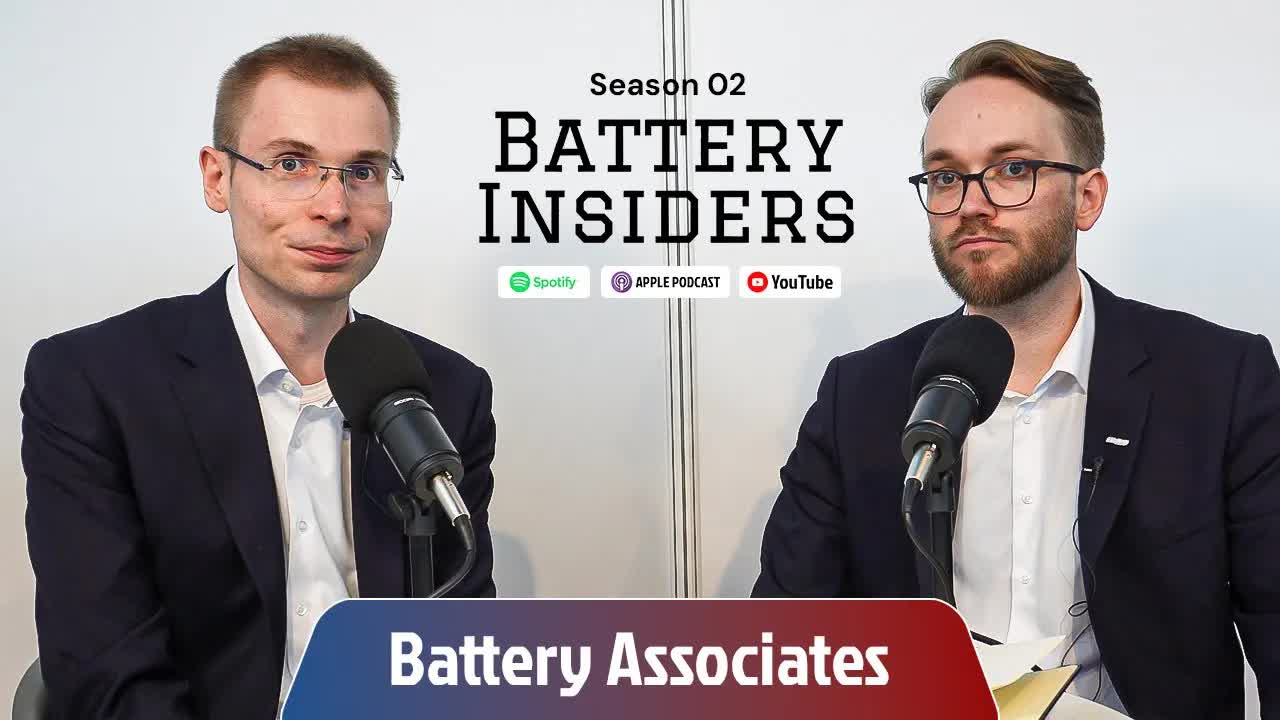
Sebastian Wolf
Chief Operating Officer, PowerCo SE
PowerCo is a wholly owned Volkswagen subsidiary developing and producing the unified cell, with plants planned in Europe and North America. Simon introduces Wolf as CEO in the recording; his title is COO.
Recorded in Stuttgart, at the European Battery Show
What this episode covers
The unified cell exists to solve a problem Volkswagen created for itself. Across the group there were pouch, prismatic and cylindrical cells in a range of sizes, which made it difficult to move between car generations. The unified cell is a prismatic cell at a standardised size, chosen to minimise geometric variation and to make it possible to retrofit cars with newer cell technology through facelifts and new product generations.
The point Sebastian Wolf makes clearly is that fixing the format does not fix the chemistry. One form factor, flexible on what goes inside. PowerCo is working on LFP and NMC, on technologies not yet on the market, and on production processes including dry coating. He puts more than 50 production innovations in the funnel, alongside all-solid-state work with QuantumScape.
His list of what makes European production hard is unusually specific and unusually unglamorous. Cost against experienced Asian competitors. The German supply chain due diligence act, whose name he offers in full and then notes is complicated. Recycling quotas. German labour regulation and its effect on labour cost. Legislation affecting construction and capital cost. And energy, which rose dramatically before relaxing recently. All of it lands on operating expenditure.
On LFP he supplies the constraint that most European discussion of the chemistry skips. LFP is cheap in China because the supply chain is fully localised and currently in significant overcapacity. In Europe, cathode active material for LFP is not available. Not expensive: not there. He expects that to develop over years, which raises the question PowerCo is actually working on, which is whether something will supersede LFP by the time Europe's LFP supply chain exists. His answer is to be in LFP and in whatever follows it.
He also relays something from the Chinese market that rarely reaches European coverage: LFP has cold-temperature performance problems, and Chinese manufacturers are themselves looking at alternatives.
The most striking line is about posture. Volkswagen, he says, was the teacher in the engine world. In batteries it is the student, trying to learn, gain experience and build its own expertise. And becoming a me-too producer will not be enough. Long-term success requires innovative products and innovative production technologies that compensate for higher labour costs.
On EV demand he pushes back on the narrative. European EV registrations are still increasing month on month. The perception of a slowdown is country-specific, and Germany's is a direct effect of withdrawn incentives, while Spain is running double-digit year-on-year growth.
Questions from this episode
- What is the unified cell, and why standardise the format?
- A prismatic cell at a standardised size. Volkswagen had accumulated pouch, prismatic and cylindrical cells in various sizes across its brands, which made it complicated to exchange between car generations. Standardising the geometry minimises that variation and makes it possible to retrofit cars with new cell technology at facelifts and new product generations. Wolf is explicit that fixing the format leaves the chemistry open: PowerCo is flexible on what goes inside the same box.
- What makes producing cells in Europe expensive?
- Wolf lists them without softening any: competing against experienced Asian players, the German supply chain due diligence act, recycling quotas, German labour regulation and its effect on labour cost, legislation affecting construction and capital cost, and energy costs, which rose dramatically before easing recently. He treats these as operating expenditure drivers that have to be solved rather than complained about, and notes PowerCo has its first production line running with significant customer volume committed.
- Why can't Europe simply adopt LFP for the cost advantage?
- Because the material is not here. LFP is cheap in China because the supply chain is fully localised and currently in significant overcapacity. In Europe, LFP cathode active material availability is a genuine gap rather than a price problem. Wolf expects it to develop over a few years, which creates PowerCo's real question: will a newer technology overtake LFP by the time Europe's LFP supply chain is ready? His answer is to work on LFP and on what follows it simultaneously, so as to be a step ahead rather than a step behind.
- Does LFP have downsides people underrate?
- Cold-temperature performance. Wolf notes that when you listen to the Chinese market, they see this as a real limitation and are looking at alternatives themselves. He also points out that the LFP versus NMC comparison has break-even points that move with raw material prices, since NMC's higher energy density can make it more effective on a euro per kilowatt hour basis depending on where the market sits.
- What is PowerCo doing beyond current chemistry?
- More than 50 production innovations in the funnel, including dry coating, which PowerCo has communicated publicly. On cells, work on technologies not yet on the market, and all-solid-state work with QuantumScape aimed at understanding how it could be scaled. Wolf's framing of why this matters: a me-too producer will not succeed against Asian competition, so the compensation for higher European labour costs has to come from innovative product and innovative process together.
- Is European EV adoption actually slowing?
- Not in registrations, which are still increasing month on month across Europe. Wolf's view is that the perception of a slowdown is country-specific. Germany saw an immediate hit to sales when incentives were reduced, while Spain is running double-digit year-on-year growth. He identifies charging as the real remaining issue, split between charging cost, where he says the VW group has initiatives running, and network coverage. His argument for the customer is total cost of ownership, and his observation is that people who have driven an EV tend to stay with them.
Listen to this episodeWatch on YouTube
Part of Making cells at scale
Transcript
About this transcript. Generated automatically from the recording, then corrected against a glossary of company and guest names. It has not been checked line by line. Machine transcription mis-hears technical terms, numbers and names, so treat any figure here as a prompt to check the recording rather than a quotation of record. Spotted something wrong? Tell us.
0:00Introduction, and what PowerCo is
Dr Simon Engelke
0:00Welcome everyone. Thank you so much for joining us here live from the European Battery Show in Stuttgart. I'm very delighted to have Sebastian with us, who is the CEO of PowerCo. Thanks for joining us.
Sebastian Wolf
0:19Thank you for having me today.
Dr Simon Engelke
0:21Fantastic. So on this Battery Insiders podcast, we want to learn a bit more about PowerCo and some of your thoughts on some of the latest developments in the world of batteries. Of course, we also talk about Europe, but also about Asia and a lot of really interesting trends you're observing. So maybe if you can just start a bit by introducing, I mean, probably most of you know PowerCo quite well at this point, but a bit like, you know, what is PowerCo and what's your vision?
Sebastian Wolf
0:43So, yeah, first of all, thank you for having me today. So what is PowerCo? So PowerCo, first of all, is a 100% Volkswagen subsidiary focused on producing and developing the unified cell. And our mission is to really scale the unified cell in a large volume and then produce it in Europe and North America.
Dr Simon Engelke
1:04Fantastic. Great. And maybe you already mentioned unified cells. So maybe if you could expand a bit on that for the people here who are used to maybe cells, but what's unified cell? And also maybe how are you planning to deal with different chemistries, new developments, etc.?
Sebastian Wolf
1:18Sure. Well, ultimately, what was the problem Volkswagen was facing until now? So we have a lot of different form factors in terms of pouch, prismatic, but then there's also cylindrical cells. And then we have different sizes of those. And those make it very difficult and complicated to exchange between different generations of cars. And this is why Volkswagen decided to really unify their cell form fact. So in the end, the unified cell is a prismatic cell with a standardized size to minimize the variations in geometry and also to make it easier for us in the future to retrofit cars with new battery cell technologies,
2:01Why Volkswagen standardised on one cell format
Sebastian Wolf
2:02also with facelifts and new product generations.
Dr Simon Engelke
2:04Very cool. And of course, you have a big volume. So that's why I think that's quite attractive. If you then, I mean, here being at the European Battery Show, if you maybe look a bit at Europe, and also to understand a bit on what's like, you know, your sustainability requirements, and like how to operate in the European Union, or maybe also what are some of the current challenges and opportunities to save it?
Sebastian Wolf
2:22Yeah, well, ultimately, for sure, we have the requirement to ourselves to be sustainable, to really make the sustainable battery cell for the Volkswagen Group. However, there are also challenges. One challenge is the cost for sure. So we're competing with very strong, very experienced players from Asia. We're competing in an environment all by Lieferketten-Sorgfaltspflichtengesetz, a quite a complicated name. And then we talk about recycling quotas we need to fulfill. We talk about different labor regulations, especially for the labor market in Germany, which puts a huge pressure on labor costs. We talk about legislations, which make it challenging when it comes to construction costs, capex costs. But also we're talking about energy costs. And we've seen it in the last years that especially the energy costs increase dramatically. Nowadays, luckily, we've seen a relaxation on that topic. But still, those are opex drivers, which put us in a very complicated situation, which we have to solve and which we are actually solving. So that being said, PowerCo is on a good path. So we have already launched our first production line. So we are in production with our unified cell already. PowerCo is moving forward with a significant customer volume. So I think based on this, we're in a good position. However, we're also aware that we need to not see ourselves as teachers, how Volkswagen and the engine world has been in the past.
3:57The full list of what makes European production expensive
Sebastian Wolf
3:57But we are students and we're trying to improve ourselves. We're trying to learn, trying to get the experience from where it is right now, try to build up our own expertise. And we're also aware that just becoming me too will not help us. And in the long term, we will only be successful if we have innovative products, but also innovative production technologies, which in the end compensate for the higher labor costs or higher productivity.
Dr Simon Engelke
4:22There's Brato here and again that you're already producing. Hopefully I can see it sometime. I would love to come by and see it. You already mentioned a bit like innovation, how this is key and R&D. And of course, there's a big history also, I think, as you said, from a Volkswagen company, leading a lot of interesting technology in the automotive sector. And now there's batteries. So maybe if you could share with us anything, of course, you can share. I know there's a lot of things you cannot share. But from a roadmap and R&D, where are you standing right now? What do you maybe see in the future?
Sebastian Wolf
4:48So I think that's the beauty about the unified cell. So yes, we have a unified cell form factor. We are fixed to one format, if you want. However, we are flexible in terms of chemistry and also we are flexible in terms of technology, which is inside. So we are looking at LFP, we're looking at NMC, but also completely different technologies which are not on the market yet from a product point of view. However, we're also looking at different production processes such as dry coating, as we have communicated and more. So we have more than 50 production innovations in our funnel, which we are working on right now. And we're also looking at completely all solid-state batteries with partners such as QuantumScape to understand, OK, how can we potentially scale that in the future?
Dr Simon Engelke
5:33We had the CTO of QuantumScape on here before on the podcast. So that's really good to hear that this partnership was still running. And I think maybe then if you look at another topic about you mentioned cell chemistry, I think another chemistry probably want to talk about this LFP. I just go back from two weeks in China and seeing the LFP volumes there, of course, it's massive. And it's really, you know, even the price reduction has been pretty remarkable in that market.
5:56Students, not teachers, and why me-too will not work
Dr Simon Engelke
5:57But if you could share a bit maybe about like how do you see this trend of LFP? You know, any thoughts on how big this will come? I mean, I know PowerCo has announced some numbers. So anything could show on that?
Sebastian Wolf
6:07So I think we're in a situation in the European market and we'll probably touch upon that later on as well, where the EVs are under pressure, I would say, under pressure, especially in terms of price and cost competitiveness. And as such, LFP is right now under hot discussions because they at least in the Asian and Chinese market give a significant price advantage. So we're also looking at that for sure in Europe. For sure, this price advantage is always depending on what is the current market price for the raw materials. So there are also break even points for NMC cells to become, especially in terms of euro per kilowatt hour due to the higher energy density, suddenly more effective than LFP cells. But for sure, it is a topic right now under consideration. What has to be considered, especially for the European market, from my point of view, is the availability of the raw materials. And so LFP cells are very cost efficient in China because there's a completely localized and available supply chain with a significant over capacity in the market right now. However, the situation in Europe is a completely different one, where for an LFP, especially cathode active material availability, we see challenges. And I would even say we just do not have that availability in the market for the raw materials right now. So this will develop in a few years, but this will take time. And the question from our side, which we are working on very hard on, will there be a new technology after LFP, which at the point when the LFP supply chain is there, will maybe already overtake the LFP technology. So this is ultimately what we have to be ready for. And nevertheless, we are working on LFP.
7:52LFP, and the cathode material Europe does not have
Sebastian Wolf
7:53For sure, this is clear. However, even in China, and this is quite an interesting topic, when you listen to the market over there, they see LFP does have some challenges when it comes to cold temperature performance. And they're also looking into alternatives. So we have to, yes, have to be part of the LFP, but we also have to be part of what's coming next to then in the end be the one step ahead we need to be in order to be competitive as a European player.
Dr Simon Engelke
8:19Maybe one quick thing there for our listeners. I think one thing people don't appreciate is how things are connected. So one thing we discussed in the BatteryMBA is essentially how byproducts from the construction industry can be used in LFP. That really reduces all those LFP costs. And of course, in China, having so much construction really was kind of a back end. I think there's an interesting connection people don't really see. But if you go into the depth of it, then you understand why things get cheaper in certain regions. So I think absolutely fascinating what you just said.
Sebastian Wolf
8:45Yes, absolutely.
Dr Simon Engelke
8:46That's something often not really fully understood. Another thing, of course, is adoption. Right? EV adoption. You just mentioned it. Of course, I now saw in China, I saw lead acid coming interesting again because it's quite safe for stationary. But if you look at EV adoption, EV batteries, which of course, U.S. power is your main market. We've seen a bit of a slowdown. I've just spent some time in London at the Financial Times, which of the car summit. And most people there spoke about less demand than they were hoping a year ago. On the other hand, we look at China. We see 50% of EVs in the city. So maybe what are some of your thoughts on EV adoption in Europe? What's kind of slowing it down globally?
Sebastian Wolf
9:25I mean, I think the first fact we need to talk about that EV adoption in Europe is not really slowing down in terms of going to no increase anymore. We do actually still see an increase in EV registration numbers every month. So I think this perception of EV slowing down is basically a perception we have in some countries. And in Germany, you do see a significant impact of the reduction of incentives, which had an immediate impact on the sales numbers.
9:54Whether EV adoption in Europe is really slowing
Sebastian Wolf
9:55But overall, in Europe, we even have countries such as Spain, where we have a two-digit increase on a year-by-year sales number for EVs. Nevertheless, I think one topic for sure is charging. And charging, I think it's all about energy costs. So we have to work on that topic. And I think there are a lot of initiatives also within the VW group how to make sure that actually the charging costs are getting more beneficial for the customers. And in the end, it's also the charging network. But on the other side, everybody who's driving an EV or who drove an EV, probably they all stick to their EVs right now because it's much more comfortable. And in the end, in a TCO calculation, and this is, I think, what you need to tell the customers, it's more effective. Yeah, right.
Dr Simon Engelke
10:44Yeah. And I think, you know, as someone who loves driving EVs, I think, okay, very much. Super exciting. You know, I really, really appreciate your time coming on our podcast today. This was the Battery Insiders podcast here live from the European Battery Show. The Sebastian Wolf, CEO of PowerCo. My name is Simon Engelke, founder and chair of Battery Associates. If you're interested in more of these episodes, please subscribe on YouTube, Spotify, Apple Podcasts. And you can also go on batteryinsiders.com to put down your email there and you get notified about future episodes. And yeah, hopefully see you again very soon. We'd love to see some of the, you know, the manufacturing you mentioned. And yeah, talk to you very soon. Thank you.