
Episode 148 · 26 October 2024 · 00:11:33
From 0.2 to 200 gigawatt hours in six years
Insights on the Indian BESS market by Debmalya Sen
A view from the India Battery Show on why 74% of Indian storage tenders serve a single use case, what the country's tendering speed teaches the US, and where the talent has to come from.
Read the article: From 0.2 to 200 gigawatt hours in six years
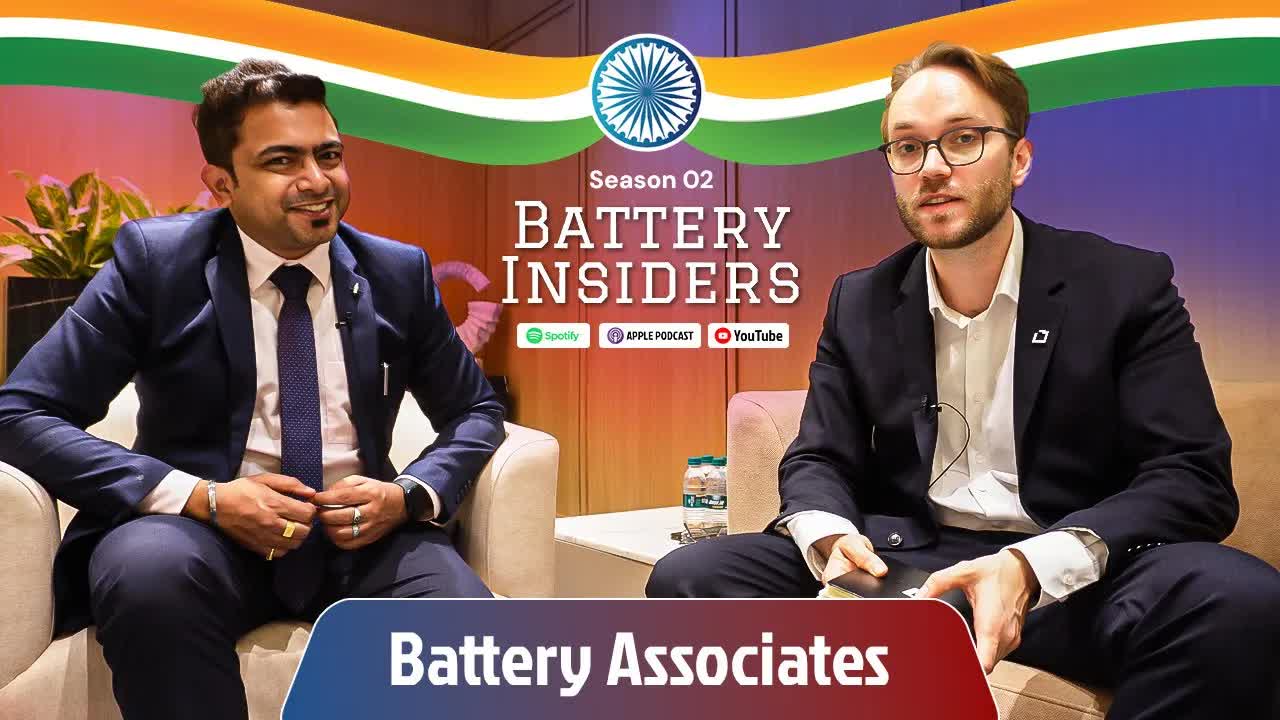
Debmalya Sen
India Lead, Energy, World Economic Forum
Sen spoke to Battery Insiders at the India Battery Show, near Delhi, shortly after sharing a conference stage with the host. In the episode he says India's tendering experience is put in front of US counterparts through World Economic Forum sessions.
Recorded in India Battery Show, near Delhi, India
What this episode covers
Asked where India stands on batteries, Debmalya Sen answers: we are nowhere. Installed storage capacity is about 0.2 GWh on a grid of more than 400 GW, which he calls nothing. The gap is what makes the number interesting. India has a target of 500 GW of non-fossil generation by 2030, and to absorb that it estimates a need for roughly 42 GW of battery storage at five hours duration, around 208 GWh, alongside some 19 GW of pumped hydro. So the ask is a jump from 0.2 GWh to more than 200 GWh in six years.
India started late and then moved quickly, mostly through policy. Sen lists energy storage obligations, interstate transmission system charge waivers, viability gap funding for stationary storage to bring costs down, and production-linked incentives on the manufacturing side. The tendering has followed. Last year set a record with 25 storage-linked tenders; at the time of recording the count already stood at 23, with the year still unfinished. On batteries specifically, around 16 GWh of tenders had been issued, 13 GWh of that in the current year alone. The turnaround from tender issued to awarded to construction started has also shortened.
On the mobility side the strength sits in two- and three-wheelers, where Sen says penetration has been notable and some segments have already reached price parity with petrol equivalents. Passenger cars lag, though he sees a little traction, and electric buses have moved with government support through the FAME schemes. Charging has been the bottleneck. Guidelines for charging infrastructure were missing and have recently arrived, with targets for chargers within a set radius in both urban and rural settings, and the government backing swapping alongside plug-in charging rather than picking one. His assessment of progress: slowly improving, not fast.
The revenue question is where he is most pointed. Batteries elsewhere usually start with power applications, frequency regulation and ancillary services, then move to energy applications once that market saturates. India skipped straight to energy applications, because its ancillary market is not conducive to battery participation. The result is a narrow revenue base: 74% of tenders issued to date address peak management, around 15% diesel generator offset, the rest other uses. Prices have come down, though Sen attributes that to global oversupply rather than anything domestic. Better multi-stacking of revenue streams from the same asset, he argues, is where the returns are.
Questions from this episode
- How much battery storage does India have, and how much does it need by 2030?
- Installed storage sits at roughly 0.2 GWh, which Sen describes as nothing on a grid of more than 400 GW. The 2030 requirement comes out of India's target of 500 GW of non-fossil generation. To integrate that, the estimate is around 42 GW of battery storage at five hours duration, which works out at about 208 GWh, plus roughly 19 GW of pumped hydro. That means going from 0.2 GWh to over 200 GWh in six years, a jump Sen is blunt about calling a huge ask.
- What policies is India using to accelerate battery storage?
- A mix of demand pull and supply push. On the demand side there are energy storage obligations, waivers on interstate transmission system charges, and viability gap funding for stationary storage systems, which is intended to bring the cost down and speed up deployment. On the supply side, domestic cell and battery manufacturing is being promoted through production-linked incentive schemes. Sen's framing is that India came to storage late but built the policy and regulatory scaffolding quickly, and that the tendering activity of the last two years is the visible result.
- How fast is India's energy storage tendering pipeline growing?
- Fast enough that the record set the previous year was matched inside nine months. That year saw 25 energy storage-linked tenders, a record at the time. At the point of recording the count had already reached 23, with three months of the year left, which Sen expects to make it the best year yet for storage in India. On batteries alone, around 16 GWh of tenders had been issued, and 13 GWh of that came in the current year. Standalone storage is only part of it: renewables-plus-storage tenders add more.
- What are grid batteries in India actually being used for?
- Almost entirely peak management. Of all tenders issued to date, 74% address peak management, around 15% cover diesel generator offset, and the remainder sit under other uses. Contracts typically ask the asset to guarantee a peak for two or four hours. Sen explains the pattern as a leapfrog: markets elsewhere start with power applications such as frequency regulation and ancillary services, then graduate to energy applications, while India went straight to energy applications because its ancillary market is not conducive to batteries taking part.
- Is India's EV market further ahead than its stationary storage market?
- It has been. Sen calls India one of the leading markets globally in two- and three-wheelers, where penetration has been notable and certain segments have already reached price parity with internal combustion. Passenger vehicles have been slower, with some traction now appearing, and buses have moved with government support, initially through subsidies and the FAME schemes. Over the last year, though, and matching the global mood, he says the stationary storage market has taken the limelight. Charging infrastructure remains a critical bottleneck, with guidelines only recently published.
- What can other countries learn from India's storage market?
- The tendering and approval process. Sen contrasts the time it takes in India to get a tender from conception to award, and then into construction, with the US interconnection queue, which he puts at 18 to 24 months. He says India's record here is shared with US counterparts in World Economic Forum sessions. The traffic runs the other way too. He names two things India should take from abroad: research and development, where he sees potential that is not being used and points to the scale of Chinese investment, and building a trained talent pool large enough to serve the opportunities now arriving.
Listen to this episodeWatch on YouTube
Part of India
Transcript
About this transcript. Generated automatically from the recording, then corrected against a glossary of company and guest names. It has not been checked line by line. Machine transcription mis-hears technical terms, numbers and names, so treat any figure here as a prompt to check the recording rather than a quotation of record. Spotted something wrong? Tell us.
0:00Introduction
0:00Music
Dr Simon Engelke
0:10And welcome everyone. Thank you so much for joining us for the Battery Insiders podcast. Here live from India, not too far from Delhi. And we're here at the India Battery Show. And I'm really delighted to have Mr. Debmalya Sen with us, who is the India lead at the World Economic Forum. And we've known each other for quite some time, or for years now, and in different capacities. And it's such a delight to be able to be here in person with you. And we just shared a stage together. Yeah. Which I think where you shared some really interesting insights about the India market, the perspective about India for battery.
Debmalya Sen
0:43So, wonderful to have you. Thank you. Thank you. And so beautiful to have this. And first of all, welcome to India. And yeah, I think the way it has all been shaping up for this sector, it's just very promising. So happy to do this.
Dr Simon Engelke
1:00Absolutely. And yeah, again, I know you have many slides and I can recommend follow this person on LinkedIn. You can find more insights there. But I think I would just like to start, like where are we right now? Because I think a lot of our listeners, and me included, right before coming here, you have some idea about India. But I think there is so much more happening than a lot of us and maybe our way off. So maybe if you could just set a bit of the scene, where are we right now in India of later batteries?
Debmalya Sen
1:25Thank you. So, you know, where are we right now? We are nowhere. Okay. If you look into the installed capacity today, it's around 0.2 gigawatt hours. That's nothing. In a grid, which is as of today, more than 400 gigawatts, right? 0.2 gigawatt hour is nothing. And when you actually look into how China, Australia, US are doing it. But say that, you know, India has been striding really fast in this area. Why do I say this?
1:56The 2030 target and what it demands in storage
Debmalya Sen
1:56First, of course, India has its target to achieve 500 gigawatts from non-fossil fuel energy by 2030. And in order to do that, in order to sustainably get that into grid, India estimates that India will require around 42 gigawatts of energy storage, battery storage by 2030 for five hours duration. That's 208 gigawatt hours, right? Along with around 19 gigawatts of pumped hydro will be required. Now, so I'm saying from 0.2 gigawatt hours, the ask is to go to 200, more than 200 gigawatt hours by 2030. It's a huge ask. Six years, right? Six years, exactly. Six years. Now, so therefore, what has happened is India has started late, but India has quickly picked up pace also. A lot of policy and regulatory developments has happened over time, right from bringing in mandates like energy storage obligations to giving various waivers from ISTS waivers, interstate transmission system waivers, to also getting in a system of viability gap funding for stationary energy battery storage systems, so that the cost can be brought down and accelerated deployment can happen. So all these things have happened along with, of course, supply side, where we have been promoting domestic manufacturing, along with production-linked incentive schemes. But that said, over the last two years, the tendering scene has actually picked up big time. Last year, it was a record year where we had 25 energy storage-linked tenders. Today, as we sit here, we are already at 23. So we are already at par, and we will look, this will become the best year yet for storage in India. Now, if I talk directly about batteries, today we have around 16 gigawatt hours of tenders which has been issued, out of which 13 just got issued in 2024,
3:56Tender volumes, costs and shortening timelines
Debmalya Sen
3:56and we are still three months to go. You don't know where this number will go. And the best part of this is, of course, costs have reduced globally, and that has impacted a lower LCOS in India. But more than that, what we have been seeing is the turnaround time, the tender from the tender getting issued to that getting awarded to finally construction starting. That timeline has reduced significantly in 2024, which is a very positive sign for batteries in India. So, yes, we started late, but we have very quickly picked up pace. And as I say, today around 16 gigs has been issued, out of which 8 gigawatt hours is online. That means it's an open opportunity for everyone. And this is just stand alone, right? And apart from that, we also have RD Plus storage tenders, which again brings in a very big opportunity in this market.
Dr Simon Engelke
4:48That's like on the stationary side, right? And also from an e-mobility standpoint, what's happening there maybe as well?
Debmalya Sen
4:54Correct. So, you know, India is one of the leading markets if you look into the two-wheeler and three-wheeler industry across the globe. And the penetration that has been happening in that sector is really noteworthy. Initially, a lot of subsidies came from the government. Now we see in certain aspects we have already reached price parity with an ICE, right? So that I think India has done relatively well in the two-wheeler, three-wheeler segment. Passenger vehicles has not been that much till now, but yes, we do see a bit of traction coming in. Also, public transport, buses is one area where also we have seen. And again, a lot of support from government came in form of FAME policies, one, two, where they actually incentivized, you know, promoting these kinds of electric vehicles. So, yes, electric vehicle has been strong, but I think over the last one year, and that has been the sentiment globally, the stationary storage market has taken the limelight.
5:57Electric two- and three-wheelers, and the charging bottleneck
Dr Simon Engelke
5:57Yeah, which I think is very unique also, especially about this as a market, right? Very different to other regions like Europe, etc., where automotive has really seen as the big pull, even though now there has been a bit of a slowdown. And we have seen also BESS over-exceeding than maybe some people have been thinking. I think here may be one interesting insight I found today in one of the CEO roundtables here was, and the CEO roundtable was the topic of infrastructure and some of the limitations there. Charging infrastructure, again, a big topic in many different markets, but also being something where I think there might be more new incentive programs coming, which will also address these or at least help starting it with.
Debmalya Sen
6:29Yes, yes. So, very recently the government came out with guidelines for charging infrastructure, which was missing. So that is in place. Government has also been kind of promoting both, one charging, the other one is the swapping model. Both has been kind of in discussion. They don't only want to go one way. So, yeah, the charging part has been one of the critical bottlenecks. And I think as of today, there has been a target with the government came out that within a radius, you need to have charges in every urban setup as well as rural setups. But as of today, the scene is slowly improving, not very fast, but yes, slowly.
Dr Simon Engelke
7:09And one other aspect, I think, which was quite interesting, you brought up also in the panel was the topic of value stacking. Yes. And the limitations right now, how you can use best in India. So maybe you could share a bit more about that for our listeners.
Debmalya Sen
7:20Sure. So, you know, globally, if you look how batteries have grown in terms of revenue streams, you will find that they start off with power kind of applications, frequency regulation, ancillary service. Once that market saturates, then you go over to energy kind of applications. In India, we have kind of taken a leapfrog directly to energy kind of applications. Why? It's also because the ancillary market in India is not that developed or rather it's not that conducive for batteries to be participating in that market. So therefore, we see in India directly going to energy kind of application and that also primarily for peak management.
7:57Peak management, and why value stacking is missing
Debmalya Sen
7:57Of the all tenders that has been issued till date, 74 percent addresses peak management. Around 15 percent is DG offset and the rest is others. So you see, it has been primarily a single use case that these tenders had been has been addressing that you manage my peak. OK, or do you adhere and give me, you know, kind of a peak guarantee for four hours or two hours in these kind of tenders. So while that is good and prices has reduced, not because of any other, but because of the global oversupply situation that we are seeing. But India has been predominantly, as I'm saying, that it has been a predominantly one use case. But that is where I think a lot of opportunity lies that if we can better multi stack revenue streams from these assets, the cost and the returns can be much more.
Dr Simon Engelke
8:54Yeah, I think that's that sounds really good. And maybe that's a I think we're kind of touching on these points already. But like if you would now look at India. Right. And I think you have seen all of these developments. Like what is maybe one thing other regions can learn from India? Yeah. And maybe what's one thing where you think, you know, that's something where India needs to improve. Yeah. And to really be successful in this. Thank you.
Debmalya Sen
9:15I think one thing that we can really share with the world is the tendering process, the approval process. If you look into US, the interconnection queue is 18 months, 24 months at some times. We have done a tremendous job there. The approval process, the entire system of a tender getting conceptualized that to getting awarded has been quite a learning in India. And I think in as part of World Economic Forum in many of these sessions, we do share this with our US counterparts and others that this is what India is doing beautifully.
9:52What India can teach, and what it needs to learn
Debmalya Sen
9:52So, yes, that is one thing that we definitely can share with the world. And something that we can learn from the world is, I think, you know, two things. One, of course, is from the aspect of research and development, which I feel there is a lot of potential here, but we are not utilizing that to its fullest. So that is one part. And especially China, I guess, the way they have done it, you know, and China is China because of the amount that they have just invested in that. Right. So I think that we need to learn. And the second part is building that talent pool. Yeah, we have a lot of talent, a lot of opportunities coming up. But when these opportunities do come up, will we have enough trained manpower to address that opportunity?
Dr Simon Engelke
10:43I couldn't agree more. As you know, you know, it's something we really focus on also as Battery Associates, with the BatteryMBA program and a lot of other trainings we're developing and we're supplying to our partners. And I think, again, empowering people is so important. Also one of the reasons why I really didn't want to miss this event to also meet with the local talent and really, really support that as well. But yeah, Deb, I just want to really thank you for these insights for today. Absolute delight. I'm sure we're going to see each other hopefully soon again. And yeah, also this was Simon Engelke with Battery Associates. And yeah, you listen to the Battery Insiders podcast. And if you want to hear more about these or watch more of these, please subscribe on Spotify, Apple Podcasts or YouTube or anywhere else where you listen to your podcast. With this, thanks so much, Deb. Thank you.
Debmalya Sen
11:22Thank you.