
Episode 150 · 9 November 2024 · 00:20:30
A second life battery priced like a lead acid one
Exploring second life Li-ion battery ecosystem of India by Dr. Rashi Gupta
The CEO of Vision Mechatronics on India's first high voltage second life battery, why standards get written but not enforced, and training service technicians from scratch.
Read the article: A second life battery priced like a lead acid one
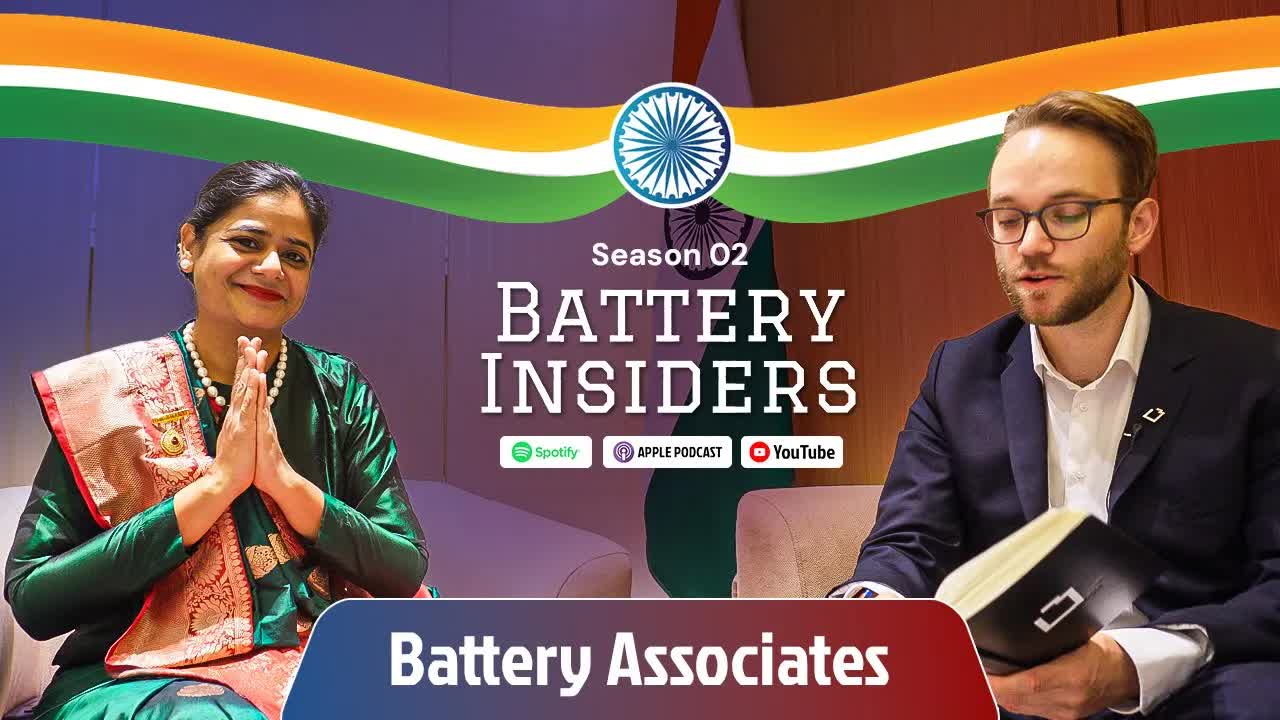
Dr Rashi Gupta
Chief Executive Officer, Vision Mechatronics
Vision Mechatronics is an Indian energy storage manufacturer. Gupta moved into lithium batteries in 2015, funding it from her existing robotics business, and the company now builds battery systems and its own BMS in India for customers in India, Europe and the US.
Recorded in New Delhi, India
What this episode covers
Vision Mechatronics used the India Battery Show to launch what Rashi Gupta calls India's first high voltage second life battery, built with JSW MG Motor India and sold as Relive. Her argument for it is commercial. India's storage market has a gap: lead acid packs and traditional inverters at one end, new lithium systems at the other, and the distance between them is what stops commercial, industrial and residential buyers moving across. A repurposed pack, she says, gives performance close to a first life system at a price band close to the traditional product, which is the comfort a cautious buyer needs before switching technology.
The obvious objection is that new cells keep getting cheaper. Gupta has heard it and does not think it settles anything. She expects prices to stabilise once the current geopolitical pressure eases, and points out that a second life pack has already had its sourcing cost absorbed by the first life, so a real price difference remains. Her analogy is coffee: you can buy it at a roadside stall or at Starbucks, and both have customers. The segment she has in mind is rural India, plus tier two and tier three cities and the industries in them.
Selling into that market, she says, starts with the customer's mindset rather than the specification. Price sensitivity comes first, then availability, then trust in the technology. For EVs the worry has shifted from range anxiety to charging anxiety. For storage it is still price, availability and safety, sharpened by fires around the world. Gupta is impatient with how those get explained: thermal runaway is a description, not a root cause, and the question worth asking is what led to it. She says her own systems have never produced a fire in a warranty claim.
Her answer on cost is to argue value instead of price. Put a low cost battery with no cooling, no ventilation and no temperature cut-offs into a desert at 50 to 60 degrees and it will not perform, and the whole investment is wasted. Pay a small premium for a system that handles the heat and runs another ten years and the return is better. She makes a similar point about safety rules. She works on standards with UL, BIS and IEC, and thinks the writing is fine while the implementation is not. After India's EV fires, NITI Aayog, DRDO and others investigated and changes were made mandatory. Her question: why wait for the incident, when the standards already existed?
On localisation she made a deliberate choice not to chase cells. Vision Mechatronics began with a German collaboration in 2015 and built in India from the start, exporting to Europe and the US. The strengths she chose were electronics, software, assembly and system design, so everything in the battery except the cell is now made locally. She claims the first Indian designed and made active balancing BMS, now sold in Europe and the US, and has run predictive monitoring since 2017 that flags a pack three months before it degrades. Volumes are close to three gigawatt hours. The machinery for making cells, she adds, is still imported and could be built in India too.
The last stretch is about who does the work. Short of trained engineers, Gupta recruited young women from industrial training institutes and put them on service calls, staying on the phone with them the first few times so they stopped being afraid of the equipment. That team now travels to rural sites that can be two days away. She also changed the products: fuse boxes that open like a drawer so a customer can swap a fuse over the phone, and lighter connectors after women told her the old ones were too stiff. Products, services and courses, she says, have mostly been designed by men, and academia has to be part of fixing that.
Questions from this episode
- Why does India need second-life batteries?
- Gupta's case is about a gap in the market. At one end sit lead acid batteries with traditional inverters; at the other, new lithium systems that commercial, industrial and residential buyers find capital heavy. That distance is what slows lithium adoption in a price-sensitive market. A repurposed pack sits in between: performance close to a first life system, at a price band near the traditional product. It also takes away some of the fear of committing to a technology that might change again or fall further in price. She sees the strongest use cases in rural India and in tier two and tier three cities.
- Does second life still make sense if new batteries keep getting cheaper?
- She thinks so. The recent fall in lithium prices was steep, but she expects prices to stabilise as geopolitical pressure eases. More to the point, the sourcing cost of a second life pack has already been absorbed by its first life, so a meaningful price difference survives. Her framing is that every product has a segment: coffee sells at a roadside stall and at Starbucks, and both have buyers. She also expects entry barriers in the Indian market to tighten soon, which changes what is available at the cheaper end.
- What does Vision Mechatronics actually make in India?
- Everything in the battery except the cell. Gupta decided early not to chase cell manufacturing and to build instead on electronics, software, assembly and system design. The company started with a German collaboration in 2015 and manufactured in India for export from the beginning, shipping to Europe and the US. She claims the first indigenously designed and made active balancing BMS in India, which is also sold into European and American markets, and has offered predictive monitoring since 2017 that can flag a pack around three months before it goes bad. Cumulative volume is close to three gigawatt hours.
- What is wrong with battery safety standards in India?
- Not the standards, in her view. Gupta works on standardisation with UL, BIS and IEC, and says the documents themselves are written well. What is missing is implementation, and the compulsion to apply them at every layer of the ecosystem. Her example is what followed India's EV fires: investigations, reports from NITI Aayog, DRDO and other national bodies, and then changes made mandatory. Her objection is the sequence. Good standards already existed, so the industry should be working in preventive mode rather than waiting for an incident and correcting afterwards. She adds that thermal runaway describes a fire rather than explaining it.
- How should a buyer compare batteries on more than price?
- By working out what the system will actually do in the conditions it faces. Her example is a desert at 50 to 60 degrees: a low cost battery with no cooling, no ventilation and no temperature cut-offs will not perform there, and the entire investment is wasted. A system built to handle that heat may cost a premium, but if it runs for another ten years the return is better. She frames this as value for money rather than lowest price, and thinks adoption of storage and EVs gets easier once buyers make that calculation.
- How do you get more women into the battery industry?
- Gupta, who sits on the UN's Council of Engineers for the Energy Transition, says the conversation has to happen twice: with young women, and with their parents, who still believe the energy sector is difficult and laborious. Then the industry has to make room. Short of skilled engineers, she trained young women from industrial training institutes and coached them through their first service calls by phone until the fear went. She also redesigned around them: fuse boxes a customer can reset like a drawer, and lighter connectors after women said the originals were too stiff. Products and courses, she notes, have mostly been designed by men.
Listen to this episodeWatch on YouTube
Part of India
Transcript
About this transcript. Generated automatically from the recording, then corrected against a glossary of company and guest names. It has not been checked line by line. Machine transcription mis-hears technical terms, numbers and names, so treat any figure here as a prompt to check the recording rather than a quotation of record. Spotted something wrong? Tell us.
0:00Introduction
Dr Simon Engelke
0:00Welcome everyone. Thank you so much for joining us on the Battery Insiders podcast. We're here live in New Delhi or near to New Delhi for the India Battery Show. And we have a really exciting day here and I'm exceedingly excited to have Dr. Rashi Gupta with us today, who is the CEO of Vision Mechatronics. And I think we had some great discussion yesterday and some CEO roundtables. And I think in some way, I think the way to describe you is as a pioneer in the battery manufacturing in India. Because you started already in 2015. And maybe if you could start with that, what's your own story into batteries?
Dr Rashi Gupta
0:45Yeah, I mean, I'm also fondly known as Battery Valley of India. When I started in 2015 with lithium batteries in India, everyone told me this is a wrong investment. You will lose all your money. And I was like, no, I'm not going to lose my money. Let me just do it. And even if I do, it's my money, you know. I'm not taking anybody's investment. I mean, I'm bootstrapped. So it's my money. And then I think I did a good job with that. And I'm here today with you at the podcast. So I think I've done a good job there. And it was very difficult for me to understand. You know, back then there were not many investments happening in the battery space. It was very difficult. So from my existing business of robotics, I got the money invested into lithium batteries. And then we made this whole thing, whole show really, really successful. I mean, today I just do not do the first life, but I'm also doing this. We have launched at this battery show, India's first high voltage second life or a repurposed battery in association with JSW MG Motor India. So that's a big step. And in terms of sustainability, in terms of circularity of lithium batteries
1:57Launching Relive, and why second life suits India
Dr Rashi Gupta
1:58and giving, you know, that EV a new life. So the product is also called Relive.
Dr Simon Engelke
2:03Congrats. I think it was very exciting. And I think second life is a big topic also being discussed, I think, all around the world. I think there's different approaches in different markets. Maybe if you could share a bit more about starting on that. For India, why second life? Why do you think that makes sense?
Dr Rashi Gupta
2:17I think it really makes sense to have a second life battery because, see, what is happening is India is a very, very sensitive, you know, price sensitive market. So what happens is there is a gap. There's a traditional battery storage with the lead acid and, you know, the traditional inverters that are there. And then there is this lithium and market. So there is a gap. And this gap is a deterrent for the adoption of lithium in India. So what I found out that CNI sector for that matter or the residential sector for that matter is not adopting to these tech because they find it a little capital heavy. I should not use the word expensive, but capital heavy. And then you are stuck in the game there. So this gap that we have from this old technology to the new technology is something that can be bridged with the second life, giving them the comfort of comfort and performance of the first life. Similar to the first life, yet having a price band, which is almost same as the traditional batteries. That would give them a comfort to actually transit into the newer technologies, have an easy adoption and see the reliability of the new technology as well. Because people today are also scared, you know. What if tomorrow the technology changes? I have invested so much of money into this and tomorrow or maybe the prices fall, which we have just recently seen that there was a very strong free fall into the pricing of the lithium batteries. So they feel that I have made a wrong investment. So second life will give them that cushion, a comfort zone to come out of that barrier.
3:58Falling cell prices, and where second life still fits
Dr Simon Engelke
3:59That's interesting because you just touched on the topic of price reduction, right? And of course, that's exciting, right? Because it really makes electric vehicles and electric batteries more affordable. But of course, if you put second life, it's a challenge in some way, right? Because if your upfront battery gets so much cheaper in the time you use your second life batteries, that always has been a big discussion in Europe, I know, how competitive can second life be, especially when the first life batteries drop so much on price. Do you have any thoughts on that? Do you think it's going to stabilize soon?
Dr Rashi Gupta
4:29I think the prices will stabilize soon. It is also given the geopolitical stress that everyone is having going through, the whole world is going through right now. I think it will stabilize soon. It should not be such a big stress. But see, every product has a space in the market. Every product. You get coffee at the roadside stalls also and you get coffee at Starbucks also, okay? And there's a difference. So, every product, there is somebody to take in the market. You have to find which market segment your product fits. And I really feel that this would make a lot of sense because the sourcing cost has already been absorbed by the first life, okay? So, that would reduce. And I think there is a significant price difference that you can still see. And in India, what happens is you could also see a lot of, you know, entry barriers coming in very soon, as we also were discussing that yesterday. So, you know, those entry barriers will make a big challenge. And then second thing is, if you look into the rural segment, if you look into the tier two and tier three, even industries and segments of the cities, this is something that can actually make a very good use case there.
Dr Simon Engelke
5:46And maybe kind of talk a bit more wider, right? Like on, especially on the Indian market, right? We have a very global audience, people listening from all around the world. And I think maybe understanding India a bit better, especially from a battery angle.
5:57Understanding the Indian customer
Dr Simon Engelke
5:57So, maybe from a system perspective, right? What you have been working on, I know you have built battery systems, etc. Like what is really important for the Indian market? Maybe some of your learnings come to it.
Dr Rashi Gupta
6:07I think first understanding the customer mindset is the most important thing for the Indian market. Without that, you just cannot be existent in the Indian market. It's very different because Indian mindset is way different from a European mindset, okay? The second thing I have understood is, make them understand what is your application that you are going to use these batteries for and how do you want to really, really solve the problem of the customer. So, when I do that, I can really make a space for them, give them a product that solves their problem and give them a product which is robust, long life and which is value for money. So, it's important to understand that what is the value you are creating for yourself and your customer. That is how you will deal with the Indian market. That is exactly what you can do in the Indian market.
Dr Simon Engelke
6:57That's what kind of, you just touched on the mindset. So, you think the price sensitivity is one of the big ones or any other aspect?
Dr Rashi Gupta
7:03Price sensitivity, then availability, trust on the technology. These are certain factors which have been really, really at the forefront for quite a while now. Like for example, when we said EVs, at that time it was range anxiety. But today there is a shift in the mindset. Today it's the charging anxiety, which is more troubling the EV mindset today. And then if you look at ESS, it's the pricing, it's the technology, it's the availability, it's the trust factor. Because we have seen fires across the globe, right, on this. And it's not easy to understand the root cause. I mean, saying just thermal runaway does not give you the root cause. Why was there a thermal runaway is the important question. What led to that fire inside the battery? And I'm very proud to say that in the last almost 12 to 13 years of my existence,
7:59Standards that get written but not enforced
Dr Rashi Gupta
7:59into the battery domain, we have not had fires in warranty claims.
Dr Simon Engelke
8:04And maybe also, because I think it's really an important aspect, right? We see it also in other discussions in Europe and in the US. And you get a lot of backlash, right? Once you have these fires, we don't want to avoid that. And especially when you have, on the safety aspect, maybe we can touch a bit on the safety. Because I know you're very passionate about the topic, also from a standardization standpoint. Maybe you could share a bit more about the standardization work you've been involved in.
Dr Rashi Gupta
8:25Yeah, so I'm also involved in the standardization with the UL, with BIS Bureau of Indian Standards, with IEC. And what I feel is that we all write good standards, but we somewhere lack implementation of these standards, you know. Somewhere that compulsion has to come in every layer of making that entire ecosystem. We make standards, but we don't implement them well. So I would still suggest and submit a case that we need to somewhere have more robust implementation of these standards to make the ecosystem safer. Like when EV fires were there in India last year, what happened was then there was a lot of investigation, and there was new standard that came in, and there was reports by Niti Aayog and DRDOs and, you know, everybody, all the apex authorities of the country. And then, you know, there was this standard that, no, you got to, they'd made some mandatory changes. So why should we wait for an incident to happen and then make it mandatory? When already such good standards are written, let's make them mandatory before, let's go into the preventive mode rather than into the corrective mode. So that is important.
Dr Simon Engelke
9:40Yeah, nothing makes no sense. Looking a bit on the system, on the pricing again, like what do you think, I think are the drivers for kind of getting cheaper systems? Do we need more cheaper sales? Do we need more smarter, you know, cool, whatever it is.
9:55Value for money instead of lowest price
Dr Simon Engelke
9:56Like, do you have any thoughts on that?
Dr Rashi Gupta
9:58I think we need more value. We need to understand more value and not just the price. Because what happens is, if you are in a desert, say, for example, you are in a desert with at 50 degrees and 55 degrees or 60 degrees, a cheap battery without, I mean, I should not use the word cheap, but a low cost battery with, with, you know, no cooling systems or no, no, you know, ventilations and mechanisms, which are temperature cutoffs or the right thing, it will not make sense. It will not perform. So you have eventually wasted your entire investment. It's gone down the drain. Rather at the same time, if I invest in a battery, which is having all the cooling mechanisms, which can withstand those temperatures. And if I have to pay a slight amount of premium on that, and my product functions for another, say 10 years, my ROI is much better than having the entire investment blocked and wasted and gone down the drain. So this is the economics and value that, that companies or the users have to really understand on what technicality with the value for money is something that I'm getting. And once that conception attitudes change globally, things will be much more easier for having an adoption in battery storage and, you know, EVs also for that matter.
Dr Simon Engelke
11:23Yeah. And then also there was a topic a lot again, the CEO round table yesterday about localization, indigernization, looking at the Indian market and this big discussion, what is required in India? And what should really be produced? 100%, 20%, 80% of different things. And I know making India is a big, big topic also. I mean, I think you're also involved in that. So maybe we could share with your perspective on it.
Dr Rashi Gupta
11:45Yeah. I've been doing this right since 2015, you know, when I had a German collaboration and then I started and I proposed to them,
11:52Indigenising everything except the cell
Dr Rashi Gupta
11:52let's make it in India. And they agreed. And then we are all making the batteries in India and supplying to Europe, US and other markets as well. But what happens is, what we did was we smartly played the game that we did not want to do a cell indigenization. We have to play with our strengths. So our strength was on the electronics, on the software, on the, you know, on the assemblies and making the systems more perfect and robust. on the entire BESS. So except the cell, I have indigenized everything in India. So, you know, in India, I'm the, I'm probably the first manufacturer of, uh, active, balancing, smart, indigenous, designed and made in India BMS. And I've been doing that since a long time now. And I've perfected that. And that is sold even in Europe and in US markets.
Dr Simon Engelke
12:50No, that's really exciting. I think it's also something I found really exciting here walking around that. I think there's a lot of different equipment, which is getting produced in there, which I personally wasn't aware of. Exactly. This is quite eye opening.
Dr Rashi Gupta
13:00Yeah. And then India also can do something is like, you're okay. We need to focus on cell manufacturing, but there is an entire ecosystem that comes. There are so many machines that are needed to make these cells that could be indigenized. Even they're imported from the neighboring countries that could have been, uh, uh, indigenized. Of course, BMS and the software, like we are the ones who have a preventive predictive monitoring at Vision Mechatronics. We have started this way back in 2017. Preventive predictive monitoring where we can actually, with the amount of data that we have, we can actually, uh, predict three months in advance that your batteries are going to go bad now. Yeah. So imagine if we can do so much, can we not create safe and robust systems in India?
13:48Volumes shipped, and women in the energy sector
Dr Rashi Gupta
13:48Of course we can. And not just for India, we can do it for the world. So it's making India for the world. And that's what I'm trying to achieve.
Dr Simon Engelke
13:55That's exciting. And I think maybe you could, I don't know if you can share a bit more about like the volumes you've been working with now in your batteries.
Dr Rashi Gupta
14:00I have been like now close to three gigawatts.
Dr Simon Engelke
14:05Oh, well, yeah. Three gigawatts hours roughly. Yeah, roughly, yeah. Yeah. That's quite significant. And now you're opening up your new second life. So it's another.
Dr Rashi Gupta
14:13Yeah, that's a second life thing. And, uh, I should, I should invite you as well to come and see it. Yeah. It'll be, it'll be nice. Yeah.
Dr Simon Engelke
14:20And then maybe also one other aspect is, it's also, we are quite passionate about, right? With battery associates and the BatteryMBA, et cetera, is women in batteries.
Dr Rashi Gupta
14:28Ah, very,
Dr Simon Engelke
14:28very proud of the, about 30% woman in our community as well as in the BatteryMBA. Um, but there's a lot more to do. And I think even yesterday we had like a show of hands, how many women are in the room?
Dr Rashi Gupta
14:38And there were just three.
Dr Simon Engelke
14:39Yes. This was a CO one too, but also in the larger audience as well. Definitely not enough. So what can we do?
Dr Rashi Gupta
14:46Okay. I mean, I have been working globally on women empowerment issues. In fact, I am also a member of council of engineers of energy transition at United Nations. So, you know, there again, I'm the only Indian female passport holder out there, you know, official Indian person out there. So, I mean, what I see is, we need to talk at the, at the level where these girl, young girls and young minds are understanding that we need more feminine energy to come into the energy sector, to the electricity sector. Second is we need to talk to their parents. Because still now, even now, there is a stigma that the energy sector is a difficult sector. The electricity sector is a very difficult sector. It's a very laborious sector. However, times have changed now. It's no more laborious. Even the designs and even the development of systems is far,
15:44Training service technicians from scratch
Dr Rashi Gupta
15:44far easy now. So, we need to tell these young girls that it's easy. You know, what one step I did in my company was, we were falling short of, of course, the skills are not there. You can't find engineers or diploma holders for this sector, right? So, what I did is, I tried training these young girls from ITI. And they were so scared. They were like, what if we do something wrong? And if there's a boom, because everybody says, you know, that they will catch fire. But it's not like that. So, I told them, we have tech, right? I mean, the world has reached a technology state where I can just connect to anywhere in the world, right? With the new mobile phones, with the new IoT systems and all the data that is available. And we have implemented IoT in our battery in 2015. People are now talking about IoT in batteries. We did it back then. So, what I told these young girls was that, okay, you go to the site. I will stand on the other side of the phone. Okay? Despite all my service personals and teams available. I said, I will be with you. And I trust you. You can go and do it. Instilling that confidence in them. And today, I have a team of these young girls who are far superior than any other technicians that would be available to solve or service out anything on the field. And they are not scared of going to any difficult places, any difficult terrains. Because most of these energy storage requirements are from the rural India. Where, you know, reaching that space itself would sometimes take you maybe two days of travel. They are so distant and they are so far apart. And then another thing that I did was, I designed the products in such a way that, whoever it is, a woman or a child or an old man or a young or an old woman or any, any, any person can do a DIY analysis and a DIY kind of first aid to the system. And an emergency response really, you know, I did that because I realized that there could be times when we are not reachable.
17:42Designing products anyone can fix
Dr Rashi Gupta
17:42There could be an SOS. I have seen those, you know, during COVID times, it was, it would be, you know, traveling was so difficult and reaching the space would require so many permissions. So what we did was at that time is we, we have these, you know, special fuse boxes kept, you know, which is just open like a drawer, put the fuse in and close it. So on the phone, we just told one of these ladies, you know, the fuse had blown off because of enlightening that had fallen on the solar panels. So we just told her, open the drawer, change the fuse and close it. And just press the button again. And your system starts. So make it easy for people. Design in a fashion, right from the inception of the product till the grave, you know, from the whole life cycle, you've got to design it in such a way from wheel to grave that you have the customer in mind. And, and it should be easy. Like we had a challenge with your connectors, you know, they were too heavy and bulky to push in and push out. And then women used to say, oh, they're too heavy for us and they're too tight. So we changed the model again there, taking the feedback. So you have to design the product, you have to design a service, you have to make your courses, keeping women in mind, which have not been done because these products and courses have always been designed by men. Right. So that change has to come in the mindset, that change has to come in academia also. Then there has to be an industry academia partnership, where you talk about getting these young minds on board. I'm, I'm being general neutral here, not just men or women, but getting both on board because imagine if you do not have the next generation in the energy sector, where will you have electricity on your mobile phone to see the YouTube shots, to see Instagram reels or to even have a podcast like this.
19:38A closing word to young engineers
Dr Rashi Gupta
19:38So this sector needs you right now. All of the young people who are listening to this podcast, we need you now and we need you to be in this sector. This is a hardcore sector where we need very intelligent, young, bright minds and we can't do it without you. We really cannot do it without you.
Dr Simon Engelke
19:57Love it. I think we're going to conclude it there. I think that's some really, you know, good advice and I think very much resonates also to work we are doing. So really appreciate you sharing it. Yeah. And I think with this, I just want to thank you all for listening today for this battery insiders podcast here from India. And also we want to thank Dr. Rashi Gupta for sharing your insights with us. And I'm sure we're going to stay in touch. So thanks so much.
Dr Rashi Gupta
20:16Thank you so much for having me here. It was an absolute pleasure. Thank you.
Dr Simon Engelke
20:20Thank you. Thank you.