
Episode 151 · 16 November 2024 · 00:21:05
The hundred-metre oven, and how to remove it
Exploring AM Batteries dry coating technology
The CEO of AM Batteries on taking the solvent NMP out of electrode coating, why his process avoids PTFE, and the first rolls of dry film to leave the pilot line.
Read the article: The hundred-metre oven, and how to remove it
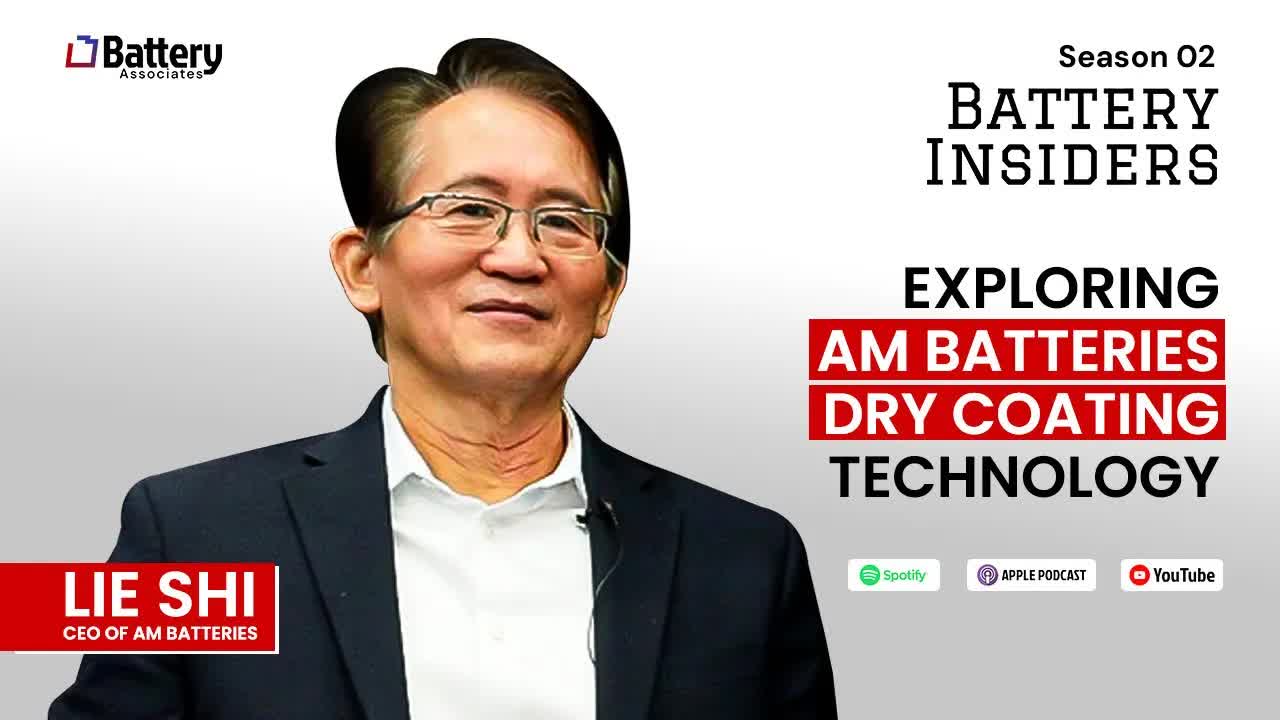
Lie Shi
Chief Executive Officer, AM Batteries
AM Batteries was founded in 2016 by two university professors to remove solvent from electrode manufacturing, and sells turnkey dry coating equipment rather than cells. It raised $30 million in October 2023 in a round led by Toyota Ventures. Shi joined as chief executive after more than twenty years in the industry, including a period as president of Celgard.
Recorded in The Battery Show North America, Detroit
What this episode covers
A wet electrode line ends in an oven around a hundred metres long, and its only job is to drive off NMP, a toxic solvent with a boiling point of 200 degrees centigrade. Battery makers tell AM Batteries that this oven accounts for more than 40% of the energy a plant consumes. The solvent is expensive, has to be captured so it does not escape, and gets sold on to chemical companies by producers that cannot reprocess it themselves. AM Batteries sells equipment that removes the step entirely, depositing dry powder onto the current collector electrostatically instead of mixing it into a slurry first.
The company was founded in 2016 by two professors who wanted to get the solvent out of electrode making, and it spent roughly four years in the lab. What changed the picture was Tesla's battery day in 2020, when Elon Musk put dry coating at the centre of the 4680 cell and the cost reduction meant to come with it. A seed round and a Series A followed within twelve months, then $30 million in October 2023 led by Toyota Ventures. The CEO joined about fourteen months before this conversation, after more than twenty years in the industry and a period running Celgard, one of the largest separator producers in the US.
The numbers he uses are all measured against the wet process. Energy consumption down 40%. Capital and operating expenditure down 40% as well. Floor space down 70%, which he puts down to AM Batteries' own approach rather than dry coating generally. Carried through to a finished cell, he estimates a saving of 10 to 15%, so $10 to $15 on a cell costing $100 per kilowatt hour. His argument for why the timing works is that the easy savings in cell manufacturing have already been taken, so any process offering a reduction of that size gets a hearing.
On chemistry the process is close to agnostic. AM Batteries has run NMC at both 622 and 811, LFP, silicon anode and some sodium-ion materials. The exception is lithium metal anode, because the deposition is electrostatic and a conductive material will not hold. The harder problem is engineering, and it reduces to three things: making the film wider, making it uniform, and running it fast enough to compete with a wet line. Days before this conversation the company shipped its first rolls of film, rather than sheet samples, from the engineering pilot line to a customer, so that customer can build a large pouch cell and compare.
Energy density is still set by the cathode and anode, but he claims 5 to 10% more of it from thicker loading. Wet coating struggles with thick electrodes because uniformity suffers and drying gets more expensive, so most lines sit around 60 microns. AM Batteries can reach 120 to 130 microns, and has gone to five times the wet standard in trials without needing to. The pitch to early adopters, which he calls lighthouse customers, is deliberately unambitious: keep the same binder at the same percentage, change only the machine, then compare. Customers report equivalent rate capability, energy density and cycle life.
He is careful about the comparison with Tesla. Tesla's route came out of Maxwell, acquired in 2019, and uses PTFE, which is difficult to handle, energy intensive to mix and unstable in the anode. AM Batteries does not use PTFE, and instead grinds whatever binder the customer specifies to the right particle size and flowability. It has also signed a joint development agreement with Zeon for a binder designed for a dry line rather than adapted from a wet one. On timing he expects a percolation point in about five years and general use across gigafactories in ten, with high precision consumer electronics staying wet.
Questions from this episode
- What is dry electrode coating, and how is it different from the wet process?
- In the wet process, active material, conductive additive and binder are mixed with the solvent NMP into a slurry, coated onto metal foil, then sent through a long oven to dry the solvent off. NMP boils at 200 degrees centigrade, so the drying is slow and the ovens are long, often around a hundred metres in a gigafactory. AM Batteries uses electrostatic deposition to put dry powder straight onto the current collector, with no solvent, no slurry and no drying oven, and sells that as turnkey equipment to battery makers.
- How much does dry coating cut energy use and cost?
- Battery makers tell AM Batteries that more than 40% of a plant's energy goes into the drying oven, and the company uses 40% as its benchmark saving against the wet process on energy, on capital expenditure and on operating expenditure. Its own process also cuts floor space by around 70%, because the oven and the solvent recovery system go away. Taken through to a finished cell, the CEO puts the total saving at 10 to 15% of cost, or $10 to $15 on a cell costing $100 per kilowatt hour, alongside a lower carbon footprint.
- Which chemistries does AM Batteries' dry process work with?
- The company has run NMC at both 622 and 811 in the lab, along with LFP, silicon anode and some sodium-ion materials, all of which work. The CEO is comfortable calling the process chemistry agnostic on that basis, on the grounds that the physics does not care at a first principles level. The one thing it cannot do is lithium metal anode. Deposition is electrostatic, so a conductive material will not take the charge needed to hold the powder onto the foil.
- Does dry coating improve energy density?
- Indirectly. Energy density is driven by the cathode and anode chemistry, not the coating method, but dry deposition allows a thicker electrode. Wet lines rarely go thick because uniformity suffers and thicker coatings are more expensive to dry, so they typically stay around 60 microns. AM Batteries can reach 120 to 130 microns, and has loaded up to five times the wet standard in trials, though it does not need to go that far. Simply doubling thickness gives a 5 to 10% gain in cell level energy density.
- How does AM Batteries differ from Tesla's dry electrode process?
- Two ways, and the CEO is deliberate about both. Technically, Tesla's route came from Maxwell, which it acquired in 2019, and depends on PTFE. He describes PTFE as hard to work with, the reason the mixing step is so energy intensive, and unstable if used in the anode. AM Batteries avoids it and grinds the customer's chosen binder to the right particle size instead. Commercially, the two are not in the same market: Tesla makes cells and cars, AM Batteries makes equipment, so Tesla could eventually be a customer. AM Batteries has hired an engineering director who previously worked on dry electrodes at Maxwell.
- When will dry electrode manufacturing be widely adopted, and will the wet process disappear?
- The CEO expects a percolation point in about five years, at which the major players adopt, and general use across gigafactories in ten. Talking to large manufacturers, he says everyone is working on dry electrodes and reactions fall into three groups: sign a joint development agreement and start qualification, go with an equipment supplier that already sells to Tesla, or develop it in house, which is mostly the Japanese and Korean response. He does not expect wet coating to vanish. High precision consumer electronics still need the uniformity it delivers, and uniformity has safety consequences, as the Galaxy Note 7 showed. Automotive and stationary storage, being cost sensitive, should move quickly.
Listen to this episodeWatch on YouTube
Part of Making cells at scale
Transcript
About this transcript. Generated automatically from the recording, then corrected against a glossary of company and guest names. It has not been checked line by line. Machine transcription mis-hears technical terms, numbers and names, so treat any figure here as a prompt to check the recording rather than a quotation of record. Spotted something wrong? Tell us.
0:00Introduction
Dr Simon Engelke
0:00And welcome everyone. Thank you so much for joining us here for the Battery Insiders Podcast. And we're today in Detroit for the North America Battery Show in the United States. And it's a really busy day. A lot of things are happening. And I'm extremely delighted to have Lie Shi with us, who's the Chief Executive Officer of AM Battery. So wonderful to have you. Thank you. Nice meeting you, Simon. Perfect. So I think, you know, today we want to talk a bit about dry electrode manufacturing. I think it's one of these topics, actually, a lot of you have been requesting to hear more about. So I'm really excited to have this conversation. And yeah, maybe just to kind of start a bit, if you could start by introducing your company, give us a bit of an overview of their metrics.
Lie Shi
0:47Okay. Maybe I can start with the history. The company was founded in 2016 by two professors. One of them is from Texas A&M. The other one is from Worcester Polytechnic Institute. And they want to solve one problem, which is how do we get rid of the solvent used in making electrodes? And the traditional way, we call it the wet process, is mixing active materials with conductive material binders, but using a solvent. And this solvent happened to be a lovely chemical, toxic material called NMP. And so two professors thought, if we can use a dry process without using solvent, it can save a lot of energy and save a lot of space and also without using toxic materials. So then they started funding the company. And then for the next four years, they were working in the lab and writing papers and start to progress. But then back to the day happened. This is precisely four years ago in 2020.
1:55Tesla's battery day, and the funding that followed
Lie Shi
1:56And Elon Musk got on the stage and said he's going to make the 4680 sales from the skinny 2760. And also he said he's going to reduce the manufacturing costs by 40% by turning the dry process into a real manufacturing process. And so that is a game changing moment for the industry and also for AM batteries, because the founders realized the moment for AM battery has arrived. So within 12 months, they raised the seed run and series A followed within 12 months. Then last year, October 2023, we raised the $30 million, this time led by Toyota Ventures and other major investors. So we finally arrived and we moved into a new facility and started to develop engineering pilot lines. Our business model is to sell turnkey equipment for battery makers to make electrodes using the dry process.
Dr Simon Engelke
3:01That's awesome. Maybe also just one quick word about yourself, right? Because I think you have kind of different experience as well. Interesting. Yeah.
Lie Shi
3:07Yeah. And I have been in the industry for over 20 years. And before I joined AM battery, maybe 14 months ago, I was running Celgard. I was the president of Celgard for a few years. And Celgard was a company, maybe the largest separator producer in the U.S. And one board of AM batteries called me up and I was intrigued. And once I looked into this technology and realized this could be an opportunity to change the landscape of manufacturing. So I just felt privileged to join the company. And, you know, in your lifetime, you don't have many chances to say, I can compete against Tesla and become the major player in the new space of dry battery electrodes.
4:00How the wet process works, and why NMP is the problem
Dr Simon Engelke
4:00That's so fascinating. I think it gives you definitely also the credibility to run things at a big scale. I think that's what I've done with Celgard. And then maybe a little anecdote to our listeners actually have something in common. Because also we as battery associates, that are our first battery associates battery day, one day after the Tesla battery day. That's also four years ago. Interesting. It started. So you might have a similar time. Yeah. It is a big game changing for you as well. For us as well. Because there's a lot of inspiration we took from that as well, which is amazing. Yeah. Maybe now for the listeners, right? You don't know so much about, you know, how your process, you just mentioned this turnkey solution you're developing. How does this differ to the current battery infection process?
Lie Shi
4:41Yeah. Maybe I was too quick earlier. But the current web process is, you can say it's a relatively simple process. But they use a solvent. There's an NMP. They mix material together to make a slurry. Slurry is just a layman's and maybe expert expression liquid mixed with powders. Then you start to coat them onto metal foil. And the metal foil, we usually call them current collectors. Then after coating, you have to send them through this huge oven to dry off this lovely chemical called NMP. And the NMP not only toxic, it has a very high boiling point of 200 centigrade. So considering how difficult to dry off water, this one is exponentially more difficult to dry off. That's why for anyone building a gigafactory, they usually have a hundred meter long oven to just dry this material off. Then they have a recovery system to keep them inside because the material is toxic. Then some advanced companies process them again and use them again. But early starting companies, usually they sell them to the chemical companies.
6:0040% less energy, 70% less floor space
Lie Shi
6:00So as a result, overall NMP material is also very expensive. And talking to any battery makers, they will tell you more than 40% of energy is consumed by this drying oven. And that's why if you can get rid of this, that can really save a lot of energy. So the operating expense, carbon footprint, and also capital expenditure will be reduced dramatically. We usually use this 40% reduction as a member. We fall against the wet process. Dry process will save energy by 40%. And we can reduce with our unique technology, can reduce the space usage by 70%. So that's a big saving for any battery makers. Especially nowadays, the low handling flows are being taken. And any technology can come in, can have this kind of dramatic reduction. It makes it very attractive.
Dr Simon Engelke
6:59I think especially at the topics of cost and also sustainability are really big ones. I think these ones. I see this also in Europe, PowerCo and other companies talking about that as well. Maybe if you just, because you mentioned now there's 40% cost reduction, right? And I guess, is this now on the OPEX side, CAPEX? Or if you could maybe share with us more on the OPEX, CAPEX talk. Is there something more?
Lie Shi
7:17So on the capital expenditure and also operating expenditure perspective, we fall it can reduce cost by 40% for all the world. Yeah. For both of them. And when you get to the whole battery production, and we think if you have $100 per kilowatt hour sale, and by using dry process, you can reduce the cost by 10 to 15%. So that's a huge number, $10 to $15.
Dr Simon Engelke
7:47It's one of the steps, yeah. Maybe to understand a bit about compatibility with different chemistries and technologies. So is it like chemistry agnostic, the process?
7:56Which chemistries work, and the scale-up problem
Dr Simon Engelke
7:57And yeah, also can you use it with all kinds of different battery chemistries? Or are there somewhere it's more difficult?
Lie Shi
8:01So we have tried in the lab a few things. And definitely to work with the NMC, whether it's a low nickel 622 or 811. And also we are trying with LAP that is working. And also we are working with silicon anode, which is working as well. And the sodium-ion, we are also trying some material that is working. So maybe I can call it agnostic chemistry. One thing we cannot do is lithium metal anode. Because our unique process is electrostatic deposition. Yeah, we are using electrostatic deposition to put this powder onto metal foil. So if the material is conductive, then it doesn't work in the electrostatic approach.
Dr Simon Engelke
8:48And then also a kind of thing about this, right? So what's going to be some of the limitations you already mentioned with the metal there? But other ones, like rumors are that other companies are trying to make this work as well, that scale-up is really difficult as well. They can do it in a smaller scale, but to get it at a high volume consistent scale is very difficult. Maybe if you could share a bit more about that.
Lie Shi
9:10So good question. Because at the chemistry and the physics level, at a first principle perspective, I think this is agnostic. But we're facing the same challenge everyone is facing to scale-up engineering piece. So that is the challenge we're facing. Because on three fronts, we need to make the film wider. And we need to make the film very uniform. And also we need to make the speed up so it can compete with the web process. And actually just on Monday, we made an announcement that we ship some rows of film to one of our customers and made with the engineering pilot line. This is the first time we send rows of film.
9:54First rolls of film, and electrode thickness
Lie Shi
9:54Until this point, we usually send sheet samples. And now the battery makers can make a large battery pouch cell. And they can see how it stack up against the web process technology.
Dr Simon Engelke
10:11That's a major milestone for us. Congrats. That's big. And I think then also the role and the consistency, these kind of things are really crucial. I thought for getting the right adoption. Maybe we can also talk a bit about energy density topics. Any differences? What hour per kilogram we can get to? Or is it all in the calendering? Or just kind of understanding. Are there any differences? Okay.
Lie Shi
10:37So on the energy storage or energy density perspective, it's driven by the original chemistry. The water cathode anode you're using. But overall, we can increase the energy density by 5% to 10% because we can load up the thickness more easily than web process. And web process, if you start to get the asphalt material very thick, uniformity is an issue. And also the drying becomes even more expensive. So people usually do not make very thick batteries. And with all process, our deposition can get it loaded up very high. And actually, we try to load in maybe five times of the web process. We don't need to go that far. But just by doubling the thickness, we can increase the end result of energy density by 5% to 10%. Can you share about what kind of thickness can you get to? Yeah, we can get to 120, 130 microns. So usually it's 60 microns right now.
Dr Simon Engelke
11:44I mean, some of them are higher, depending. Yeah. Then I guess also on the energy density, because it's a bit different with which kind of binders you're also using, right?
Dr Simon Engelke
11:52And do you need more binder than liquid closers?
Lie Shi
11:55No, we are trying to make it similar. So this is where we're trying to make the lighthouse customers, which is a word I recently learned, means early technology adapters. I want to make them feel comfortable. So the barrier to entry for them to accept this technology became lower. So I just usually tell them, what binder percentage you like, and what cast of material you like to use. We'll try to have the same percentage of active materials. So as a result, usually they try it, then they can have a comparison very quickly, then realize, oh, this is what actually works.
Dr Simon Engelke
12:34Because I think that's really important, right?
Lie Shi
12:35Yeah, very important.
Dr Simon Engelke
12:36You want to be able to kind of essentially just do what they already have done, like at least a composition, and do it in different places.
Lie Shi
12:43Yeah, they have one less thing to worry about, you know, because with 4M change in the battery makers, you don't want them to change the materials. You just change a machine. So that's why after they make the comparison, they say, wow, this rate capability, energy density, and the cycle life are all equivalent. And of course, we do have a more ambitious plan, trying to make the drive process even better than the web process. This includes increased thickness. And also, we signed a joint development agreement with Zeon, which is a major binder player. We asked them, let's develop a binder for the drive process. Because nowadays, the motor binder is tailored. They have put a strange additive in to make a web process work. But I said, take those out. I don't need those. Just develop a clean binder for us. So that's very exciting. That's our next generation product.
Dr Simon Engelke
13:41I think, as you just said, right? Because that's one topic also I've heard is that there's been some discussion, I think more PTFE-based
13:47Why the process avoids PTFE
Dr Simon Engelke
13:47and some binders, which are used for a lot of the drive processes. And some people looking for more like, you know, other turners for binders, like more sustainable ones, removing fluorines and things like this. And I think there's a lot of potential development as well.
Lie Shi
14:02And also, I want to use the opportunity to clarify one second. I mentioned Tesla, right? And I want to say we are different from Tesla from two perspectives. One is the technology is different. And I think most people know the history of Tesla's drive process. They bought a company called Maxwell in 2019. And then two years later, they actually sold Maxwell supercapacitor business back out into the market. Then they kept the drive process. That process is using PTFE that you mentioned. It is a very difficult material to work with. That's why the mixing part is so energy intensive. And also PTFE is not stable in anode if you use it in the anode production.
Dr Simon Engelke
14:49That's why our approach
Lie Shi
14:51actually do not use PTFE. So this is a key differentiation I want to emphasize. And the second part is even though Tesla's technology is competitive against A and Bs. But we are not working in the same space. You know, they are battery makers. They make cars. And we are equipment producers. Down the road, Tesla could be our customers. So that's a clarification I want to make.
Dr Simon Engelke
15:16I think it's an important one. So like just last thing on the binder. So what kind of binder? Do you use like more PTF ones? Yeah. Like just standard ones? Yeah. That's why just like
Lie Shi
15:25I mentioned earlier, you use a PTFE and give it to me and we'll grind it in the right particle size. So we just need to control the particle size and the flowability and how it handles in the electrostatic deposition. So...
Dr Simon Engelke
15:41And maybe just as a kind of
15:43Five years to a percolation point
Dr Simon Engelke
15:43like a last question because this sounds great, right? I think everyone wants that, right? We want to have low energy requirements, lower costs. You know, I think that's everyone is looking for that. But from a timing perspective, you know, when do you think this will be like, you know, what do you think when this could be common in the market or more widely adopted? Okay. Maybe Sharon.
Lie Shi
16:05So I was talking with Kurt Kelty at the GM this morning and also talking to some experts in the marketplace. We felt that in five years it will reach a percolation point. Then the major players will all adopt this. Then in 10 years, it will be prevalent in the old gigafactories will be using this technology. And for AM batteries, we are finalizing the engineering pilot line. So we start to have selected customers. We want to sell this engineering pilot line too. Then allow them to get into this field very quickly. And also talking with the major players in the world, very quickly we find out everyone is working on the dry battery electrode process. Then when they look at our process, they usually have three reactions. And one of them is, okay, let's have a JDA start to get into the qualification of your program. So that is one group. Then the second group is we are working with the Tesla equipment provider because some people who sell the equipment to Tesla, now they start to promote themselves as the equipment maker for dry battery electrode space. So we want to try that approach because Tesla has proven its work. we think we can catch up. Then the third group is some Japanese companies and the Korean as well.
17:38Catching up with Tesla, and the Maxwell hire
Lie Shi
17:38They said, we have our own approach and we want to try it ourselves. So those are the three reactions, which is very reasonable. I think we understand we are a relatively young company. And so for us, we first thing is we need to catch up with Tesla in terms of commercial capabilities. Then we want to leapfrog them. And we are very happy. Actually, we recruited the engineering director who used to work at Maxwell, who invented the dry battery electrode process. and last year he joined the AM batteries from Tesla. And so we are very happy because when people ask him, what did you jump ship? He said, well, we found out the AM battery may have a better mouse drive.
Dr Simon Engelke
18:28That's exciting. I think one last thing on this one, do you think, because all people, for example, for solid-state, right, I get asked, will this replace all the other existing technology we have? Same with this, is there any reason why, in case it all works out as you dream, right, like as you're working hard on, is there any reason that wet process would still exist? Are there some reasons? Or would it be that there's no reason that dry could, in theory, replace all of the wet process? Interesting.
Lie Shi
19:01I think high precision, maybe consumer electronics, that requires, I think the wet process, people continue to advance their uniformities. And I know that consumer electronics, like iPhone, Galaxy, those still require extreme precision. And we know, and also from the safety reasons, uniformity sometimes affects safety. Do you remember Galaxy Note 7, right? And that's just
19:33Where the wet process will survive
Lie Shi
19:33because they went very thin with the separator, like a 5 micron or 7 micron, and the uniformity wasn't very good, and the safety feature was not well covered. Then it started to hurt the battery. I felt maybe very high end, and you will still have wet process, high precision, manufacturing
Dr Simon Engelke
19:54are required. So there's like some, but then for like automotive, and things you think,
Lie Shi
20:00yeah, I think maybe automotive, energy storage system should all go to dry very quickly.
Dr Simon Engelke
20:07Because they're also very cost sensitive, right? And I think, yes, very cost sensitive. From our automotive customers, it's all about reducing costs.
Lie Shi
20:13Excellent. You capture a very good point. Cost sensitivity is very important.
Dr Simon Engelke
20:20Yeah. So Lee, I really, really appreciate these insights. Thank you. I'm very happy both of our companies are similar age, so let's keep growing. But no, really appreciate these insights and stay in touch.
Lie Shi
20:32Yeah.
Dr Simon Engelke
20:32And also want to thank all of you listening to the Battery Insiders podcast today. Again, here as a US version at the Battery Show in North America. Big thanks also to Informa Markets for having us here. And again, hopefully you subscribe to our YouTube channel or Spotify or anywhere else you listen to this podcast. And we'll hopefully talk and see you very soon. Thank you all.
Lie Shi
20:53Thank you, Sam. a incredible If a incredible incredible incredible incredible