
Episode 152 · 23 November 2024 · 00:35:07
The cheapest cathode, and what scrap does to a cell business
Celina on Lithium-Sulfur Batteries and Scaling Battery Manufacturing
Lyten's chief battery technology officer on lithium sulfur's route to twice the gravimetric energy density of high nickel, why a 10% scrap rate ends a cell company, and why she thinks cells can eventually sit below $50 a kilowatt hour.
Read the article: The cheapest cathode, and what scrap does to a cell business
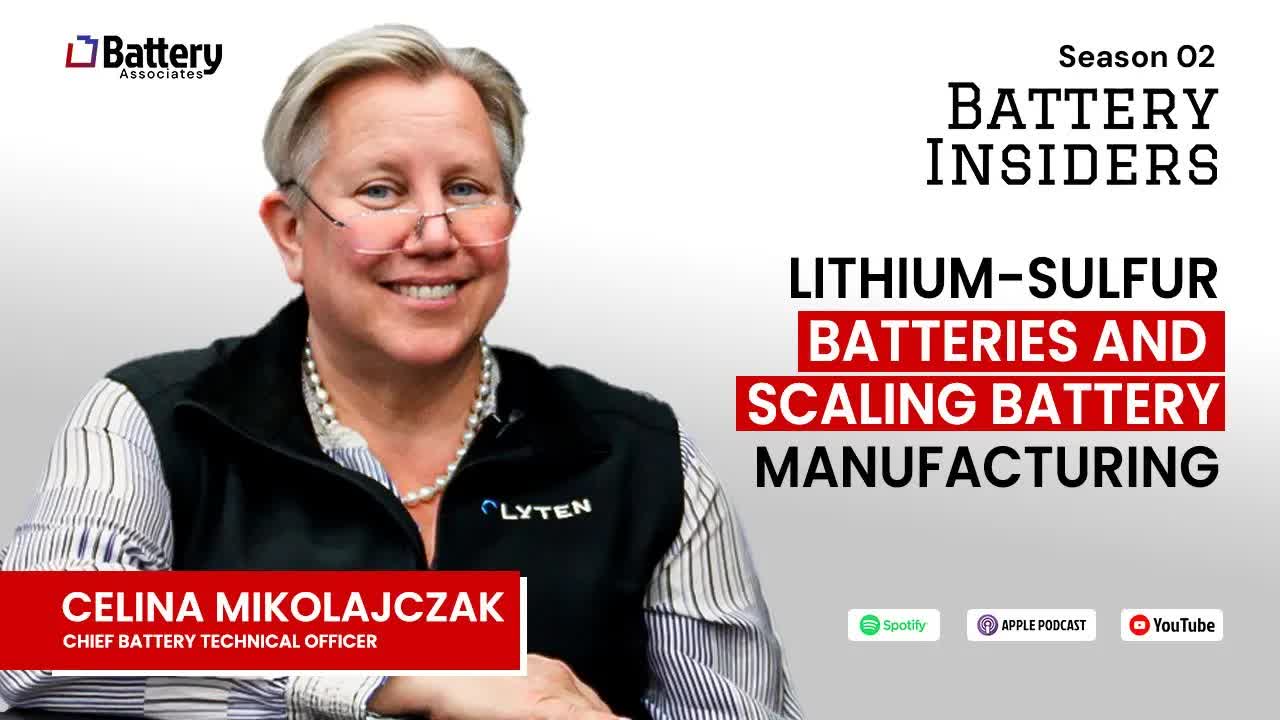
Celina Mikolajczak
Chief Battery Technology Officer, Lyten
Mikolajczak has worked on batteries for 25 years, starting with failure analysis at Exponent, then cell and safety engineering at Tesla, pack design at Uber, engineering at Panasonic's Gigafactory and a spell at QuantumScape. Lyten is developing lithium-sulfur cells.
Recorded in The Battery Show North America, Detroit
What this episode covers
Lithium sulfur has two arguments in its favour, and Celina Mikolajczak makes both in plain terms. The first is energy density: the chemistry has a roadmap to roughly twice the gravimetric energy density of high nickel cells. Lyten is not there yet. It is at parity with good conventional lithium-ion, somewhere in the 200 to 300 watt hour per kilogram band, and it has been at this for about five years against the 30 years it took lithium-ion to reach the same place. The second argument is cost, because the cathode is cheap and abundant.
That cost case is what drew her to the company. She frames nickel as a hard constraint rather than a political one. There is a limited supply, getting more of it means doing environmentally questionable things, and even then the answer to whether there is enough nickel to electrify everything is not a convincing yes. Sulfur, lithium and carbon all have straightforward answers to the question of where they come from. She also thinks lithium itself is less constrained than the discussion suggests, because the industry has taken the cheap sources and has barely started on subsurface brines.
The manufacturing sections are the sharpest part of the conversation. Tolerances in cells are measured in microns and tact times in microseconds, against minutes and fractions of millimetres in car assembly. Nobody touches the cells; the machines do, at speed, precisely, every time. Scrap is where that discipline shows up on the P&L. A one metre wide coating running at 50 metres a minute fills the scrap bins in about a minute if something goes wrong, and a gigafactory can burn a million dollars of material in a day. A sustained 10% scrap rate, she says, means you are done.
She is equally direct about who runs those factories. Equipment pushing hundreds of thousands of cells a day needs specialists who know exactly where debris builds up and what maintenance each machine wants. That is high-skilled work, not an entry-level line job, and she describes cell making as a route back to craftsmanship for blue-collar workers. The same goes for the daily judgement calls: whether a slightly elevated scrap rate justifies stopping the line is a decision a factory leader makes in real time, every day.
On where the market goes, she does not expect one chemistry to win. Lithium sulfur will take the segments where weight matters, heavy trucks, aircraft, satellites and micromobility, plus the cheap end where cost decides, while high nickel and LFP keep the places that suit them and iron-air fills another. She thinks current cell prices are partly subsidised rather than real, warns that artificially low prices produce a painful correction later, and puts the long-haul floor for lithium sulfur below $50 a kilowatt hour. Not this decade, but eventually, and she does not see the other chemistries getting there.
Questions from this episode
- What applications is lithium sulfur best suited to?
- Anywhere weight is at a premium, and anywhere cost decides. Mikolajczak lists heavy trucks, aircraft and satellites for the energy density argument, and adds micromobility, where lightening the pack makes a scooter someone has to carry up the stairs far more appealing. On cost, she points to the everyday car and to inexpensive three wheelers. Her view is that lithium sulfur will always be substantially cheaper than nickel and LFP chemistries because the supply chain is simple and sulfur is cheap, which is what makes electrification at the low end of the market possible.
- How cheap can lithium-sulfur cells get?
- Below $50 a kilowatt hour in the long haul, on her estimate. Not tomorrow and not this decade, but she believes lithium sulfur has a path there on real bill of materials and real cost to produce, and that the other chemistries do not. She is sceptical of today's headline prices, which she thinks are partly subsidised rather than real pricing. The upside is that low prices have people considering electrifying more things. The risk is a shock when prices correct upwards and everyone ends up in a bad place.
- What scrap rate can a cell factory actually survive?
- It depends on the margin you command, but she is blunt about the ceiling: at a 10% scrap rate you cannot survive as a going business. That might be where you sit while ramping equipment, but you cannot stay there long without very deep pockets. The reason scrap rates are one of the industry's best-protected numbers is that they tell you a lot about margins. Automotive volumes leave little headroom, so once scrap starts mounting, profits disappear quickly, and a gigafactory can produce a great deal of it very fast.
- Why is the industry moving away from high nickel chemistries?
- Because of supply. She traces the pattern: consumer cells started on cobalt oxide, which worked well until the industry scaled and cobalt's conflict-mineral and environmental problems became unavoidable, which pushed everyone towards high nickel. A decade later the same question has arrived for nickel. Supply is limited, getting more of it means increasingly questionable extraction, and even then there may not be enough to electrify everything. Each time the industry optimises for one constraint it runs into the next one, which is the argument she makes for chemistries built on abundant materials.
- Does lithium sulfur have a cycle life problem?
- Cycle life is the hard part of the chemistry, and she says so directly. Lyten has been making strong progress and expects cells the market will find acceptable. She offsets that against the environmental picture: the carbon footprint of a lithium-sulfur cell is about half that of a conventional lithium-ion cell today, and should fall further as energy density rises. On recycling, only the lithium is worth much, so the economics may not always justify it, though the process is not especially hard. A lithium-sulfur cell in landfill is also a much smaller problem than one containing nickel and cobalt.
- What kind of workforce does cell manufacturing need?
- Skilled people, not line labour. Mikolajczak pushes back on the idea that automation removes the need for workers. Equipment running hundreds of thousands of cells a day needs specialists who understand maintenance, know where fine debris accumulates in each part of the machine, and know what to do about it. She calls it craftsmanship and sees cell making as a chance for blue-collar work to return to that standard. She also stresses that you cannot learn a cell factory from papers or conferences. You have to work inside one, under the pressure of production that never stops.
Listen to this episodeWatch on YouTube
Part of Making cells at scale
Transcript
About this transcript. Generated automatically from the recording, then corrected against a glossary of company and guest names. It has not been checked line by line. Machine transcription mis-hears technical terms, numbers and names, so treat any figure here as a prompt to check the recording rather than a quotation of record. Spotted something wrong? Tell us.
0:00Introduction
Dr Simon Engelke
0:00Welcome, everyone. Thank you so much for joining us for the Battery Insiders podcast here live from the Battery Show North America in Detroit. And I'm extremely delighted to have a fantastic guest with us today, Celina Mikolajczak, who is the Chief Battery Technology Officer at Lyten. And yeah, today we're going to talk about sulfur technology, sulfur batteries, but also quite a bit more than that. My name is Simon Engelke, and I'm the founder and chair of Battery Associates. I'm extremely excited to be joining us for today's conversation. So, Selina, wonderful to have you. Well, thank you so much for inviting me. Absolutely. And I mean, really, one thing is, you have been involved in a lot of different technologies. Quite a few things. I think not that many people can say that. All the topics you've looked at, you know, best, lithium-ion batteries, and solid-state, and our sulfur lighting. We could share a bit about like your perspective on these different topics and
Celina Mikolajczak
1:03some of the milestones you have seen. Sure. I've been doing batteries for 25 years. That's why I've done a bunch of things. I've kind of really grown with the industry and worked as the industry has grown on, you know, the topics of the day, which is really quite a, you know, luxury and a pleasure, right? I started in the industry back in late 1999, early 2000. At that point, lithium-ion was really seeing, you know, massive growth into laptops, right? And then into cell phones, but they weren't really into cell phones yet, right? A lot of questions about battery safety and about quality and safety and, you know, battery failure at the time. I was working at Exponent Failure Analysis. I started doing failure analysis on batteries, and, you know, there wasn't anyone to teach me how to do that, right? This was just a need that had come up from the industry. So I spent, you know, a decade doing that, right? And
1:56Twenty-five years of battery failure analysis
Celina Mikolajczak
1:57in that time frame, cells evolved. When I started, there was prismatic, small prismatics, and there were 18650 cylindricals. And when I left Exponent, most of the consumer electronics guys had moved to pouch cells. That was super hot. And cylindricals seemed to be like, you know, in kind of their failure going down, except I went to Tesla, where we started using only, where we were only using cylindrical cells, right? And then watched as cylindrical cells came back into favor as, you know, Tesla ramped Model S and then Model 3 and Model Y. So I've kind of seen, you know, work with the industry and really been focused on where the big problems are. That's where I've gone to. So when I started, it was consumer electronics, the failure side, then I went to Tesla, because I was starting to see the same problems over and over again, right? And it wasn't that interesting. And then here comes Tesla. And now the challenge becomes, can you take something that you developed for consumer electronics that had maybe a three to five year life? Would you take it to eight to 10 years or longer? Would you make it into a car and imbue the car with the safety systems to make it really safe, right? To the point where, you know, I've got a car at home, I've got a Model S that's vintage now. I've got a Model Y that's newer. And I got three power walls in the garage. So I probably have about 200 kilowatt hours charging in my garage every day. And, you know, I've burned a lot of cells. I've done a lot of safety testing. I'm calm. I'm like, yeah, I'm good with all that in my garage, right? That comes from all the, you know, all the work we did on quality, on safety testing, on understanding what causes failure and mitigating that to make really a car that works. And that's compelling. And, you know, really drive the industry to say, yeah, we can make electric cars, right? So, and, you know, when I started at Tesla,
3:57Building a supply chain that did not exist
Celina Mikolajczak
3:58a lot of people thought this thing was never going to work. You know, I could read the press every day and there would be boosters that said, yeah, you know, electric cars are coming and other people saying it'll never happen. It's a total scam, right? And, you know, just watching that press going back and forth, back and forth, and then seeing the community. I mean, we had to really create the supply chain out of nothing, right? We would go, you know, see suppliers for parts for our electric car, and they weren't necessarily even automotive suppliers, right? Or they might be automotive suppliers and we'd tell them what our volumes were and they'd be like, so, so is that per month? And we'd be like, no, no, that's for the whole year. And they were like, wow, you're a really small time, right? And just don't even want to talk to us. And then, you know, sitting here today on the Detroit Battery Show, I mean, I've heard there's 11,000 exhibitors and 19,000 people. Unimaginable in like 2012, right? A little more than a decade ago, you know, no one was going to talk to us. And we were creating these suppliers. And here now we have this massive industry that's really focused on electrification and EVs. So big changes. You know, I was a Tesla for quite some time. I wanted to do more. So I went to Uber and I design battery packs with a team for, for micromobility and for aircraft and got a taste of being a pack designer, which was different and interesting. Uber divested itself of that hardware business. Okay. I went to Panasonic to the cell factory and ran engineering at the Gigafactory, which is an education that, you know, anyone that's doing cell making or wants to do cell making, you need to go get that education, right? Because what you learn in a full-scale,
5:53What you only learn inside a cell factory
Celina Mikolajczak
5:53high-speed cell manufacturing facility is, I think, impossible to learn from reading papers or attending conferences or, you know, from any kind of other background. You have to live it, be inside the factory, feel the buzz, feel the pressure of the fact that it's going 24-7. It does not stop. You do not to get to stop. You might slow some things down. You might stop a machine. You might have to like fix some stuff, but it's all under that pressure of continuous production, right? And that if you stop, you're never going to get those production days back again. You will never recover that revenue and you just lost your profit margin, right? So, you know, that pressure, that ongoing dynamicism that the factory doesn't go to sleep, the problems don't stop at 5 p.m., right? They just keep going. And how do you put a team together that addresses that? How do you keep that going? Some of it comes out of your cell design, right? Because your cell design has to be fundamentally manufacturable. And then you have to have the equipment that's going to run, and it's going to run continuously for years at a time. And yes, you're going to have to maintain it periodically. You'll have to take it down. You'll have to put up other equipment. But again, you can't stop, right? That continuous nature of the whole manufacturing process, you can't really get it until you live it, right? And you live under that pressure. Once you do, you start looking at the world a bit differently, you know? And when, you know, and I came back to the Bay Area and I went to QuantumScape and worked there for a bit, then I came to Lighten to do lithium sulfur. And, you know, the reason I came to Lighten was I looked at this chemistry and I said, okay, this thing solves some of the big problems we're having now, right? It solves our supply chain
7:51Why lithium sulfur, and the nickel constraint
Celina Mikolajczak
7:52problems. And, you know, you can say, well, there's the Chinese geopolitical problems. Yeah, that's fine. That's one problem. But there's also the fundamental problem of there's a limited supply of nickel. And to get more of it, you have to do some increasingly, you know, environmentally questionable things, right? And that's a problem. And then even if you do those environmentally questionable things, even then, do you have enough nickel to really electrify everything? And the answer is not a convincing yes. The answer is more like, no, not really. So, you know, when I look at lithium sulfur, I'm like, wow, this is a technology that, okay, I can make it on standard equipment. I can foresee running this in a real factory. The price is going to be lower. So this is a candidate for electrifying everything. And I don't have a raw materials problem, per se. I'll have plenty of challenges. I'm going to have to scale a supply chain just like anyone else. But from a fundamental perspective, where do you get sulfur? Where do you get lithium? Where do you get carbon? These are straightforward answers. And they're not, they don't create a whole environmental problem at the same time, right? So, you know, it's been a really interesting journey, but it's, it's been a journey toward the harder and harder problems or the problems of the day, right? Because, you know, once people figured it out, then you're like, then you're just kind of doing stuff over
Dr Simon Engelke
9:23again. And then it's boring, right? So I think what I can tell is you're a problem solver. That seems to me to excite you, which I very much can relate to. Yeah, I mean, definitely people like you to address these challenges and going there. And I think what's kind of interesting how you cross pollinated, I feel like, a lot of these different industries, right? I mean, bringing your expertise
Celina Mikolajczak
9:43into them. So I think that's super fascinating. Well, it's kind of, it's kind of fun to do something
9:47What every chemistry has in common at scale
Celina Mikolajczak
9:48multidisciplinary like that because batteries are very multidisciplinary. They always have been, right? People like to say, oh, you know, I went, I want to go study electrochemistry and that's great. But the electrochemistry in a battery is only one starting point. There's all these other things and you have to take that all in. And isn't that the most fun problem when you have to take all the experience from all these different areas and bring it together? That's a fun problem.
Dr Simon Engelke
10:14And maybe now if you just think about that, right? So we mentioned these different technologies you've been working on from lithium-ion batteries, to also a bit of a look at solid-state and our sulfur. Are there like some common topics or is it like, you know, common challenges and scale up and manufacturing or is it all quite different?
Celina Mikolajczak
10:35There's a lot more commonality than you think. Okay. They are very different technologies. But some of the questions still remain the same, right? The scale is huge, right? So you really do have massive supply chain. You can't be thinking in small amounts, right? You have to be thinking in these large amounts and face into that abyss, right? Because, I mean, we're talking about electrifying, changing our basically our transportation infrastructure out of a petroleum-based industry industry into an electric industry. If you think about the scale of that and really start looking into it, you realize, wow, there's a lot to do here. There's a lot. So the scales are huge. The factories are daunting, right? You walk in and you're like, you're just taken aback at how big everything is, right? So that's a big piece of it. The other thing that is true for all these chemistries, the tolerances are very, very small. So in batteries, you measure your tolerances in microns,
11:43Microns, tact times and how cells differ from cars
Celina Mikolajczak
11:44okay? And to produce its scale, you measure tact times in microseconds, right? So, and why does that matter? Well, you know, in the automotive industry, right, when you make cars, right, you know, a car or frame or a piece of thing comes into a station and then people like jump on it and work on it and do some stuff and then it moves on. So your usual tact time is something on the order of like a minute, minute and a half, maybe, you know, but your tact times are in minutes or fractions of minutes, right? And your tolerances, you might measure in fractions of millimeters, right? Like to make sure that all the fit and finish of the car is right. So that's, that's kind of where you're working. When you go to cells, you can't touch the cells anymore. You have to have the machines touch the cells. They have to do it at speed and they have to be entirely precise every time. And that's true, whichever chemistry you go to, right? So that's what makes it so hard. And that's what makes it so different from all the other manufacturing that we're kind of used to thinking about, right? Like, you know, for a long time, I think a lot of people have in their minds, the old idea of a factory, there was like a Lucille Ball episode, right? I love Lucy episode where she and the other one are packaging like candy or doing something with candy. And you see the, like a assembly line and they're touching, right? For a lot of us, that was in our mind for what a factory is. And the reality of a modern day factory, it's very different. And a cell factory is really, really different.
Dr Simon Engelke
13:18That makes a lot of sense. And I think also very important to, to educate people, people on that, right? And I think people are understanding what a factory of today is and also what it might look like in the future.
Celina Mikolajczak
13:26Yeah. Yeah. I think a lot of people are like, well, you know, it's not, not manual anymore. You're not going to need these workers. It's like, no, no, no, no, no. When you have equipment that's pushing hundreds of thousands of cells through it every day, you need equipment specialists.
13:40Cell making as skilled craftsmanship
Celina Mikolajczak
13:41You need guys that really understand maintenance and they understand where, and they understand, okay, you know, if I push a hundred thousand cells through here, I'm going to have where in this location, this location, that location, I'm going to have debris. That's just, you know, little fine dust that just builds up every bit in this location here and there. This is what I'm going to have to do to take care of this machine. That's high-skilled labor. That's, that's not entry-level, you know, hire a guy at a high school, put them on the production line thing. This is craftsmanship. And, and I always view it as, look, cell making is an opportunity for the, you know, middle-class and the blue-collar worker to come back to craftsmanship, to come back to a level of expectation of the job that is not, you know, at some low level, anyone could do it, but it's a level of, you know, real pride, right? Which, you know, it's kind of different than most people are thinking about.
Dr Simon Engelke
14:40I fully second that. And yeah, we have a few initiatives on this regard, so I couldn't, I couldn't speak a little more. Another topic, we get a lot of questions about the scrap race.
Celina Mikolajczak
14:48Oh yeah. Oh my God. Yeah.
Dr Simon Engelke
14:51It's like one of the best, you know, protected data point, it feels like in this street, but the one everyone wants, no one talks about. So maybe I don't know if you can share a bit of, you know, perspective on this, like what is good, a great scrap rate? Like where are we today? Things like that.
Celina Mikolajczak
15:09Well, it depends, right? It depends who you are and depends what you're making. I will tell you that if you have a lot of scrap, you will not be profitable. Okay. Like really not. And then, you know, what's a good scrap rate? What's a bad scrap rate? That depends on the price margin that you're commanding with your customer, right? If you're, if you've got a big margin on the sell, sure, you can have a big scrap rate, right? But if your margins aren't that big
15:39What scrap does to margin
Celina Mikolajczak
15:39and you're working at volume, which is really where the automotive industry is, right? They're not making boutique sales. They're making millions a day, right? If you're making millions a day, you don't have huge margins on that. You're doing this in volume. If your scrap rate starts mounting, your profits start disappearing in a heartbeat, right? And it's also, it's just a lot of physical scrap, right? If you, you know, if you think about it and you say, well, I've got a coating, all right? And my coating's a meter wide. Okay. And I have a bunch of cathode on it and I, you know, and it's a meter wide because I'm going to slit this down into pancakes, right? Okay. How, how quickly am I going to fill up my scrap bins if I let 50 feet of this thing go by without, with a problem? And it goes by at, you know, 50 meters a minute, right? So if I let it go a minute with some big issue that I have to then cut that out, I filled my scrap bins, right? Now, is this huge money relative to what you're doing every day? It doesn't matter. It's still huge money, right? You look at that and you're like, wow, I really don't want to do that, right? So, yeah. So, you know, people are protective of the scrap rates because it tells you a lot about their margins. Okay. And what they're allowed to be, right? But, you know, I can't, like, you cannot survive as a going business. If your scrap rates are like 10%, you're done. You're not, never going to happen, right? Okay. So that's just like a non-starter. Now, that might be your scrap rate when you're ramping up the equipment and you've got all kinds of problems, but you can't be there long, right? Because, you know, the other thing about this is let's assume you've, you're scrap that one meter wide, you know, 50 feet or 50 meters of this thing, right? Well, that's a lot of money.
17:37Stopping the line, and factory energy use
Celina Mikolajczak
17:38It's straight up, right? So if you don't have revenue to back that up, you're out of business in a heartbeat, right? So this is where everyone's trying to knock the scrap rates down because in a gigafactory, you can make a ton of scraps so fast and it'll cost you a million dollars in a, in, you know, a day or something, right? You're like, oh my God, right? So you, you know, that's where you work and that's where some of the pressure comes too, because, you know, let's assume you've got some equipment that isn't working quite right. Are you scrapping the material? Are you not? If you, if you're scrapping a lot of it, you'll shut down the line. If you're scrapping a little bit more than normal, should you still shut down the line or should you keep running and take the scrap fit? And this is where the factory manager, the factory leader is making these decisions in real time
Dr Simon Engelke
18:26every single day, every day. So. And as you said, right, we have seen, especially the ramp up can be terrible, the scrap rates, right? Going to 50, 80, whatever percent.
Celina Mikolajczak
18:38Oh yeah. I've seen it all. Oh yeah. So you can't live there for very long. Like.
Dr Simon Engelke
18:42Oh, you need really, really deep pockets. Yeah. Yeah. I think it's a couple of things on that. Um, another topic also, um, looking at sustainability, right? I think it's a big topic, especially in European markets, but I think also over here, efficiency, right? Like energy requirements, monitoring, things like that. Is anything interesting you have seen in this regard? Is there any evolution you have seen?
Celina Mikolajczak
19:04I mean, I think people are thoughtful about this. Um, people in the battery space have been thoughtful about efficiencies for a while because again, you're, you're working with margins, right? If you're, if you're using too much electricity, you're taking that right out of your profits, right? On your factory. And, and that can be substantial, right? So people have been thoughtful. Um, but there's, you know, there's continuing ongoing pressure with the materials people are using.
19:34From cobalt to nickel to the next constraint
Celina Mikolajczak
19:34I mean, when I started in the industry and all the cells were consumer electronic, they were all cobalt oxide based. Okay. It was a great chemistry. Oh my God. It was fantastic. Right. It helped in so many things, but it's a conflict mineral and you can't get that much of it. Now, when lithium-ion batteries were starting out, no one thought too much about it because cobalt was kind of a by-product. And so it was reasonably achievable that no one was worried about it. But then as the industry grew, suddenly people were like, wait, we can't have this cobalt or we're creating these terrible environmental conditions, these social conditions. So people start moving away from cobalt, right? And that's where you got the high nickel chemistries. So suddenly then, you know, I started a Tesla and CA, there was a little teeny bit of cobalt in there, but mostly it was nickel and aluminate. All awesome. Great. We solved the cobalt problem. Great. You know, a decade later, we're looking at this and going, ah, there's not enough nickel, right? So now we've got to go solve that problem. So you, you kind of see the continuing evolution as the industry scales, as the demand goes up relative to, you know, the materials that are
Dr Simon Engelke
20:44out there. So that's pretty cool to see. That's also maybe one thing, right? When you optimize for one topic, because now, right? I mean, another topic is LFP, right? Which also Tesla and others, they have pushed really strongly, right? Then we've replaced nickel. Yeah. Then others, even I've seen China, a lot of development in India and other regions on sodium, right? Yeah. Really keep replacing all kinds of things. Yeah. And like, if you like bring in a new technology like sulfur, right? Where you optimize one thing, but the market is also continuously shifting, right? Like your, your reference, your peers are shifting too. Yeah. So I think how you stay like, you know, as relevant, give you an example, right? Because I've seen with sodium-ion, all the reasoning or like all the argument for it was cost, right? Yeah. Remember the days when people are like, oh, sodium is going to be cheaper. And now we're in this interesting position where suddenly sodium is not cheaper. Actually, the LFP is cheaper. And suddenly the story is all about, oh, but this
21:33Sodium ion, cost stories and lithium supply
Dr Simon Engelke
21:33might be safer, like supply chains, you know, like more robust and things. And so it's interesting to also see how technology, the story around change. And honestly, I started my career on sodium-ion. I think there's still a place for it, right? So, and, but the story is different than what it has meant. And maybe it's cheaper again in 2008 when the lithium price goes up and all these things, right? So I guess just from your perspective, like even as a sulfur, right? Because now you mentioned you can just do, we replace the nickel topic and so it will be a high performance. Yeah. But do you maybe think one day, you know, sodium-ion becomes a big topic, you need like sodium sulfur?
Celina Mikolajczak
22:06Or? No. You know, here's the thing, like lithium sulfur is appealing to me because it really is the cheapest, right? The cathode is incredibly inexpensive, incredibly abundant. Lithium, I know people talk about lithium as supply chain, but I really think as a, as a community, we haven't really started tapping real lithium supplies. We've gotten the really cheap ones, like, you know, out of the, out of Camo Plateau, you know, where like the sun and the wind do half the work for you. But I really think subsurface brines are an answer there that's going to be, if we pursue it cost effective, should drop the price of lithium substantially, should stabilize world lithium supplies. It's going to take someone to decide to do it. You know, people ask me, well, why haven't the oil companies done it already? I would think the oil companies would want to do it. I've heard that, you know, they're like, well, the profit margin isn't that big compared to doing oil. And I'm like, well, that's a problem, isn't it? But this should be fixable is what I'm saying, right? And this should be something where lithium should be very abundant as a raw material.
Dr Simon Engelke
23:19And do you think like, cause now you have seen quite a few different chemistries in your career. Do you think we need a different chemistry? Like, or do you think like they're going to be another chemistry which really going to, you know, change the entire market?
23:31Which chemistries survive, and where each fits
Celina Mikolajczak
23:32Well, so I've seen a bunch of chemistries come through, right? I mean, you know, when I was starting, the cell phones were still nickel metal hydride based batteries, right? And, you know, we still saw some of those in laptops and, you know, that was what was in cars. That was the Prius, right? And the power tools were still using NICADs. And, you know, cadmium is another one of these things that we'd really rather not have running around in our communities, right? So we've seen that kind of evolution, right? And I think battery chemistries do evolve. So like I look at lithium sulfur coming in, it's not going to displace high nickel chemistries. People will still use high nickel chemistries. People will still use LFP. Sulfur will take another big chunk of the market where it's really well suited. Those other chemistries will stay where they're well suited. And, you know, it's going to be about cost and performance, the usual things, right? There's not that many other chemistries left out there, right? You know, when you look at the electrochemists, what do you get to get high power? People talk lithium air. Challenging, really challenging. You know, when you talk about lower energy, lower performance, lower energy density chemistries like LFP or, you know, the iron, iron-air batteries that Form is doing, they'll have a place to, right? As we electrify, you know, but they're going to, they're just going to have a different place in the market, right? Where you're going to want to do those things. So I feel like, I don't see us, I see us just expanding the market, having more needs, more variety of needs and developing chemistries that fit those needs well. And then continuing that expansion.
Dr Simon Engelke
25:26And also, I think there's a lot, I think one thing I really always amaze me to be,
25:29Aviation, micromobility and power for AI
Dr Simon Engelke
25:30you mentioned earlier, it'd be places in here where you see all of these companies doing all kinds of things. Even like if you maybe do like a filtering here, maybe it's 90% lithium iron or something. And all of them have place, right? Optimizing their specific topic.
Celina Mikolajczak
25:45Yes. And we hope all of them are profitable, but you know, but they're all like legitimate business interests and it's thousands, right? So there's so much there. You know, people like, oh, it's just electrification. I'm like, no, no, no. You're talking about the entire transportation sector for the world. That's a lot there. A lot.
Dr Simon Engelke
26:09And even going aviation and topics, which also have been quite interesting with so far, I remember quite a few approaches have been on these application requirements.
Celina Mikolajczak
26:17Yeah. Anywhere where lightweight is at a premium. So aviation, satellites, you know, even like micromobility, when you've got a heavy battery pack and someone wants to take a scooter up the stairs to their apartment. Well, if you lighten up that battery pack, it makes that scooter a lot more appealing. Right. You know, so there's lots of things like that, that, that we're going to see, but we're going to see new applications too. I mean, people are talking about, you know, applying electrification to ships and, you know, watercraft and a lot more stationary and, you know, and then there's this whole AI revolution that's going on that takes huge amounts of power. And the only way people are really going to do it is if they can use renewables. Well, you don't just use renewables, you use renewables plus battery. So which chemistry is going to be great for that? Well, whichever chemistry is going to be great for that, that sector is going to suck up all those batteries, right? And it's going to leave another big hole where something has to fill. So there's a lot of this going to be happening.
Dr Simon Engelke
27:20And maybe for our listeners, right, you might be curious about SOFR and like, what's your pitch? Like which application do you think are like best suited for sulfur batteries?
27:28The pitch for lithium sulfur: weight and cost
Celina Mikolajczak
27:29Yeah. So lithium sulfur has really two, two big wins to it. The first one is it has a roadmap for energy density that gets it to twice the gravimetric energy density of high nickel chemistries, right? So are we there yet? No, but we're getting close. We're, we're at par with conventional lithium-ion, like good conventional lithium-ion. We're roughly numberized. So like, you know, in the 200 to 300 watt hour per kilo, right? So we're making those cells today. And we've been at this like five years. Okay. That's taken 30 years to get to in conventional lithium-ion. So we've got a lot of low hanging fruit and roadway ahead of us, right? So you're looking anywhere where energy density matters, which means weight, weight versus range, right? Gravimetric, right? Heavy trucks, aircraft, satellites, all those things are weight matters. Great area for lithium sulfur. The other big benefit is cost because the supply chain is so simple, straightforward and sulfur is so cheap, right? Um, you're always going to be substantially cheaper than any of the nickel chemistries and the LFP chemistries, substantially cheaper. So you want to have electric cars for everyone. You want to have three wheelers that are inexpensive for everyone. Your cell is lithium sulfur. That's how you get there, right? So, you know, when people talk about the average price of, you know, batteries coming down, it's not going to happen with nickel or LFP. It's going to, it's because those, an analyst have been pricing in lithium sulfur into that roadmap, right? So that's, that's where you're like the everyday car, everyday person's car, that's going to be lithium sulfur.
Dr Simon Engelke
29:14Well, we just understand, right? Because we have seen this remarkable price reduction over the last year, right? Like what happened, it's just like amazing. Oh yeah. And also really, I think it took a lot of people and of course, there's many drivers and
29:24How low cell prices can actually go
Dr Simon Engelke
29:24over capacity and well-mitted and lots of things, right? But now looking at something like 50, 60 kilowatt, dollar per kilowatt hour, and people are like, whoa, what happened? You know, that was, it was a hundred, what a year ago. And of course there's carbohydrates and micro-app and these things. Yeah. Just understand like, because I was, I did some other interviews and you know, about different manufacturing processes and they were talking about, we can do 10% price reduction. Right? That's, that's our goal on, on a, to the cell. How about you, where do you think like, so far, putting it up from a cost perspective, that's a significant cost reduction. Is there like any magic number you have in your mind or where you want to get to? Or what you think?
Celina Mikolajczak
29:59Where do I want to get to?
Dr Simon Engelke
30:01Where do you think it's possible, right? From a technology perspective?
Celina Mikolajczak
30:05Long term, long term. Yeah. Long term, I think we can get below $50 a kilowatt hour. All right. I do think a lot of the stuff that you're seeing right now is subsidized. I think it is not a real pricing. And that's good and bad thing. I mean, the good thing is the price is so low. As a friend of mine pointed out at dinner, price is so low, people are considering electrifying more things, right? Because suddenly it's like, hey, wait, this is not too expensive. We can do these things, which is great. At the same time, when it's artificially too low like that, then there's a shock where the price goes up again and then everyone gets kind of into a bad place, right? So, but I think, you know, if you look at real price, real bomb, real cost to produce, I think lithium sulfur will be cheaper than everything else. And, you know, what's that number look like? Well, right now that looks like, you know, you should be able to get under 50 in the long haul. Not tomorrow, not this decade, but long haul, yeah, you should be able to get there. The other chemistries don't have a pathway to that. Not really. If you look at what it takes to produce the materials, they don't get there.
Dr Simon Engelke
31:14Then maybe one last thing also on the stability topic, right? Which is something where so far, I think it's a lot of questions we've received. Like, what do you see on that? Like
31:22Cycle life, carbon footprint and recycling
Dr Simon Engelke
31:22life cycle, these kind of topics from sulfur compared to other chemistries?
Celina Mikolajczak
31:27Yeah. So, you know, from a stability perspective, I mean, lithium sulfur, the hard part is always the cycle life, right? But we've been making really strong strides in that. And we think we can get cells that are going to be very acceptable to the market. The other thing about sulfur is the carbon footprint for these cells is about half that of conventional lithium-ion, right? So, and that's even now, today, right? We get up in energy density, it's going to be even lower than that, right? So, the cells, the environmental impact on the cells just starts off as substantially less impactful, right? And then, you know, do you want to recycle these cells? You know, how hard is it to recycle? The thing about lithium sulfur is, you know, you got sulfur and lithium in there. And the only thing that's worth anything is the lithium, right? Which one has opportunities to recycle, right? But it's not like, if you throw, if you're throwing away these cells, and, you know, they end up in a landfill, right? If you've got nickel and cobalt in the landfill, that's a real issue, right? And you really, really have a problem with that. A lithium sulfur cell is like, it's not, you know, you're not like so freaked out about it, right? So, you say, well, can I recycle it? Yeah, you can. It may or may not be worth your time. You probably will be eventually, but then it's not, it's also not that hard to
Dr Simon Engelke
32:57recycle either. It's a lot of bucket, I would say, to NSP, right? So, I mean, also, you all know lithium in there as well, and there is approaches, and I think it has to be recycled, right? Like, from an approach and will be, but it's a big topic, right? I think where, how these things are connected, right? That people don't think about, and I really appreciate that you have this in mind as well. Yeah, yeah. That's really just the ocean flow. So, that's super exciting. Honestly, as someone
33:21Why lithium sulfur's moment is now
Dr Simon Engelke
33:22that's been following also one of your work, but also of all the, also the sulfur as well, I think it's really, I think it's one of these really interesting technologies which could unlock a few things, right? You said from a cost perspective and from an application perspective, which is, I think, you know, really exciting. I think just from a problem set to address two at the same time.
Celina Mikolajczak
33:41Yes, exactly. I'd optimize for both. Yeah, exactly. Well, it gives you that margin, right? So, you can kind of work in the space and make some mistakes because every time you try and scale a new chemistry, you run into some real difficult times. You run into some really bad scrap rates, right? You have to solve those problems. So, you've got to give yourself some room. So, it has some room to allow that development. And yeah, I think, you know, this is, this is kind of, I think we're at a point where lithium sulfur can now take off and become that next great chemistry where, you know, people have tried it on and off periodically for a while and it's not a little taken off. This is the Tom. Excited to follow this journey, Selina. I really,
Dr Simon Engelke
34:20really appreciate your time today and giving us insights for our audience of talking about sulfur, but of course, also about manufacturing, which I think are two really important topics. I want to say big thanks also for all of you listening today from the Battery Insiders podcast community. And yeah, I hope you had a really good time here hearing us today live from the Battery Show in North America, in Detroit. Big thanks also to Informa Markets for having us here. And of course, massive thanks to you, Selina, for sharing your insights. And again, super excited what you already have done. Very excited how you're going to address the sulfur topic now. Let's see what you're going to address next. But for now, really excited to see your
Celina Mikolajczak
34:55journey there. Thank you so much. Thanks for inviting me. Thank you.