
Episode 153 · 3 December 2024 · 00:16:25
Pack efficiency, transistors, and why copying China fails
Chasing Efficiency: How the West Can Compete in the global battery market
McKinsey's battery materials lead on the pack efficiency gap between Chinese and Western EVs, why anyone in cells should be targeting $20 a kilowatt hour, and what vacuum tubes and transistors say about catching up.
Read the article: Pack efficiency, transistors, and why copying China fails
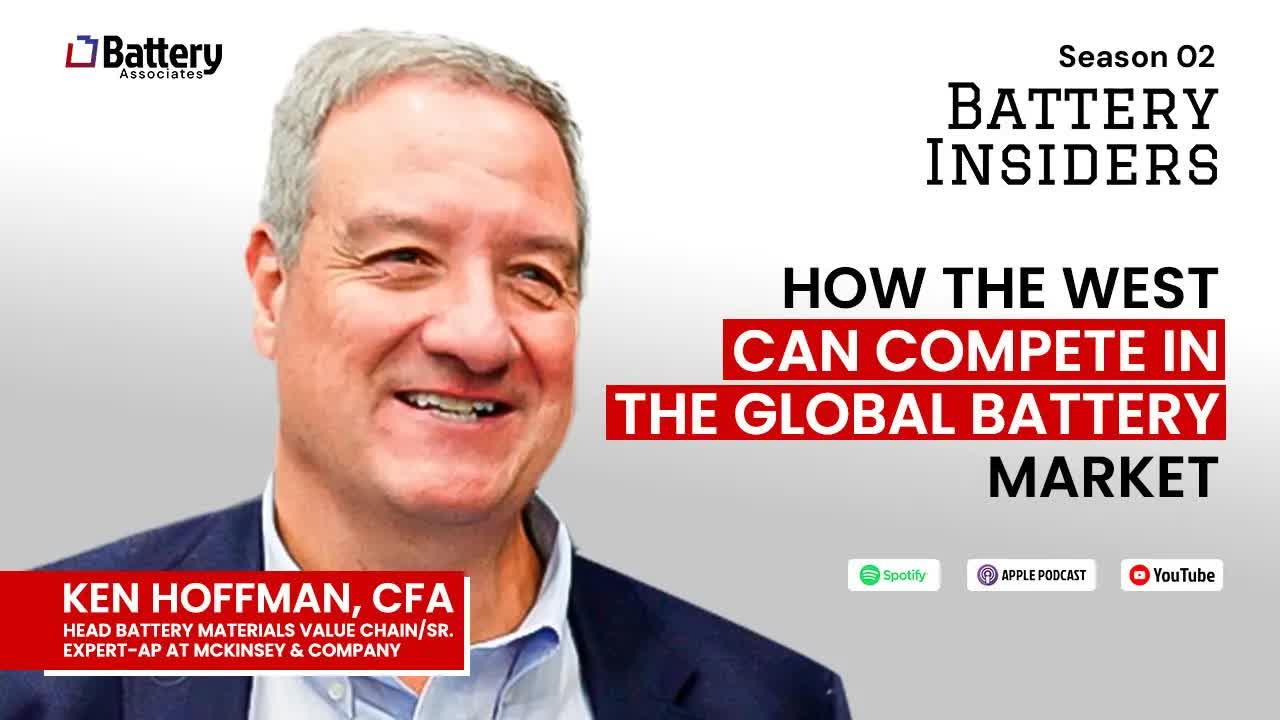
Ken Hoffman
Head of battery materials and value chain research, McKinsey & Company
Hoffman covers battery raw materials and the supply chain that feeds cell production. He spoke shortly after returning from a trip through Asia.
Recorded in The Battery Show North America, Detroit
What this episode covers
The number Ken Hoffman keeps coming back to is pack efficiency, meaning how much of the pack volume actually holds active material. Western vehicles sit in the high 40% range, he says, with Tesla in the low fifties. Cars now coming out of China are in the seventies and aiming at 80%. That is what allows 140 kilowatt hour packs, and it is why there are three vehicles on sale in China today with more than 600 miles of range and recharge times under ten minutes. Cell chemistry moved too, with LFP going from about 180 to closer to 200 watt hours per kilogram, but the pack is where the jump came from.
He thinks that forces a reset in the West. OEMs went to China planning cars for three years out with 400 miles of range and an hour and a half of charging, saw what was already on sale, and came back asking what they were doing. Price is the other half of it. BYD Seal variants with around 500 kilometres of range sell in China for roughly 8,000 to 15,000 euros, and the thousand-kilometre cars land at 40,000 to 45,000 dollars, which he thinks would sell very well on a US lease. Keeping those cars out is mostly a matter of crash testing and other administrative levers.
On whether China's lead can be closed, Hoffman reaches for history. The United States owned vacuum tubes in the 1920s and thirties. Japan decided it could not win there, bet on transistors instead, dropped cost and raised capacity, and ruled for about fifteen years until the US moved to semiconductors. His read is that you leapfrog rather than copy. That means investing in lithium metal anodes, lithium sulfur and similar variants, and it means a cost target: if you are not aiming at $20 a kilowatt hour long term, he says, you should not be in the space.
The same logic applies to refining, which he calls a gap the West has not filled. Trying to out-China China does not work, because the scale efficiencies there are unbeatable and building a copy of a Chinese plant in Iowa will not be competitive. What can work is technology that skips process steps and still lands the same product, a new membrane, a regenerative process, chemistry that does the job on a much smaller footprint. Cut capex and opex hard enough and the location stops mattering. He also notes there is no major North American cell producer and that Europe's attempt is not going well.
On raw materials, he explains the price swings as the behaviour of small markets. Lithium was a niche metal, 150,000 to 180,000 tonnes a year a decade ago, used in medicines and phone glass; this year over a million tonnes of lithium products will be produced. With no real spot market, small inventory builds snowball, which is what happened in China. Two lithium cycles have each run about 24 months, which is also how long China needs to bring new capacity on. Longer term he expects prices to fall, helped by direct lithium extraction and by deep-pocketed entrants such as Rio Tinto, which announced its Arcadium acquisition the day before this recording.
Questions from this episode
- Is the EV market actually slowing down?
- Hoffman says no, and that the opposite is closer to the truth. He expects a relatively slow few months followed by Western models that, in his words, will knock your socks off. His reasoning is what he has seen in China, where cars already deliver the two things consumers consistently ask for, range and fast recharging. Once Western OEMs reset their products to match, he expects a jump in the capability of cars sold in the West, and with it stronger demand for lithium, iron phosphate, iron manganese phosphate and high nickel material.
- Why do Chinese EVs get so much more range?
- Pack design rather than chemistry. Hoffman puts Western pack efficiency in the high 40% range and Tesla in the low fifties, against the seventies and an ambition of 80% in newer Chinese vehicles. More active material in the same space means packs of 140 kilowatt hours and the long ranges that follow. Chemistry contributed something, with LFP moving from around 180 to closer to 200 watt hours per kilogram and higher cell amperage, but he is clear that the pack is the reason LFP has come roaring back into the market.
- How much do Chinese electric cars cost?
- In China, BYD Seal variants offering around 500 kilometres of range sell for roughly 8,000 to 15,000 euros, which Hoffman calls a good price for the value delivered. At the top end, the thousand-kilometre cars are 40,000 to 45,000 dollar vehicles, and he thinks those would sell very well on a US lease given their size. He notes that tariffs are not the only barrier: cars have to be crash tested to be street legal, and if regulators decline to test them, that alone keeps them out.
- Can the US and Europe compete on refining?
- Not by copying. Hoffman says China's industrial complex has scale efficiencies that are hard to believe, so building a replica of a Chinese facility in Iowa will not be competitive. The opening is in processes that skip steps and still deliver the same product: a new membrane technology, a regenerative process, or chemistry that works on a much smaller footprint. Cut both capex and opex that way and he thinks a Western refiner can compete with anyone. He also points out that North America has no major battery producer of its own yet.
- Why have lithium prices swung so violently?
- Because lithium and cobalt were niche metals that suddenly were not. Lithium ran at 150,000 to 180,000 tonnes a year a decade ago, mostly for medicines and phone glass; over a million tonnes of lithium products will be produced this year. In a market that small, with no real spot market, even a modest inventory build snowballs, and buyers in China bought ahead because they expected prices to rise. Two cycles have each lasted about 24 months before the price collapsed, which matches how long China takes to bring significant new refining capacity online.
- What role should governments play in the battery industry?
- Hoffman wants to see more of it in Europe and North America. New battery companies are starved of capital and need help getting off the ground, and private investors will come in but want a partner. China invested in cell companies, those companies then pulled the raw materials industry along, and demand and supply rose together. He accepts that not every investment will work. The point is that early versions carry high costs and only reach economies of scale by version two, three or four, and somebody has to fund the start.
Listen to this episodeWatch on YouTube
Part of Making cells at scale
Transcript
About this transcript. Generated automatically from the recording, then corrected against a glossary of company and guest names. It has not been checked line by line. Machine transcription mis-hears technical terms, numbers and names, so treat any figure here as a prompt to check the recording rather than a quotation of record. Spotted something wrong? Tell us.
0:00Introduction
Dr Simon Engelke
0:00Welcome everyone. Thank you so much for joining us today for the Battery Insiders podcast here live from the Battery Show in North America in Detroit. Some really packed days and today I'm really delighted to have Ken Hoffman with us, who's the head of battery materials and value chain at McKinsey. We've known each other for quite some time. It's a great pleasure to have you on some of our events, which has been really fantastic. But being here today, of course, I want to talk a bit about the US lands. We're here at this event and I know you have a lot of experience on the raw materials side, but of course also more general, I think, where the trends are going. So maybe if we can kick it off kind of where we are today materials-wise, because I know the Inflation Reduction Act, there's been a lot of different topics we've been talking about for the last years, but kind of where are we standing in the United States on battery materials?
Ken Hoffman
0:57Sure. And I think to step back to where are we in batteries? I've just returned from Asia. And I think people keep asking, is there an EV slowdown? Is the interest waning? And my answer to that is absolutely not. I think it's actually the reverse of that. And I actually believe that you're going to be relatively slow for the next few months, but you will start to see some models come out in the West that will really knock your socks off. Why? In China today, there are three vehicles on the market. You can go in, put down your money and drive away that get more than 600 mile range and can recharge in under 10 minutes. And I think a lot of the Western producers who are spending billions of dollars, you know, investing into the space went over to China and, you know, I'm going to produce a car three years from now that give me, you know, 400 mile range in an hour, hour and a half recharge time.
1:55Pack efficiency and the reset facing Western cars
Ken Hoffman
1:55When in China today, you know, I can get 600 mile range and 10 minute recharge time. And they're like, guys, what are we doing here? So I think you're going to see a reset. I think it's, it's all about pack design. Uh, at the end of the day, the Chinese haven't, while they've made some improvements in the raw materials in the batteries themselves. So you've seen, you know, LFP go from 180 Watts per kilo. Now they're getting closer to 200 Watts per kilo. So I, that, that helps a bit, but it's more in the battery cell itself to increase the amperage of the cells. And it's really increasing what we call pack efficiency. How many chemicals can you put in the same space? And what the Chinese have done is we look at Western vehicles, you know, the efficiencies are in the high 40% range to Tesla of low fifties. The cars and vehicles coming out of China now are seeing in the seventies and even aiming towards 80%. That is allowing much larger packs, 140 kilowatt hour packs. Um, and that is allowing these types of ranges, which whenever we talk to consumers range and recharge are exactly what they want. And these cars deliver. So I think once you see a reset of Western vehicles, one, it's going to be a huge increase in the capability of cars sold in the West, which I think consumers will love. And from a material standpoint, that means they're going to come back and sort of demand these materials in an even bigger way. So demand for lithium, uh, demand for iron phosphate, demand for iron manganese, uh, phosphate, which I think could be the next sort of big wave of caffeine material. Um, and demand, obviously still some of that high end material is going to go to the high nickel grades. So I think all along the value chain, there's going to be some interest.
Dr Simon Engelke
3:39And of course, another one, you now spoke about range, right? Which from a consumer perspective is quite relevant, but another one is cost. And I think, especially on the European side, that's what we all talk about right now and tariffs and everything to kind of protect the market somewhat.
3:50What Chinese EVs cost, and what keeps them out
Dr Simon Engelke
3:51It was kind of, you know, getting implemented. Like how is this in the U S like what's the perspective on cost for, for batteries in the East?
Ken Hoffman
3:57Well, again, I'll go back to China. I mean, in China, you can buy some of the BYD seal vehicles, which will give you sort of 500 kilometer range. And in China, they're selling for anywhere from 8,000 to 15,000 euros. That's a nice price point for a car that delivers great value. Um, it is those upper end cars, the thousand kilometer cars. Now there are 40 to $45,000 vehicles, which on a lease in the U S and the relatively large vehicles would I think sell very, very well. So I think again, China is where everyone should look for the future of the West and they have those broad range of vehicles. And again, I think if you're sitting in the West and I've talked to a lot of the OEMs, um, they sort of, have sort of been really taken aback at how rapidly the Chinese have changed the market. And again, we all thought the change would be, all right, we're going to a solid-state battery. That's going to change everything. Or a lithium sulfur battery. That's going to change everything. I think the, the trick has been pack and the pack densities, and that's, what's allowed for the ability for LFP to come roaring back into the market. You know, in Europe, Morocco is becoming this huge base for LFP powders. Um, I think you're going to see more of a range, uh, up and down that value chain, but, but there'll be one battery that wins. There'll be several chemistries, but, but they all will have a place.
Dr Simon Engelke
5:17And do you think like from a cost perspective that, cause I mean, when I talk to my friends right in the United States and they're looking into buying EVs and then now look at, for example, I mean, I even found some cool EVs that like from China. Um, and if you have a hundred percent tariff and even then they're like, it's still cheaper than maybe an option I have here. There's like a similar spec sheet. Um, and of course there's limitations and software and everything, but, um.
Ken Hoffman
5:39Well, the main thing is they, they need to be crash tested and if the U S won't crash test them, they won't be street legal. And there are ways governments can impede the, uh, the, you know, the Chinese vehicles coming in.
5:50Vacuum tubes, transistors and leapfrogging
Dr Simon Engelke
5:50But the question is like, cause you mentioned now there's going to be some really exciting developments, which I'm very excited about. But I think just from a cost perspective, do you think like that the United States can get, the automotive industry can become, you know, at par at cost? Or is this even the goal or is it like, well, how close does it have to get that it's like really makes sense?
Ken Hoffman
6:09Well, I think, you know, people say does China have this insurmountable lead and what I keep, I'm a huge, um, history buff and I just love, you know, seeing how the world has evolved in the past. And I do think it could be an algorithm to what happens in the future. Um, you know, the U S in the 1920s and thirties was the leader in vacuum tubes. Computer technology was big. Radio technology was big and vacuum tubes was it. And the United States was amazing at vacuum tubes. Japan came out and said, I can't be the U S in vacuum tubes. They're just too good. They have too much of an infrastructure. They have everything going for them. So they went to transistors and they made a bet on a new technology that vastly dropped the cost, vastly increased the capacity. And then the world went to transistors. And for about 15 years, Japan ruled the world with transistors, but then the U S couldn't compete with the Japanese on transistors. And so then you saw semiconductors and then that sort of became the U S because. And so does China's lead, is it insurmountable? And so I think that's where you'll know. I think what you need is for these investments in these new cell technologies, be it lithium metal anodes, be it, um, uh, lithium sulfur or other different variants. I think that's where the investments could really drop costs because we always tell people, if you're not targeting $20 a kilowatt hour in costs long-term, you shouldn't be in the space. And so I think those are the investments that will, you'll see the technology change. And I think you'll see that that's, we'll give other countries the opportunity set to become big. Note that there isn't really a major North American battery producer. Um, Europe thought they had one.
7:45The IRA effect and the missing Western champion
Ken Hoffman
7:45I don't know how that's going right now, but I think what you're going to see is you need domestic industry with domestic innovation that is going to, uh, to grow up. And therefore, if you had major, you know, a CATL of Europe, a CATL of North America, who's innovating, who's coming out with new technologies, then, then you have the opportunity set to really, um, take the march on, on low cost, better, better quality vehicles.
Dr Simon Engelke
8:11I think it's been impressive to see the ecosystem. I was also getting brought together in events like this.
Ken Hoffman
8:18The IRA has had a massive impact. It really has. I mean, coming to the show now for many years, you know, we used to be in the suburban showcase and, you know, it was in one room and then next year it was in two rooms. And then last year it was out in the parking lot. And so now we moved into this huge facility here. So I, I really think the, uh, the system is it's here, it's happening. Um, but I still think you're going to need some innovations occurring, um, in other countries, if they are going to try to challenge China for that battery dominance.
Dr Simon Engelke
8:49And then, cause I think a big question we get asked a lot, and I've been looking into as well, but I would love to get your thoughts on it. Like raw material prices, right? Especially for batteries. I mean, we have seen kind of like a roller coaster of materials and lithium went crazy high and nickel and cobalt. And now it's pretty much, much more relaxed now. And people, you know, now even sodium-ion is not even financially attractive right now. And I'd get again in the future. But, um, it's like, maybe can you explain a bit to our listeners, why have we seen the price fluctuations for lithium, cobalt, nickel, the way we have?
Ken Hoffman
9:21Well, I think for lithium, cobalt, and nickel, number one, they were relatively niche metals, particularly lithium and cobalt. I mean, you think about it 10 years ago, lithium was 150, 180,000 metric tons for the entire world. It was used for medicines and for gorilla glass on your, on your phones, very niche, small areas. And then all of a sudden we saw this incredible demand increase this year, over a million tons of lithium products will be produced.
9:46How lithium stopped being a niche metal
Ken Hoffman
9:47Um, you would have said impossible years ago. So when people say, oh, we can't produce it, we can produce it. Um, but when you have an industry where one, it's so small, there's no real spot market, um, inventory build, even a little bit of an inventory build will really start to snowball. And you did see that in China where people said, oh, the price is going to go up. I better buy some inventory. Oh, well, the price is going to go up more. I better buy, you know, and you saw huge increases in inventory, not really being used. And then all of a sudden, uh, China is very good at building, uh, lithium refining capability much better than the West. And what we've seen is two cycles in lithium. They've lasted exactly 24 months where we've seen the price speak, uh, you know, go up huge and, you know, last for about 24 months. And then all of a sudden the price collapsed twice. Now we've seen that. And so how long does it take China to get significant new lithium capacity on the market? 24 months. But I think what happens long-term is the price of lithium actually declines. And the reason why I say that is there are now, uh, a friend of mine from Tesla called me and he said, he's come up with 96 companies with direct lithium extraction technologies. Um, I, I, I can't not believe that because every time I go to one of these events, there's five or six more companies I never heard of who say, oh, we have a direct lithium extraction technology. But these direct lithium extraction technologies promise a huge decline in overall, uh, capital expense of these facilities as well as operating expense. You know, you're talking about facilities going from multi-billion dollar facilities to hundreds of millions of dollar facilities. You're talking about, you know, some cases, thousand dollar conversion costs for spodumene to lithium products or, you know, $500 conversion costs from grinds to say carbonate oil hydroxide. So, so you're really starting to see huge changes as three or four of the 96 DLE technologies actually work.
11:43Deep pockets, DLE and refining in the West
Ken Hoffman
11:43And then I think you'll see a dropping of cost. And now that you have, you know, yesterday, Rio Tinto, uh, said they're going to acquire Arcadium. You're starting to see very deep pocket companies with huge research capabilities enter this industry. I really think that they're going to look for economies of scale. And so particularly in the lithium standpoint, I think you'll really see cost decline. And then could the same be true for turning manganese into manganese products for, um, NMC and LMFP? Yes. Can you see, you know, big investments in phosphate for lithium phosphate? Yes. And I think over time you'll actually start to see cost decline on the material standpoint.
Dr Simon Engelke
12:24And then you just mentioned, you know, on the mining side, but of course we also touched on refining, right? Which is also, I've had a lot of conversations here, which is also one of the massive gaps in the United States. Um, do you think that's something where the U S will move into more or what's the approach about refining?
Ken Hoffman
12:39I think if the U S is going to become a major refiner, they can't try to copy the wheel. They can't try to, to out China, China. I think China, you know, is such a massive industrial complex. Um, there's efficiencies of scale there that are just unbelievable. However, again, I think if people are looking at new technologies that skip a lot of the processes, but can still get the same product, that would be the opportunity set for companies in the West. But I don't think you can go over to China, look at one of their facilities and say, I'm going to build that in Iowa and I'm going to be competitive. I just don't think that works. But if I say I have a new membrane technology or I have a new, you know, regenerative technology or, you know, a technology that uses chemicals in a different way to be very, very efficient on a much smaller footprint, then I think you can, um, actually vastly reduce both your OPEX and your CAPEX. Then you can be competitive with, uh, with anybody in the world.
Dr Simon Engelke
13:36That's kind of like, you know, you have been, uh, in this industry for some time.
13:39Why governments still have to write cheques
Dr Simon Engelke
13:40You have, you know, been at all of these events, maybe like what are some of our things, like some of the trends you see overall and you kind of maybe hope to see maybe if we would come together again in a year's time. Um, yeah, what's my body anticipating?
Ken Hoffman
13:51Well, I would like to see an expansion of, of governments investing in this industry. A lot of the problem that many of these particularly battery companies have is they need to sort of get off the ground. Uh, and we did see China make a lot of investments and a lot of say cell companies and a lot of when those cell companies had money, then they can go to the raw material industry. And then all of a sudden you have this, uh, virtuous circle of demand, sort of, you know, bringing supply up. Um, and so I really hope that you see both in Europe and North America governments continue to make really big investments. Not all of those investments will work, of course, but when you have all these new technologies, they are very starved for capital. Uh, private capital is willing to come in, but they sort of need a partner and the government's really that partner to sort of come in and say, okay, your first variants are going to be pretty high costs, but there'll be economies of scaling your version two, version three, version four. Someone needs to kick that off. And I hope that's been started in the West. And I hope that continues. If we're sitting here a year from now and a lot of investments have been made, a lot of the stuff I'm, I'm talking to, particularly in the raw material side is, is commercial ready. Um, they're really starting, you know, the pilot plants have been running now. They're showing a lot of success. They're ready to put their foot in the ground to sort of really sort of build out commercial capacity, which will drop cost. I think if we continue to see the momentum we have currently a year from now, we'll have a lot better picture of the market. Plus I think the OEMs are very, very rapid to make changes to their vehicles. And I really start thinking, I hope a year from now, we will start to see cars with 500, 600 mile range. The announced, uh, I think you'll start to see bigger and better performing charging stations, um, which will be able to fuel these cars much quicker.
15:37A better picture a year from now
Ken Hoffman
15:37Um, and I think you'll, you'll really have the opportunity set to really see this industry instead of the slowdown a year from now, we could be like, well, oh my gosh, everything's picking up so fast. What's happening. I think that's a real possibility.
Dr Simon Engelke
15:50Awesome. Cannot wait for that. If I think for now, can I really appreciate your insights. And I also want to thank all of you listeners to the battery insiders podcast to, to share your time with us today and then hear about some of these great insights on raw materials and batteries. And yeah, this was, um, Simon Engelke, founder and chair of battery associates. Here was Ken Hoffman at the battery show in North America in Detroit, um, talking about batteries and supply chains. So again, Ken, really appreciate your time.
Ken Hoffman
16:15Thank you very much. Thanks for having me.