
Episode 155 · 18 March 2025 · 00:41:01
Twelve months to decide whether Europe has a battery industry
Trade, policy & industry growth in Europe's battery industry
T&E's senior director on why state aid in its current form does not work, what a EUR 25 per kWh production subsidy would fix, and why she is annoyed with European carmakers.
Read the article: Twelve months to decide whether Europe has a battery industry
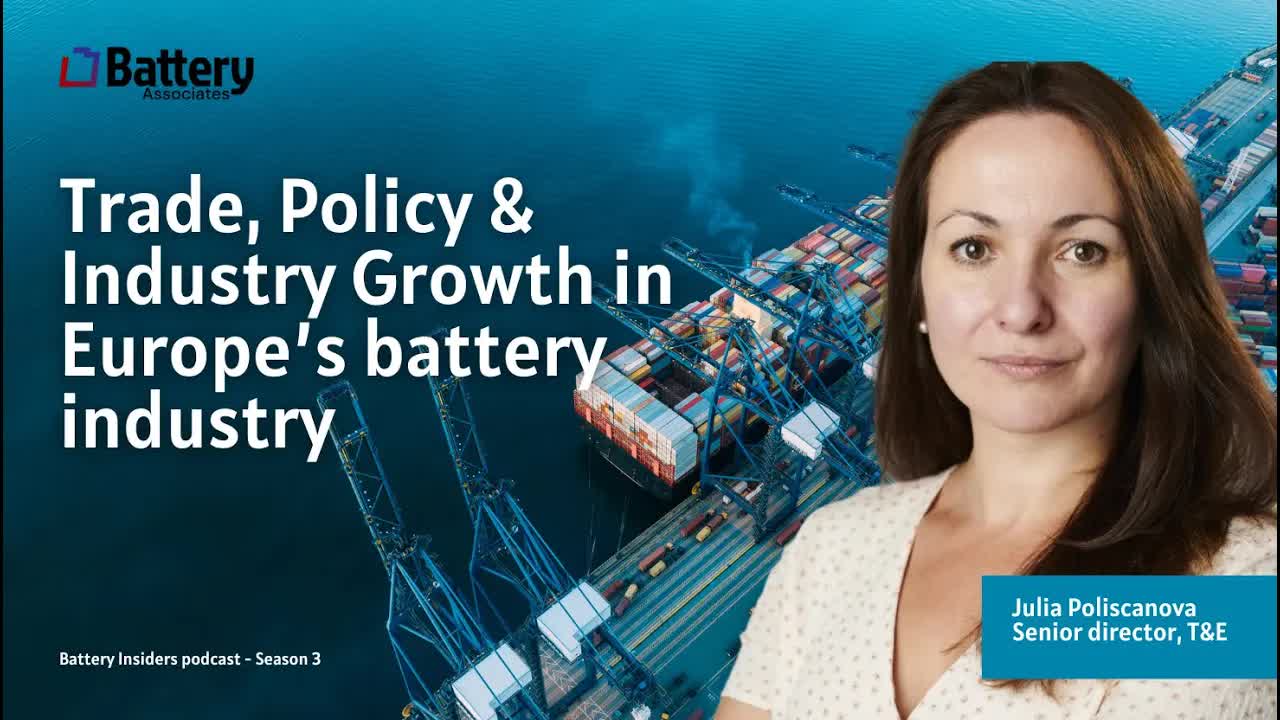
Julia Poliscanova
Senior Director, Vehicles and Emobility Supply Chains, Transport & Environment (T&E)
T&E is a European campaign group working on transport decarbonisation, and publishes analysis on battery supply chains, critical raw materials and EU industrial policy.
What this episode covers
Julia Poliscanova starts by refusing the usual explanation of Chinese success. It was not just subsidies. It was an all-in strategy sustained for over a decade across supply-side policy, demand-side policy, investment support and help abroad. Her conclusion is that Europe has to be equally all-in, and that means abandoning what she calls naivety about the WTO. She dislikes the word protectionist and thinks the era needs a new one, but the position is clear.
Her most concrete proposal concerns how Europe already spends money. The continent hands out hundreds of billions in state aid, mostly at national level, and she argues the framework is unfit for purpose: member states competing against each other rather than Europe competing globally, settled behind closed doors through per-project haggling. What she wants instead is transparent, production-based support covering both operating and capital costs. Her worked example: anyone producing a kilowatt hour of batteries in Europe gets EUR 25. Clear enough that an investor can calculate a business case before they arrive.
The structural point most people miss is who is actually building. Over 50% of European battery investment decisions are being made by European companies, and those companies are startups without the expertise to scale. That is the opposite of the United States, where experienced tier-one South Korean players dominate and know how to build a factory. Which is why she argues Europe's missing policy tool is operating support rather than more R&D money, since the early years of a factory are simply expensive to run.
On why European cells cost more, she separates three causes and dismisses a fourth. Energy is about 50% more expensive than China and 20 to 30% more than the US. Scale and yields are low because the industry is still learning and wasting material. And she rejects the cheap-labour explanation outright: it may have been true twenty years ago, but the reason Chinese factories are cheaper today is very high automation and process efficiency, which Europe can copy without paying anyone less.
Her sharpest passage is about leverage. The prevailing European narrative, as she describes it, is that we are poor Europeans at the mercy of the Chinese who must please them or lose the technology. She does not believe it. The American market is closed to Chinese companies, Chinese domestic demand is weak and oversupplied, and Europe is the only market of real volume left. That access is leverage, and it should be used to set conditions on joint ventures: local control, genuine IP and skills transfer, and requirements to use local suppliers.
She is specific about where that is failing. The Stellantis and CATL joint venture is not producing meaningful technology transfer, and she is careful that this is not because the companies are behaving badly. Nobody has asked them to, so they do not. She contrasts it with the United States, where CATL's licensing deals with Tesla and Ford hand over LFP technology that the licensee then owns and develops further.
Her timeline is the thing to take away. Europe has at most twelve to eighteen months to change policy and go all in. Do that and a successful battery industry by 2030 is still reachable. Do not, and Europe becomes an assembly plant for Asian players or simply imports everything.
Questions from this episode
- Does Europe need its own version of the Inflation Reduction Act?
- Poliscanova thinks yes, but is clear it is not primarily about the money. Europe already spends heavily, mostly through national state aid. The problem is the mechanism: member states competing with each other rather than Europe competing globally, negotiated project by project behind closed doors, which does nothing to create a business case. What she wants is transparent production-based support covering both operating and capital costs, with a published rate. Her example figure is EUR 25 per kilowatt hour produced in Europe, so an investor can do the arithmetic before committing.
- Why are European cells more expensive than Chinese ones?
- Three reasons, and not the one people usually give. Energy costs around 50% more than in China and 20 to 30% more than in the US. Scale and yields are low because the industry is still learning, which means waste. And the structural point: over half of European battery investment decisions are being made by European startups without prior manufacturing expertise, unlike the US where experienced South Korean tier ones dominate. Poliscanova explicitly rejects cheap labour as the explanation, arguing that Chinese cost advantage today comes from very high automation and process efficiency, which Europe can match without lowering wages.
- What leverage does Europe actually have with China?
- Market access. Poliscanova argues the European narrative of helplessness is wrong: the US market is closed to Chinese companies, China's domestic market is oversupplied with weak demand, and Europe is the only market of real volume. She wants that used to set conditions on foreign direct investment, particularly battery joint ventures: local control, genuine IP and technology transfer including skills, and requirements to use local suppliers so that Asian factories in Europe do not simply generate business for their Asian material suppliers.
- Is technology transfer actually happening in European joint ventures?
- Not meaningfully, on T&E's analysis. She names the Stellantis and CATL joint venture as an example where true transfer is not occurring, and is careful to say this is not because the companies are behaving badly. There is no framework requiring it, so it does not happen. She contrasts this with CATL's licensing arrangements with Tesla and Ford in the US, where the LFP technology passes to the licensee to own and develop. On China's export restrictions she makes a useful observation: the ban covers newer, more advanced LFP technology, not current LFP, which is good enough for Europe to learn on.
- Can Europe supply its own lithium?
- On paper, yes. Lithium is ubiquitous, Europe has meaningful resources, and geothermal recovery adds cleaner options beyond hard rock and brine. T&E's analysis suggests that if every project currently in development came online, Europe could be self-sufficient in lithium for EVs and storage by 2030. The problem is whether they materialise: many are pre-FID, delayed or cancelled. She wants operating support for energy-intensive refining, and European content requirements, because new local suppliers cannot win offtake against cheap Chinese lithium in an oversupplied market, which keeps them from ever scaling.
- What does she think of European carmakers' position on tariffs?
- She is openly annoyed with them. Her reading is that they behave as global players optimising global profit, buying cheap wherever possible and selling wherever profitable, which makes them naturally opposed to tariffs. She contrasts that with battery companies and other supply chain players in the same industry dialogues, who argue tariffs are what creates the case for local production. Her expectation is that carmakers are resilient and would adjust, and many are already thinking in terms of local-for-local strategies.
Listen to this episodeWatch on YouTube
Part of Europe: policy and money
Transcript
About this transcript. Generated automatically from the recording, then corrected against a glossary of company and guest names. It has not been checked line by line. Machine transcription mis-hears technical terms, numbers and names, so treat any figure here as a prompt to check the recording rather than a quotation of record. Spotted something wrong? Tell us.
0:00Introduction
Dr Simon Engelke
0:00Welcome, everyone. Thank you so much for joining us for the Battery Insiders podcast. Very excited of this first episode in the new year. And we have a familiar face with us. Some of our listeners who may remember a while back, we had Julia Poliscanova from T&E, the senior director there, with us. But it also has happened since then. So I'm extremely delighted to have you here in this online format, which is something new we're trying now again. We have been online, we have been in person, and we're back online trying different things. And Julia, extremely delighted to have you here to share a bit of a light on the latest in Europe, but also EVs and many other important aspects for the battery world.
Julia Poliscanova
0:39Hi. Hi, Simon. It's actually really cool to be back and chat to you again.
Dr Simon Engelke
0:43Fantastic. So I want to go right into it, because I know our listeners are very keen for the topics we want to discuss today. So maybe starting a bit on the geopolitical and trade dynamics topics. You know, we know that the EU wants to reduce its reliance on Chinese battery materials. On the other hand, China controls over 80% of refining. So what do you think could be some of the strategies, and how realistic are they to ensure self-sufficiency for Europe?
Julia Poliscanova
1:10I think to answer that question, we do need to understand what or why has China been successful. It's not just about subsidies. The Chinese government has had an all-in strategy on all things, from electric cars to batteries to raw materials for over a decade. Policies on supply side, policies on demand side, investment support, of course, helping abroad, etc. So they really went all in. And this is exactly what Europe should do if they want to be successful. We have to go all in when it comes to our trade policy. And in my view, stop being naive about WTOs. We should be more protectionist.
1:55Why China succeeded, and what all-in actually means
Julia Poliscanova
1:55I don't like that word. I think we should invent a new word for the new era. But we do need to go all in on trade. We do need to go all in on investment support. But we should also not throw away the core policy we have today that creates investment certainty for batteries and minerals in Europe. And that is the decision to go all electric in Europe by 2035. Because if that falters, then the entire belief or investment certainty into this value chain in Europe also diminishes.
Dr Simon Engelke
2:27Great. Thanks for sharing. And one thing we also spoke a lot about is this topic of Inflation Reduction Act, right, for the United States. And of course, there's some more recent developments on that as well, some of the challenges there. But there was this big question, right, like should the EU do something similar and risk kind of more trade regulation potentially? Or what is kind of an approach you think could be effective based on what we have seen in the past?
Julia Poliscanova
2:50So we actually do believe as T&E, and I personally am really convinced that Europe does need something like the US IRA. Now, what does it mean? It's not just about the money. I think it's important to remind us all that Europe already spends a lot of money. At European level, mostly for research, a little bit for CapEx or capital support, but especially at national level. We have hundreds of billions of subsidies, the so-called state aid, which we already give actually battery companies, for example. But the problem is that the way we do it today is not fit for purpose. We have state aid as a sort of old school framework, which is about member states competing with each other, not Europe competing globally. And it's just behind the closed doors, intransparent, per-project haggling, which really doesn't do anything for creating business case in Europe. So what we do need is, yes, we need money, but we also need to do it in a way that is this transparent production-based support.
3:57State aid is not fit for purpose
Julia Poliscanova
3:57Basically, we cover both operational and capital costs to scale, for example, battery factories, and we do it in a way that is really clear. For example, we say anyone who produces a kilowatt hour of batteries in Europe gets 25 euros. We can do the same with green hydrogen and others, but it's so clear so that for investors, it's super clear. If I come to Europe, this is what I get. This is my business case. And it will really accelerate things. At the moment, it's just too murky, too intransparent, and it doesn't work.
Dr Simon Engelke
4:29Thanks, Oshan. So I hear from this, as you said, it's broken up. And of course, also knowledge is a key there as well, right? It's not just money as one of the, but also exchange. And of course, something we also very strongly believe in. And we were trying to support through the initiatives we're running. So yeah, I think very much resonates there. That it's not just the money. Money is also key, but also working together effectively, but also knowledge exchange being important too.
Julia Poliscanova
4:51Absolutely. Absolutely. I think today we actually need to attract all the players that have knowledge in this value chain to work together, including foreign players, to scale much quicker than we have been doing up until now.
Dr Simon Engelke
5:06So we then talk about some of the more domestic industry challenges. You already mentioned a bit like how it's a bit more fragmented, right? The battery industry in Europe compared to China, which is also very vertically integrated. It's a big topic, I think, there as well. What do you think could be some policy tools which would help the European gigafactories for a true scale?
Julia Poliscanova
5:23So when it comes to European gigafactories, so generally the battery setup in Europe, it's quite important to understand its peculiarities to answer the question about policies. Today in Europe, we see that over 50% of all battery investment decisions are being made by European companies. So companies that do not have expertise and also by, at the same time, those European companies are startups. So they are struggling to scale.
5:53EUR 25 per kilowatt hour, published and transparent
Julia Poliscanova
5:54That's very different, for example, from the US where you have mostly tier one experienced South Korean players who know how to build a factory. So here in Europe, given this, and if we do want to have some of these European companies succeeding alongside South Korean and Asian companies, we do need to have a targeted tool of policies. What can it be? Well, first of all, we will have to be patient because it will take a bit of time. One thing that we are missing is something I mentioned earlier. We are missing finance support or investment aid, which is based at or targeted at scaling. We give a lot of money at research and development phase. It's good. We need that, of course, but it's not enough on its own. We give some money in terms of capex or capital, so we help you build a factory. But we don't give anything at the level of opex. And this is where we need support because at the beginning, it is just more expensive and costly to run those factories. So better opex-based or output-based support is important as a policy tool to help these companies get where, for example, Chinese players are today. But I think another important policy here today, given the speed of this, is a much better framework around technology transfer. I believe we should really get Asian and European players to work together, but have a framework where our European companies really learn from those players. Learn, especially in terms of operational expertise and scaling. How do you increase the yield in your factory? Well, you actually just need to get some people who went through this, for example, in China 10 years ago, and you don't make the same mistakes again. So to speed things up beyond finance, beyond trade protectionism as well, which I mentioned earlier, we also need, I would say, even more enforced technology transfer between Asian and European players.
7:48Half of Europe's battery investment is being made by startups
Dr Simon Engelke
7:49Again, very much resonates on the technology transfer and the partnerships there. There's also this topic, right? We have seen quite some ambitious projects being announced in Germany and France, but also others from a range of stakeholders. But we have seen quite a lot of the European factories struggle with costs. It really comes down to that. Is there like any EU level coordination or any approach you think could help in that regard?
Julia Poliscanova
8:14Yeah. High energy costs are a problem for so many industries, specifically in the batteries industry. I think it's important to dig a bit deeper and understand what's behind the high costs, right? So one part are certainly energy costs. We have much high energy costs. I think we are 50% higher than in China and still 20, 30% higher than even in the US. That is a problem. And here we do need European policies aimed at much faster rollout of renewables, including their connection to the grid, as well as various new mechanisms. For example, power purchase agreements a lot faster between battery companies and renewables to really get that capacity. So this is for sure something at European level we can do to have a much better energy single market. But it's not the only reason why specifically in battery factories the costs are high. One of the main reasons remains low scale and low yields because we are still learning. And as we are learning, there's lots of waste and we're not that efficient. So that policy aimed at faster operationalizing learning from the Asian players, as I just mentioned, all of that is actually really important. Otherwise, that learning curve will take a lot longer. And the final point I would like to stress. So a lot of people say that in China it's cheap because labor's cheap, because there are low environmental standards. I don't believe it is the case today. It probably was the case 20 years ago, but no longer.
9:45Energy, yields, and why cheap labour is not the answer
Julia Poliscanova
9:46One of the main reasons why Chinese factories are so much cheaper is high levels of automation and really incredible superior efficiency. And this is something we can also do. We don't want to pay people lower. We don't want to have cheap labor in Europe, but we can be super automated and invest in those process efficiency mechanisms and technologies. So that's also something that I think can really help. And again, where European level maybe can help to scale that a bit faster than each government would do on their own.
Dr Simon Engelke
10:18Thanks. And also maybe interesting question from the European lens on the UK, right? Kind of how they have positioned themselves post-Brexit as well, right? Potentially as a alternative also for battery investments. How realistic do you think they can compete with the EU or what could be the role there? That could be interesting as well.
Julia Poliscanova
10:36I think it's quite understandable why the UK is a lot more open to trade because they are smaller. So ultimately they become really protectionist. Some countries or companies will be like, well, why would we bother going there, right? So I understand why. But to answer your question, I believe as Europe, as the EU and the UK, we should not be competing. Instead, we should be closely collaborating and cooperating. My view is that the UK and the EU should work towards something like an EU-UK battery alliance, whereby you would treat the UK and the EU as one single market or one alliance for the EV value chain. For example, in the UK, there are a lot of projects to refine lithium. There's also a lot of projects to recycle, but not so many cathode, for example, activities or battery cell manufacturing is not as high. Whereas just across the channel in Dunkirk, you have a lot of activity with cathodes and battery cells being developed.
11:41The case for an EU and UK battery alliance
Julia Poliscanova
11:42So we can really have this one supply chain whereby batteries are produced with components from these two different regions. Then they're recycled everywhere. And the electric vehicles, quite importantly within the current trade conversation, the electric vehicles made with that are then traded tariff free between the borders. I think this alliance would really help us because in the current world, competing with the US, with China, scale really matters. So we should really try to scale and be together with allies rather than competing with everybody.
Dr Simon Engelke
12:16Interesting proposition. I think it's interesting to see how this develops. Looking more on supply chains and also on potential alignments, right? So there's in Europe, we have our EU, we have the Critical Raw Materials Act, which has quite some impact on the battery sourcing. And also, you know, do you think it's enough for kind of reducing dependency on imports, which we spoke about earlier?
Julia Poliscanova
12:38So the Critical Raw Materials Act is something my team, myself, our organization spend a lot of time on. And I would say that on paper, as the law, it's actually pretty good. So maybe just as a reminder for listeners, so what it aims to do is, most importantly, it aims to really scale and develop the local capacities in Europe in terms of mining of critical minerals, their refining, processing and recycling. It's a little bit weaker, in my view, on the international side. So the focus is really domestic. So on paper, it's good and it has targets or benchmarks for all of this. For example, Europe wants to process at least 40% of all the minerals domestically by 2030. However, and it's a big however, what we really don't have at the moment following the agreement of that law is, one, money, so that the money doesn't come with that act. And that's very different in all the other jurisdictions. In Australia, in the US, for example, in Canada,
13:38The Critical Raw Materials Act: good on paper, no money
Julia Poliscanova
13:39there's money that comes with that idea to develop local resources. What we also lack, I have to say, is speed in implementing this. We are having a very complicated bureaucratic system to select strategic projects that's been going on for six months now. Well, if we can't even select a strategic project, how can we ever get it off the ground? So I think that's been quite frustrating for us as T&E. And finally, just to add that even though the act has a lot of those targets, they're not binding on anybody. So it's not actually clear who is responsible. So say we don't meet the refining or the processing target. What happens? And if no one is responsible, sometimes it means that no action is taken. So I would really urge those, you know, if someone listens here who actually has the power and is implementing the Critical Raw Materials Act, let's act. You know, it's not enough to write something. It's actually about doing.
Dr Simon Engelke
14:34Yeah, and you already spoke about earlier a bit about the story of lithium refining as well, that there's in Europe some development, also in the UK. But of course, there's also the topic of mining, right, which kind of also touched on, which is quite a bit of a bottleneck. And yeah, just curious from your perspective, do you think European lithium productions can scale up in time or any thoughts on that?
Julia Poliscanova
14:55So actually, lithium is one mineral of which Europe has in abundance. Generally, lithium is ubiquitous. It's one of the interesting features about lithium. And especially now, because we discovered that we don't only have to recover it from either hard rock, like in Australia, or brines, like in Chile. We can also do it from geothermal resources, of which Europe has quite a few. And that's where we have even more innovative and cleaner projects in Europe. So we have a lot of potential. Actually, our analysis shows that if all of the projects that are in different stages of development came online, Europe can be self-sufficient in lithium for the demand from electric vehicles and batteries for storage, right?
15:40Europe's lithium, and whether the projects will happen
Julia Poliscanova
15:41So it's by 2030. So the potential is there. But indeed, as you said, Simon, the problem is that, or the question is, will those projects actually materialize? Some of those projects actually are mining and refining together. So it's already a combined integrated project. Sometimes it's just mining. Sometimes it's just refining. So it really depends. But a lot of those are not yet at the stages of the final investment decisions or are even being canceled and delayed given the current economic dynamics in Europe, for example. So if we don't have a much stronger set of industrial policies to support those projects, they won't happen. And I will mention two policies at least. So the first one would be a bit like with batteries, much better financing for those projects. And a lot of those projects, especially refining projects, they're energy intensive. So they do need OPEC's support to be competitive with the regions where energy is cheaper. So this is number one. But the second important policy is actually to have some sort of European preference or local content requirements to require various, for example, battery factories in Europe, Asian factories, to use those local materials. Because the problem today is, understandably, these new projects are struggling to scale. They're more expensive. And they can't get offtake. Because it's so easy in the current oversupplied market to simply source lithium from China. It's simple. It's cheap. So unless you have to source it locally and help that local supplier, you won't do it. And you're in a constant vicious circle. There is no competitive supply in Europe. So your supply is supplied it from elsewhere. So that supply never develops locally. And we need to break that. And actually, the recently published clean industrial deal in Europe is quite promising in that regard.
17:36Local content requirements and breaking the vicious circle
Julia Poliscanova
17:37Because for the first time, it does talk about creating some sort of European content requirements. And that can really help a lot of those companies, including lithium refiners.
Dr Simon Engelke
17:48Great. And of course, in the end, as you said, the challenge also costs. So I think that's something that has to be bridged. Because, of course, the customer maybe doesn't want to pay more for lithium in the beginning. But, of course, battery passport and things, they're connected. Maybe a question also on other battery materials. And, of course, a lot of them come from African countries. Which is then also a bit of a question. Is there a new dependency which would come, right? If that's in African countries for these materials? Or do you think that's a more sustainable diversification strategy? Or what's kind of a good approach there?
Julia Poliscanova
18:20I think us being more proactive in nations, African nations, for example, and some others in Asia, is a very smart diversification strategy. The reality is that today, China is an undeniable leader in most of those minerals. And that will continue. They will have a large share. I don't believe that suddenly we'll switch 100% to African minerals anytime soon, right? So, and our mines in Europe will take time. Whether we like it or not, they will take time. Look what's happening in Serbia. We just don't know. People don't want them. So in this environment where we are struggling to get our supply of the grant on time, and we only have one supply of China, in my view, the best strategy is to diversify and go to as many other different suppliers as possible to have more leverage in the market. So African nations, I think, is a great example. It's just really important that it's a more equal, balanced partnership where we can help them with technology, for example. We can help them with some downstream developments in their country, clean tech, etc., in exchange for that material. But Africa is not the only country. I think when it comes to nickel, we're really missing a trick with the Philippines.
19:32Africa, the Philippines, and what a fair partnership looks like
Julia Poliscanova
19:33Again, if someone's listening who is active, let's go to the Philippines. It's not yet a missed opportunity. It soon will be because the Chinese are doing the same, but we can still help the country develop their minerals. And if we come as Europeans with our ethos and standards and technology, we will also do this more sustainably and more ethically. And that's also where a big benefit for those countries is. Similarly, there's a number of countries in Asia, in South America. And the more of those partnerships and joint projects we have, the more resilient and diversified our network of minerals is. And that makes it just more secure as well for Europe.
Dr Simon Engelke
20:14Great things. And then maybe on some of technology related and some of duplications there, I mean, there's this big, I think it was quite a bit of an interesting announcement, right? And there was kind of China reportedly considering bans on the NFP materials processing technologies. I'm an expert of them. And also some recycling technologies, which of course are quite highly thought after. Do you have any idea how this might impact joint ventures, you know, partnerships between European and Chinese firms as well as American and Chinese firms?
Julia Poliscanova
20:48That's an excellent question. And it's a topic that we as T&E have been looking at in detail recently. So we actually published a report into some of those European-Chinese joint ventures, for example. Maybe a few things first before talking about joint ventures. If we take a step back, I think we need to redesign our narrative on China. Today, the narrative in Europe is, oh, we're poor Europeans. We're at the mercy of the Chinese. We just need to please them, do what they want. Otherwise, they'll take away the technology. I don't believe in that. I think Europe has power and Europe has leverage. And that leverage is our market. The American market is closed to Chinese companies.
21:30Redesigning the narrative on Chinese leverage
Julia Poliscanova
21:31In China, there are also quite difficult economic times. And there is issue with demand. There's huge oversupply. And globally, the only really market of volume, of significance, is actually in Europe. So that access to our market is the leverage that we should use more. And we should use that access to the market as a leverage to set conditions on joint ventures around technology transfer. Speaking specifically about LFP and LFP cutouts, when I looked into those regulations, what I found really interesting is that the ban is actually on the more advanced, newer types of LFP technology. There is no outright ban on the current LFP technology, which frankly is good enough for us in Europe, because we're struggling and we need to learn to make that. And once we learn, our smart engineers can also improve it and take it to the next heights. And this is already done in the U.S. For example, the licensing deal between CATL and Tesla, it's a very similar one with Ford, by the way, gives the LFP technology to Tesla. And then Tesla, you know, owns it and they develop it further. So we should be doing exactly the same. Today, it's not happening in Europe. In some of the joint ventures, for example, the one between Stellantis and CATL, the meaningful, true technology transfer is not happening. It's not happening, not because companies are bad, but because there is no framework. No one asks them to do that. So why would they actually bother, if you pardon me for using that word? They just don't have to do it, so they don't. So we do need to have quite urgently that framework around conditions on foreign direct investment, in particular battery JVs, which should include things like local control in those JVs, true IP and technology transfer, for example, including skills. So we need to help our engineers run those factories, because today they don't have those expertise.
23:30Why technology transfer is not happening in the joint ventures
Julia Poliscanova
23:31And the final point we need to include in that is some requirement to use local suppliers. Otherwise, those Asian factories in Europe will be just creating business back in Asia for the materials. And we need some local preference in those. So we really give that offtake, you know, that volume certainty to so many great startups that are trying to do this in Europe on anodes, on cathodes or minerals.
Dr Simon Engelke
23:58Yeah, and fully agree on the skilled side, right? I mean, something we're very passionate about also is battery source, yes, with BatteryMBA, but also other education work we do. And I think, as you said, it's very key to become resilient, right? And I think also building up locally. And I think it's an interesting aspect, as you mentioned, that there's quite a bit of difference between different companies and approaches they take on making sure they get their control also over this knowledge. And then maybe also kind of already spoke a bit about like the market potential, right, with Europe. And of course, it also is connected to quite some more aggressive or more forward thinking, maybe you could say, EV adoption targets. But also we have seen the challenge, right, of higher battery prices still, some tariffs, even though there was quite a bit of reduction in battery prices, which could slow down some of the growth. What are some of the things you could think could mitigate that? What could be some policy interventions which mitigate the slowdown?
Julia Poliscanova
24:52So I have to say that I don't agree with the whole thesis that tariffs just make EVs and batteries expensive. We don't see that. So on the one hand, we don't see that indeed because of oversupply in the market. At the moment, battery cells are in China literally being sold beyond the production cost sometimes because of this price war. So it's not really happening. But more importantly, I think it's just really important to price in resilience and sustainability into this supply chain. So today, you're right, there's abundant batteries coming from China.
25:26Pricing resilience in, and the Russian gas analogy
Julia Poliscanova
25:27Really, our electric vehicle targets are not at risk because we can just import everything. But will it always be this way? A bit like with Russian gas, you know, the taps were open and it was cheap and then the taps were closed and they were used for political, just strategic, et cetera, reasons. China can do the same. Any other country can do the same. Look, America is suddenly not our ally anymore. So this aspect of resilience is so important. I don't think we need to or make be completely self-sufficient and make all of our batteries. But if we can't make one battery or, you know, can't have one proper factory, which is truly European, that's a big problem. And here, you know, yes, short term, we will have some higher costs. But this is the price to pay to have that secure, resilient supply chain. And I believe that the high costs are a short term phenomenon. They will not be here forever. The reason why we have high costs, as I mentioned earlier, largely is because we lack scale and have low yields. So as we scale, as we learn, as we bring this industry here, the costs will come down. And eventually, when we cross that bridge, we will have a supply chain, which is competitive, green and resilient. And I think that the short bridge, which is maybe a bit, you know, frictious to get there is a worthwhile price to pay.
Dr Simon Engelke
26:50Yeah, and it's interesting to say, it's, I think, a very different conversation as what we had maybe years ago. On resilience, I think it's definitely taking up speed through the more recent events, as you mentioned. And then also the topic of costs, I think, but also connect, of course, to the supply chain, right, and vertical integration. So all interconnect, as we said, not just the manufacturing, but also the material costs itself.
Julia Poliscanova
27:12Yes, absolutely. So another reason why batteries are cheaper in China is it did vertical integration, as you rightly say, so that you have, you know, your own suppliers, you buy from them. When European companies go to the same suppliers in China to try and buy from them, they get
27:26Vertical integration, and why European buyers get worse quotes
Julia Poliscanova
27:27completely different quotes, completely different costs, right? So that's another reason why we should develop it locally, because if we have this local supply chain, for example, Renault works with Verkor, and Verkor, for example, works with Imerys doing lithium. They can have that vertical integration, and Imerys can also give much better price, potentially, to Verkor, exactly what we are not getting in China. So this vertical integration is very important, and we need in Europe to have a facility or expertise at each part of the supply chain. If we have one gap, that's it. It goes then to China and comes back as the final battery or EV, actually. So that the whole supply chain approach is really important. It doesn't need to be 100% at each stage, but it needs to be significant to have that resilience.
Dr Simon Engelke
28:20Maybe also aspect, right, I think from the European perspective, I think a lot about local battery production also has been by ESG concerns, right? I think there's been a big discussion there. And of course, now with the ongoing market developments, I think there's this big question about cost competitiveness, and is the ethical sourcing, is this kind of compatible in the same way? I think there's a lot of pressure from the European side right now. Any additional thoughts on that?
Julia Poliscanova
28:45Absolutely. So I do believe that ethical and sustainable batteries can be cost competitive. Some of the reasons why I believe that are, for example, the grid. So in Europe today, we simply have a much cleaner grid than elsewhere. So batteries that we produce here, they will be cleaner. However, that grid, for example, renewables on Sweden or renewables in Spain are not expensive. Actually, that high volume renewables grid today is the cheapest. Some of the cheapest electricity prices are in Spain because of renewables. So that's both a green and a competitive advantage. Another reason why ethical or sustainable doesn't have to come at a higher cost is also recycling.
29:27Whether ethical batteries have to cost more
Julia Poliscanova
29:28So, yes, it will take a few years to scale recycling capacity. But once you have a closed loop and you have that recycling route where you recover the materials from the batteries, put them in the new batteries, eventually it is actually cheaper as well. And you're not dependent on volatile material markets, for example. And finally, one big aspect of ethical for us as T&E is also supply chain due diligence or supply chain transparency. And here, I actually think that this is already a competitive advantage for European companies. A lot of them already do it. They already are more transparent. And doing it at scale, rolling out various technology solutions, for example, using blockchain or other technologies to trace, does not have to come at a higher cost. Once you've done it, once you've scaled it, the costs are actually the same. So, a lot of these things do not really come at such a high premium as some people think. There's just always that beginning of the journey that as you scale, it takes more time and it takes a bit more money. But once you're there, it's not a problem.
Dr Simon Engelke
30:41Great. The scale there. Okay. Then, I think, kind of final bit for the final few minutes, some kind of bit of forecasting with thinking into the future. Of course, not that easy, but I think it would be interesting for some of our listeners. Yes.
Julia Poliscanova
30:54We can talk about crystal ball.
Dr Simon Engelke
30:56Crystal ball time. Exactly. Special feature, crystal ball. If you kind of look at right off the topic of tariffs, again, something people care a lot about thinking about some of what happened in the United States with some potential imposing some higher tariffs, especially on Chinese batteries. What do you think could happen if Europe would do something similar? If they follow, what could happen? How could China retaliate? What could be some of the consequences if Europe takes a similar approach?
31:23What happens if Europe raises tariffs
Julia Poliscanova
31:24So, first of all, I do want to say that I think the pendulum on tariffs in Europe is swinging in the direction that I believe is right, which is more towards protectionism, even though I don't like that word. I do think that in the coming years, that's my prediction, we will see more anti-subsidy investigation announcements and more tariff raises, for example, on batteries also in Europe. Now, around the impact, of course, raising tariffs is a dangerous tool. It's a crude measure, and sometimes there are ramifications. It can be ramifications, not just within the battery supply chain, but other industries. You know, the Chinese will not be buying our whiskey or eating our pork, etc. But overall, as I mentioned earlier, I just strongly believe that we have more leverage and power vis-a-vis China than we think. The access to our market is really important to them. And I do believe that they would be more keen and open to talk to us, to agree a solution, an amicable solution. For example, Europe announces battery tariffs, and then China and Europe discuss, and they say, look, the first 20% of your imports can be low tariff. And then after that, we will increase them. So that's one prediction. And then my second, maybe more structural prediction is that I don't think it will deter Chinese companies from being in Europe. What they will do, they will just come and produce here, right? So they're already doing that. A number of players are in Spain, in Hungary, in Poland, in Germany, etc. So I think they will continue doing that. They have the technology. They have the expertise. They want to expand. They have global expansion strategy. The only thing that I worry about is what value will those investments bring? Will we be an assembly plant, you know, for final kits in Europe? Or will we really get the supply chain and technology transfer and skills that we talked about before?
33:23Why she is annoyed with European carmakers
Julia Poliscanova
33:24And here, if Europe puts the right policy in place, I think we can really benefit from those investments.
Dr Simon Engelke
33:33Great. Thanks for sharing that. And then also, I mean, we've seen a bit of headwind, right, against some of these battery tariffs, especially from European automakers. Yeah. What do you think there is, you know, should I kind of work with them on that? Or do you think that's kind of a necessary step in industry policy to just go ahead?
Julia Poliscanova
33:49Well, I'm just a little bit annoyed with European automakers. I think they behave more like global players looking after their global profit. And of course, if you're a global company, you don't really care about European industrial policy. You just want to buy cheap where it's available and then sell your product wherever it's possible to make a profit. And that's why I believe European car makers that are global businesses really are against tariffs. If you ask any other company in the supply chain, for example, I was in automotive dialogues recently this year and a lot of other players, battery companies, for example, were saying a completely different thing. They were saying, we need those tariffs to create the case for local production and for on-shoring, right? So my hope is that people in charge of that in the European Commission, for example, the Trade Commissioner Šefčovič, here's the truly European players who care about the European industrial policy, jobs and economy and go with higher tariffs. And I do believe that automakers are incredibly resilient and they will adjust. And a lot of them are already thinking about local for local investment strategy.
Dr Simon Engelke
35:03Great. And maybe also kind of the question a bit about some of the alliances, right? We have in Europe, like the European Battery Alliance, EPA, but also others like Pepper and other, I mean, there's quite a few of them. And how do you think they could kind of like, you know, counterfeit maybe some of the developments or dominances be seen in China and the US?
35:19Alliances, and Europe's missing standardisation
Julia Poliscanova
35:20So I think alliances like the European Battery Alliance are incredibly useful. They're incredibly useful at facilitating the exchange between those various battery companies. And also, because a lot of those European players are relatively small, they're startups, they don't yet have that persona or a strong lobby presence in Brussels. The European Battery Alliance can really act as the voice, a strong voice of that industry in Europe. And I think that's really, really helpful because a single voice for the industry, they can really stand, for example, against the car industry voice, which sometimes says different things. So that's very helpful. But more broadly, I think what we're still lacking in Europe is much better coordination, collaboration, and even standardization in the battery industry. At the moment, everyone is demanding, you know, different batteries. So if you're a startup, you have to already from the beginning, you know, qualify for so many different requirements that it makes it very difficult for you actually to scale. So here, you know, this joint action and alliances like the Battery Alliance maybe can help to push for some of the standardization in this industry, to help for things to scale faster. There's lots of standardization in China because the Chinese understand that this drives scale and we're missing this. And hopefully, this broader industry alliances can be this pre-competitive way to do some of that.
Dr Simon Engelke
36:48Of course, we all see challenges with standardization when there's still a lot of dynamic development, etc. So it's always a tricky, tricky balance to do.
Julia Poliscanova
36:57No, absolutely. You shouldn't be completely prescribing as a government how a battery should look like, right? But a few of those pre-designed standardization tricks would really help. So we are not completely from scratch designing a battery for each carmaker because that's just really difficult and it delays some of the efforts today.
Dr Simon Engelke
37:17Then I think two final quick questions. One would be, do you think there should be like more direct partnership with certain countries, let's say South America, Australia for lithium, to kind of reduce dependence from other stakeholders? And the second last question would be kind of looking into 2030. You know, where do you think we stand as a European battery industry? Do you think, you know, we're going to lag behind or do you think actually we're going to become the global leader, going to move up? Kind of, yeah, get a bit of your sense check on that.
Julia Poliscanova
37:44So first of all, on partnerships, I'm a big fan of those global partnerships. We absolutely must do them. But what I would say today, we already have actually a lot of partnerships. I don't know how many people know, but we have about 15 strategic partnerships with all the key countries. The problem is that they remain just that, memorandums of understanding written with big meetings, but without projects, joint projects underlying them. And for me, that's the next step. There's a number of countries I mentioned. So Chile is definitely one. Australia is another. The Philippines as well, where we need to take those partnerships to the next level. So the commission talks about this so-called clean trade and investment partnerships. That's the new buzzword in Brussels. Again, not clear how it's different from the previous partnership. But what I think those partnerships should include is actually the ability or the mandate for the European level. So, for example, the commission or the member states to directly co-develop projects in those global south countries and even take direct stake or equity in those projects. When you have equity, you have control. You also can help and monitor the conditions under which the projects actually develop. And I think that is something we're missing. The Americans are already doing this. The Chinese have been doing it for a while, but we're still behind. We today have, you know, humorous or sad. That's how you look at it. Situations where the same week we're announcing a strategic partnership with an African country, the Chinese are buying a mine in that country.
39:17Twelve to eighteen months to decide
Julia Poliscanova
39:18Right. And that can't really happen. So let's go beyond partnerships to action and develop projects together. And then your final question is, is the million dollar question, whether we will succeed or not. What I would say is that we have maybe maximum a year or 18 months to actually really, really, really change the policies and go all in. And if we do go all in on trade, on investment, for example, on local content, we still can catch up and we still can have a successful battery industry in Europe by 2030. If we don't do that, if we still live in this old mantra, this is not possible, this is complicated, we don't have political buying, then I'm afraid I think it will be lost. And we will be either an assembly plant for some Asian players or simply just importing everything, which would be a disaster for jobs, for example.
Dr Simon Engelke
40:17Brilliant. Thank you so much for this. Julia, absolute pleasure again talking to you and getting especially these policy insights. I know you're working hard on bringing the knowledge and also into the right stakeholders there with T&E and really appreciate all the work you're doing. For now, we want to thank also all our listeners from the Battery Insiders podcast. My name is Simon Engelke. I'm the founder and chair of Battery Associates, but delighted to have you all here listening either on YouTube, Spotify or Apple Podcasts or anywhere else you listen to your podcast. If you're interested, please make sure to subscribe because we've got quite an interesting lineup for this year for many other great speakers. And again, for today, Julia, we want to thank you for spending your time with us and see you very soon.
Julia Poliscanova
40:55Thanks so much, Simon. It was really great to chat.
Dr Simon Engelke
40:57Thanks, everyone. Bye-bye.