
Episode 156 · 10 April 2025 · 00:55:10
Every constraint people worried about turned out not to be one
Advancing Renewable Integration with Innovative Battery Technologies
The chair of the Energy Transitions Commission on why cobalt and nickel stopped mattering, what a battery at USD 10 per kWh would change, and a bet on battery-powered long-haul aviation that settles in 2070.
Read the article: Every constraint people worried about turned out not to be one
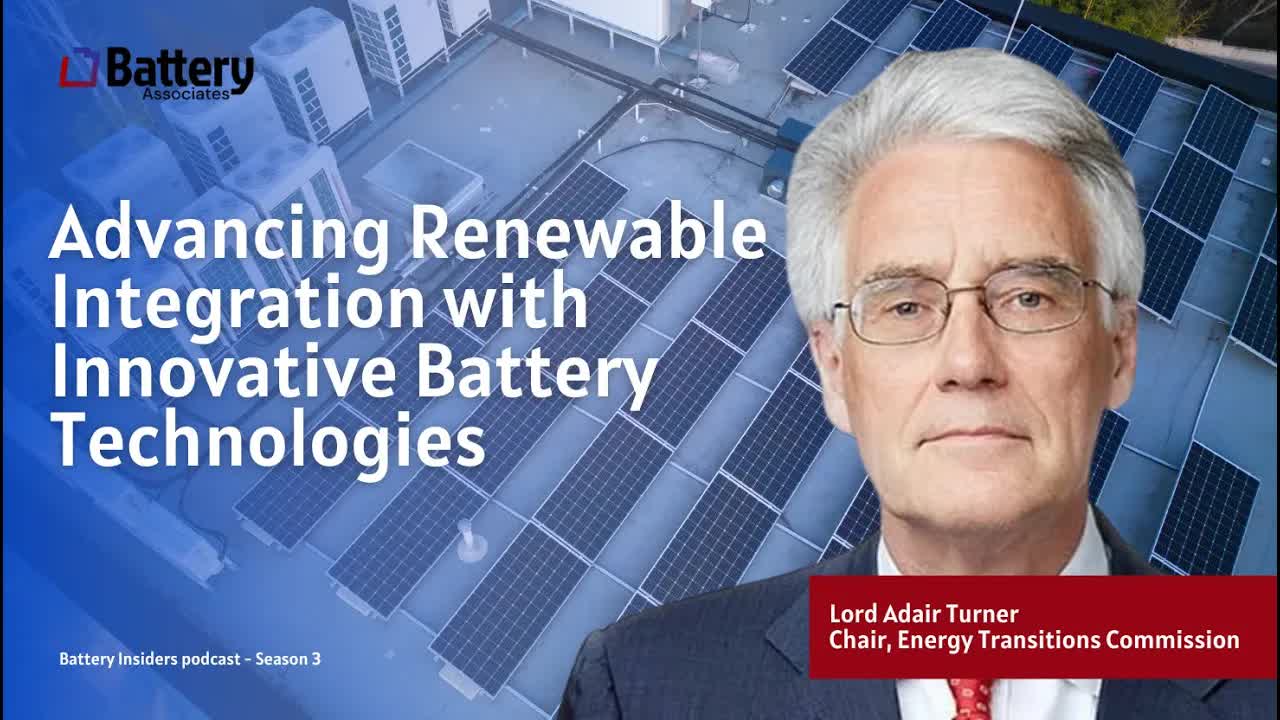
Lord Adair Turner
Chair, Energy Transitions Commission
Turner was the first chair of the UK's Climate Change Committee, appointed in 2008. The Energy Transitions Commission is a global coalition working on the technical and economic challenges of reaching net zero across every sector.
What this episode covers
Adair Turner's central claim is that the constraints people keep raising about batteries have a habit of dissolving. He has watched this happen repeatedly since 2008, and the pattern is consistent enough that he now treats new bottleneck arguments with scepticism.
His worked example is cobalt. Five years ago the dominant chemistry was NMC, and the industry was anxious about cobalt supply from the Democratic Republic of Congo, with its environmental, child labour and corruption problems, and about the nickel price. Then a wave of innovation he admits he did not see coming produced lithium ferro phosphate, which needs neither. Cobalt and nickel prices had risen three or fourfold between 2019 and 2022 and are now back where they started. Over 50% of batteries now made worldwide are LFP. That is a complete change in five years.
Lithium tells a similar story: a fourfold price rise from 2020 to 2022, completely reversed, despite a boom in stationary storage and EV sales running ahead of five-year-old forecasts. His expectation is that supply questions get solved by new resources, then by less harmful processing, then by recycling, which will supply a significant proportion of the lithium, nickel and cobalt going into batteries within ten years.
The most useful framework in the conversation is his breakdown of storage duration. Batteries could technically do any of it, since there is no lower limit on how slowly you charge a cell. The reason they do not is purely economic: they only pay when cycled hundreds of times a year. Packs have gone from USD 1,300 to 1,400 per kWh in 2010, in today's money, to under 100. At USD 10 per kWh, he says, you would use them for multi-day storage and the whole architecture changes.
Until then the answer is regional. In the sunbelt, where seasonal variation is small, solar plus batteries becomes close to a complete solution. In northwest Europe the binding constraint is a February anticyclone over the North Sea that can suppress wind for two or three weeks, possibly coinciding with peak demand from electrified heating. For that he expects hydrogen made by electrolysis and stored in salt caverns, accepting roughly 50% round-trip losses because the capital cost per kWh stored is low enough that cycling once or twice a year is fine.
The number that should make grid planners sit up: by 2050, 1.5 billion electric cars with 60 kWh packs is 90 TWh of battery capacity parked on streets, against daily demand of around 120 TWh. Private cars are in use perhaps 5% of the time. Turner's point is that if that capacity were usable, it would solve short-duration balancing without building any more stationary storage. He is honest that he first heard the vehicle-to-grid idea 10 or 15 years ago and it has not arrived, and argues the first and much easier win is simply getting people to charge at sensible times. Parts of Australia now give electricity away between 11am and 3pm because there is so much rooftop solar.
Questions from this episode
- Are critical mineral constraints going to slow the battery transition?
- Turner's position is that every time the industry identifies a constraint, it turns out not to be an important one. Cobalt and nickel anxiety was answered by LFP, which needs neither and now accounts for over half of global battery production. Lithium prices quadrupled and then fully reversed. He accepts there may be future pinch points and is specifically worried about local environmental impacts from nickel development in Indonesia, but expects supply to be solved by new resources, better processing and eventually recycling. He also notes the overall environmental impact is two or three orders of magnitude below the fossil fuel system being replaced.
- Why don't we use batteries for long-duration storage?
- Economics, not physics. A cell has a maximum charge and discharge rate but no minimum, so you could fill one over a week and drain it over the next. The reason nobody does is that batteries have historically cost enough per kWh stored that they only pay when cycled hundreds of times a year. Packs have fallen from around USD 1,300 to 1,400 per kWh in 2010, in today's money, to under 100. Turner's threshold: at USD 10 per kWh you would use them for multi-day and even 100-hour storage.
- What does Europe need that the sunbelt does not?
- A different set of technologies, because the balancing problem is a different shape. India, Indonesia and Africa face a mainly diurnal challenge: store solar by day, run the air conditioning at night. Northwest Europe's hardest case is a February anticyclone over the North Sea suppressing wind for two or three weeks, possibly during peak demand from electrified heating. Batteries cover two to twelve hours. Compressed air, liquid air, vanadium redox flow and pumped hydro extend that. For the seasonal gap, the German Dunkelflaute, Turner expects hydrogen from electrolysis stored in salt caverns.
- How much storage is already sitting in parked cars?
- By 2050, on Turner's arithmetic, roughly 1.5 billion electric cars averaging 60 kWh gives 90 TWh of battery capacity, against daily electricity demand of around 120 TWh. Private cars are in use about 5% of the hours in a year. If that capacity could be used, it would cover short-duration balancing entirely without additional stationary storage. He is sceptical about sophisticated vehicle-to-grid arriving soon, having first heard the idea 10 to 15 years ago, and argues the achievable win is time-of-day pricing that moves charging to when electricity is surplus.
- How much decarbonisation is possible before you need storage at all?
- More than most people assume, and this is his message for India and China. UK electricity went from 500 grams of CO2 per kWh in 2010 to 125 in 2024, a 75% reduction, with very little battery investment and almost no long-duration storage. That came from closing coal, using gas as the fossil fleet, and running that fleet flexibly against wind output. Coal is inherently less flexible than gas, but new technologies can make it flexible. The trick stops working once you target near-zero carbon electricity, which is where the UK now is.
- What market structures actually get storage built?
- Turner declines to be prescriptive and describes three that work. Quantitative mandates, where new wind and solar must come with a set amount of storage. India's round-the-clock renewables contracts, where the developer commits to delivering electricity for 80% of hours per year, and increasingly for specific half-hours nominated 24 hours ahead, which pushes the wind-solar-battery optimisation onto the developer. And capacity markets, with one critical condition: neutrality between paying a gas turbine to exist, paying a battery to exist, and contracting demand-side flexibility. He thinks some capacity markets have historically favoured gas.
Listen to this episodeWatch on YouTube
Part of Storage and the grid
Transcript
About this transcript. Generated automatically from the recording, then corrected against a glossary of company and guest names. It has not been checked line by line. Machine transcription mis-hears technical terms, numbers and names, so treat any figure here as a prompt to check the recording rather than a quotation of record. Spotted something wrong? Tell us.
0:00Introduction
Dr Simon Engelke
0:00And welcome, everyone. Thanks so much for joining us for the Battery Insiders podcast. I'm extremely delighted today, as Simon Engelke, the founder and chair of Battery Associates, as the host of today's episode, to talk to Adair Turner, who is the chair of the Energy Transitions Commission, which is a global coalition of companies to identify technical and economical challenges to get to net zero in all the sectors. And I was very fortunate to see you speak in the context of one of the large OEMs out there and really sharing, I think, a lot of your good insights and also a lot of enthusiasm of what is even possible in this industry. And I'm really delighted to speak with you today. Thanks for joining us.
Lord Adair Turner
0:38Thank you.
Dr Simon Engelke
0:39Brilliant. So let's get right into it. I think I just touched on, you know, with your coalition, you look at technological challenges. So let's talk a bit about technology. And of course, here's part of the Battery Insiders podcast. Of course, we're also quite interested in the battery side. And to maybe start on the technological topic, talking about cost and scalability. And of course, we have seen that the battery price we have plummeted. It's really exciting, especially on the stationary side as well, but also, you know, lithium iron phosphate, but also topics such as sodium-ion, which could still drive it down even further. So looking at all of these developments and the rapid developments and the possibilities of scale up, right, to terawatt hour levels of storage. What do you see as some of the bottlenecks to really make this happen? Supply chains, for example, is a topic we've talked about manufacturing. Anything else which can stop this massive transition we're seeing?
Lord Adair Turner
1:31Well, I basically think we are on an unstoppable transition to a dramatically increased role of batteries and in particular, probably lithium iron and maybe sodium-ion batteries in our energy systems. Since I began to be very involved in issues to do with the energy transition about 15 or 16 years ago, 17 years ago now, 2008, when I became the first chair of the UK's climate
1:58A 90% fall in battery cost, and what it changed
Lord Adair Turner
1:59change committee, one of the most dramatic and at that stage, unexpected changes has been an extraordinary fall in the cost of lithium-ion batteries. Essentially, they are down 90% in price or even more than they were in, say, 2008, 2009, when I first started working in these areas. And this has transformed the prospects for electrifying the global economy. It transforms the prospects for electrifying road transport in particular. But it has also transformed the prospects for storing electricity within grid systems, which enables us to deploy renewables far faster than possible, far faster than we previously thought was possible. It really is a major change and has changed my point of view over the last 10 to 15 years as well as possible. Now, people then say, well, there are constraints. I have to say, I don't think there are major constraints or every time we think there's a constraint, it turns out that it isn't an important one. I remember five years ago when the main technology we were using, the main chemistry mix we were using in a lithium-ion battles was NMC, nickel, manganese and cobalt on the cathode. And people were worried about, well, how are we going to get enough cobalt? Most cobalt is coming from Democratic Republic of Congo with all sorts of environmental and child labor and political corruption issues. What about the price of nickel? And then to an extent which I did not see coming about five or six years ago, a wave of innovation gave us the lithium ferrous phosphate battery, which requires no nickel and no cobalt. And as a result, the cost of cobalt and the cost of nickel, having gone up by about three or four times between about 2019 and 2022, are now down to back with the way they were before.
4:04How LFP dissolved the cobalt and nickel problem
Lord Adair Turner
4:05Because it turns out, although nickel and cobalt can enable us to have very high performance batteries, we don't need them in all batteries. And over 50% of all the batteries now being produced in the world are LFP batteries with no nickel and cobalt. A complete change in just five years. As for lithium, there is lots and lots of lithium in the world. And again, we've seen a rise in the lithium price between 2020 to 2022 of about four times. And we've seen it completely reverse. And that's despite the fact that there's an extraordinary boom going on in battery energy storage systems using lithium-ion batteries. And despite the fact that actually electric vehicle sales across the world are progressing faster than was predicted five years ago. Now, of course, there may be mineral supply pinch points that develop in future. And there are very important local environmental impacts about mineral development. For instance, I'm very worried about some of the local environmental impacts of the big nickel production developments which have occurred in Indonesia. But overall, I think we should be confident that all the mineral supply issues will be solved by finding new resources, by new and less environmentally harmful processing technologies which are being developed. And then later by the recycling of battery material. Now, of course, that at the moment is relatively small simply because we haven't yet got to the end of a big generation of EVs. But within 10 years time, I think a significant proportion of all the lithium and the nickel and the cobalt to the extent that we're still using lithium and cobalt going into electric vehicle and stationary batteries will be coming from the recycling of the batteries at end of life.
6:04Why the environmental impact argument still favours batteries
Lord Adair Turner
6:04So my overall belief is this is unstoppable. And when we at the Energy Transitions Commission have looked at the environmental impact of on this of the world, of course, there's an environmental impact. Human beings can't have a high level of prosperity without some environmental impact. But it is an order of magnitude less or two or three orders of magnitude less than the environmental impact of the fossil fuel system that we're replacing. So I really am an optimist of this. It's one of the in a very tricky and worrying world. This is a technology which can transform humanity's prospects for the better.
Dr Simon Engelke
6:47We appreciate it. You said closing the loop circularity. Definitely topics you can touch on more later as well. Maybe talk about one aspect. You touched on all of the benefits. Another topic, of course, is the topic of long duration storage. If you think about lithium-ion you just mentioned, we often think about one hour, two hour, four hours, maybe a bit more. But then, of course, we also have other topics. You know, we have seasonal times. Right. We also have loads of the, you know, longer time where, you know, it's darker, maybe in winter. Maybe, you know, there's time when the wind is not blowing as much. So things like that. So maybe what are some of the other technologies we need for that? Is it an vanadium redox flow? Is it hydrogen? Maybe could you share a bit more on the topic of long duration storage? What are you seeing in that regards?
Lord Adair Turner
7:29Well, you're absolutely right. It's very important to understand all the durations across which we will have to shift supply via storage to balance supply and demand in a variable system. And in fact, the Energy Transitions Commission will be producing a major report in July, which sets out that picture. Interestingly, it's very different in different regions of the world. If you look at the challenge which India or Indonesia or Africa will have, it will be almost entirely, very primarily, a diurnal challenge.
8:05Diurnal, weekly and seasonal: three different problems
Lord Adair Turner
8:06Right. It will be you have a whole load of solar PV by day. How do you keep the air conditioner running when the sun goes down? Much less in those countries seasonal variation. When you come to Northwest Europe, by far our biggest balancing challenge is what to do in a February winter when we get an anticyclone in the North Sea where the wind supply goes down, not for an individual hour or day, but goes down for maybe even two or three weeks. Two or three weeks, which you know might happen once or twice in a winter, but you don't know when exactly they're going to happen. And if that's a very cold anticyclone, it might correspond with precisely the point where there is high electricity demand. If, as we should, we have electrified heating, getting rid of the gas boilers and completing them, replacing them with heat pumps. So we have these different balancing challenge. We have short term, essentially diurnal, two hours, four hours, say eight hours, but not more than that. We have weekly and a couple of weeks. And then we have these long seasonal ones. And we have to deploy a set of technologies to address each of these different duration challenges. Now, interestingly, when you look at batteries, technically batteries could solve any of these, right? There is no limit to how slow you can charge and discharge a battery. A battery has a maximum C rate, a rate at which you can charge and discharge it. But that's a maximum. You could take a battery and slowly fill it up over, you know, a week and then slowly run it down in a week. The reason why we don't think we do that is not technical limitations.
10:01Batteries could do long duration, the economics stop them
Lord Adair Turner
10:02It's economics. Batteries have in the past cost so much per kilowatt hour storable that they're only economic if we're going to be cycling them many, many times per year. If we're going to be cycling with them at least, say, 365 times a year, charging them up in the day and discharging them at night. An interesting issue is how low can battery costs go? And does that challenge that assumption? Right. If I could give you a batteries in 2010 cost in today's money, 13 or 14 hundred dollars per kilowatt hour. Now at the pack level, they're going below a hundred dollars per kilowatt hour. If I could give you a battery which costs ten dollars a kilowatt hour, you might use it even for that very long duration storage. It's all an economic issue, not a technical issue. But at least for now, our assumption is that the batteries will do the two hours, the four hours, the eight hours, the eight or 12 hours, which is enough to solve all of the diurnal challenges. And that's really important because it means that in, say, the sunbelt of the world, where there is a lot of sun and not much seasonal variation in energy demand, solar plus batteries is going to become an almost complete solution. Come again to the northwest Europe or other high latitudes, we're going to need a range of technologies. Those will be batteries at the shorter duration. And then there's technologies like compressed air, maybe liquid air, maybe vanadium redox flow batteries at a slightly longer level. Pumped hydro, very powerful technology wherever we have the physical situation. Of course, best when you've got some mountains, some elevation because it's all based on gravity.
12:02Compressed air, pumped hydro, heat in bricks
Lord Adair Turner
12:02Heat storage, a very interesting one, just heating up bricks or stones with electrical input when we've got surplus electricity and then releasing that heat, either to be used as heat or to drive turbines when we need it. Now, of course, one of the biggest challenges is those really long cycles that I referred to earlier. How to take, say, surplus winds that we would tend to have in October and November with autumn winds and to store up enough energy that we can deal with this, as it's as in the German word, the Dunkelflaute, the doldrum of the February or so anticyclone. Here, I think hydrogen is going to be the dominant technology, making hydrogen from electrolysis when we have surplus wind and solar and storing it in salt caverns. The analysis, for instance, for instance, for the UK suggests that we have lots and lots of storage in salt caverns and the cost of doing that is relatively low. So the capital cost per kilowatt hour storable is so low that it doesn't matter that you're only cycling it once or twice or three times a year. But there are significant conversion losses, of course, because what you will do is you'll make the hydrogen and then almost certainly get it back to electricity by burning it in a gas turbine. And the combination of the loss in the electricity, the electrolysis process and in the combustion process will probably be 50 percent or so. So by definition, the electricity that comes out at the end is going to be twice as expensive as the electricity that you put in. But there are these full range of technologies available and we are confident that they can solve the problem, though with this interesting wrinkle that I think the challenges of balancing supply and demand,
14:02Hydrogen in salt caverns for the Dunkelflaute
Lord Adair Turner
14:03we are going to find much easier and much cheaper in the sunbelt of the world than in the northern latitude windbelt.
Dr Simon Engelke
14:10Brilliant. So what I hear from that is in some region, it can be a full solution with battery storage and some others we need to complement with other technologies.
Lord Adair Turner
14:19Absolutely. Absolutely. Yeah.
Dr Simon Engelke
14:21Fantastic. So another application of batteries is electric vehicles. And electric vehicles, of course, and that's also the context where we are first connected. But then, of course, also the topic how you can maybe use EVs as a stability to complement. We go to grid for the grid as well and kind of enable, you know, and demand response and smart charging and things like that. As you mentioned, you know, we have more EVs coming, you know, online maybe than people anticipated five years ago. But there's still a range of challenges, right, from infrastructure and others for EVs. Maybe you could share a bit more your perspective on what we have to do now to really scale up further, right, to these millions of EVs which we require in the system. And maybe what are some of the challenges to overcome in that regards?
Lord Adair Turner
15:05Well, of course, it's interesting. We sometimes talk about these challenges as if, oh, we've got to work out what they are. But let's be clear, there are two major countries in the world, two countries, one very big, one relatively small, which have solved these problems. I mean, Norway now, 95 percent of all new vehicle sales are electric vehicle and primarily straight battery electric vehicle, not plug-in hybrid. And when in the UK people say to me, oh, these battery electric vehicles, you know, they won't work in cold climates because the batteries don't work as well in cold climates. And they won't work in countries with long driving distances. I say to them, well, have you ever been in Norway? And can you give me an explanation of why it's working in Norway? The answer is, if you invest enough in charging infrastructure, then the EVs will be the solution for the whole of passenger cars.
16:01Norway has already solved the EV question
Lord Adair Turner
16:01And I think we've got to the stage, took a long time in relation to Japan in particular, where we've realized that the idea of the hydrogen passenger car is a complete dilution. Battery electric vehicles are fundamentally advantaged. They are much more efficient. They're silent. They don't produce local pollution in cities. They have far higher acceleration for people who enjoy that sort of thing than old fashioned, noisy, inefficient internal combustion engines. These are going to win. And in China, of course, we're just at the stage where a big country rather than Norway, a little country where they're going above 50 percent of new passenger car sales. And I suspect that by 2030 in China, there'll be 90 percent of new passenger car sales. So I think it's important to realize this is a revolution which is absolutely unstoppable. And with the fall in battery prices, we are probably only two or three years away from having getting to the point where the battery electric vehicle is cheaper than the internal combustion engine vehicle for the same sort of size and comfort level. And again, that point has already been reached in China. And the other dimension of a innovation and battery technology advance is not just that the costs are coming down, but the energy density is going up. Energy density is measured both gravimetrically as watt hours per kilogram, volumetrically as watt hours per litre. But both of those volumetric a bit faster than gravimetric are growing up, going up at maybe six to eight percent per annum, doubling every 10 years or so. And that's why we are now seeing coming onto the market EVs with ranges of 350, even 400 miles.
17:57Energy density rising 6 to 8% a year
Lord Adair Turner
17:57Let me do that in kilometers, 500 kilometers, 600 kilometers, which will meet almost all people's needs for range. So this is unstoppable. What is interesting about that? And it's the other question you asked is, well, what is the implication of that for the power system? Because let's run some interesting little numbers here. Suppose by 2050, all the car fleet, which will then exist, is electric. Let's say that's 1.5 billion cars, all of them electric. And suppose they all have, on average, a 60 kilowatt hour battery. That means that we will have, sitting out there on our streets, 90 terawatt hours of battery capacity sitting around. And one of the features of passenger cars is that when we're talking about the individually owned passenger car, not the car fleet, the taxi, but the individually owned passenger car, they're typically only used about five percent of all the hours or sometimes less. The other time they just sit in the garage, sit on the street. So we're going to end up with a system that has demand per day of 120 terawatt hours. And we've got, sitting in the street unused, 90 terawatt hours of battery capacity. So the challenge is clearly, how do we use that? Because it is so much that if we worked out how to use it, we could solve all the short-term duration balancing needs, not with having to put even more batteries into the stationary storage element,
20:0490 TWh of batteries parked on the street
Lord Adair Turner
20:05but by just using the batteries which are in the EVs. Now, at one level, this is very exciting technology. At another level, I first heard this idea 10 or 15 years ago. And we're not really seeing yet a lot of all this sophisticated vehicle to grid type sophistication that people have talked about, you know, signing up to a tariff from your electricity provider and agreeing that as long as you let them software control their battery, your battery, they can put electricity in and take it out. The first step is to simply strongly encourage people to at very least charge that growing fleet at a sensible time of day. And, of course, this is also true to a degree, but somewhat less a degree in heating buildings. This issue of how do we get people to use electricity when it is surplus to requirements, say, in the northern latitude in the middle of the night when we still got wind, or in sunny parts of the world in the middle of the day when there's surplus solar electricity. And here, time of day pricing of electricity is absolutely crucial. I was recently talking with one of our members, Ausgrid, a major distribution company in Australia, and talking about the fact that there are parts of Australia now where electricity is free from 11 a.m. to 3 p.m. because there is so much rooftop solar that the grids don't want to pay that rooftop solar to produce because it's excess to requirements. And, indeed, the system itself is excess to requirements. So what they're trying to do there is saying educate people between 11 and 3, electricity is being thrown away.
22:03Time-of-day pricing, and free electricity in Australia
Lord Adair Turner
22:04So please charge your car in that period of the day. So there is a huge potential to use this enormous passenger car fleet battery capacity, first of all, to shift electricity demand to times of day where we've got surplus electricity. And I'm sure that will occur to a very significant extent over time. I think we will achieve that revolution of people being sensible about when to charge their car. Whether or not we then progress to the sophisticated level of the battery also putting electricity back into the grid on a complicated software control process, I don't know. But if we achieve the first, we will dramatically reduce the costs of achieving the balance of supply and demand within systems with high levels of renewables.
Dr Simon Engelke
23:01Right. I'm sharing that. And I think expanding a bit on that, right, I think I want to go maybe to the topic of policy and regulation. And I know also, again, you know, for the vehicle to grid, for example, there's two topics, right, with inverters, maybe a bit more technical topic. And then maybe with regulation, you know, having the right energy markets, maybe we can go a bit more into that now. I mean, a big topic, of course, in Europe, also people talk about, but also in other regions, right, the topic of permitting, right, for this news, getting the systems, especially best systems as well. There's a lot of different kind of regulations or there's a lot of question marks about how to really set this up in effective ways, get this rollout, right, of these systems out there. I've heard of very creative ways with like having, you know, this containers on movable vehicles so you can move it around, which is easier from a permitting stance in certain regions or all kinds of kind of complicated topics there for also getting these, you know, best installations. But then, of course, also connect to wind and solar farms. So maybe if you could share a bit about like what you have seen maybe out there from a regulatory perspective, kind of what has worked well, maybe about some challenges and to get these systems online as quick as we can, because that's something I think we're all very passionate about.
24:08Containerised storage and the fall in system cost
Lord Adair Turner
24:09Well, if I can begin by you mentioned these containerized solutions. This is a really important technological innovation, which has really occurred in the last three or four years, where the battery producers are putting the battery packs, battery packs have cells within them and then various packaging around them. And they're putting them in shipping containers, literally a T-E-U's, as they call it, 20-foot equivalent unit, the actual, you know, shipping containers, these extraordinary things like a Lego brick, which just move in this highly standardized fashion. So they're putting them in there with different degrees of integration of things like inverters so that you can buy now what's called a DC block without an inverter or you can buy an AC block with an inverter, a DC to AC converter within the system. And these are creating systems which then, to a significant extent, are making battery energy storage closer and closer to what you might call plug and play. You get your container and you just plug it into the system. And this has driven down the cost because within any battery system, it's quite interesting, until about four years ago, the cost of stationary battery storage was much higher per kilowatt hour than the cost of EV battery storage. And at one level, that was a bit odd because with EVs, we've got this challenge of getting them into the smallest space possible. But because that market had developed more, because it was more standardized, because we had large automotive OEMs giving large standardized orders for producers, that had developed faster. What we've now seen in the battery energy storage market is this containerized solution, much bigger scale, and all what's called the BMS, the battery management system costs, which are in addition to the packs, which are in themselves in addition to the cells, the battery management systems coming down in cost.
26:12Permitting, and why storage draws less opposition
Lord Adair Turner
26:13Now, that doesn't immediately get around the other problem that you mentioned, which is permitting, because, you know, these things do take up space. You've got to put them in a field. People may not like them, you know, being that field, you know, taking over, you know, whatever that was before. Hopefully, as much as possible, we put it on brownfield land, but sometimes it will be greenfield land. So it generates the same opposition and concerns that any form of development has, whether it's housing development or onshore wind development or pylon development. I think over time we will find this less challenges in terms of local opposition than, for instance, things like pylon development across the line, because, you know, these things can be made, you know, relatively invisible. They don't need to be all that high. We can use lots of brownfield land. We can, you know, we can go down a bit. We can, you know, cut out space to a a take them down below the level of the visual site, etc. But, you know, we are building a new electricity system, which requires new forms of development. And of course, every time you put in a large battery storage system, a large battery storage system, you are going to need some sort of grid connection. And that's going to create wires above or below the ground. And there may be resistance to that. So we've got to try to speed these permitting processes. We've got to try to speed the development of grids, though the really big grid needs will be generated by the fact that the offshore wind is in a different location than the coal was. We should maybe think about, you know, innovative ways of making sure we reuse assets that we have at the moment.
28:08Reusing old coal plant grid connections
Lord Adair Turner
28:09For instance, every old coal plant has massive great big grid connections with it. So when you close a coal plant, which is already a brownfield site, why not put a massive great battery installation there? Because you're using the existing asset rather than having to build new assets. The other thing to say is that the more that we can put in decentralized battery capacity, a battery capacity into people's homes, into commercial and industrial sites, the more that we achieve our balancing of supply and demand right down at the local level. And then we don't need to do as much extension of the grid. We don't need to build as much new transmission or distribution grid because we're balancing at local level rather than balancing across the whole grid level. So there's a set of intelligent policies to support decentralized storage, including in-home storage as much as possible. Solar plus batteries together, for instance. There is trying to develop as much as possible, you know, less visually, less space absorbing developments, using as much brownfield site as possible, using existing grid connections as possible. And I think we just need, you know, very conscious policies to do that. I mean, the good news, of course, is that the one thing that battery installations don't have, they take up space. People don't like the visual impact of them, but they're not producing any effluent. They're not, you know, they're not polluting. They're not producing noise compared with a lot of our existing energy system. They are less intrusive.
30:04How far the UK got without any storage at all
Dr Simon Engelke
30:04Brilliant. Well, that makes a lot of sense. And then maybe I was talking a bit about going in the direction of markets, right? Some of the incentives, maybe if you can share. I mean, you mentioned already individual, right? It would be good to have storage at home, but then of course also, you know, larger installations. Do you think right now, you know, there's enough kind of incentives out there to kind of support that?
Lord Adair Turner
30:26Well, here's an interesting thing on the development of battery energy storage. I think, and all the long duration ones, which we talked about earlier. The challenge is just beginning. And it's quite interesting and important to realise how much progress we have made with decarbonising electricity systems without doing a whole load of storage. So the UK in 2010, our electricity had a carbon intensity of 500 grams per kilowatt hour. In 2024, it was 125 grams per kilowatt hour, a 75% reduction in the carbon intensity of electricity. That's partly because we closed down our coal plants and used gas as our fossil fuel fleet. But it's also because we have grown renewables to, I think now, you know, in excess of about 30, but pushing on towards 40% wind and solar as our source of electricity. And so far, all that we've really done is switch the gas fleet to flexible operation. So when the wind blows, we shut down gas plants. And when the wind doesn't blow, we ramp up the gas plants. And so far, we've had very little battery investment and almost no long duration investment.
32:02Why that trick stops working near zero carbon
Lord Adair Turner
32:03And this is a very important message for countries like India and China. You can go a long way towards decarbonisation if you can make your fossil fuel fleet more flexible. And although coal is inherently less flexible than gas, there's a whole load of new technologies that can make it flexible. So this is why so far, although we talk about all these storage technologies, it hasn't been huge deployment. But we are now at the stage where we have to. So the UK is committed to get to zero carbon or close to zero carbon electricity by the early 2030s. We won't be able simply to do that by this trick of running the gas fleet in inverse to the solar and wind. We'll have to have bits where there's no solar and wind, but we're not running the gas fleet. We're doing something else. We're now at the stage where we're going to have to develop the batteries, the compressed air, the pumped hydro, the hydrogen. And we need markets that support that. It's interesting the different market structures that can support it. And I don't think one can be prescriptive. One of the things that you can do is you can do quantitative mandates. You can say whenever you develop wind and solar, you have to put in a certain amount of battery or other storage capacity. You can do what the Indian government has done. Very interesting development, which is what's called the round the clock renewables contract, where in the major auctions for new renewable capacity and generation in India, typically the provider has to commit to delivering electricity 80 percent of hours per year. And indeed, they're now moving to an environment where it's not just 80 percent of all the hours at the developers option.
33:59Mandates, round-the-clock contracts, capacity markets
Lord Adair Turner
34:00The system generator can say, and if I tell you 24 hours in advance, a particular half hour period, I need electricity. That needs to be one of your, you know, 6,000 hours per year. And that then pushes to the developers the challenge of saying, OK, what is the combination of wind and solar and batteries which will enable me to meet that contract in almost all states of the world, relying on very, very expensive wholesale electricity in the market if I get it wrong and I can't quite meet it in all states of the world. So that's another very interesting contract structure and one which is revealing that these combinations of wind, solar and batteries are now cheaper than coal power in a new coal power in India to provide electricity throughout the year. Really interesting test. Another structure you can have is, of course, capacity markets where you, Rick, you, you, the grid operator pays people to exist as a capacity and then they they operate in the energy market off their marginal cost, which, of course, is very low. So the crucial thing if you go that way is you must have neutrality of treatment between a capacity market that pays a gas turbine to exist and a capacity market that pays a battery to exist or a capacity market, which is a contract with a demand side flexibility provider. And I think we've had a problem in the past that some capacity markets have developed in a non neutral fashion. They've had a favoritism to basically say, I know I need my gas turbines to continue to exist, even if they only run a thousand hours a year. Therefore, I'm going to pay them to do it. So, look, I don't think we can be prescriptive about this. And I think what we've got experimentation going on. But what we undoubtedly need is system operators throughout the world thinking about the combination of this suite of techniques which will enable us to develop all the technologies and the business systems, the combinations of technologies which will enable us to run systems with very high levels of variable renewables. And we foresee systems where, yes, they'll have hydro wherever you've got hydro. Hydro is a beautiful resource, particularly dammed hydro wherever you've got it. It's cheap and it's flexible. Yes, they will have nuclear. Again, if you've got existing nuclear, keep it forever if you can, because the zero marginal cost is low. But we see a world in which variable renewables, wind and solar, will probably go to over 70 percent of supply in almost all countries of the world. And we will need system operators which think very carefully about the combination of market design and contract structures which enables us to do that in a cost effective fashion.
Dr Simon Engelke
37:03Well, and you just mentioned cost, right? And of course, another topic is the investment required, right, to get all these systems into place. We know that's a massive investment only on the battery side, right, Bess? What's kind of required there? There's a lot of appetite as well in the markets. But yeah, maybe if you could share a bit more about, you know, what could make it? Is it attractive already now this year for the financial markets? Who's going to put the money in? Is it more individuals? Is it more companies? Is it more investors? Is it more governments? Who's really getting us most of the capacity?
Lord Adair Turner
37:32I think it's going to be in most countries mainly private investors and private companies, private developers. I mean, it's very interesting. In the EV market, we don't even talk about really that challenge because we just assume that there's some OEMs, you know, big automotive companies that invest to build EV factories.
37:58Who actually funds this, and where the state is needed
Lord Adair Turner
37:59And they do contracts with big battery companies. Now, if you want battery factories to be in Europe, not China, then you get governments stepping in and providing subsidies. But the core activity is done by private enterprise. And on the whole, it works well. And I think broadly speaking, you know, we are going to have private developers of wind farms, private developers of demand side flexibility offers. One thinks of a company like Octopus in the UK, absolute leader in demand side flexibility packages. And I think we'll see that in the battery space as well. And there is, for instance, intriguingly huge investment now going to stationary energy storage in the US, you know, despite the fact that they now have a president who doesn't believe in this energy transition and wants to drill baby drill. And, you know, absolutely enormous expansion going on. I don't think we should exclude a role for, for instance, infrastructure banks. And I think it should be focused on those things which are going to be most complex and first of a kind and where you get complicated combinations of things that have to happen. So, for instance, as I say, I think battery storage will tend, provided we can deal with the planning and permitting, to be a relatively straightforward plug and play system. You know, you get your battery container situations, you build as many of those you need together, you connect the grids. You know, you don't, provided you can get the land and the grid connection, you can develop a business system for that quite fast. I think where we have to do, you know, salt cavern developments, hydrogen pipelines, working out whether that's going to be retrofitting existing gas pipelines or is it new gas pipelines. I think we may have to have a role there for, say, you know, national infrastructure banks, which which take the first risk, which make it happen. Just as we are seeing, for instance, in the development of carbon capture and storage networks, where you're trying to build together multiple different players, you know, cement plants here, somebody who has an old gas field there, somebody who owns a pipeline, which is almost good, but needs to be retrofitted. You sometimes need the role of the state or more likely the infrastructure bank to just sort of help lubricate those early complicated combinations of actions. But I think provided you have power market design, right, provided you've got that suite of appropriate contracts, which I referred to earlier, I think most of the investment will come from the private sector, from private investors, long term infrastructure in funds, pension funds, insurance companies, the sort of people who do long term investments and the and the private developers who put that together into profitable packages.
Dr Simon Engelke
41:11Brilliant. I think we have also as battery associates, we have seen definitely quite a bit demand on this side. So I think I very much agree with you on that. I think there's a lot of interest in these markets and from these kind of investors under the sector. Kind of the two last topics I want to touch on, like the first one would be, we already touched on a few regions around the world, right, and kind of some of them, how they're maybe more ahead than others. And some of them are challenging times, but maybe if you could help me a bit on, you know, for the audience as well, kind of understand a bit like, you know, where's Europe standing right now? But maybe also where are other regions standing on the storage type on the energy transition topic, just to understand maybe what was compared to China, North America, just kind of a bit of understanding how we're standing in that regards.
Lord Adair Turner
41:55Well, Europe, in some ways, is among the most advanced continents in a transition.
42:07Where Europe, China and India each stand
Lord Adair Turner
42:09I mean, of course, a country like Brazil has some of the cleanest electricity in the world because it's always had clean electricity because it's always been hydro. So, but if you talk about countries that started with very big fossil fuel electricity systems and are trying to come out of them, Europe is one of the most advanced. And we have countries like Germany, Ireland, Spain, Denmark, Portugal, already going over 40 percent of their electricity becoming from variable renewables. And that is increasing very significantly. And it's quite heartening that after the Russia invasion of Ukraine and the shock that that gave us to gas supply, we did accelerate moves towards renewable deployment with the REPowerEU program. And I think with action to free up planning and permitting systems and investment is continuing. There's been a bit of a setback on the offshore wind industry, but I think we're going to see that bouncing forward again. The level of solar deployment in places like Germany and Spain and is quite extraordinary. That's been an explosion of the last few years. And then on EVs, on the electrification side, it's beginning to ramp up. I mean, there's been a lot of talk about, oh, it's going slower than we thought. Well, yeah, but just remember February, the figures are in for Germany. Thirty percent of the new vehicles are EVs. And I think we're going to see an acceleration there. So Europe is making progress. I think it's making slower progress on things to do with this heavy industry transformation and residential heat. A lot of progress, too slow in the UK. But on the whole, you know, the UK has said it wants a zero carbon power system by 2030. Let's say early 2030s. Europe has said by 2035. I think we're going to get pretty close to that. You know, I increasingly think the big challenge for Europe being zero carbon in 2050 is what are we going to do about agriculture? What are you going to do about aviation? But I think by 2050, we'll have a primarily electrified road transport passenger fleet. We'll have a primarily zero carbon. It doesn't mean to be precisely zero carbon, but let's say 10 or 20 grams per kilowatt hour electricity. We're on target to do that. China is interesting because, of course, China emissions. China emissions have probably just peaked. It may be that we'll find out that calendar year 2024 may be the peak or calendar year 2025 is deploying renewables at an absolutely stunning rate. But what has been occurring so far is that electricity demand has been going up to match that. What we've been seeing is China installing enough wind and solar every year to produce about 300 terawatt hours of electricity. But electricity demand has gone up by about 300 terawatt hours. So that although the new electricity, the new renewables have been meeting all the increase in demand, the amount of demand which is met by the coal fleet hasn't gone down. I think we're probably at the turning point. It's obviously hugely important for Europe that once they go beyond that turning point, they come down as rapidly as possible. The early stages of that will be moving the coal fleet beginning to occur already onto a flexible process so that the coal capacity still exists. But the utilization rate goes down as it begins to flex in an inverse pattern to the wind and solar. That's where China is. And, of course, China is ahead on electrification of road transport, way, way ahead, both in production and in demand. India is somewhat similar to China in that their electricity demand is going up very rapidly, actually going up slightly faster than the new renewable supply. So they really need to ramp up the pace of renewable deployment. But it has accelerated very significantly in the last couple of years.
Dr Simon Engelke
46:34Great. Thank you for sharing that. And then as a final question, just in terms of time, maybe looking a bit into the future, what we can expect, what we can see. We can, I think, definitely tell you quite optimistic, I think. And some of these topics, of course, are really good to hear and to see. But maybe, yeah, maybe on these two topics, we also touched on today, right, or the three one, maybe one on the technology side. Maybe what are you kind of expecting what could come, you know, to help on this regards, maybe also long duration or chemistry, like so do you mind. And then also the topic, you know, from economical policy standpoints, anything you kind of expect maybe to come over the next, I'd say, five or 10 or so years.
Lord Adair Turner
47:09Well, look, I think on emerging technologies, battery technology is going to progress and progress and progress. And we may see an acceleration of it. One must always be wary of saying that AI is going to accelerate. But this is one of these areas where artificial intelligence may accelerate our ability to explore all the different possible combinations of elements on the anode, the cathode, all the different ways that the battery chemistry works. It's similar to the fact we've seen this amazing breakthrough on AI in understanding protein folds in the organic chemistry area. I think in the inorganic chemistry area, just understanding every way that we can play around with the elemental table, the periodic table. I suspect it will accelerate, but it was going pretty fast even before that.
48:04Sodium-ion as an insurance policy on lithium
Lord Adair Turner
48:05I mean, there are two key dimensions of battery technology development. One is the cost and the other is the performance. On the cost, sodium-ion promises to enable us to produce just cheaper batteries per kilowatt hour storable. And the cheaper the batteries, the longer the duration which batteries can address. I mentioned earlier, if somebody can give me a battery at $10 a kilowatt hour at the pack level, then I think we're seriously into using batteries over, you know, multi-day, you know, 50 hour, 100 day cycles or even longer, not just saying that they stick at the short duration level. So sodium at the moment, early stages. And of course, therefore, it's more expensive than lithium-ion. But we know that if it becomes big manufacturing capacity, it will be lower cost than lithium-ion just because sodium is available in essentially limitless and very cheap quantities compared with lithium. I think what's interesting is, will sodium have an opportunity soon or has lithium ended up so cheap that at least it's slowed down sodium? So people tell me sodium-ion pencil in that with mass scale, I might get it at the cell level to, you know, 20, 25 dollars per kilowatt hour. And they were saying that three years ago when the battery cell, lithium-ion battery cell was $80 per kilowatt hour. But the cheapest battery cells, lithium-ion are now $35 per kilowatt hour, in which case the sodium advantage sort of gets squeezed a bit. Now, sodium, one of the reasons why lithium-ion was $80 a kilowatt hour was lithium was four times more expensive than the moment. So sodium is almost an insurance policy against us hitting limitations in lithium supply. If the lithium price ever did go up and if you thought there were supplied constraints that drove it up, then sodium is in the money. I think by the combination of lower priced lithium and the potential for sodium, what we can predict is that battery cells will get cheaper and cheaper and cheaper. We then have to concentrate a lot on everything else apart from the cell, the whole of the balance of system costs. But basically, we have a set of technologies which are going to drive down the cost of the ion based batteries. We also need to keep our eye on other technologies which are highly dependable, highly interesting at longer duration. For instance, there's a very interesting ones called iron-air batteries, which exploit. And it's almost, you know, intriguing to understand. It exploits the process of rusting and de-rusting. Oxidation is a, you know, it's like combustion. It produces energy and reduction, de-rusting iron, you know, turning iron ore back into iron, absorbs energy. And you can use that cycle. Now, the cycle is has a large round trip inefficiency, but its capital cost is very low because you're it's very straightforward and you're using a very cheap material, which is why iron-air might develop as an alternative even to hydrogen for some of these very long, long duration a challenges where it doesn't matter that, you know, you're only cycling a few times a year because your capital cost is very low.
51:58Iron-air, and exploiting the chemistry of rust
Lord Adair Turner
51:59So on cost, a set of interesting things happens. And then I think even more on performance. I said earlier, we're managing to increase the energy density of batteries, maybe doubling every eight years. And as long as that continues, as somebody once said, compound interest is a wonderful thing. If you double every eight years, you quadruple every 16 years, you know, and then, you know, beyond that, you go up 16 times every 32 years, et cetera, et cetera. And what that means is that whereas at the moment, I assume that batteries are only applicable at road transport and at the very short end of aviation, the sort of, you know, 10 seater plane going 500 kilometers, but nothing like a jumbo jet getting across the Atlantic. I'm going to stick in my neck out and make a bet for anybody who wants it. But I just warn you, the date at which we settle this date is this bet is 2070. And I will be dead then. So you ain't going to get your money back. By 2070, we will have long distance battery aviation. Right. Because it will get there. If you look at the theoretical energy density, given the fundamental physics of what's called lithium air or lithium oxygen batteries, they have the energy density that can do that. So we can't rely on that. And the decarbonization of aviation up to 2050 has to be based on sustainable aviation fuel continuing to use a liquid hydrocarbon. But I think you have to assume that the energy performance, the energy density and therefore our ability to support mobility, transportation, it will just be for the next 50 years on a relentless upward path,
54:00A bet on long-haul battery aviation, settling in 2070
Lord Adair Turner
54:01which eventually will achieve even long distance aviation, even if we need other policies in the meantime. We can't rely on that. So those are different dimensions of where, you know, the technology is going to take us in future.
Dr Simon Engelke
54:19Brilliant. Adair Turner, absolute pleasure. I could talk with you for hours. Thank you very much. Now I think we have to wrap it up. Yeah, I know. But I think it's a very good outlook there as well. And we keep our eye out on these other applications as well and opportunities. But I know for now, we want to thank you for joining us for the Battery Insiders podcast. Adair Turner, this was absolute pleasure of a conversation. I think great insights, you know, on the market and getting understanding where we stand and where we can go. All the listeners today on the Battery Insiders podcast, if you enjoy these conversations, you want to listen more of them, please make sure to subscribe on Spotify, Apple Podcasts, YouTube or anywhere else where you listen to this podcast. We'd love to hear from you. Also free to share your feedback with us. Always great to hear that. And yeah, for today, Adair Turner, thank you so much for joining.
Lord Adair Turner
55:01Thank you very much indeed. Thank you.
Dr Simon Engelke
55:03Simon Engelke with Battery Associates and talk to you soon. Thank you.
Lord Adair Turner
55:06Bye bye.