
Episode 157 · 23 April 2025 · 00:48:36
Every cell gets a switch, and the software decides
Multilevel Inverters: A Key Innovation for Battery Integration?
The co-founder of Pulsetrain on replacing the copper bars between cells with semiconductors, why the company is selling into construction machinery before cars, and the 15 kilograms it takes out of the powertrain.
Read the article: Every cell gets a switch, and the software decides
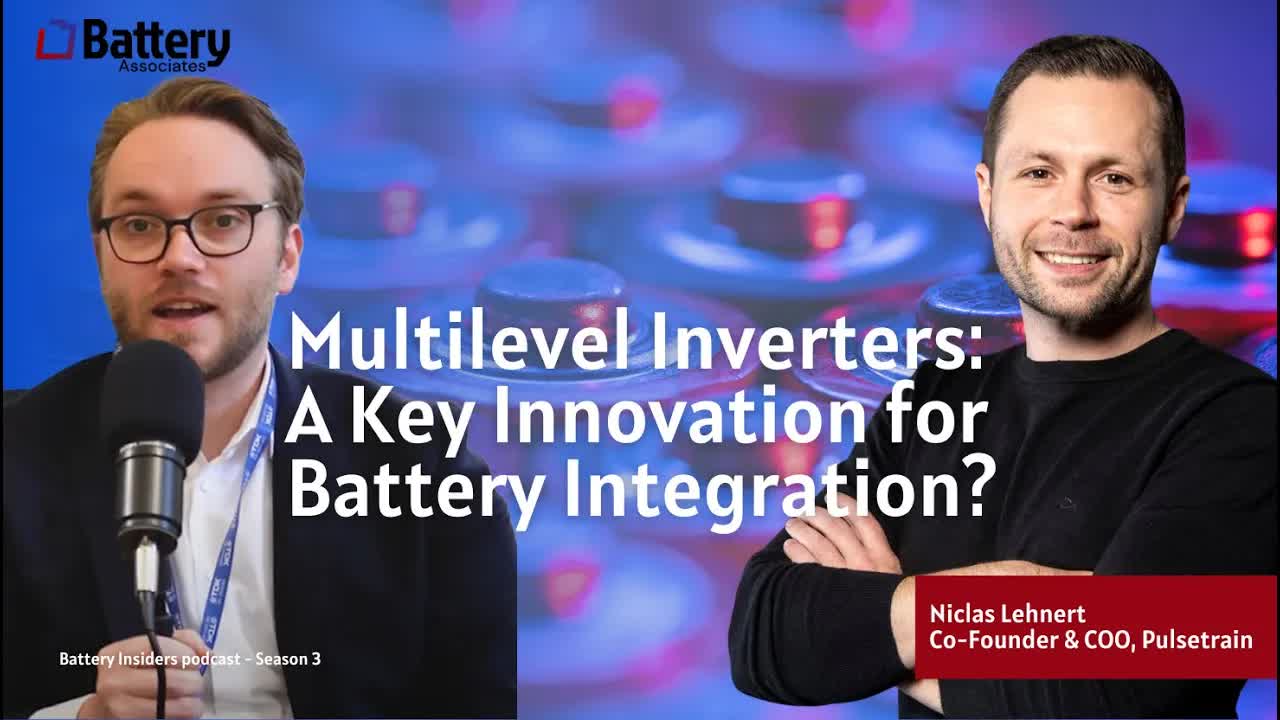
Niclas Lehnert
Co-founder, Pulsetrain
Pulsetrain develops multi-level inverter technology and is based in Munich, having spun out of the University of the Federal Armed Forces there. The company recently changed its name and Lehnert runs its operational side.
What this episode covers
In a normal battery pack, the several hundred or several thousand cells are wired in series with copper bars, and the connections are fixed. Pulsetrain replaces those bars with low-voltage MOSFETs, one per interconnection. The connection between cells becomes dynamic, and software can switch any cell into series, into parallel or out of the circuit altogether. Do that and the pack becomes a matrix that can synchronise to almost any incoming signal, AC or DC, fast or slow, and can generate a sine wave for the motor directly. Both the onboard charger and the inverter come out of the system, which Lehnert puts at up to 40% less weight for those three components together, roughly 15 kilos.
The lifetime argument follows from access. A conventional battery management system treats the pack as one entity, so it has to protect the weakest cell in it. Lehnert's illustration is a pack of a thousand cells where a single cell has fallen to 75% capacity and the rest are at full: the pack is limited by that one cell. In practice cells drift apart through environmental differences and minor production variation, and they age at different rates. Automotive end of life is usually taken as 75 to 80% remaining capacity, reached on average at roughly 10 to 12 years. Distribute the ageing evenly and that point moves later.
How much later is the open question. Simulations in the research sector show lifetime extensions between 60 and 80%, sometimes beyond 80%. Lehnert names Professor Lienkamp at the Technical University of Munich, Professor Weyh at the University of the Federal Armed Forces, and his co-founder Dr. Manuel Kuder as sources of published work. Pulsetrain has a first real-life prototype running and is checking the results against real data. He is careful about it: the tests are ongoing, he would not lean too far out of the window, but the early results point the same way the research does.
The data side is where AI comes in. A vehicle running a multi-level inverter generates cell-level data constantly, which goes to the cloud, gets evaluated, and comes back as changes to how that individual pack is operated. Conventional systems can generate data, but cannot act on the conclusions in the vehicle. Lehnert concedes the underlying datasets barely exist, because cell makers test standard charge and discharge protocols rather than this kind of use. So Pulsetrain builds its own baseline. Beyond current, voltage and temperature, the hardware can push a pulse signal through a cell and read the response as a Nyquist plot.
None of this was buildable a decade ago, because the semiconductors did not exist at a sensible price. The technology needs parts that handle low voltage and high current, and nobody was asking for them, so nobody made them cheaply. Crypto mining changed that: the graphics cards it ran on used the same class of component, and once they were on the shelf the price fell. The other blocker is organisational. Multi-level converters need hardware and software expertise tightly connected, and Lehnert says those two fields rarely come together at Western OEMs, which is where he thinks his team has an edge.
Automotive is the obvious market and, he says, a brutal one to enter: extremely cost sensitive, with high entry barriers. That leaves the premium and high-performance segment, or proving the technology somewhere else first. Pulsetrain chose the second, and picked construction machinery, where buyers calculate on total cost of ownership rather than sticker price and where power levels are lower than in a car. The company was at Bauma in Munich the week before recording. Aviation is a third or fourth option: the redundancy a multi-level inverter offers suits it well, but Airbus, Boeing and MTU struggle to certify even a replacement screw.
Questions from this episode
- What is a multi-level inverter, in plain terms?
- In a conventional electric vehicle you have three things: a battery pack with a battery management system, an onboard charger for AC charging at home, and an inverter that turns the pack's DC into AC for the motor. A multi-level inverter collapses all three. It replaces the fixed metal connections between cells with semiconductors, so software can switch each cell in series, in parallel or bypass it. That lets the pack synchronise to an incoming charging signal on its own and generate the AC waveform for the motor directly, with no separate charger or inverter.
- How does cell-level control extend battery life?
- Conventional packs are limited by their weakest cell, because the management system cannot address cells individually. Cells drift apart through environmental effects and small production variation, then age at different rates, so the gap widens. Automotive end of life is usually taken at 75 to 80% remaining capacity, which current cars reach at roughly 10 to 12 years on average. With per-cell control, weaker cells can be used less often and stronger ones more, spreading the ageing evenly across the pack, so the point at which the pack hits 75 to 80% arrives later.
- What does AI actually do in this system?
- It turns cell data into operating decisions. A vehicle running a multi-level inverter generates data on every cell while it drives. That goes to the cloud, algorithms find patterns in it, and the results are sent back to the individual vehicle so the pack runs in the state it currently needs. Conventional systems can produce data but cannot proactively change how a specific vehicle or fleet is operated. Lehnert also notes the raw material is scarce: cell makers test standard charge and discharge protocols, so Pulsetrain measures its own, including pulse response read as a Nyquist plot.
- Why is Pulsetrain starting with construction machinery rather than cars?
- Automotive is the obvious market by size and an extremely difficult one to enter, with high barriers and severe cost sensitivity. The alternatives were to go in through premium and high-performance vehicles, or to prove the technology outside automotive first. Pulsetrain chose the latter, in construction, for two reasons. Buyers there calculate total cost of ownership, so the initial price matters less. And the machines run at lower power levels than a conventional electric car, which makes a new technology easier to implement. Cars come afterwards, with better cost performance and proof points.
- What does this mean for vehicle-to-grid and second life?
- Because only software decides which way power flows, the system is bidirectional by design, and at full motor power rather than the three or three and a half kilowatts of a bidirectional onboard charger. With a 100 kilowatt motor you have, in theory, 100 kilowatts available to the house or grid, though plugs and cell discharge rates set real limits. Second life gets simpler too. Instead of opening the pack, removing cells, rematching them and fitting a new management system, you take the pack out and update the software to tell it that it is now stationary storage.
- Does it improve fire safety?
- In two ways, according to Lehnert. Better and more precise data makes anomalies that precede a thermal runaway easier to spot, so a warning can come earlier than a conventional system would give. And if a cell is going critical, the system can short circuit it, which removes almost a third of the energy in it immediately. The chemical energy is still there, so this is not a fix. What it buys is time: enough to tell the driver to get out and walk away, and enough for rescue services to reach someone who cannot.
Listen to this episodeWatch on YouTube
Part of Storage and the grid
Transcript
About this transcript. Generated automatically from the recording, then corrected against a glossary of company and guest names. It has not been checked line by line. Machine transcription mis-hears technical terms, numbers and names, so treat any figure here as a prompt to check the recording rather than a quotation of record. Spotted something wrong? Tell us.
0:00Introduction
Dr Simon Engelke
0:00And welcome everyone. Thank you so much for joining us for today's Battery Insiders podcast. My name is Simon Engelke. I'm the founder and chair of Battery Associates. And I'm really excited to have a fantastic guest with us today, Niclas Lehnert, who will talk about a really important topic, which we might often don't talk about because we're very focused on batteries. And batteries, we often think about the cells and everything which comes into it. But of course, we also have to integrate these cells into systems. And there's a lot to learn about that. And there is a topic around inverters. And Niklas has worked on an exciting topic related to multi-level inverters. And we hopefully today get a bit more insight of what this actually is. I have to admit, it was a kind of a learning curve for myself when I joined some of the sessions with you guys in the past. But yeah, I hope today as a listener, you get a better idea of this technology as well. And maybe afterwards, make a decision for yourself if you think this might be the next big thing. So Niklas, great to have you. Thanks a lot for inviting me. Looking forward for the conversation. Absolutely. So we know each other for some time. So maybe we can also kind of a bit of a background here. I've seen you around a lot of startups and founder events. And we have been in the battery sphere, especially related to Munich. And we have been seeing kind of, I think, both of our developments there. So I'm really excited to have you here. And today you're also here with a new brand name. I know it's still, it was by Virtus, now it's Pulsetrain. And maybe we can also talk a bit about that, the founding. And also, I think some of the really exciting people you brought on board to really kickstart this company and what this aim is of this Pulsetrain company to kick it off for today's episode.
Niclas Lehnert
1:37Perfect. Sounds good. So jumping right into it. Yeah. My name is Niklas, co-founder of Pulsetrain, currently taking over the responsibility for all the operational stuff because I myself do not have a tech background. Still was always interested in tech, even if I never was talented enough to do an engineering degree.
1:56From rolling out EVs to improving them
Niclas Lehnert
1:57But nevertheless, someone also has to do the operational work, which is my task in our context. And what comes with this is that I might have the ability to explain on a very high level and probably quite understandable for everyone what we're actually working on, in our case, multi-level inverters, and what the technology is about, what we can provide, and what we are especially aiming for. And our overall goal is basically to be a pioneer in revolutionary battery management and inverter technology to really reshape the e-mobility of tomorrow. And that is still a thing, even if when we are talking about electromobility, we are talking about a rather new field of mobility. But nevertheless, during the last decade, we made some really great progress in rolling out e-mobility, replacing combustion engines, bioelectric engines, really focusing on simply rolling out and implementing electromobility. And I think we are pretty much at the end of this stage of e-mobility or the new chapter of mobility. And now it's more time to really again focus on innovation, about improving on a technical level to provide the users, so every one of us or most of us, with a better user experience, with a better technology, and in the end reach a mass adoption of electromobility and really pushing this thing forward so that in the future we will basically only see electric cars and vehicles on the streets and no longer combustion engine vehicles.
Dr Simon Engelke
3:37Fantastic. So hopefully you as a listener now are intrigued. Glass is presenting as an option to really disrupt the EV industry. And especially I think these days, right, where a lot of people may be kind of a bit worried that everything's already figured out and a lot of this happens actually in Asia or comes from Asia. I think it's really interesting to see this innovation
3:52The three components in a conventional powertrain
Dr Simon Engelke
3:53we're going to talk about today. So to kick it off, for the person who's really not familiar with this topic, which I have been as well, so I can very much relate with you. So if you could maybe break down what a multi-level inverter is in really simple terms, how it works and why people should care about it.
Niclas Lehnert
4:09Definitely. I'm happy to do so. So basically to make it easy, we compare a conventional setup with a multi-level setup. And you need to imagine like the heart of every electric vehicle is basically the battery pack because the energy comes from there. And it simply makes the vehicle usable for moving from A to B. And in a regular system and in, I would say, almost all the vehicles you can currently buy in the shops, you have a three-folded system. So as a heart component, you have the battery pack, including a battery management system that is taking care of the battery cells so that you do not overcharge them, that they are operating in a safe state and simply taking care of the battery pack. And that's the job of the battery management system. The second component you have is most likely an onboard charger so that you are also able to charge at home in your regular AC grid. And then as a third component, you also have your inverters to basically transfer the DC energy from the battery pack to an AC signal that is then usable for the electric motor that you are in the end able to move from A to B because only with that you can move the vehicle. So, and in conventional systems, those battery management systems especially, they are only taking care of the battery pack as a whole. So there is almost no or only a very limited ability to really take care of the battery cells themselves as a single component. And you always need to imagine in a battery pack of an electric vehicle
5:48Replacing copper bars with semiconductors
Niclas Lehnert
5:48and it almost doesn't matter if you are talking about a car or an e-scooter or any kind of two-wheeler, you always have several hundred, sometimes even several thousand of battery cells within the battery pack to operate it. And current battery management systems are taking care of all of them at once and treating them basically as one entity. And that is the fact because those battery cells are all wired in serial, either with copper bars or any other kind of metal. But in the end, it's always a fixed connection between the battery cells. And the first and most important difference to a conventional battery management and a multi-level inverter concept is that we are now replacing those fixed connections with proactive components. So what does a proactive component mean? A proactive component in the context of a multi-level inverter is basically a very performant semiconductor. To be even a bit more precise, it's a low-volt MOSFET who is taking care of the interconnection between each and every battery cell within the battery pack. And if you are now using, instead of like a fixed piece of metal, those semiconductors, then suddenly you no longer have a passive connection between the cells. But with the multi-level inverter, you have a proactive and dynamic connection between all of the cells within the battery pack. That's the first difference we need to highlight. And the second thing that like is created out of this is that now you can also control and access all of those battery cells. Meaning that you have a better understanding of what is the state of health, the state of charge of those battery cells. And you can use them precisely as the software component, which is also a very important part of a multi-level inverter.
7:43The battery matrix, and what the software takes over
Niclas Lehnert
7:43The software component can now control those battery cells. And with this, not only has the ability like to generate data, to evaluate data, but also has the ability to switch those battery cells in serial, parallel, and also bypass in a more or less arbitrary way. So that you are now also able to, without having an onboard charger, synchronize on almost any incoming signal, AC, DC, fast charging, slow charging, you name it. And at the same time, you're also able to generate a sine wave, meaning an AC signal for the motor straight from your battery pack without using an inverter. Because when you have a proactive dynamic connection between the battery cells, what you are creating in simple words is a battery matrix. And this matrix is controlled by the software component, who is then taking care of the functionality of powering the motor, charging the battery cells, and at the same time, monitoring the battery cells, so that they are always operating in a safe state, and even more important, in an optimum state. And that is the major difference between a multi-level inverter and a conventional battery management system. Replacing passive components by proactive components, and creating a dynamic interconnection between battery cells, and with this, removing the onboard charger and the inverter from the overall system.
Dr Simon Engelke
9:13That sounds really exciting. And just to kind of, you know, understand this, so it means you really don't need these two other inverters. You only need the BMS in the end?
Niclas Lehnert
9:21Correct. So if you, it always depends what is your, like, direction you are coming from. You could either say that it is a battery management system with an included inverter functionality, or if you come from the other side, it is an inverter with an included battery management ability. I like how you bring everyone with us,
9:39Why the right semiconductor did not exist before
Niclas Lehnert
9:39like, you know, take everyone with us.
Dr Simon Engelke
9:40So, okay, great. So I guess that sounds quite attractive, right? So we can get rid of some components, you have some new capabilities there. But I guess now the question is, you know, why hasn't this happened yet? What are the challenges? And also maybe why is it time now, right? I mean, I've seen recently also other news from Porsche with some demos, and suddenly a lot of people talking about it. I know you're probably also involved in that conversation and trying to get this conversation going. But also I know you have been on this for some time. So what has been blocking it and why do you think now is the right time?
Niclas Lehnert
10:08In the past, one major thing that has been blocking the technology for really being implemented into an industrial application, into like a user experience part, is that for our setup, you need a quite specific kind of semiconductors, which are able to handle a very low voltage, but a quite high current. So that was a requirement no one was actually caring about in the past. And for that reason, like the semiconductor producers, were also not really interested in developing such semiconductors or even selling them because there was simply no demand. And then suddenly, like also roughly 10 years ago, the topic of crypto mining came into the game. And with this quite like a quite specific type of graphic cards and those graphic cards need exactly the type of semiconductor we also need, like low voltage, high current ability. And that was more or less also a Kickstarter for our technology because then suddenly the semiconductor producers had on stock off the shelf semiconductors that can also be used in our context. And with this, the price like significantly dropped for those components because obviously before this time, you could buy such semiconductors, develop them, but they would have been super expensive because you are the sole and only user of them. So no one is really interested in going into an economy of scale. For that reason, the system would be super, super expensive. And for this reason, simply not competitive, no matter how much better you are on the tech side. So the development of a new type of semiconductor in a large scale was one enabler that was missing in the past that we have now. And a second very important thing is, or a barrier that we needed to overcome was that as I already like said in the beginning, during the last decade, we've been quite focused on simply getting electric cars to the street and to the customer. And there was not so much a focus on really optimizing on the tech side. So we've been using and still using off-the-shelf technology that has been proven to work in the past. And now we are more moving and heading into the direction that we are optimizing on a tech level to really improve the user experience and the technological abilities of those electric vehicles. And that's why I think we have quite a good timing to now move into the direction and to now bring the multi-level inverter technology into the market because we have the components now. We have now the right timing that the OEMs and the Tier 1s are more focusing on the tech side again. And for this reason, I think the timing is quite right. The technology is quite right. And also the components are quite right to now have not only a tech competitive, but also a cost competitive system. And a third very important point is as a multi-level converter, always is a very close connection between hardware and software. This is also something, especially in the Western hemisphere and the Western OEMs. These are two fields of know-how
13:33Hardware and software know-how at Western OEMs
Niclas Lehnert
13:34that are rarely coming together, especially if you really need to connect them. And that is also something that is still, I would say, a kind of a challenge that some of the OEMs have to really build expertise and to build know-how, especially on the software side. And that also helps us a lot because we are quite good in this field. And I would say we're even better in connecting those two components, hardware and software, to then get to a multi-level inverter and to really optimize on a system and tech level.
Dr Simon Engelke
14:06I mean, you just brought up three interesting points, I think, for our listeners. So one, there's something else we can thank crypto for. Yeah. Establishing, which is interesting, right? So, I mean, I know there's people very interested in crypto. It seems like crypto has this good side benefit, potentially enabling this technology you're developing. The second, a topic of iteration in the automotive sector. It's very much something also through our work we're seeing that, you know, the first, you know, if you're an electric, if you're a car company, you're building your first EV, right? You're probably just trying to get it to work. You don't really have to bandwidth to kind of do all of these other iterations and modifications. But then, as you say, now that actually there are first generations are out there, these automotives are looking into what is the next generation look like? How can they improve? And of course, one of this is also on the sell side, right? Like solid-state and these things that are trying to see if they can make it work. But also, as you say now, and I can believe that, it's also looking like, you know, how can you improve the system? And we already have seen other interesting developments on the system side. So I think there's interesting timing to make sense. And then, as you said, the hardware software side working together, I think it's a really difficult thing. So I think, yeah, I can see how this is a challenge, but I can also see how if you bring it together, it can really make it effective. Absolutely. Can't agree more. Perfect. So now let's go a bit more into the topic, maybe more in depth, right? So I think one is interesting, and again, my team was also looking through your website
15:28Where the lifetime extension claim comes from
Dr Simon Engelke
15:29and your new exciting claims. So let's go into some of them. So, I mean, there's one topic of 80% extension of battery life, which is something which was brought up. And also here, topic of AI. And of course, we have to talk about AI in this time of the world. And it's another topic. How can you achieve that? Maybe also interesting, how does AI play a role here? And then, yeah, also anything you can share on algorithm, data, anything in that regard.
Niclas Lehnert
15:55So starting with the lifetime extension, again, I will more or less compare a conventional with the multilevel systems. In the conventional systems, as you're treating all the battery cells, which are within the pack, pretty much the same, because in the first place, you don't really have access to them to treat them differently. And in the second place, you also do not really have precise information. What are the precise differences? Between those battery cells. That leads to the fact that you're always treating them the same. But that also leads to the fact that you always need to take care of the weakest cell within your system. And to make a very extreme example, which will rarely be a real life example, but just to make it, like to highlight how it works, let's assume that you have a thousand battery cells within your battery pack. 199 of them are still at 100% capacity and only a single one is at 75%. Then, in most of the cases, you need to take care of this one single battery cell and you are no longer able to charge to 100% capacity, but the whole pack can only be charged to 75% because you simply need to take care of the single weak point within the system. So, that was quite an extreme example. In the reality, it rather looks like this, that all of those battery cells within your pack will have a slightly different state of health and state of charge because of an environmental impact
17:26The weakest cell, and end of life at 75 to 80%
Niclas Lehnert
17:26or because of a production failure, even if it's only a minor one. So, they are not perfectly the same over the whole battery pack. And that leads to the fact that they are aging differently or in a different pace, meaning that at a certain point, you will have quite some difference between the maximum capacity within the overall battery pack. And as you always need to take care of those weakest cells within the system, in this case, they are defining your end of life because, like, taking the automotive context, on average, we can say that when you reach a 75% to 80% left capacity, you could define the vehicle as used up and no longer be applicable for an automotive application. And the point of time when you reach this is, this is, again, only on average, there is outliers in both directions, reached at roughly 10 to 12 years for current cars which are on the street. Newer generations are performing better, but on average, you can calculate with 10 to 12 years. And that is simply because batteries are aging in a different pace. And what we can do now, and this is where the lifetime extension comes into the game, as we can really take care of those single cells and really can take care of what is the actual demand on how to treat a specific battery cell, we can make sure that the aging process is distributed almost perfectly over the whole battery pack. So you will have almost no differences between the aging state of single cells, which means that in the end, if you have a look at the timeline, the point of time when you reach your 75 to 80% simply is reached on a later point because all of the cells are aging in a similar way, meaning that you can simply move the time
19:21Data, the cloud and what AI is doing
Niclas Lehnert
19:21or the point of time when you reach your 75 to 80%. That is one point. And the second point, and this is where AI comes into the game, this is not simply possible because we have access to the battery cells, but this is also true because we can understand them. And to understand the battery cell, you basically need data. In the best case, a lot of data as in most of the AI models. So whenever a car is operated or any electric vehicle that is using a multilevel inverter, when it's operated, the battery pack is constantly generating battery data. And this battery data in the best of all worlds can then be first collected, being sent up to the cloud in a regular pace, in the cloud being evaluated. And then, and that's also a major difference to comparable conventional systems, we can then use the learnings from the patterns and the data we had, which are then run through the algorithms. we can use these results, send them back to the individual vehicle you are currently using. And with this, making sure that the battery pack is always operating in the optimum state for your individual pack. And that is a huge difference to conventional systems because even if they have the ability to generate data, they never have the ability to really proactively change something in the operational state on the individual vehicle or even on the fleet. So that also helps us to slow down this aging process as we can always make sure that the battery pack and the battery cells are operated in the optimum state they are currently demanding. So that is the point where AI comes into the game. And that is important because as you have a huge bunch of data and to really see what patterns and what results you get that basically needs to be done by AI and that basically needs to be done by models who are then operating and optimizing the algorithms and in the end the battery management software that is then implemented on those individual cars and that's where the topic of AI also comes into the game.
Dr Simon Engelke
21:37Very cool. And just to fully understand also for our listeners, so when people are aware of like cell balancing, right? Very simple form. You want to keep on the same voltage level, etc. So what you're saying now is and that's something you can do, right? Just normal system but like, you know, equalize it. And then what you're saying now is that if you now notice there is a cell which does worse, right? Like that great, more, as you said, it's 10% whatever worse than other ones. Now you could, for example, apply less of a current as a simplification.
Niclas Lehnert
22:06Exactly. So you can really individually take care of at which exact moment this battery cell is used. And if we take as an example like a standard driver's case going on a highway with a more or less constant speed, then we can really choose which ones we're using at a specific moment. And for this reason, making sure that the weaker cells are used less often and the stronger cells are used more often.
Dr Simon Engelke
22:33Okay, nice. And then I guess there's two questions to that, right? So one is, like what's the state currently on this, right? Like how much, do you have data already available like showing this, right? That you can, for example, extend the life. And then, and that's actually one interesting point. I went to a multi-level inverter event where one of your other co-founders was speaking and there was this discussion about by another company more on the industrial side application how there isn't really data available for cells like, you know, on degradation for this kind of use cases because normally people are very used to charge this charge but now what you're doing is not really a test protocol for most even cell makers, right? So, like how do you deal
23:12Research results and the first real-life prototype
Dr Simon Engelke
23:13with that and what's maybe the data or like the insights you have so far on that?
Niclas Lehnert
23:16Yeah. So basically, there is lots of research ongoing who really wants to dive deep, deeper into the topic. I can only recommend Professor Lienkamp from the Technical University in Munich who's doing some great research and there is also Professor Wey from the University of Federal Armed Forces here in Munich who's also doing some great research and that's by the way also the institute we spinned off from and of course my co-founder Dr. Manuel Kuder who's publishing a lot into this direction and there is lots of simulations ongoing in the research sector showing lifetime extensions between 60 to 80 sometimes even go beyond the 80 percent and we are currently at a state that we have our first real-life prototype up and running and are now checking on real-life data what are the actual results and as long as the results are not or the tests are ongoing I would not lean too wide out of the window but the first results we've been evaluating are definitely going into the same direction as the research in the past has shown so we are now not only relying on the research side but we are really testing in real-life or in real-life lab conditions for a specific use case already definitely showing that the outlook and the promises can be kept so that is one side and then of course besides now like the German ecosystem there is also plenty of other research institutions also in the US who are taking care of this and when it comes to the set of data I totally agree that they are almost not available and that is
25:08Pulse signals and reading the cell response
Niclas Lehnert
25:08also why we needed to first create a baseline of available data not only current voltage and temperature for example which are I would say the standards you are measuring but what we can do additionally I'm not going to dive too deep into this but the intrinsic ability of a multi-level inverter is also to not only get a DC signal over the batteries but also get a pulse signal which you can more or less imagine like an AC signal you are pumping through your battery and when you are doing this then you are getting a specific response from it and this specific response also gives you a result which is called a Nyquist plot just that I have said it but the result and the shape of those outcomes also gives you a very precise understanding of what is currently going on within this battery cell and that is something we are additionally using and also tracking to get a better understanding and to create those sets of data that are necessary to really optimize on a data perspective cool okay
Dr Simon Engelke
26:21now just thinking this further right so now you have this technology and then you said on the extension of lifetime another one is like maybe more extreme situations such rapid acceleration hypercars and maybe also vehicle grid as another application which is a big one as well where inverters I know is also a big topic and the inverters actually have some challenges there as well because they optimize maybe for one of the applications more the fast charging or more on the lower current for houses so yeah maybe we could share a bit more also like temperature fluctuations anything else where this could be helpful
Niclas Lehnert
26:53multi-level inverters as the functionality side is way way way way more defined by software compared to regular
27:03Bidirectional at full motor power
Niclas Lehnert
27:03systems gives you the opportunity to make the system way more flexible when it also comes to like non-driving applications as you already said for example vehicle to grid vehicle to home applications because in the end only the software is defining in like which direction power and energy is floating so if you have a multi-level inverter your system itself is intrinsically B-directional and not only with like three or three and a half kilowatts but with the full motor power so you can imagine if you have for example a hundred kilowatt motor within your vehicle then at least in theory you also have the ability to feed back energy or electricity to the grid or to your house with a power level of a hundred kilowatts I'm absolutely aware that most of the plugs are not able to handle such high power levels same is true for the discharging C-rates of the battery cells but in the end you do not need to take care of bidirectional onboard chargers and then transferring energy and having several interfaces which are always connected to losses and inefficiency with the multi-level inverter you are per C always bidirectional with your full power making it way more interesting to like really integrate vehicles into the public grid and also into your home grid because you simply have the power available that makes a difference in such an application that is one thing and a second very important thing especially when we have a look at the sustainability aspect is that also when we talk about second life applications currently you need to remove the battery pack you need to open it up you need to remove the battery cells you need to rematch them you need
28:58Second life without rebuilding the pack
Niclas Lehnert
28:58to put a new battery management system on top of them basically you need to build a new battery pack before you are ready to reuse them in a second life application takes time is expensive because it takes time and the process is not very lean for this reason second life applications are currently not really competitive with first life applications because in most of the cases they are simply more expensive because of that if you have a multi level inverter in your battery pack the only thing you need to do is remove your battery pack update the software so that the software now knows okay I'm in a new application I need to be a stationary storage for example and you're good to go no hardware adjustments no rematching that makes it way easier and way more realistic to reuse those battery packs coming from the mobility sector for example and for the customer the vehicle user currently if you want to resell an electric car you might face quite a hard time because the person who's buying it can never be sure what is the battery pack is it 87% is it 97% is 90% no one really exactly knows what it is and with a multi-level inverter you have always an almost perfect indication of what is the maximum capacity this battery pack can deliver to you and with this you also have the ability to define a decent price and a realistic price when you resell it so for you as a user that makes it way easier to on side buy a used car and on the other side to resell your used car
Dr Simon Engelke
30:40I can see that and maybe that's a bit of thing on the application side right so and I think there's two other companies and I guess it's the Munich ecosystem right I think one thing said is Munich probably there's one place in the world right now where most people talk about multi-level ! stationery
31:06Cost, and choosing an entry market
Dr Simon Engelke
31:07also using multi-level which I'm aware and then you also have another one instagrid which is for power so another two applications of course I would think that EV is the big one right like that's where everyone wants to go but also probably one of the hardest ones so props that you're going in there now or focusing on that you mentioned a topic of costs right and that's I think also another big challenge I would think right because you have all of these you know even though maybe got cheaper now through crypto but it's still you know a lot of kind of you know trollers you have to put into each of the cells so do you think this will be something which starts also with hyper cars and any application that doesn't make sense or do you think actually from a price standpoint this is possible
Niclas Lehnert
31:57if you're not locking into stationary then in mobility what is the most obvious case of course automotive you can see it every day you're using it likely every day and a huge market an obvious market but as you already said an extremely complex market with extremely high entry barriers and that's what we also experienced because and especially in the context of cost they are very sensitive and that also leads to the fact that you either have the chance to go over the premium and high performance segment so like the really expensive really like performance cars or the other way would be to like create a proof of market in another segment that is not the automotive so like the non-automotive market and to prove that the technology is working that it's cost competitive like also using the momentum of having first systems in the market to drive costs down and we actually decided to go
33:01Why construction machines came first
Niclas Lehnert
33:01for the second option so to rather focus on a market that is outside of the automotive market namely the construction market because what we have seen there is that the cost pressure from a system perspective is not as high as in the automotive case because the OEMs and especially the users of those machines they rather calculate on a total cost of ownership so the longer you can use the vehicle the cheaper it gets for them the more efficient it gets for them so the initial price is not that important for them for this reason like the cost component is a bit less intense or a bit less important and the second thing is that as the overall performance indicators of those vehicles even if they appear huge they most of the time have a way lower power level than every conventional electric car on the market which makes it for new technology also from a tech perspective a bit easier to get implemented and to get really a use case shaped out of your innovative development so we currently decided to first create a proof of market in the construction sector that's also why we visited the Bauma last week in Munich which was quite successful with lots of new and interesting leads and operate first on this market for non-automotive and construction machines before we then in a second step like really move into the direction of automotive with a better cost performance for sure and also with more learnings and more proof of markets or more proof points in the market that the technology is working is reliable and tearing down a bit the fear of some OEMs to really make the first step and to maybe invest into an unreliable system which it's definitely not I
Dr Simon Engelke
34:54think that's smart I think a lot of people and of
34:56Taking 40% off three components
Dr Simon Engelke
34:56course especially in the venture funded world you always look at the biggest addressable market TAM and of course automotive is usually the one people love just from the size but as you say it's just such a difficult market to go in so I think having a market where you can more easily enter and get your learnings and build up the credibility and establish your technology and then you can aim for the big world automotive of course from a VC standpoint people want to see that you can get there eventually if it all goes well but I think having a market to entry strategy on a market which is more easily accessible makes a lot of sense to me and now a question on another aspect is the rate I saw some resource on our team on your website about the rate reduction through a system and I think there was something mentioned about 40% which sounds rather ambitious so I'd love to hear about how and why
Niclas Lehnert
35:48when it comes to the weight reduction we are always comparing the multilevel inverter from our side to a regular powertrain excluding the motor because we can't replace that one so we are always comparing the on-board charger the regular battery management and the inverter weight to what the multilevel inverter is providing and as we are combining all of those three components into one component that leads to a weight reduction still having in mind that we are also an electronics component ourselves but overall you can save compared to regular on-board charger BMS and inverter up to those 40% in numbers spoken or in kilograms spoken this means on average roughly 15 kilos you're saving on the powertrain side simply because you're combining those components
Dr Simon Engelke
36:48okay that's quite significant talking about like you know
36:52Cell to pack, and what happens when one cell fails
Dr Simon Engelke
36:52advancements on the cell infrastructure cell structure and also on the system structure and how our systems are set up there's a lot of talk also about like cell to pack right is this something which would actually help your case or
Niclas Lehnert
37:06be more challenging I would actually say we are or the multi-level inverter is helping this case because if you're talking about a cell to pack approach that's non-repairable that's a throw away concept in the end because whenever you have like a minor failure the pack is done because you can't remove or repair anything within it so we rather see this if you have such a concept which definitely has some advantages and that's why it is done but if you're going into such a direction you should make sure that you can take care of this battery pack and that you can still operate it even in case if you have failures or like any problem within it without replacing the whole pack and that's why I would say the concept of cell to pack or even pack to chassis only makes sense or provides the advantages it should be if you have a multi-level inverter or a system that can handle certain levels of failure so that you are not forced to replace the whole pack or like if you have cell to a chassis and even remove the whole car if you have a cell failure
Dr Simon Engelke
38:21interesting
Niclas Lehnert
38:22yeah again there's an interesting development so definitely
Dr Simon Engelke
38:25going to keep an eye on that another aspect is you mentioned earlier also in just overcoming some of the challenges of some cells which are maybe not doing too well because there's a lot right and we have seen this also in the last years of you know big cell makers like CATL and where they go the PPM they want to go into like extreme high levels of quality meaning you know that this ideally shouldn't happen question is ever possible right you probably always have some challenges due to all kinds of the cells are too perfect and you don't need this advanced kind of different use of each of the cells because they're perfect the same so there's no way like this
Niclas Lehnert
39:14I would say as we are still talking about chemical systems which are like extremely complex whenever you scale them I do not really see a high risk by simply being obsolete because the cells are so perfect because in the end when the cells are perfect that likely means that they are more cost driven or that they're simply more expensive than cells with lower quality so whenever you have the ability to produce perfect cells that would be in general quite great from a production perspective nevertheless whenever you're applying them to a battery pack and to a final application your environmental influences so heat cold the user in the end if this is not also perfect and you can't make sure that the temperature is always perfect and that you will never have a temperature difference within your pack whenever this comes into the game no matter how perfect your cells has been in the past or from production perspective the aging process is still driven by plenty of indicators and by plenty of variables making it still important to have a system that can handle those differences and can handle those variables so I would say it would be good if we can produce high quality cells in a high number even to lower cost to lower cost but that doesn't necessarily makes a good battery management system obsolete because you still have those environmental factors and all the variables that are coming into the game whenever you applied your battery cell okay it sounds like you have a hope there so that's good
Dr Simon Engelke
41:01but I mean it makes sense I mean bit of a challenging question here but I guess another aspect is related to applications we haven't talked about yet is electric aviation we had another podcast guest Lord Edette Turner who has a bet with me in the audience the full audience that by 2070 we're going to have electric aviation mid long range and unfortunately probably won't at least in his own words he won't be around then so we can settle the bet but we have this bad standing so I guess a question for you any thoughts I know Munich had a lot of electric aviation approaches unfortunately challenges more recently but also in other regions like China and other places there's developments we're also seeing so maybe you could touch on this topic is this helping also because weight reduction and power improvement both sounds to me like aviation as well
Niclas Lehnert
41:52another point that is very important for aviation is the redundancy so whenever you have a cell failure I mean in the car or whenever you're on the ground you can simply stop the vehicle and like get off it if you're in the air getting off is maybe a bit challenging whenever you have a cell or a system failure so the redundancy that a multi-level inverter can provide is definitely also a benefit that perfectly fits into electric aviation nevertheless why we have decided against this market as an entry market is that the regulations and the entry barriers at least for like the commercial aviation are even higher
42:37Electric aviation: redundancy against certification
Niclas Lehnert
42:37than in the automotive case your development cycles and certification cycles they are extremely challenging even big companies like Airbus or Boeing or MTU are facing a significant challenge to implement new technologies even if it's only a screw they are replacing so that is a market that is definitely very interesting and where multi-level inverter definitely provides a lot of advantages the sector is looking for nevertheless for us as Pulsetrain it's a market that might be third or even as a fourth option to move into simply because it's a complex industry with high demands on quality and technology and also certification so for that reason we prefer and we decided to first stay on the ground before we go and head for the
Dr Simon Engelke
43:31sky again I think another smart approach but yeah good to hear that there could be something in that market too maybe it's the last market where we see a lot of traction with is the best like stationary batteries industry there's a lot of excitement about that because again there's interesting business cases on that in Europe but also North America and elsewhere so maybe if you could share a bit on that and also the aspect of fire safety because that's one thing which is also concern the best industry of course also in automotive and others but yeah if maybe could share on these two topics
Niclas Lehnert
44:14whenever you have better data and more precise data it's easier for you to predict or to see whenever there is anomalies within your data that might lead to a thermal runaway in the worst case and as we have more data and also more precise data for us
44:32Predicting thermal runaway, and buying the driver time
Niclas Lehnert
44:32it's easier to find those patterns and to predict a thermal runaway earlier than a conventional system could do this that is one point why I would say we are better off at this point and a second very important point is that whenever you have a multilevel inverter you have the ability when you notice okay this battery is going into a critical state quite fast to kind of short circuit the battery cell meaning that you can remove immediately almost one third of the energy that is within this battery cell because the energy is in the reason why it's taking fire or why it's catching fire so with this approach of short circuiting and that's only a very high level explanation in detail it's a bit more complex but with this approach you can take away one third of the energy that would also add to a thermal runaway immediately being left with the chemical energy that is stored within the battery cell but still if you remove the one third the thing what you get from this is that you are simply adding time to tell your user okay the battery is in a critical state already you should now leave your vehicle because the likelihood of catching fire is extremely high so please stop and walk away and whenever you are gaining time for this information and for the is in an accident and is no longer able to move every second you can add on the timeline that makes an event of catching fire from the battery side moving into the future gives a firefighter or any kind of rescue unit the chance to save you from the situation and in the end could lead to or could make the difference between surviving or not surviving such an accident so that is a quite critical indicator that something is crucially wrong with your battery cell and if you then have this data and can transfer the data to the user you simply have the ability to tell him before the event is happening
Dr Simon Engelke
47:23brilliant unfortunately I think we're out of time there's many other topics I'd like talked about maybe like solid-state and others and how this can play a role but maybe people have I'm sure Niklas is happy to provide some additional insights or on LinkedIn if you found it through LinkedIn comment as well there but for today Niklas I don't know if there's anything else you want to share otherwise we can wrap it up no
Niclas Lehnert
47:54we can wrap it up was very nice talking to you and I hope we could give a good overview on how multi !
Dr Simon Engelke
48:07I definitely learned a lot again I think you did a great job on explaining multi level inverters a bit more so yeah hopefully you found it interesting as well again reach out to Niklas if you have more questions about the technology or reach out to me as well and then yeah please subscribe and like the Spotify or YouTube or Apple podcast or anywhere