
Episode 158 · 17 June 2025 · 00:40:55
The unified cell, and the thirty years that led to it
In conversation with Frank Blome, CEO of PowerCo SE
The CEO of Volkswagen's battery company on the unified cell, why the first line went up in China, and what solid state has to prove before it reaches a car.
Read the article: The unified cell, and the thirty years that led to it
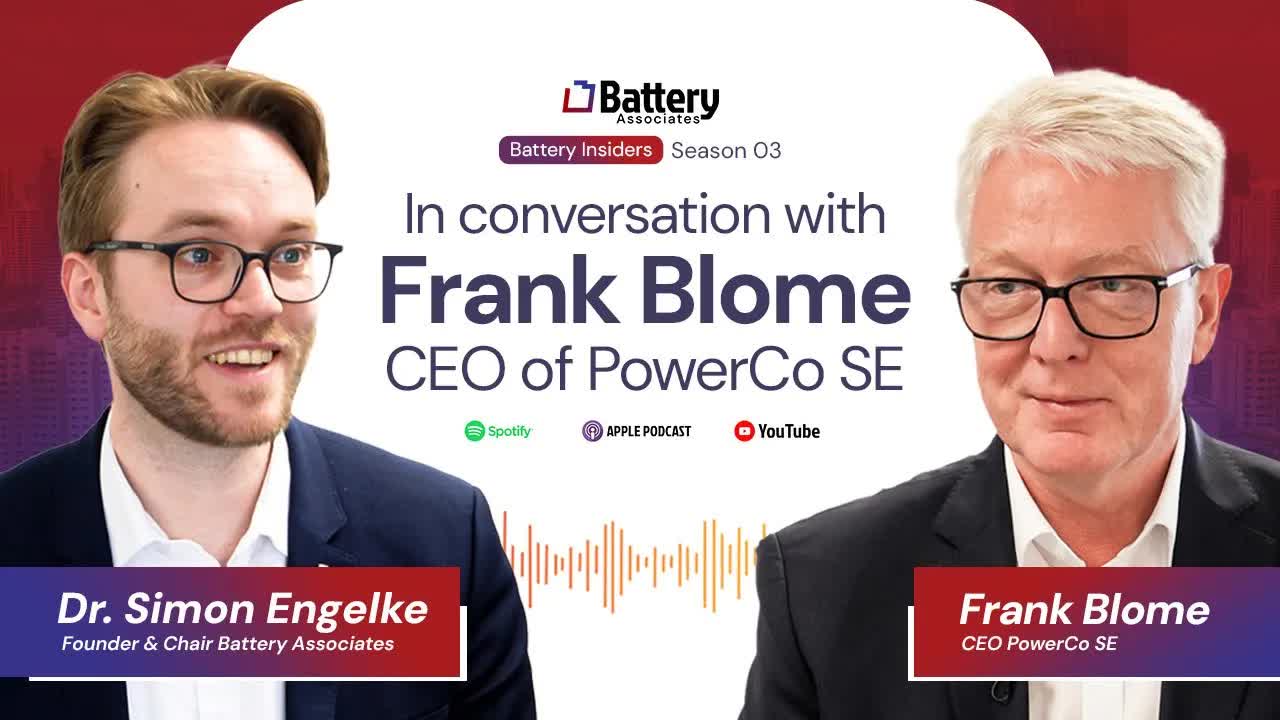
Frank Blome
Chief Executive Officer, PowerCo SE
PowerCo is Volkswagen Group's battery company, headquartered in Salzgitter, Germany, with plants under way in Germany, Spain and Canada.
Recorded in Salzgitter, Germany
What this episode covers
Frank Blome built his first electric vehicle as a student, roughly thirty years ago, by taking a small combustion micro car and fitting it with an inverter and motors he and two classmates developed themselves. They ran it first on a cable from a generator, then fitted lead acid batteries and discovered, as he puts it, that this is not a good solution. Almost nobody believed in EVs at the time.
That thread runs through the whole conversation. Blome worked on inverters, motors and battery systems through the early hybrid years, then moved into cell production at a point when the product was good and the market was not there. The Japanese, Korean and Chinese manufacturers were already producing at volume for laptops and phones, and that scale showed up in their prices. He is direct about the outcome: as a business, it did not work. Today, he says, the same asset would be worth a great deal.
He joined Volkswagen because if EVs were going to happen, he wanted to be somewhere doing mass production. He set up the Center of Excellence for Batteries, hired the team, built the test benches, and shipped batteries into the ID.3, ID.4, Taycan, e-tron and others, along with the charging specifications that let every car work at every station. A small pilot line in Salzgitter followed, on a site with a long history of building combustion engines. PowerCo came out of that in 2022.
Most of the conversation is about the decisions underneath the scale-up. Why one unified cell format across every plant, and how that makes the plant investment safe regardless of which car sells. Why the first production line went up in China with almost entirely Asian equipment, and why getting cells into test fleets quickly is what unlocks everything downstream. What PowerCo is doing with QuantumScape on a lithium anode, and what still has to be proven before it goes into a vehicle. Why dry coating improves quality, energy use and cost at the same time. And the reason roughly 80% of what the board discusses each week is cost.
He is also clear-eyed about Europe. Asia invested first and got government support that has no European equivalent, so Europe has to do a number of things considerably better to compete. He thinks it is doable, and that technology changes create openings, but not that it will be easy.
Questions from this episode
- Why did PowerCo choose a single unified cell format?
- So that the plant investment is safe regardless of which cars sell. One format carries different chemistries and different applications, and every PowerCo plant can build it. Blome compares it to the module and platform strategy used for combustion engines and axles: if one car outsells another, PowerCo can still supply the cells. He credits the wider Volkswagen Group, and Thomas Schmall in particular, with pushing the approach through.
- Where does PowerCo stand on solid-state batteries?
- PowerCo defines solid state as more than a cell without liquid electrolyte. Going down that path means a lithium anode and no graphite, which brings a weight advantage and, if everything else is done right, a cost advantage too, because you are not paying for graphite. Charging improves because lithium no longer has to travel into the graphite. PowerCo is industrialising the technology with QuantumScape now. The proof of concept has been shown; quality, production system and cost still have to be worked out. Blome would not give a date, but said PowerCo may be able to announce how it moves on within the next year.
- Why did PowerCo build its first production line in China?
- Speed. Almost all the equipment comes from Asian partners, and Blome describes the competence there as genuinely impressive. That let PowerCo build the line, scale it and get product into test fleets in a short time. The reason that matters commercially is simple: until you can show in a car that the product is reliable and hits the right cost, nobody will release it or buy it.
- What makes dry coating worth pursuing?
- It improves several things at once, which Blome says is unusual. The machinery is simpler, so the processes are less complex, which means better quality and less scrap. The machines use much less energy. And it avoids chemicals that PowerCo wants to design out of the product anyway. Less energy, less critical chemistry and less scrap all reduce cost. PowerCo is working on it with Koenig & Bauer.
- Can Europe build its own battery supply chain?
- Blome pushes back on the idea that there is nothing here. Umicore is one of the most established cathode material suppliers and PowerCo has a joint venture with them. He accepts that a great deal sits in Asia and has to come to the Western world, and thinks it will, partly because the business is here and partly because geopolitical pressure is changing how companies invest. He also expects Asian players to invest in Europe, which he does not see as a bad outcome for the ecosystem.
- How much of running a cell company is about cost?
- Around 80% of what the PowerCo board discusses in its weekly meetings. Cells are the single largest block of value in the car, so a product that is more expensive and only slightly better is a difficult sell. Blome frames the discipline as standard automotive practice: deliver the specified performance, quality and lifetime, and show up with a cost structure that works. He also notes what happens if it goes wrong. A cell plant running high scrap rates takes years to recover in margin, and he has watched that happen over the last twenty years.
Listen to this episodeWatch on YouTube
Part of Making cells at scale
Transcript
About this transcript. Generated automatically from the recording, then corrected against a glossary of company and guest names. It has not been checked line by line. Machine transcription mis-hears technical terms, numbers and names, so treat any figure here as a prompt to check the recording rather than a quotation of record. Spotted something wrong? Tell us.
0:00Introduction
Dr Simon Engelke
0:00Welcome everyone. This is Simon Engelke from Battery Associates and I'm really excited for today's episode. It's our first Battery CEO episode where we're going to talk to leaders in the battery space. And I'm really delighted today to be here in Salzgitter in Germany to talk to Frank Blome, who's the CEO of PowerCo. And today we're going to dive into one his personal story, because I think there's a lot to learn there, as well as in the story and the development of PowerCo. So again, thank you so much for joining. Frank, absolute pleasure.
Frank Blome
0:30Thank you very much, Simon, for having us and having me.
Dr Simon Engelke
0:33Perfect. So as I mentioned, today I want to start with you. And what I learned is you actually have been involved on the EV side, or you have been thinking about EVs for quite some time. I think, if I stood it correctly, even your studies, your diploma, you have been looking at EVs. So maybe if you can just bring the listener up to speed of kind of, how did it all start? Why did you start believing in EVs?
0:54Building an EV as a student, thirty years ago
Frank Blome
0:54Yeah, I was young and needed the money. No. This was after my studies, electric drivetrains. So power electronics, motors, a little bit of batteries. And these days, we were three students, Andreas, Klaus and me. And we were finally building an EV out of a combustion engine, very small micro car. And we were putting, we were developing the inverter and the motors. And finally, we built everything together, put it on a test bench and then put it in a car. And the car was driven then, first of all, with a generator, with a cable. And after everything worked out, we were putting batteries, lead acid batteries into the car and figured out that this is not a good solution. 30 years ago, yeah, was a lot of fun. And this was a start in my journey to finally go into mass productions with EV components. Yeah, but it was a lot of fun, was a great theme. And honestly, nobody believed in EVs in these days.
Dr Simon Engelke
2:03Yeah. And then also, I think you did a really exciting step to go and you can tell the story better, was Li-Tec. And we're looking at kind of building cells here in Germany, right? There's a few different companies who came together to really build battery cells and put them actually into vehicles. Maybe we can tell a bit the story there.
Frank Blome
2:18Yeah, in the early days of hybrids and I was involved in my continental days into inverters, motors and also in battery systems.
2:28Early hybrids, and making cells before the market was ready
Frank Blome
2:28First, lithium-ion batteries for hybrids and then I was asked by Mercedes to join the party. I was in charge of automotive, of battery systems. And we had this joint venture also with Evonik where Li-Tec was founded and finally developed and produced battery cells. I was also part of that. In the days when I took over the CTO job at Li-Tec, we were launching the production. That was a big adventure. I was in charge of production in these days and development, all techniques. And we had a quite good product, a quite good quality, but it was very early. Nobody was really believing in EVs other than JB Straubel, Elon, a few other guys like me. And yeah, we were producing in low volume. The product was good, but you need big investment to scale it up. And with these two partners and in the early days of EVs, this was not a, let's say, from the business scope, was not a successful adventure. I would say today this would be a big asset. In these days it was a difficult topic because, you know, the Japanese and the Koreans, the Chinese, were even not on batteries in these days. They were already producing big volumes for, you know, laptops, cell phones, cars, hybrids, everything. And with that, the scale were finally ending up in much better prices.
Dr Simon Engelke
4:01Yeah, because that's really interesting, right? I said, because batteries, you know, people didn't think about EVs at the time, right? There's like consumer electronics and it kind of came. And I think kind of, yeah, if you look then, right, so you were working on building these EV batteries. And then now PowerCo, right? Next step. I mean, you have been involved with Volkswagen for some time on the battery side. And then 2022, you started the company and you have been the CEO from the beginning. Maybe you can share a bit about, like, what has been the thought about, you know, building this battery company from Volkswagen?
4:29Joining Volkswagen and founding PowerCo
Frank Blome
4:30Yeah, this was, I was asked to join the party. I had a great time working for the Mercedes group in my jobs. But, you know, Volkswagen was big scale. Yeah, and this was finally, I came to the conclusion, if EVs really want to make it, you have to work for somebody who is doing mass production. And then I decided to join the party. Great decision. I love my job. I really had an exciting time in the beginning when we were founding the Center of Excellence for Batteries, the so-called. Yeah. So I was building this up. We were hiring people. We were building a structure and building test benches, you know, buying cells from wherever in the world, producing batteries in-house and launching cars. ID.3, ID.4, you know, Porsche Taycan, Audi e-tron, all these great cars. Skoda, Cupra. Yeah. A lot of fun. You know, charging infrastructure also was part of the responsibility. Totally new in Europe. Nobody other than Tesla had something like this. We needed to work out specifications to make sure all cars are, you know, compatible to all charging stations. You know, this was a lot of fun. And I can say there's a lot of competence in Volkswagen. We were just collecting, you know, the competencies of all the brands and made sure that all this power will end up into customer satisfaction. And then after some time, the idea came up when we were to say we need to do something technology-wise in-house for battery cells. We were starting with a small pilot line development center, small pilot line production over here in Salzgitter as part of also the transformation of automotive. Salzgitter is a very traditional location for combustion engines. And we were moving, you know, buildings, people, competencies into the new world of battery cells. And then after we successfully developed and launched a few product on a sample scale, we got the order to build up PowerCo and set up a business plan, a business model to develop cells, battery cells and produce battery cells. And then this year we will produce the first cells over here in Salzgitter in the big plant. And then we launch a plant almost every other year in Spain and in Canada. So a lot to do, big challenges, but a lot of fun.
Dr Simon Engelke
7:03Absolutely. And I think it's really fascinating also, as you just mentioned, right, now starting production here, but you already had a line also in China, right? Line Zero. And I think I've been announcing, I think, 100,000 cells or so already produced there. So what is kind of the strategy? Because if you think like, you know, the CEO hat, right? You have like, okay, on one hand, you want to build a lot of cells, right? There's a lot of vehicles you want to get batteries for at the end of the day. You want to do this in different markets. Like, how do you approach that? Like, you know, how do you balance the priorities of different markets, production? How do you track that?
Frank Blome
7:32That's a good question.
7:33Balancing markets, cost and the unified cell
Frank Blome
7:33So finally, of course, our customers and our shareholder is almost the same person. So this is an asset for us because they are pushing us a lot. They put a lot of pressure into PowerCo. But of course, they are also spending money into PowerCo. So this is lose-lose or win-win. So far, we performed well. Also, you know, cost is quite essential if you want to do battery cells today because a lot of players in the world, overcapacities, low prices. So this is a discipline you have to work out quite well. And you have to be sure with a product strategy. You cannot invest into a plant and then figure out nobody wants a product. Yeah. Then this is a big, big issue. It's a big one-timer if you end up there. That's why we did our homework first. And I can say many thanks to the whole Volkswagen Group supporting us to develop the unified cell. So that's the one format we have with different chemistries, different applications. But we can produce that in all our plants. So we will invest into plants that are flexible to do these products. The product, you know, finally, if we will sell the one car much better than the other car, we can supply cells. It's a bit like, you know, the module or the platform strategy of combustion engines, axles, cars. Yeah, we follow the same logic. Thomas Schmall, our head of supervisory board, was pushing us into that, supported us a lot to get there, and the whole Volkswagen Group did. And we are really thankful because we don't care too much about what changes in the car strategy, in the future strategy. As long as we can play with the newest chemistries in our cells, our plants will produce these cells. That makes the strategy robust. And finally, make sure that the investment will pay back. Yeah. That is the one thing. The other thing, of course, is if you want to be a, let's say, fast follower, we will see if we are fast, but we think so. A fast follower has to do a lot of things right and better than the ones who are already in the business. So we have to make sure that we focus on the right technical roadmap. And we are fast and reliable with supplying samples into test benches and cars. That's why we started also this first production line in China. Almost 100% of the equipment comes from Asian partners. And there's a lot of competence. It's really impressive what's going on over there. So finally, within a very short time frame, we were able to build it up, scale it up, and sell products into test fleets. What is quite important for the business success? If you cannot show in a car that your product is reliable, that you get to the right cost level, nobody will buy the product.
10:42Why Line Zero went up in China
Frank Blome
10:53Nobody will release it or buy it. So that's a very important proof point. We were quite fast into that with our line zero.
Dr Simon Engelke
11:02So you just mentioned kind of how you have been able to use China as a testing bread and really start ramping up there. So now you have also all of these other locations, right? Here's Salzgitter, which I think it's really impressive to see already. You're a big building there. Thank you. Hopefully one time I can also see it from the inside.
Frank Blome
11:18Absolutely. You're welcome to do so. End of the year.
Dr Simon Engelke
11:22Perfect. I will take you. I'll get up to it. So now there's a lot of discussion also kind of what's coming next, right? You already touched on. I think it's in a quite unique position that you already have your own demand, right? You know where these cells can go. There's some other companies, battery companies, which have been, you know, didn't make it because they didn't have an end customer, right? It's been a big challenge. Some others maybe haven't gotten to quality there. And you know, as Volkswagen, you know what quality is. So you have a lot of expertise there. But now, of course, on the battery side. I guess one thing I'm kind of curious, I already mentioned a unified cell, which I think is something quite unique. Also about your approach to have like one cell format overall, like prismatic across all the vehicles, etc. Another topic is also kind of what's coming next, right? So I was just spending a lot of discussion about solid-state again. Some, you know, some people are very bullish about it. Some are very hesitant about it. I know you have this partnership with QuantumScape, right? Where you're also on the board. I've been here.
Frank Blome
12:17Not any longer.
Dr Simon Engelke
12:17Oh, you have been on the board? Okay. And there's about 80 gigawatts, for example, possible, right? On potential capacity. Maybe it would be interesting to understand a bit like how essentially do you think is solid-state really in the future for automotive? Because some people think this is the breakthrough and some people think it could be nice, but not necessary.
Frank Blome
12:36Yeah, let's start from that end.
12:37Solid state, the lithium anode, and fast-charging LFP
Frank Blome
12:37So the solid-state technology, as we understand it or we define it, is not only a cell without liquid electrolyte. But we think that if you want to go the path, you have to work with a lithium anode. So no graphite any longer. This is bringing you an advantage in weight, giving you an advantage in weight. What is good and an advantage if you do everything right, also in cost, because you don't have to pay for the graphite. If not, the other components will eat up the advantage. So that is a high performance application, high energy density. Charging is better because the lithium down has to run all the way into the graphite. We see that the product, QuantumScape, develops. And we do the industrialization together right now as we speak with the team on site. That's a challenge. It's a lot of new components, a lot of new production processes. But the proof of concept has been shown. Now we have to work out whatever quality, production system, cost, to make sure finally we can bring it into our vehicles. I strongly believe in the technology because technically it's really fantastic to see it's working without graphite. It has to be robust. High energy density is also higher effort in robustness in regards to thermal propagation or other things. And we have seen really good and promising results also on that end. And we are working on bringing the technology into production. I will not say when today, but we are quite optimistic that maybe in the next year we can announce how to move on. On the other end, we work with LFP for the affordable cars. We produce already our own LFP cells. We have fast charging LFP cells on test benches where we are able to charge within, let's say, around 10 minutes. And we are in discussion with our car guys now how to implement this and when to bring it. And, of course, the whole range in between, you know, high performance, high cost and optimized cost. But less performance is in our range of development. And some of that will go on production. Thanks.
Dr Simon Engelke
15:19And then there's another technology like dry coating, right, which I think you also have a partnership with Koenig & Bauer. And I think that's also another of these technologies, right, where it could be quite some cost effectiveness, you know, and reduction, which could be interesting. Maybe you could share a bit about this. What's your thought about dry coating, like, on this technology?
Frank Blome
15:37Yeah, this is a good question.
15:38Dry coating and European machinery
Frank Blome
15:38Thank you, Simon. This is one of the technologies that has advantages in all the important areas. If you think the advantages, it's much easier machinery. So easier machinery, less complex processes, brings you better quality or less scrap. The machine is consuming much less energy and we do not have to use chemicals, what we anyway want to develop out of the product sooner or later. So on top of that comes cost. Less energy is less cost. Less critical chemistry is less cost. And with that higher quality, less scrap is also less cost. So this is one of the examples where we work on all the important topics. I'm really happy with working with German companies like Koenig & Bauer. We have other examples too, where we see that there's a lot of power still in the German or European machinery companies by also, you know, being part of the future business we believe in. Anyway, in Asia is all the history and all the high scale production of machinery, of batteries as today. But again, yeah, new technologies will change the picture.
Dr Simon Engelke
17:13Okay. So I guess my question is, if you say like, you know, like now what's your first priority? Is it about getting the first kind of production done, like the existing technology? Or do you at the same time to already have to focus on what comes next, the next generation? Because I think some kind of Asian companies are already maybe another generation working on the next one because they already figured out the one before. So just kind of how do you approach that?
Frank Blome
17:39Yeah. Okay.
17:39State of the art first, radical change later
Frank Blome
17:39So, of course, we go with what is state-of-the-art production technology in the first step. And we will, the next plant, Spain will be, you know, better, more modern than Salzgitter. And after that, St. Thomas in Canada also is getting the next step of technology. And this is more an optimization than a radical change into everything.
Dr Simon Engelke
18:05Yeah.
Frank Blome
18:05There are a lot of startups in the world who try to change everything. But this business is really cost intense, investment intense. And with that, you have to make sure you sooner or later can finance the future out of your revenue, out of your profit, your margin. So that is important. And so far, with the machinery we are buying in Asia, we are quite competitive. We have developed good products. Quality in our plant where we produce already the samples is on high level. Yeah. Now we scale up Salzgitter. Same way, same production equipment. So also robustness into the game. If you have an issue in cell production with quality and you end up in, you know, producing, I don't know, 50% of scrap. And I've seen that in the last 20 years. You need years to compensate this in your margin. Yeah. This is a disaster in your balance sheet. And that will probably never come back. So you have to make sure that you, first of all, of course, deliver what you promise to the customer, that you also deliver what you promise to your shareholder. In our case, it's the same one. And finally, it has to pay back. And you have to show up with optimizations, with innovations to make sure that you improve year by year, month by month.
Dr Simon Engelke
19:33And then, like recently, for example, I was moderating a panel at an automotive event. And I asked the audience, like, do you think batteries should be produced in Europe? Like for European EVs, should batteries be produced within Europe? 93% said yes. Then I asked, for example, some Chinese and Asian automakers. And I asked them, so what's your plan on building, you know, batteries in Europe? And they said, I mean, it would be nice, but we don't have the supply chain here yet. Like, you know, if we have all our materials and everything sorted in China, but we don't have the same here in Europe, that's a big problem we have. Like, do you have any thoughts on that? Like, how to overcome that?
20:08Should batteries be built in Europe?
Frank Blome
20:09Yeah, I think that the batteries will be as critical to the success of a car manufacturer as combustion engines. So all customer satisfaction in regarding to fast charge performance, like acceleration, weight, range, all that is finally very much dependent to the battery and to the battery technology, of course. Cost, of course, is even higher level important than combustion engine and transmission today. So yes, I think a car manufacturer, a mass production car manufacturer has to understand and have the technology, at least part of it in-house. Yes, the strategy at Volkswagen is not PowerCo. is getting 100% of the volumes. I think that's smart. I don't like it. Yeah, I would love to have 100% of the business, of course, for PowerCo. But even if we would make a decision, it would be probably impossible for us to get there within the next 10 years. Because it's a big, big effort in, you know, building it up, getting the people into the technology and also finance the whole thing. It's competence, it's speed, it's money, it's everything. But I strongly believe that we have to do this in Europe. So, yeah, why is it an Asian technology so far? Asia invested a lot into this. The companies were getting fundings from the governments, were paying no taxes, were getting electricity for free, buildings for free, and so on and so far. There's no system in Europe or in Germany to balance it out like this. So we have to do a lot of things much, much better to be competitive sooner or later. But I would say we're on a good way.
Dr Simon Engelke
22:07And I think another part is then to build up this ecosystem, right, and get the suppliers. And I know this is a big topic as well, right? I mean, we can see, like latest studies we looked at, in theory, if all the factories working out in Europe, we actually maybe have enough cells. But then there's, you know, the discrepancy between like the cathode materials, the electrodes and everything else, right, is not there at all within Europe. So what could be done to overcome that?
Frank Blome
22:30Yeah, you cannot say it's not there at all.
22:33Building the European supply chain
Frank Blome
22:33We have Umicore, one of the most traditional and knowledgeable cathode material suppliers. We have a joint venture with Umicore. And of course, there are more than just cathode material you need. A lot is in Asia. You're perfectly right on that one. And this has to come also into the Western world. And it will because the business is there. Geopolitical stress right now is pushing also companies to invest with different mechanics, let me say, to put it that way. It's not only economics. It's following also the forces of the governments or the regions. But all that finally has to be done to make sure that the end product is attractive to the customer. Everything we do, we do to satisfy our customer. What is the car brands? And they want to satisfy guys like you buying the cars. So that is finally the game. And you are absolutely right. The Asian world was faster and earlier with all that. But it's not impossible to build it up in the Western world. And we see a lot ongoing into that regards. We also see technology steps where, you know, an existing product will not be the product for the future. It will be totally different production technology and design. And with that, there are a lot of chances to be part of the game in the Western world. Probably a lot of Asian players will invest also in Europe and will have good business here with the product they already supply.
Dr Simon Engelke
24:21It's probably not a bad thing from an ecosystem perspective, right? As you said, you can't do it all by yourself. You need these other actors as well. So if they bring their supply chains, I think that would be really good. So I think that's something I personally wish, right, that we bring more supply chains to Europe as well. Not just the cell manufacturers, but also some of the supply chains as well. And then, yeah, I mean, you already mentioned some of the virtual integration you started on, kind of with Umicore and others. So, I mean, a lot is about IP, right, and batteries. So one is production excellence, which you, again, I would say Volkswagen has, there's a lot also, right, you have there. But then also IP, and again, battery IP being rather new, right, to like the, for the ecosystem. So how do you build up this IP here in PowerCo?
Frank Blome
25:02Yeah, we do a lot of patents.
25:04Patents, secret processes and freedom to operate
Frank Blome
25:04We do a lot of corporations. And we try to make sure that we, of course, are not in a jeopardy when we launch a product. Of course, we check everything. Whenever we figure out the other patent, of course, you have to, what is conflicting our design or process, then we have to make a deal with the one owning the patent. Or we have to figure out a workaround in R&D or in production technology to do what finally is without any conflict. Yeah, it's, it's, this we do anyway, also with all other components in the car. Yeah, but you are right for batteries. There's a lot in Asia. Yeah, but we also were building up a patent portfolio in the last years. What is so far is quite attractive. Yeah. A lot of the early patents are not any longer valid because they were overdue sooner or later. And with that, I would say we are quite on a good track there. Yeah. But another thing you have to, you have to work out if you want to succeed the business.
Dr Simon Engelke
26:17Yeah. It's interesting what you said, right? With LFP, for example, right? We're kind of expiring some patents. On the other hand, I forgot the exact numbers. I think it was like a few hundred a day or something. New patents filed right in China and also quite in Europe and US, et cetera. I mean, there's a lot happening at the same time, right? So is it getting harder now to kind of come up as innovation? Is it getting more dense?
Frank Blome
26:39Yeah. Yeah, absolutely. Like, you know, if you try to figure out a base patent for a combustion engine today, almost impossible. Yeah. Yeah. But for batteries, it's getting in the same direction because the new ideas can only be a patent or become a patent in a very detailed whatever application of design or production process or both. Yeah. So you're right. And this is getting more and more mature over the years. Absolutely. But you have to check what you do and you have to make sure that finally your product is not in a conflict.
Dr Simon Engelke
27:21And do you think then it's more important to have like, you know, good patents or IP strategy or processes? And of course, it's always both. But is there one which is more important?
Frank Blome
27:30No, it's both. It's really both. So finally, you have to make sure you have freedom to operate with both. And we do things in production where we even not all our employees understand how we do it. Just a few are involved. So it's a secret process, right? And then we have other things where we just file a patent. And I hope it's getting through and say, OK, this is the idea. This is what it is. And if somebody violates it, we have to talk.
Dr Simon Engelke
28:03That's also, I think, again, for a lot of people, not maybe so because a lot of people, listeners are more in R&D or research or, you know, don't know too much about it. And I think one thing is quite amazing is battery production itself. It's kind of incredible fast paced, right? Like it's really fascinating to see and kind of to optimize it. And it's really about this optimization scrap rates you mentioned earlier. Like what can we do kind of to make this more appealing to people? Because I think in Germany, maybe I've been quite lucky. Manufacturing has a big history. But I think overall, maybe it feels a bit less popular these days generally and also in certain markets. Have you any thoughts on that?
28:38Making battery manufacturing attractive to work in
Frank Blome
28:38I would say that it's not too far away from things we do in other applications. Of course, the battery industry has a few special challenges. But the production itself can be done with everything we know. And, you know, especially Salzgitter, where we have a lot of quality guys focusing on combustion engines over years. Understanding automotive business, you know, ISO TS, APQP, whatever you name it. The standard rules on how to make sure the customer is never getting a bad product. Securing everything. Same for logistics. Yeah, if we do these topics, these guys don't care if it is a transmission combustion engine or a battery cell or a battery system. We can utilize our finance systems. Yeah, how to, you know, make sure we track the costs of a product. We track how to improve it and so on and so far. How we release a product in R&D. All that is following automotive rules and standards. And it's not only production. It's a whole thing. And that finally pays back. That makes us faster. Yeah. Of course, the real battery experts then have to be people who did it already in other companies, other applications. We have a lot of people from, hired from the US, from Asia, from all over Europe, more than 50 nations in the meanwhile. And you have to do a lot that these guys are working together with all these different cultures. Yeah. And we do so, yeah. And finally, if everybody works hand in hand together, then there's a great chance to finally build up a company what pays back and makes the employees and the customer happy.
Dr Simon Engelke
30:32And then, of course, another important topic we really touched on is this cost, right? And I thought the last year has been absolutely fascinating how much cost reduction we have seen on batteries, right? That's been quite remarkable. And I think, yeah, I've been halving it. And now there's other, you know, and I remember a year ago we spoke about this a little bit about sodium-ion, right? And kind of now, you know, how competitive it is. And, of course, we have seen the lithium price go down a lot. People, some, you know, some companies believe in it more than others. So if you could share a bit more about this topic of cost, do you think it's kind of a race to the bottom and it's just about cost, cost, cost? Or is it more about innovation to come? Like what are differentiators in the future?
31:08Cost as the dominant constraint
Frank Blome
31:08Cost will be important. Cost will be important. And these battery cells are a big, big, the biggest block in the car if you talk just about the value, the cost. And with that, to bring a product what is more expensive and a little bit better is probably difficult, yeah? So the cost and the performance is important. But finally, we focus very much on cost. We have a lot, the whole board, every meetings we do every week, there's probably 80% of what we do is focus on cost. Of course, maturity of the product is important. Of course, launching a plant and make sure everybody is trained and so on and so far. But these are things we do with other products too. And we have our processes. And also for costs, we have our processes. But it's new suppliers, it's new design, it's new environment for us, probably also new markets and case by case. And all that has to be managed, yeah. On the other hand, our R&D guys from Volkswagen, automotive business and our purchasing guys are really trained to count the penny. And are really trained as a team to work it out, as a team to also create win-win situations with the suppliers. But make sure we do not spend too much. And we find the right suppliers to make long-term business relations. I'm sure that some of the suppliers see it differently. I was working for a supplier a long time in my Continental days. But finally, if the customer pushes very much on cost and is getting you there with mass production, with high volume, this is securing the company here. Of course, you have to then make sure you earn money. It's not only price, it's also cost. But the focus is very much, also for the next 10 years, will be very much on making sure you are having an attractive product. The customer wants it. The performance is what is specified. Also, the quality, the lifetime is what the customer wants. But you have to show up with a good price and a good cost structure to make it. And this is, in my world, this is standard automotive business.
Dr Simon Engelke
33:42There are a few things you touched on, right, like all these different actors you're dealing with. You have your suppliers. And, of course, Volkswagen has a big history, right, working with suppliers. But then there's also startups, right, which can bring innovation. So then you have you, right, as a company, OEM, and even now as a battery company within Volkswagen. Like, who is pushing innovation in this on the battery side? Is it like, should you try to get it from an innovative startup? Is it from an innovative supplier? Should it be all in-house? Like, what's the strategy there?
Frank Blome
34:12Yeah, it's everybody and everything.
34:14Where innovation actually comes from
Frank Blome
34:14So this is sometimes there's one example where we had a supplier who worked out a new current collector film. And this was, I don't know, 10 years ago. We could manage to run it through a coater and the oven. And finally, everybody gave up on that. And with new technologies, new coating ideas like dry coating, it comes back. And, you know, copper is getting more expensive. So this new technology has an advantage. And then you start to work on it. And it's very often it's not the one idea. It's a combination of design process and also supply chain topics. And to manage this, to figure out where is the best compromise, the best cost, the best performance. This is what our guys are doing every day.
Dr Simon Engelke
35:12And then maybe as kind of a, you already spoke about the costs, you know, the 30%. I think that makes all sense. I think two things. One is, I mean, there's also another application stationary, right? Batteries, which is, again, a big boom right now in certain markets. Also North America, we see exciting developments. Europe. What's kind of your angle to that with PowerCo as a battery company?
35:31Stationary storage and vehicle to grid
Frank Blome
35:31You know, we were setting up a business unit for stationary batteries. And it's a relatively small team. But they already are building up stationary storage systems for customers. The need is there. Of course, you know, if you want to run more and more regenerative energy, you need it. Also, my house has a battery in the basement. I have photovoltaic on the roof, of course. We have, right now we have three EVs at home because my two older kids were leaving the house already. But they also drive EV. And with that, I would love to have more electric power on the roof. But you need a battery in the basement. If not, the business case, especially in Germany, is bad. And it makes sense. It makes sense to, you know, use and utilize the energy. And we see that this comes also on grid systems, big scale. Again, we have sold some of the systems already. Technically, we are, I would say, quite competitive. Cost-wise, I would say, we are really interesting for the market. That's the feedback. And we want to play a role also in that business. But focus for PowerCo is, you know, make Volkswagen Group happy in the first step. Supply what we promised into the cars. And if, with the rest of the power we have, we also support and supply into the stationary markets. But I'm a strong believer into regenerative energy. That's the only thing what finally makes the EVs green. And with that, we need batteries. We need energy storage to make sure that we use whatever we can produce.
Dr Simon Engelke
37:19Yeah. And that's also on the integration side, right? Vehicle to grid and things. There's also some interesting, I think I heard some announcements a while back also from the Volkswagen.
Frank Blome
37:27Yeah. That makes a lot of sense. Our car guys should talk about this or our guys working on these ends. Our energy guys like Elli doing this business. We have really good ideas here. We will have good products also coming into the market. And that makes a lot of sense. Yeah. This is not that easy because a customer has to connect the car to the grid and has to allow the grid to utilize energy in and out. But this would help a lot to balance the whole thing more and more. The question is really how can you manage the thing in a market? Energy is not, you know, free trade. It has to be also controlled by the governments and follow rules to make sure everything is safe. And, you know, companies will not end up with switching off like we had the thing in Spain recently where the grid was collapsing. So with that, you need some regulations. You cannot just say, OK, it's free trade. Do whatever you want. That makes it a bit more complicated. But technically, it's feasible. And I strongly believe that this will come sooner or later.
Dr Simon Engelke
38:46Exciting. I'm looking forward to it. And then kind of maybe as a final kind of personal question, because now you have, you know, you have a place here in Europe and in Germany, Salzgitter. You also have the Operation Zero Line in China. You also have Canada coming up in Spain. A lot of different tricky time zones. So my personal work, I know it's really difficult to manage these different time zones from a client base, but also from a team base. Like, how do you manage that?
39:09Running a company across four time zones
Frank Blome
39:10Of course, you have to make sure that your calendar is following the rules. We had, if you invite the Chinese to a meeting at six o'clock in the afternoon, they show up. But you shouldn't do. This is not the right thing to do. And with that, you have to make sure that the whole company, the whole headquarter, what finally is managing the different regions, is following the rules. We were setting up the rules. And with that, we are getting into a good setup on how to bring everybody together around noon, of course. Working with Asia in the morning, working with Canada in the late hours, and Spain at the same time zone. So no problem. And you have to show up personally. So it's very important that also the board, guys like me, are showing up in the region, taking care of what's going on, supporting wherever needed, and make sure that everything is following the plan. And with that, it's a big challenge. But it's also a lot of fun if you can manage it in a way that finally it pays back. And, you know, again, employees and customers are happy. And shareholders, of course.
Dr Simon Engelke
40:30Yeah. Very important. Frank, absolute pleasure. Really appreciate your time and all of your busy schedule. Thank you. Thank you. I'm really looking forward to see this factory right over there. Maybe not. No, really, really pleasure. And a really important work. I strongly believe, you know, we need companies like you to succeed in Europe. So, you know, rooting for you. Really excited for what you're doing. And yeah, excited to see it in live person very soon. Thank you for today.
Frank Blome
40:52Thank you. Thank you very much. Thank you. Thank you.