
Episode 159 · 4 August 2025 · 00:45:30
Ten years to cash flow: building graphite outside China
In conversation with Vikram Handa Founder, Managing Director - Epsilon Advanced Materials
The founder of Epsilon Advanced Materials on why synthetic graphite got cheaper than natural, what a US plant actually costs to build, and why battery materials take ten years to reach cash flow.
Read the article: Ten years to cash flow: building graphite outside China
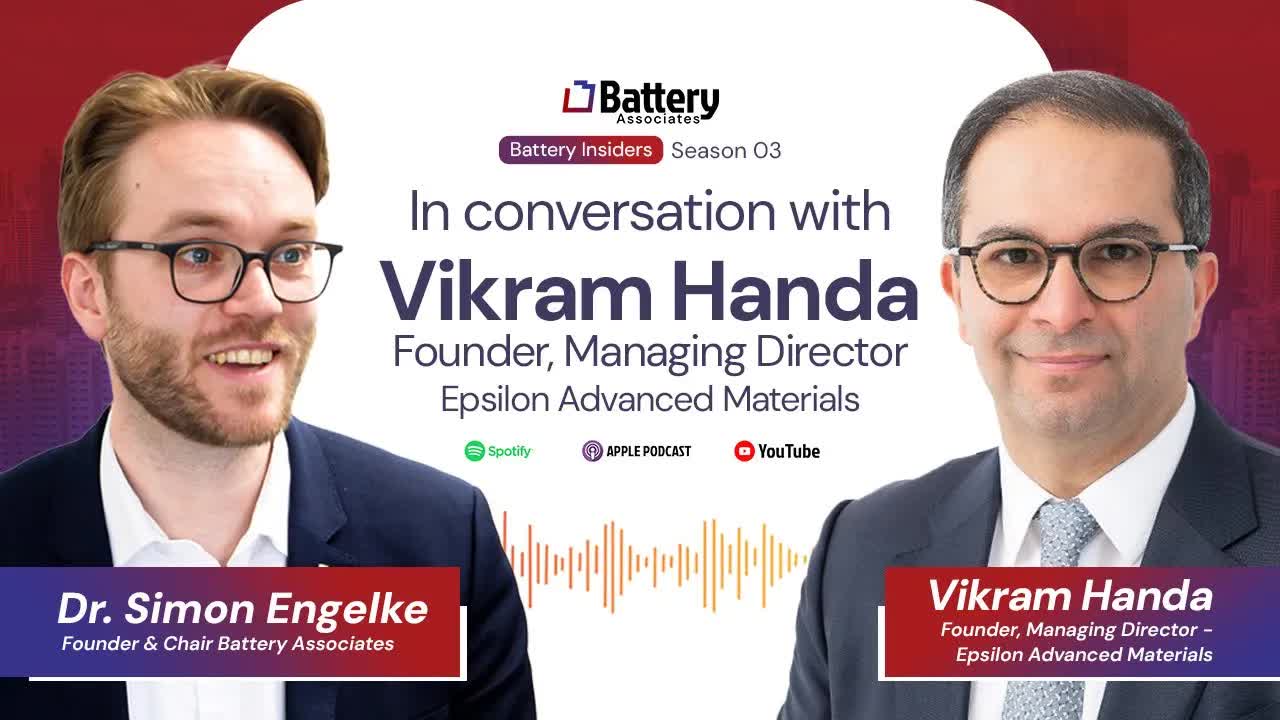
Vikram Handa
Founder and Managing Director, Epsilon Advanced Materials
Epsilon makes synthetic and natural graphite anode materials in India, with plants permitted or in permitting in India, Finland and the United States. Its parent, Epsilon Carbon, is India's third largest carbon black producer at 215,000 tonnes.
What this episode covers
Graphite is the largest material in a lithium-ion cell by weight and one of the least discussed. We name battery chemistries after the cathode, so LFP and NMC enter the conversation and the anode does not. China produces roughly 95% of the world's anode material.
Vikram Handa started Epsilon fifteen years ago taking a waste product from a steel plant and turning it into inputs for the aluminium and tyre industries. In 2019 he started Epsilon Advanced Materials to push the same feedstock forward into batteries: coal tar pitch into bulk meso-coke, then meso-coke into synthetic graphite. Chinese tier-one anode makers qualified the coke and found they could get fast charging and high capacity out of it, which is what convinced him not to stay at the coke level.
The most interesting operational detail is the coatings. Synthetic graphite needs a surface treatment after graphitisation to hit its final performance, and most producers buy two or three off the shelf. Epsilon distils coal tar already, so it makes all of them, and has developed more than twenty. Handa argues this is where the last increment of performance actually comes from, and that the customer's real complaint is never peak specification but variation between batches.
On cost, he takes apart the assumption that Chinese graphite is cheap because of scale. China built enormous merchant coke capacity on the expectation of EV growth, that capacity overshot, and prices fell below marginal cost. Most of these companies are public, so the losses are visible. Scale helps, he says, but nobody in the value chain is currently making money.
The rest is where to build and what it costs. Finland was chosen for 100% green power and has been slow to permit. The United States turned out to be the most viable place to build, partly because 20 to 30 GWh cell plants are already running there, partly because a recent trade case put roughly 160% duty on Chinese graphite, and partly because the 45X credit pays customers about USD 35 per kilowatt hour for buying locally. Power availability decided the site: Epsilon is now competing with data centres for grid connections.
Questions from this episode
- Why did synthetic graphite become cheaper than natural graphite?
- Chinese merchant refiners built very large petroleum coke capacity on the expectation of EV demand, and that capacity overshot. Coke prices fell, and synthetic graphite fell with them. Natural graphite did not keep pace because a mine takes five to seven years to bring up, and because customers kept raising their performance targets. Handa's view is that synthetic graphite can be manipulated in production to hit those targets in a way natural graphite cannot, which is why he expects 70 to 75% of the market to be synthetic.
- Is Chinese graphite cheap because of scale?
- Only partly. Handa argues the current price is below marginal cost, and points out that because most of these companies are publicly listed, the numbers are there to check. Nobody in the value chain is making money on graphite today. Scale helps, but the price is a consequence of overcapacity and of infrastructure that was provided rather than paid for, which is a different thing from being structurally cheaper to produce.
- How much does localising graphite production add to the cost of a car?
- Less than people assume. Graphite is large by volume but around 12 to 14% of a battery's value, so a 100% duty adds roughly USD 700 to a USD 60,000 car. Handa contrasts that with steel or lithium or cathode, where the same treatment hurts far more. He also points to the 45X credit, worth about USD 35 per kilowatt hour for buying locally, which he describes as close to a must-have for US customers.
- Why did Epsilon choose North Carolina, and Finland before it?
- Finland came first because customers in Italy, France and Germany were pulling Epsilon into Europe, and Finland offered 100% green power at GigaVaasa. Permitting there has been slow and is still running. In the United States Epsilon looked at close to a hundred sites and announced Brunswick County, North Carolina in October 2023. Power availability was the deciding factor, with data centres absorbing much of the spare grid capacity, alongside workforce and county-level support. Handa says Epsilon is the only synthetic graphite producer currently permitted to build in the US.
- Does synthetic graphite really have a worse carbon footprint than natural?
- Handa disputes the framing. CO2 is not the only axis: purifying natural graphite uses chemical leaching with significant water consumption, and replicating China's process elsewhere means large effluent treatment plants and hydrofluoric acid handling, which is difficult in the US. For synthetic graphite the dominant emission is power, which can be changed. Epsilon runs a lifecycle analysis on every project. Its India project comes out around 75% below Chinese synthetic graphite, the US project around 70%, driven by the power mix. His candid note: customers want this and are not yet paying for it.
- Why did Epsilon buy Johnson Matthey's LFP cathode technology?
- The processes overlap. Cathode production uses similar furnaces, similar powder handling and similar coating steps, minus the thermal purification. Handa saw no advantage in entering NMC, where established players are already backward integrated into mines, but was struck that mature LFP technology existed almost nowhere outside China. The 2023 acquisition brought around 30 people, over 100 patents and a pilot line. Epsilon has since pushed the material to a Gen 3 LFP and plans a 30,000 tonne plant in India, with iron and phosphate sourced domestically.
Listen to this episodeWatch on YouTube
Part of Raw materials and mining
Transcript
About this transcript. Generated automatically from the recording, then corrected against a glossary of company and guest names. It has not been checked line by line. Machine transcription mis-hears technical terms, numbers and names, so treat any figure here as a prompt to check the recording rather than a quotation of record. Spotted something wrong? Tell us.
0:00Introduction
Dr Simon Engelke
0:00Welcome everyone. Thank you so much for joining for today's Battery Associates Battery Insiders podcast. And I think you have a really exciting conversation ahead of us today, which is going to cover a range of topics, but specifically around carbons for batteries, a really important part, especially the graphite being also often overlooked and all the carbons across the battery components. And really also this conversation about supply chains and how to build a battery supply chain, and also a bit outside the existing regions where a lot of us have been looking at, specifically in the context of India, but also really beyond India around the world. And I couldn't be more thrilled to have a wonderful guest with us today, Vikram Handa, who is with us today from a really big company, which many of you maybe have not heard about, but we will learn much more about them today with absolute advanced material. So, Mr. Handa, Vikram, absolute pleasure to have you.
Vikram Handa
0:51Thank you, Simon. Great being here as well. Thanks.
Dr Simon Engelke
0:54Perfect. So let's get right into this today, right? So my name is Dr. Simon Engelke, and I love to have these conversations because I think they really can inform us, especially to decision making. Something I think especially today gets even more important in the battery sector. The more demanding it gets, the more decisions to be taken. So let's really start with, you know, talking about your company, Epsilon Advanced Materials and your focus on building this resilient battery supply chain, especially also outside of China, which, of course, at the moment, is really dominating the global battery supply chain. And really understanding also your core focus, right, which is in delivering synthetic and battery-grade anode materials. So I would love now to understand a bit more, you know, with your company, how you really aim to challenge, right, like to widen, let's say, the supply of anode materials. Again, right now, we know that China controls about 95% or so of the global anode production. So I would love to understand from this, where do you stand? Give us a bit of a sneak peek, who you are, what you do, and let's go from there.
1:51From steel-plant waste to battery materials
Vikram Handa
1:52Thanks a lot, Simon. So I started Epsilon about 15 years ago now out of India. We started off as a speciality carbon company where we take a waste product from a steel plant and we make various products for aluminium industry and tyre industry. In 2021, we forward integrated that business into making carbon black for tyres as well. And today we're India's third largest carbon black producer with a capacity of 215,000 tonnes. So the last 15 years, Epsilon Carbon has just been industrialising, building large-scale plants and doubling capacity in whatever area we are. In 2019, I started Epsilon Advanced Materials with a focus on battery materials. It was a forward integration of our parent business. So the coal tar pitch that we make, we developed a technology to convert that pitch into coke, particularly called bulk meso-coke. And we started qualifying with various anode companies. These were Chinese anode companies, really tier one. And they were getting unique properties based on our coke. Fast charging, high capacity. And they were able to make very unique products out of our coke. And from there came the idea that, look, we want to be part of the energy transition supply chain, but we don't want to be sitting just at the coke level. And we forward integrated. We built a pilot line to make synthetic graphite. And while we were qualifying with customers through 21, 22, 23, we started building a large-scale commercial plant in parallel. So traditionally, you kind of go through this A sample, then you build a B sample. But I felt that, you know, once we, I was quite bullish on getting through the A sample part. And then we should be ready to give our customers B sample. And I think that's what differentiated our journey to go from A to B much quicker. So we've been running our commercial plant in India for the last year and a half now. And giving customers B and C samples. And supplying smaller customers that are actually using our graphite and batteries currently. And from there, we started seeing how we can industrialize further. And we started conceptualizing a large-scale 100,000 ton plant in India. A plant in Finland. And a plant in the U.S. as well. And today we have permitted our U.S. project. We've almost permitted our India project. Finland continues to be in the process. And we are now looking to build large 30,000 ton plants, both in India and U.S., breaking ground early next year. So that's a bit of our journey so far.
Dr Simon Engelke
4:30Fascinating. And we will definitely go into some of these aspects later on as well. Well, I think to kick it off and also really thinking about our audience of the podcast. I know there's a lot of really technical people here as well. We really like to see, you know, understand beyond the technology. But I think it's very important, of course, that we also talk about the technology. Because, of course, it's also impacting a lot of what you're talking about. So maybe we can start a bit more talking about this technology using like novel synthetic anode production process. You touched on this a bit. And I think how I understand this, right, you're using or producing synthetic anodes from Meso-Coke, which is one of the derivatives of the petrochemical industry. Which, personally, I think it's beautiful in a way, right, that you take a byproduct of this industry, which, of course, right now is, you know, also impacting, right, the energy consumption, especially related to mobility. You're taking a byproduct and you find a way for the battery sector. So I think that's some of these beautiful connections people don't appreciate. But now understanding, right, so you have this really robust, I think, crude oil refining sector in India, which maybe some of you are not really aware of from our listeners. And now you have this feedstock, right, which you can use then for your raw material procurement.
5:35Bulk meso-coke, and why the coatings are made in-house
Dr Simon Engelke
5:36Maybe two questions from that is, one, really understand, right, like how does this work? Like how can you use this byproduct? And then maybe also later we can talk quickly about some of the people understanding the difference between synthetic and natural graphite. Because I think not everyone maybe fully appreciates the difference there as well.
Vikram Handa
5:52Yeah. So I think the biggest differentiator in our bulk meso-coke process is that we are focused on making the coke. The manufacturing process leads to making of coke. And one of the byproducts is oil. And that oil goes back into our carbon black plant to produce carbon black. So there's a circularity angle over there. While when you look at petroleum refineries, the coke is almost like the bottom kind of product. So they're making lots of cokes, but that's not their core product. And then what customers do is customers blend various cokes and have a recipe to give a final, say, performance in their synthetic graphite. So they might buy various green cokes, calcine cokes, and have a particular recipe that gives you fast charging, for example, in synthetic graphite. What we do is we manufacture different cokes, depending on the end user application. So if we are looking at an ESS application, we're able to make cokes that have different volatile contents, different structures, and then that gives you different performance. So that's really unique about us, that backward integration. And to be able to control supply chains, control cost, because obviously that's the singular raw material that's in the cost structure. And also, customers today are really looking for, you know, that reliability in feedstock. They don't want variations. Everybody has a high goalpost for performance. But I think the biggest pain point for customers is variation in quality. And this is where, with a very stable raw material, you can clearly have a very stable finished product. So I think that's one thing that's differentiated us. We started off our journey by developing off bulk master coke, because we developed that in-house. But the other thing that we've also developed is we've tried various cokes from around the world, and we've qualified those as well. So we're able to use coke out of Europe, coke out of the US, and some of our customers are very particular. Hey, I want a US supply chain. I want you to buy the coke here. I want you to make the product here. Some customers like the idea that, okay, you have coke in India. Why don't you ship that? Some customers like the flexibility. Hey, you can swap between cokes. If something happens to your supply chain in this region, you have the whole, say, backward integration in-house. So it's very unique. I think one thing that gets forgotten always is coatings. You know, today, synthetic graphite is, you require a coating to give that last performance, the surface treatments. And being a coal tar distillation company at Epsilon Carbon, we manufacture all the coatings in-house. So we actually don't buy anything from outside. And this has been very unique because today you see customers or, say, our peers using two or three coatings that are available off the shelf from other companies. But we have developed more than 20 different coating products. And we understand what gives what performance. And iteratively, we have a very deep understanding now of that. So I think coating is something, even though it's a very small piece of, say, your bill of materials, but it's really, really important in hitting that final performance. And that's something really unique that we create in-house as well.
Dr Simon Engelke
9:12Fascinating. Maybe I just want to highlight three really important aspects I think you just mentioned, right? And I think just one is about variability.
9:17Variability, scrap rates and controlling the feedstock
Dr Simon Engelke
9:18And we see it also from our work, right? Working with these gigafactories. I think so often I fully appreciate that you work with, you know, you have your source materials which have inherent variability because you work with natural materials. Or you now work, even synthetic case, you work with, you know, synthetic materials, but they're still coming from some other, you know, material you base them on. So there's always variability. And I think we talk a lot about scrap rates, right? And I think people don't appreciate it. And they're like, why is it not just if you have a factory running, why isn't it just perfectly running? Why is this still waste? Why is there still scrap? Why is this happening? And that's what you just mentioned, right? Like even we know porosity and these things can really change because then you have to adjust, right? Even just on the coating to make it be simple, right? On the coat, slot dye, et cetera. So I think that's one of the important things. So I think having more control of this also through what you mentioned about having more in-house, I think makes a lot of sense. I can see that. Also topic of localization you just brought up. Such an important topic right now. Looking especially in the United States case, but also other regions. We want to bring more localized supply chains more and create more resilience on that, right? And then also the topic you mentioned about in-house. Quickly understanding the in-house. So you're talking about, because maybe not everyone understands the coating. So are you talking about silicon and these kind of things? Or what kind of coatings are we talking about in this context?
Vikram Handa
10:37So I'm talking about the coating, the final graphite product. And that's very important from a surface treatment and finishing process. So after you graphitize the product, you coat it. And the customer needs that for certain properties. So that coating is very, very important. You mentioned silicon. We have also been working on silicon the last few years. We have a pilot line in India today. And we developed our Gen 1 composite product, which is close to 500 milliampere. And we plan to go to market this year with that.
11:08Silicon, blended products, and synthetic against natural
Vikram Handa
11:09There are different ways to go about this. You know, we've looked at a solution where mature customers today buy silicon, nano silicon, silicon oxide, and have it as a drop-in solution. But there are a lot of customers that don't have deep understanding. And can we go to market with a mature, developed product, which is a 5% blend, a 10% blend, depending on what they need. And then we're giving you a qualified product. And we've done the similar thing with natural graphite as well. You know, certain customers prefer natural graphite and know how to use it well. But with synthetic graphite getting cheaper over the last few years, customers have pivoted more towards synthetic graphite. It's just easier to use, easier to disperse. The properties are better. And they tend to blend. They could have a 50-50 ratio, 30-70, 60-40. What we have done is we've gone to market with a blended product. So we blend synthetic and natural graphite. Both are manufactured in-house. And we go with the blended product to the market that gives you that, say, balance between performance, capacity, cost. And we've seen that being very acceptable by customers because we take a lot of their, say, bandwidth away and go to market with a good product.
Dr Simon Engelke
12:28Absolutely fascinating. I think that's also something people don't maybe always appreciate is all of these blended hybrid formats, right? Because people think it's one or the other. But often, as you just said, it's often a mixture. Maybe just last thing on the technology before we go to cost, which you already touched on. Just for our listeners, right? So to really understand now, maybe if we could simply share the difference between natural graphite and synthetic graphite, just for the listeners who have never heard about that before.
Vikram Handa
12:53Yeah. So, again, I don't think you can classify natural graphite for EVs or synthetic graphite for ESS. I don't think you can define it because it really depends on the cell chemistry of your customer and how he has used the cathode and electrolyte or other additives as well. But we've seen more natural graphite that it is good for certain power applications. And we've seen synthetic graphite being the go-to product for EVs. And especially a secondary particle in synthetic graphite is very, very much required for electric vehicles. We've also seen that customers don't have very deep understanding of graphite. You know, they will give you a spec sheet and they say, okay, match this. But they don't have that deep understanding of what we did on our side to match that. And I think other graphite producers outside China, because obviously China has a lot of experience. But whether you look at POSCO in Korea or some of the players in the U.S. or Europe, it should really be appreciated. Because this journey to develop and qualify with customers and meet their specs is a long journey. It's a long, iterative journey. It costs a lot of money. It requires a lot of resources. And, you know, it should be appreciated that when we match their spec, we've really gone through a long qualification journey.
Dr Simon Engelke
14:13Yes, I think it's so important that you highlight that. Because I think, again, often for me, and probably someone would say this about every component of the battery. But depending on how you look at it, but I think really, especially the anode is so often overlooked. Because even from a naming convention, right, if you talk about battery chemistries or batteries, we always use just the cathode. Maybe you say it's LFP battery. Maybe it's a, you know, it's a NMC or whatever it might be. And we use this for the cathode. And, of course, we know that is maybe from the classes, right, there's, again, it's maybe a bit, it tends to mostly be graphite, right, on the other side.
14:50Why graphite is the weakest link in the supply chain
Dr Simon Engelke
14:51But then, as you just said, then there's so many flavors, again, on the carbon and the graphite side and all the additives you can put in carbon nanotubes and carbon blacks and all of these things which still play a role. So, again, and I think even also maybe one little trivia for many people, right? Like when we talk about lithium-ion batteries, and I often have the case, people are like, look, oh, lithium-ion batteries. So, it's all lithium, right? And we know, actually, it's the least, right? It's about 3% or so in there. And graphite, actually, sorry, not graphite, but carbon, it's actually the most, from weight, right, like the most common material in the lithium-ion battery. So, again, super, super important to highlight these things.
Vikram Handa
15:28Yeah, it's very important. And I think graphite, I always look at the supply chain and I say, look, you have great companies in the cathode space, like for examples of BASF and Umicore and great Korean companies. You have, obviously, great upstream lithium miners globally. You have great electrolyte companies in Japan and Korea. But when you look at graphite, you really have nobody who's matured, who's built plants outside China. And I look at, I always tell my customers, that's a huge risk. You're making large investments in gigafactories. And you're only sourcing from one region where, yes, it's all available. There's overcapacity. Prices are attractive. But the language coming out of there is also talking about export restrictions. Hey, we're going to choose who we give it to. And, yes, cost is always important. There's a cost pressure on every customer. But you've got to look at sometimes the longer five, ten-year journey and say, how do I de-risk supply chain? How do I make sure I'm ahead of the curve on performance and utilization of my plant?
Dr Simon Engelke
16:34Absolutely. And last little trivia I will drop in there and then we go to the cost topic. I was fortunate, for example, to speak with Rachid Yazami, who was a scene, right, as you could say the inventor, right, of the graphite anode.
16:44What changed to make synthetic graphite cheaper
Dr Simon Engelke
16:45And he didn't get the Nobel Prize. I think you can only award three and he probably would have been the fourth. And, yes, I think even in this side, you know, you could argue there. So maybe you have been overlooking this topic a bit too much. But going from there to maybe next topic, because you already touched on this cost. And I think it's such an important topic. It really influences the battery industry, especially today. Also applications including ESS. But I think also, especially in the Indian context, maybe even more, also maybe on some of the EV side. If you now look at this, right, so I think if you look at 2023, we saw, right, that synthetic graphite was significantly more expensive than natural graphite. It's also largely due to the energy intense production. Again, graphite, right, it's in the name, natural graphite from the ground. And, of course, can process synthetic. You get some feedstock and you produce it synthetically by just essentially simply burning something, right, like you carbonize something. But then in 2025, we have seen the synthetic graphite become more actually cost competitive. In some cases, even cheaper than natural graphite. So if you maybe could help us, it's only two years we're talking about. So what really has changed and what really has drove this cost, what drove this cost down for synthetic graphite?
Vikram Handa
17:55So I think if I look back a little earlier even, you know, everybody was talking about that natural graphite will prevail and synthetic graphite will go away back in 21, 22. And the reasons behind that were, look, natural graphite is cheaper, it's abundant, it's available everywhere, there's lots of mines, right? But the challenge was that obviously it takes five to seven years to mature a mine. And China had mined a lot of natural graphite already and they had kind of moved into Africa to start developing and investing in mines there. Just like they've gone around the world to invest in mines and, you know, backward integrate into assets. So they were mining over there, but so natural graphite was coming in the pipeline, but you again have to, you have to do what the customer needs. You have to match what he needs. And the customer's goalpost on specifications is always moving up. They're trying to get higher performance materials, higher performance cells, pack more in a cell, get more capacity, long range, fast charging. So to do that, they started pivoting more towards synthetic graphite because they said, look, synthetic graphite, I can really manipulate it in the production process and get what I really want. And to do that, there was a limitation on coke. So great coke is made in the Western world in refineries, but there's obviously a limit. There's no large investments happening in coke manufacturing in the West. But what I saw in 21, 22 in China, they were building huge coke capacity. They were like merchant refiners putting up billion dollars and just to make petroleum coke. And I said, but what are you going to do with this coke? And the answer was, oh, EVs. Look at the EV growth. They need coke. So they had the vision. I guess policy also kind of drives it to say that, look, EVs are going to grow. We're going to need more graphite. We're going to need more coke. Start putting up coke capacity. And as coke capacity grew, it also grew to overcapacity. And that put the pricing pressure on coke prices coming down. So when I look at things today, most probably the coke guy is losing money. And so is the graphite guy losing money. Just because there's so much capacity in the market today, most of them are selling below cost. There's a false impression with some customers in the West that China is cheap because of scale. I don't think that's the case. I think, yes, scale does help. But the kind of cost that they're selling it today, that's below their marginal cost. They can't be making money on that. And since most of the companies are public, you can see the numbers. And everybody is losing money in the value chain today.
20:31Overcapacity, and selling below marginal cost
Vikram Handa
20:31But they're okay. They're okay doing that. They need to run the plants and the government needs to make sure. But a lot of capacity got built. It was this policy around this is the new energy segment. And a lot of funding and a lot of investments went over there. And capacity got built up. So there's huge coke capacity. So I would, in my opinion, I would say 70 to 75% will be synthetic graphite. Just because that raw material today is available today. And it's cheap versus mines need to be explored. Investments need to be made to build those out. Fascinating.
Dr Simon Engelke
21:11And I think just a few things to add there, right? Because you also mentioned how synthetic also really grew through the ESS side, right? And, of course, we're seeing, again, China being almost purely owning, you could say, the ESS battery market even more than EV, right? Because in EV, we also have the Japanese, the Koreans, et cetera. But even on the ESS, right, it's really heavy. And maybe a small other trivia to add, because I think you just mentioned these fascinating topics of byproducts, right? And it's how this is really important in capacity building something, again, you might be pleased to know in the BatteryMBA, this executive program we're running, graphite tends to be a really hot topic. Because it's something where people really get confronted often first time with this topic. And they realize, wow, it's not something I ever appreciated for the complexity and importance of this topic from all of these aspects, from performance, cost, geopolitics, et cetera. And one other interesting, fascinating story, which we'll share there. Again, we have a really wonderful past lecture also on the difference between synthetic and natural. But one topic was shared was even on the cathode side with LFP, how, you know, again, from the construction industry in China, how their byproduct actually was a big driver for the LFP industry, because that's how you got the cheap feedstock there, right, for making cathode material. So exactly what you're sharing is the synergy effects of different industries is so important to appreciate and also the capacity building in these sectors. Because otherwise, you try, you think about building something up, you don't really understand why can another region be very different on the cost perspective or even very strategic or whatever it might be. And I think it's so important that people understand the full ecosystem because you're part of it. And I think if you don't appreciate it, it's very hard to win it.
Vikram Handa
22:45Yeah. So you mentioned LFP and obviously the titanium dioxide industry byproduct and everybody, you know, iron phosphate coming from there and everybody manufacturing PCAM at such a large scale and at such a low cost that LFP became really cheap as well. So it means today, whatever the price in China, it's almost impossible to replicate that in India or Europe or the US, right? So it's that ecosystem, like you mentioned, it's super unique and they've been really innovative as well. I give them credit to be innovative and scale up and really move fast in technology. Today, when we visit some of the Chinese companies, you know, the kind of the number of channels they have in the R&D center, the kind of people that are in the labs, they're just, you know, moving at 10, 20 times the speed of anyone else. And they have the capital and the backing of the government to innovate and do R&D. So it's amazing to see what they've done for the industry.
Dr Simon Engelke
23:48I think there's a lot to be learned there for sure. So now when we talk about this, and I think we're going from there, so we just talked a bit about this, some of the cost aspects. And now let's talk about another aspect where we touched on a little bit, but I think there's more to be discussed, which is this topic of localization and regional strategy. And you already touched on earlier, right, that you're planning facilities in India, Europe, and the United States. So, again, for listeners, which region, in your view, holds the most potential for producing synthetic graphite at costs that could rival, even though it might be challenging, Chinese synthetic graphite, and why?
24:20Why the United States is the most viable place to build
Vikram Handa
24:22So surprisingly, I would say the most viable location right now is the U.S. A, because there's already a demand established. I think the last few years, a lot of gigafactories have come up, mainly with the Korean and the Japanese cellmakers. So large 20, 30 gigawatt are factories up and running. I think the recent Trump government policy around the Big Beautiful Bill, clarifications around 45X credit. And just last week, there was a trade case that got concluded. Today, Chinese graphite has about 160% duty on it to bring to the U.S. So something that's $10 is going to be like, you know, $26 by the time it gets there. That gives the benefit or that levels the market out, let me say, for someone to make a large investment in the U.S. and build these facilities. The challenge that I think we are seeing as graphite players over the last few years to build in the U.S., I think on technology, companies have done well. I think on commercialization and scaling up, we have done well. But when it comes to industrialization and you're building large integrated plants, we have to spend a lot of money on building infrastructure. And today in China, that infrastructure is given to them free. So if his investment is significantly lower than my investment, then he's going to sell at a much lower price, obviously, to make returns. So in the U.S., the investment is really high. But this kind of anti-dumping case and the tariffs make it a level playing field where the customer looks at us now and says, hey, it's actually cheaper to buy it in the U.S. And it makes more sense for me. You know, so it's good that this clarity has come in. And I think we will hopefully see a lot of the companies like us get into good contracts and start building.
26:16What localisation costs, and what 45X pays back
Dr Simon Engelke
26:17I think that's a really timely, timely, timely insight you're sharing there. So I appreciate that. Maybe another topic then talking about this localization, right, of battery material production more generally. Do you think this would increase the cost of battery manufacturing? And then, Vidi, how do you balance this trade-off between supply chain security, which you touched on, and cost competitiveness in a global competitive market?
Vikram Handa
26:43Yeah. So if you see why graphite is large by volume in a battery, it's by value, it's about 12 to 14 percent. So if you're looking at 100 percent duty, you're not really seeing a cost of a $60,000 car go up more than $700. So I think buying more expensive graphite in the U.S. is something auto producers can absorb versus what's happening on the steel side or other minerals or lithium or, you know, cathode as well. So I think that's something, A, because the value isn't so high, it can be absorbed. But also this clarity in the 45X credit, customers are getting, I think, $35 a kilowatt hour for buying locally. That's a really big number to make you competitive. And the rules are quite clear on what they need to buy and when they need to buy from local suppliers. So I think that $35 is not a small amount. And it's almost like a must-have for a lot of the customers in the U.S. So that is why they're looking at buying locally now and the business case exists to buy locally.
Dr Simon Engelke
27:51Fascinating. So let's move on a bit on this now, this, you know, industrial strategic role in this. So, I mean, personally, I can say I think absolutely fascinating what you have been doing with Epsilon Advanced Materials and how you're leveraging, right, like industrial strategy to position and build a robust synthetic anode ecosystem outside of China.
28:09The India, Finland and United States projects
Dr Simon Engelke
28:09Maybe if you could walk us through some of your current focus markets where you touched on them earlier. We have heard, right, about the United States and Finland. But if you could share me a bit more about these projects, including your timelines and roadmaps and anything which led to this decision-making, absolutely wonderful to hear.
Vikram Handa
28:26Yeah. So back in 21, it was the customer that was pulling us to Finland. The customer was pulling us to Europe, right? And our customers mainly sit in, say, Italy, France, and Germany. But we found it difficult to build these projects over there because of the power requirement. So we went to Finland where we saw 100% green power, a location called GigaVaasa, which is a great ecosystem for our industry. But the permitting process has been very long in Finland. And so while we finished our EIA hearings, we are now in the environmental permitting stage, which I think should take another year or so. Because of the IRA, a lot of focus went to the U.S. I think the Europeans looked at U.S. Definitely the U.S. pulled in the Koreans and the Japanese technology partners to build in the U.S. So a lot of investments went into the U.S. And it was the Korean and Japanese cell makers that said, look, we really want to work with you. But because of policy, we need a clear roadmap of you to get to the U.S. So we looked at close to 100 sites. October 23 is when we announced our project in North Carolina. I would say we're the only synthetic graphite producer that today has our permit to build in the U.S. And that has been a big, say, question mark with companies that can you really build these plants in the U.S.? Can you operate them? And I think that validates our technology, our focus on ESG, our focus on safety in a high temperature industry like this. I think that's what really got us across the finish line to get permitted. We're looking to break ground early next year in the U.S. and SOP sometime in mid-27.
29:59Site selection, power, and competing with data centres
Vikram Handa
30:01In India, it's our home ground. So we have been permitting our project. We have finished all our engineering. And similar, we will look to break ground mid of next year to finish it by late-27. In India, we have already committed some volume to some customers. In the U.S., we are in advanced discussions to finalize that.
Dr Simon Engelke
30:23Exciting. That's very good to hear. And I think it's interesting, as you just said, this decision for these different regions. And even within, I think, finding the location in the United States, and you mentioned these 100 sites as you looked at, it takes a lot of time to find the best place. And this text can be quite crucial even then for the success. Because one is energy. You mentioned this is Finland. I think that's a very important point, especially in this very energy-intense process you're describing. It's a synthetic graphite. But then, of course, other topics such as talent and customer closeness and all of these things, right, which can play a role.
Vikram Handa
30:58One of the biggest challenges in the U.S. has been availability of power. You know, today with data centers sucking up a lot of the infrastructure that exists, it takes time to build infrastructure in the U.S. That has its own challenges, the power availability. So that's what really we got in North Carolina and Brunswick County was the power that we need. I think a good workforce. I think a good workforce. Good subsidies from the local county as well. So it's a really, it's a great project. And we've had a lot of support from them. And we're looking forward to building it out now.
Dr Simon Engelke
31:29Very important point about the power and the competitiveness. Other industries maybe didn't anticipate you would be competing as much maybe a year ago. If you then maybe go on this topic of validation industry partnerships, we know it's so important as a topic. Maybe if you could share a bit more about any, you know, large batch material validation you might have been doing. Any high volume cell manufacturers in the United States or Europe?
31:52In-house validation and the Tufts institute
Dr Simon Engelke
31:53If you have done so, like how have these partnerships evolved?
Vikram Handa
31:57Yeah, so most of our innovation means most of our IP generation has happened ourselves. I think one thing we work very closely is with the Japanese testing centers. And we found that there's a lot to learn from the decades of experience, their ability in making good cells. And this is something we've done in-house as well. We have back in 2020, we set up a lab that does everything in-house. So our iterative journey was much quicker. So all the material characterization, coin cell, pouch cell, multi-layer pouch cell, we're able to do everything ourselves. So what we've done is we've correlated ourselves with customers so that we are replicating what they do as well. We are continuing our innovation journey. And a few months ago, we announced a collaboration with the Tufts University in Boston, where we're going to be setting up a Tufts Epsilon Materials Institute and focus on innovation around battery materials and solve new energy problems. So I'm very excited about that. And we're just getting that off the ground in the coming months because we see a lot of innovation happening in the US. And how do we really think eight to ten years ahead in solving these problems?
Dr Simon Engelke
33:12Very good. I think thinking forward is quite important there, especially on the timelines. Now, last two topics to go to. Maybe one really important topic of ESG, environmental sustainability considerations. Again, natural graphite typically has lower carbon footprint than synthetic graphite. So maybe what are some of the steps you as Epsilon have taken to close this ESG gap? And do you believe that synthetic graphite could eventually match or even outperform natural graphite in terms of a carbon footprint?
33:45The carbon footprint argument for synthetic graphite
Vikram Handa
33:46Yeah. So I think this conception that natural graphite has a lower carbon footprint is not necessarily true because you also have to look at the impact on water. It's not just your CO2 emissions. You have to look at your water consumption to make one ton of natural graphite. China has definitely mastered the chemical leaching process to purify natural graphite. I think that process in China is done at a very low cost. But the moment you want to build that industry outside China, similar to what we're discussing on iron phosphate as a PCAM, you have to have a lot of water availability. You have to have large ETPs using HF today in the U.S. is very, very challenging. So these are things that don't let you build what they have built and definitely not at that cost structure. So when we look at synthetic graphite, we say, look, one of our biggest raw materials or biggest CO2 emissions is power. Can we get greener power? And what does that impact us? So whenever we look at a project, we actually look at we do an LCA around it. And that's what really helps us. The lifecycle analysis helps us identify, yes, this is where we want to build a project. And this is how we're going to achieve these targets. So our project in India, for example, is about 75% lower carbon footprint than how China makes synthetic graphite. And the U.S. is about 70% just because of the power source that's available to us, the power mix. So today, customers are not appreciating that. I think, you know, they want you to be greener, but they're not paying you the price for it. But I think that's going to come over time as more and more focus comes on recycling, on how are these materials made? What is your carbon footprint? How does that fall into cascade into the carbon footprint of the battery in the car? I think that's what will differentiate companies like us from others because we focused on this when we built the projects out.
Dr Simon Engelke
35:48I think it's also a really important point in this topic of traceability and visibility, right, in these topics of materials. And I think especially in initiatives such as the battery passport, right, which is too common to play in 2027 as a European Commission requirement. So I think that's one that provides more traceability and visibility potential on this topic. And then also, as you just mentioned, there's new requirements which are coming, I think, especially, again, in the European context, which have maximum thresholds, right, for carbon emission in the process, which, of course, graphite is one component. And even though from a cost perspective, it might be lower as a 12% or so you mentioned, but again, from a carbon footprint, it can, depending on what it's hosted, it can have a role which could be reduced. Maybe one last quick question just curious. Is, like, hydrogen playing any role there as well to reduce emissions or is it less of a topic?
Vikram Handa
36:40Not yet. I think what we're seeing today when we talk to companies, it's more around solar, wind, even nuclear power or solar and wind with the energy storage to give you round-the-clock power. I think that's how today we are looking at greener sources and reliable power. I don't think hydrogen has reached that cost structure yet. Yeah.
Dr Simon Engelke
37:02Yeah. I'm only mentioning, and you're right, I think the cost is the biggest challenge there, especially if you go into green, right, like hydrogen, because, yeah, again, of course, you can take gas and refine it or, like, process it quickly. But that doesn't give you this carbon advantage, which is what you're after. Great. And then maybe also one topic, we touched on this a bit earlier, this topic beyond anodes. In 2023, you acquired Johnson Matthey, Germany, LFP Cathode Tech Center, based in Germany.
37:31Buying Johnson Matthey's LFP technology
Dr Simon Engelke
37:32And maybe can you walk us a bit through your thought process on this acquisition and what's your vision, right, on your role for cathodes and generally beyond the animaterials itself for the battery value chain?
Vikram Handa
37:43Yeah. Yeah. So, I was, we were, we understood that our process is quite similar to a cathode process in the sense you have the same furnaces, you deal with powder, you coat. So, a lot of the equipment was similar, obviously not the thermal purification part. And I felt that we have no advantage if we go down the NMC route. We have great technology companies. You have some that have backward integrated to mines and we won't have a play there. I was surprised to see in, back in 22, how, how large LFP was in China and why it wasn't leaving China into other, other countries. And everybody was focused so much on NMC. So, we went out looking for LFP technology and we realized that it's actually only exists in China at a mature level. Everything else is like really early stage. And we have gone through a six-year journey to scale up and develop technology on the graphite side and own our IP. So, we were lucky to get this acquisition of Johnson Matthey, which is about 30 people, a lot of IP, more than 100 patents and a pilot line. And what we've done since the last year and a half of taking it over is, again, gone back. They had fallen a little behind in material development just because the Chinese move so fast. And we worked on accelerating the material development to a Gen 3 LFP. And now we've made a roadmap on commercialization. It means it's incredible how fast LFP development is moving and performance is coming closer and closer to NMC. And it validates being in EVs and ESS, obviously. So, our goal is to now build a large-scale facility in India. We have secured iron and phosphate sources within India. And lithium is something we're open to sourcing from anywhere in the world. But the idea is to build a large 30,000-ton facility in India. When I look at our whole business, you know, we started off as an anode company. We have now in a cathode company similar customers, similar thinking on cell performance. I would say, and we also have a recycling business, by the way, that we've been running in India for the last two years. End of life, production, scrap. So, when I look down three or four years, I look at it as a company that hopefully we've been able to marry our anode and cathode and provide a good solution to customers. We definitely don't want to make cells. We don't see that as our business. We see ourselves as a battery material solution provider. And we want to be able to create that circularity with our own recycling business, where recycled graphite is going into virgin graphite. Lithium is getting recovered and going back into lithium. And we're really able to provide the customer a solution that meets performance, ESG, and cost at scale. So, that's where I think the business is going. That's why I'm trying to drive it.
Dr Simon Engelke
40:33And that's fascinating. Also, really, with the latest developments of export restrictions, of higher performance LFP, especially outside of China. So, I think it could be quite timely. And I think, as you said, is how it's getting closer and closer to NMC, especially also due to packing. Pack intensity, where some blade and all of these technologies, which were developed in China's BYD and others. And also this topic of, you know, less cooling. And so, there's all these side effects, which I think people haven't been as much appreciated. And again, from the scale effects, with it being the pure essential chemistry for stationary, right? Where all ESS is essentially by NFP. And it's entering more also into the EV side. So, I think it's really fascinating to see that you're in this area as well. And I can definitely see the synergetic effects to the work you've already been doing.
41:18Why owning the IP matters more than licensing it
Vikram Handa
41:20I think it's really important to own your IP. I think it gets overlooked when people look at commercialization. But obviously, you need to commercialize. You need to get to market at the appropriate time. And the market is now, I would say. But you need to really innovate. And you need to keep up with what's happening in that part of the world. Because they're moving at lightning speed. This is not an industry where you license and you build something. Because by the time you build something, the industry is moved ahead. So, you need to always be up to speed. And I think that know-how needs to stay within the company.
Dr Simon Engelke
41:56I think that's a really fascinating point, which probably resonates some of the listeners. And I think it would be something interesting to take away. Maybe final personal questions before we wrap it up. I would love to, kind of just on the personal side, ask you. I mean, hearing all of this and seeing a bit of the developments I've been doing with your company. And really starting founding the Epsilon Group. And building this giant, what it is today. And I think I would really encourage people to look up what you're actually doing. Because you've been quite casual about it. But it's very significant for someone to create an organization. But like what you have created. What are some of your personal takeaways? Building an organization like that. But then also really building an organization in the battery sector. What are some of your learnings, takeaways you might want to share with others who listen today?
Vikram Handa
42:45I think one of my biggest learnings has been that this is an industry that takes time. I think you need patient capital. You need to be in it for the long run. And you need to be really committed to what you're doing. And you really need to innovate. I think there's a lot to learn from industry, academia as well. I always tell people who look at this space and say, oh, it's so fast growing.
43:09Ten years to cash flow
Vikram Handa
43:10But that doesn't necessarily make you a winner. I think it requires a lot of hard work, a great team to really get there and deliver something as a business. I always tell people that when you look at battery materials, the day you decide to enter it, it's 10 years to cash flow. So you're going to do R&D. You're going to build a pilot line. You're going to scale it up. You're going to qualify. You're going to build a large plant. You're going to see cash flow. So you have to be ready for that commitment. But innovation is the key. And you need to do that. You need to spend a lot on R&D, a lot on equipment, build your capability in-house. And I think that's my biggest takeaway when I look at what we're building.
Dr Simon Engelke
43:54I can so relate to that. And I really want to highlight that. Yeah, I think it's so important, as you said, about the constant learning, the constant. I think you have to be humble in this sector because you always have to expect that someone else is moving faster somewhere. And I think it's really important. And to have this constant appreciation of learning, constant knowledge, you have to, one, you want to absorb, but also you want to generate yourself. It's something even with us, right, with battery associates to have this, to really see ourselves as a knowledge company and really pushing that. And I think it's so important to really move this forward. And I think it's really not fully appreciated by all the stakeholders in the sector, which is fine. But I think more and more are waking up to that aspect. So, now, Vikram, I just want to really, really thank you for the time. I know you have a very busy schedule. So, I really want to appreciate you taking the time today. I can tell you from a personal side, it was an absolute pleasure speaking with you today, hearing a bit more on the developments you have been doing and you are pursuing. And, yeah, for the listeners, I just want to thank you as well for spending your time with us. Again, time is so important. So, if you take the time out of your day to listen to us, I absolutely appreciate it. And, yes, this was Simon Engelke with the Battery Insiders podcast. If you're curious to learn more, please make sure you listen to some other episodes, either on Spotify, Apple Podcasts, YouTube, wherever you listen to your podcasts, on the Battery Insiders. And, yes, again, Vikram, thank you for your time today, and we'll be in touch.
Vikram Handa
45:22Thank you very much, Simon. It was wonderful. Thanks, everyone. So, Simon, great questions, by the way. I hope the listeners find it interesting also. And because...