
Episode 160 · 24 September 2025 · 00:58:19
Until you master production, innovation is PowerPoint
In conversation with Yann Vincent, CEO of ACC
The CEO of ACC on the 20 to 25% gap with Chinese manufacturers, why he wants production support rather than tariffs, and why he is glad he never built in the United States.
Read the article: Until you master production, innovation is PowerPoint
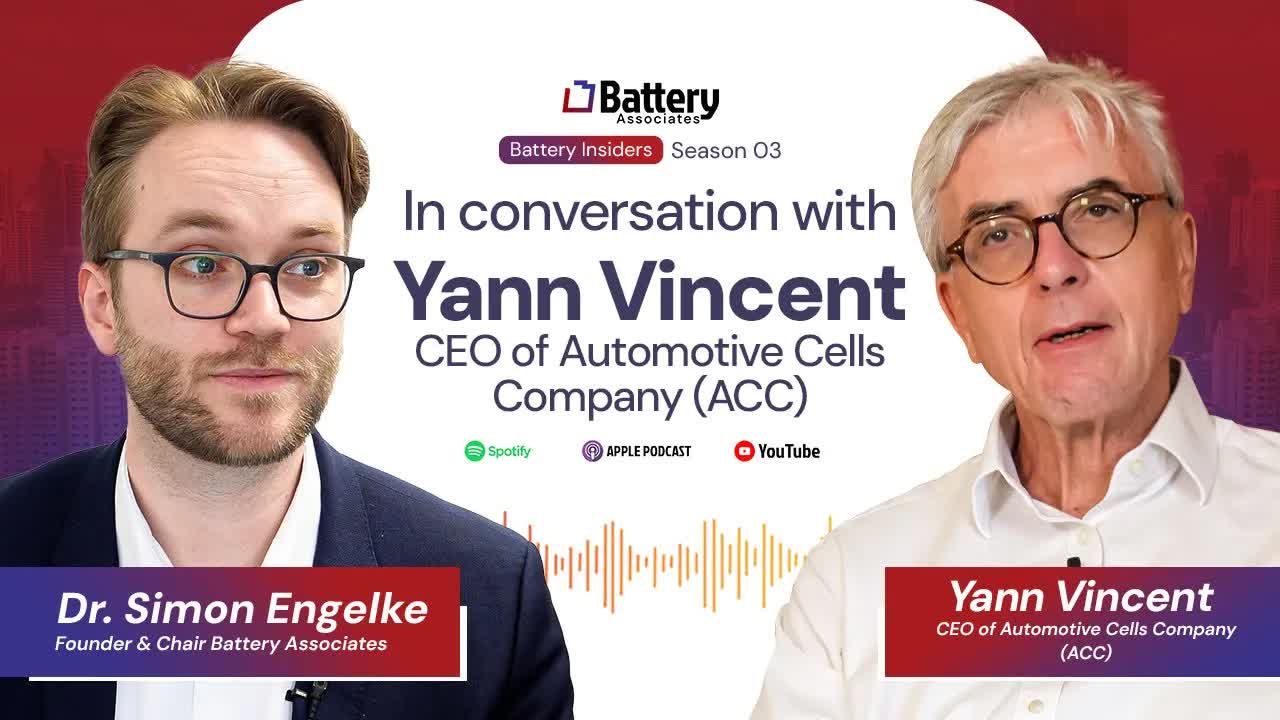
Yann Vincent
Chief Executive Officer, Automotive Cells Company (ACC)
ACC is a European battery manufacturer backed by Stellantis, Mercedes-Benz and TotalEnergies, with an R&D centre near Bordeaux, a pilot plant at Nersac and a gigafactory in northern France.
Recorded in Paris
What this episode covers
Yann Vincent describes himself as an old car guy, which is close to how other people describe him. Twenty-seven years at Renault across engineering, production, manufacturing and quality. Chief operating officer of AvtoVAZ in Russia when Renault took its stake in 2008. Head of manufacturing and supply chain at PSA from 2014 to 2020. He took the ACC job at 63, on the reasoning that nobody appoints a 63-year-old to run manufacturing at a newly merged carmaker, and that this was a one-in-a-life project he had never done before.
The build is five years old and the numbers are concrete. ACC started with 20 people in August 2020. The R&D centre near Bordeaux now has around 800. The pilot plant at Nersac, near Angoulême, has around 250 and has run since early 2022. The gigafactory in northern France produced first samples in early 2024 and started delivering serial batteries for serial cars in September 2024, with about 1,100 people and a move to five shifts after the summer. A second block next to it starts production at the end of this year. Around 2,200 people in total.
Vincent puts the competitiveness gap with Chinese cell makers at 20 to 25%, and is precise about why: they started 15 to 20 years earlier and have moved down the learning curve, they were heavily subsidised on capex, their energy is cheaper, they work harder, and they currently have overcapacity pushing prices down. He thinks Europe can close it in under five years, given two things. Energy cost, where he quotes a European average of EUR 190 per MWh against about 100 in France and about 50 in the US and China. And access to raw materials on the terms China gets them, through state-to-state agreements that price at cost plus rather than market minus a discount.
His third condition is the one people find harder to hear. Europe should partner with Chinese cell makers to speed up its own learning, through joint ventures with IP transfer and a European majority. His framing: at one point we were the teachers and they were the students, and we now have to acknowledge that this has reversed.
On support, he is firmly against tariffs and firmly for production support. Tariffs raise the price of the Chinese cells that European carmakers will keep buying for years, which makes life harder for customers already struggling to cut EV costs. He points at the IRA's USD 35 per kWh at cell level plus USD 10 at module level, calls it close to half the cost, and says Europe is moving on the equivalent very slowly because of a doctrine that subsidises innovation rather than production. His answer to that: the money is already spent building this industry, we are in the Death Valley now, and funding new projects instead of the existing ones wastes what has gone in.
The line most worth keeping is about R&D. After five years in the industry he is convinced you cannot innovate before you have mastered production, because until then everything related to innovation is PowerPoint. That is the reasoning behind staying on NMC rather than widening the chemistry portfolio, and behind treating the ramp as the only thing that matters right now.
Questions from this episode
- How far behind are European cell makers on cost?
- Vincent puts ACC at 20 to 25% more expensive than Chinese cell manufacturers. His breakdown: they started 15 to 20 years earlier and are further down the learning curve, they received substantial capex subsidy, their energy is cheaper, they work longer hours, and current overcapacity is pushing prices below what the cost base would suggest. Labour cost, he notes, is a minor part of the difference.
- Can Europe close that gap, and how long would it take?
- Under five years, provided ACC does its own homework and Europe helps on two fronts. Energy cost, where he quotes about EUR 190 per MWh across Europe against roughly 100 in France and 50 in the US and China, and electricity is a major cost driver in a cell. And raw materials, where Chinese cell makers buy under state-to-state agreements signed with Indonesia, the Congo, Argentina and Chile, which typically price at cost plus rather than market minus a discount.
- Tariffs or subsidies?
- Production support, clearly. Vincent's argument is that a tariff raises the price of the Chinese and Korean cells European carmakers will keep buying for years, which hurts customers who are already under pressure to cut EV costs. Production support closes the same gap without that side effect. He points to the IRA's USD 35 per kWh at cell level plus USD 10 at module level, which he says is close to 50% of cost, and notes Europe is moving slowly because of a principle that innovation gets subsidised and production does not.
- Why is ACC staying on NMC rather than adding LFP?
- Because innovating before you have mastered production is, in his words, PowerPoint. ACC is focused on NMC to strengthen its bedrock in engineering and manufacturing, and will widen the portfolio later. He also lists LFP's liabilities: there is no European supply chain for it at all, possibly one in Morocco eventually, and recycling it does not work economically because iron phosphate is too cheap, which would mean producing black mass in Europe and shipping it to China to be refined. Public forecasts put 2030 at 70% NMC and 30% LFP; Vincent thinks those are wrong and it may be closer to 50-50, but not 0 or 100.
- Is European demand the constraint on ACC's expansion?
- Not yet. European demand for 2030 has come down to roughly 600 GWh from forecasts of 1,000 GWh two years ago, but ACC's capacity is 30 GWh, which is about 5% of that. Both gigafactory blocks in northern France are fully booked by Stellantis and Mercedes. What matters first is proving ACC can deliver the requested volume at the required quality. Expansion in Germany and Italy is on hold until then. On the US, he is blunt: he is really happy not to have invested there, because he would be sitting on idle assets.
- Does building bigger gigafactories make them cheaper?
- Not much, in his view. The manufacturing process is completely inflexible, so the more you invest the higher the risk, and there are few genuine economies of scale in manufacturing itself. You get better equipment prices at volume, and you amortise engineering across more product, but that is largely it. His observation on the industry: people were extremely excited about building the biggest factories ever.
Listen to this episodeWatch on YouTube
Part of Making cells at scale
Transcript
About this transcript. Generated automatically from the recording, then corrected against a glossary of company and guest names. It has not been checked line by line. Machine transcription mis-hears technical terms, numbers and names, so treat any figure here as a prompt to check the recording rather than a quotation of record. Spotted something wrong? Tell us.
0:00Introduction
Dr Simon Engelke
0:00Today on Battery Insiders, we are joined by Yann Vincent, CEO of Automotive Cells Company, or ACC. ACC is a European battery manufacturer backed by Stellantis, Mercedes-Benz and TotalEnergies. They build gigafactories to power Europeans' clean mobility shift and to strengthen the continent's battery independence and industrial resilience. In this episode, we hear from Jan, the origin story of ACC and its vision for Europe's battery dependence. We cover battery cell costs, local supply chains, chemistry choices, EU regulations and sustainability. We also explore ACC's $4.4 billion financing, the impact of EV demand on expansion plans, what's next, including potential moves beyond automotive into energy storage and next-generation battery technologies. If you are keen to understand the European automotive and battery landscape, this conversation is for you. If you enjoy our podcast, make sure to subscribe so you never miss an episode. And if you're looking to take your knowledge even further, check out our BatteryMBA at battery.mba. It is our flagship program designed to help professionals upskill, connect with global experts and stay ahead in the fast-moving battery sector. And with that, let's jump into today's conversation with Jan from ACC.
Yann Vincent
1:16Hello, good to see you.
Dr Simon Engelke
1:18Hello. Thank you for having me here. I'm here in Paris, beautiful Paris, today talking to you, Yann Vincent, about Europe, about batteries, about manufacturing in Europe, about the challenges and opportunities. And I couldn't think of a better person to talk with right now on this topic, especially here in France. I think there have been a lot of interesting developments more recently or some challenges, and we want to talk about them today.
Yann Vincent
1:47Thank you very much. We're going to talk.
Dr Simon Engelke
1:50Thank you. And my name is Simon Engelke, founder and chair of Battery Associates. And the goal of this conversation is to really share insights with the audience about leadership,
2:00Twenty-seven years at Renault, then AvtoVAZ and PSA
Dr Simon Engelke
2:01about hard decisions to be made, important decisions to be made, and how we get batteries at scale and all the relevant industries connected to it. Very good. Very good. Let's go. And I think I would love to start with you, because I think you are quite a fascinating character. I want to let you know, like, I spoke to a few people who know you rather well in the past, and the real accomplishments about manufacturing and your time for new, and then, you know, Nissan and the things coming from that. And what I heard about you, you're really a person about, like, it's difficult, and it's about real manufacturing, not a motor space. You're the one to call.
Yann Vincent
2:38Well, I don't know if it's... Well, first, it's very pleasant, but I don't know if everything is true. Basically, I'm an old car guy. I'm an old car guy. I spent 27 years working for Renault in engineering, production, manufacturing, quality. I was the chief operating officer of AvtoVAZ in Russia when Renault took over 25% of the shares of AvtoVAZ at that time in 2008. And then I led the manufacturing and supply chain of PSA from 2014 to 2020. And in 2020, ACC was created, and I joined ACC to start this venture.
Dr Simon Engelke
3:32And, I mean, probably many of the listeners know about ACC, but I think it'd be interesting if you can maybe share, like, what's exactly, what's the setup, the current setup? What was the idea behind starting it and where we are right now?
Yann Vincent
3:45Well, I mean, ACC was created in August 2020 after, let's say, one year and a half of negotiations between the two shareholders.
4:00Why ACC was created, and what Mercedes added in 2022
Yann Vincent
4:00At that time, there were two, Saft Total, Saft being owned 100% by Total and PSA. So, long discussions between the two shareholders and long discussions with Europe in order to get subsidized. And the idea was, and it's still the same idea, was at the time of the energy transition, which will impact the mobility, European car manufacturers can't rely on a supply chain which will be only an Asian one, not to say a Chinese one.
Dr Simon Engelke
4:48That's right.
Yann Vincent
4:49Because, I mean, everybody does understand that in view of the cost of a battery, in view of its importance on the functional specifications of the car, you need to get some sovereignty, let's say.
Dr Simon Engelke
5:06Right.
Yann Vincent
5:08So, that was the initial intent. And one more time, it's still the same intent. We've been joined in 2022 by Mercedes. And Mercedes was pursuing the same idea, building a European champion for engineering and manufacturing batteries for automotive car manufacturers. Yeah.
Dr Simon Engelke
5:34And it's actually beautiful because I remember August 2020 quite well because that's also when I started with Battery Associates. Okay. Some story, but I think, so where are we now? You mentioned called Mercedes-Droid 2020 and then, like, you know, what has it been like? What's the status right now? Like, how many people? What's the setup right now we're talking about?
Yann Vincent
5:51Well, so, as I've said, we did start the venture in 2020.
5:56From 20 people to 2,200 in five years
Yann Vincent
5:57And at that time, we were 20 people. I mean, the ones who had been part of the pre-project, I mean, of the discussion between the two shareholders. We did create, firstly, our R&D center in Bruges, so close to Bordeaux. And as of today, roughly 800 people are working in that R&D center. Then we built a pilot plant in Nersac, close to Angoulême, which started its operations beginning of 2022. And as of today, we have 250 people, roughly, working in that pilot plant. And then the first gigafactory in north of France, which we started to build beginning of 2022. We started the production of the first samples in this factory beginning of 2024. And we started delivering batteries, serial batteries for serial cars in September 24. Nowadays, in the gigafactory, we have, it's changing any single day. So we have 1,100 people. So all in, we have roughly 2,200 people within ACC. We keep on recruiting in this first gigafactory because we're going to switch to five shifts after the summer break. And at the same time, we're building a second capacity close to the first one. So construction is well advanced. We are installing the process in this second capacity. And we will start the operations in this second block.
7:56Taking the job at 63
Yann Vincent
7:56That's the name we give to this construction. We'll start the production end of this year.
Dr Simon Engelke
8:04That's exciting. And it's a lot to go from 20 to over 2,000. That's right. So I'm personally very far from that right now. I mean, I can already appreciate, you know.
Yann Vincent
8:15Scale is not always an asset.
Dr Simon Engelke
8:17No, yes. I can imagine. Maybe just quickly before we go more like, you know, on costs and things, some of the market trends. I would love to understand maybe also your own aspect there, right? So if you, like, why did you decide to go from the automotive side to actually yourself, right? Like going to this. Like what was your own thought process behind?
Yann Vincent
8:41Well, as I've told you, I'm an old man. I'm an old man. And in 2020, that was a few months after the signing of the deal between FCA, so Fiat Chrysler and PSA. And I had discussions with Carlos Tavares on what I could do in the future. So at that time, I was 62, only 62, only 63, by the way. So, and I was willing to keep on working. But I knew at that time that I had spent six years running the manufacturing and supply chain of PSA. I won't run the manufacturing and supply chain of the merge company. I mean, you don't appoint a guy who was 63 in a new company. So we had discussion with Carlos. And he did propose to me to take over the position of CEO of ACC. See, I mean, I had heard of ACC because we were regularly discussing in the frame of our executive committee at PSA level this project. But honestly, I was more focused at that time on manufacturing and supply chain stuff. So I had not a lot of time to think about it. But I came very quickly to the conclusion it's a one-in-life project. I've never did it. I've never done it. It's exciting. So I jumped.
Dr Simon Engelke
10:37Oh, exciting. I think it's because I think it's so interesting. The more I also talk to leaders like yourself in the battery space that I think it's interesting. So different approaches. I think there's this kind of like, you know, it's I'm young and I want to make it, you know, I want to build something really big. Or I'm like, I actually have an achieved career where I know what manufacturing means and I'll bring it to a new sector.
Yann Vincent
11:00Yeah, but I mean, I could add that the nature of this project was for me, DDP for me, immediately highly interesting because it's a project for e-mobility. And e-mobility is a way to reduce the carbon footprint. And I do believe that with something to do for the planet. So maybe it's not a lot. But I mean, we have to do it. So first point of this project. The second point is that it's a way for regaining some sovereignty, which Europe has lost.
11:51Sovereignty, and giving powertrain plants a future
Yann Vincent
11:52And finally, we knew and I knew particularly that in the frame of the energy transition, we PSA, we would have to shut down some powertrain facilities. And bringing this new activity of batteries production did appear to me as a way to have a smoother transition, to bring to those powertrain facilities a social solution to something which would have been otherwise a disaster. I mean, one week ago was announced that Francese de Mécanique, where we did set up a first gigafactory, will close in the near future. Which was almost certain because we won't buy any more in the future. I don't know exactly when, but we won't buy any more ice. I mean, it's not a drama. And it's not a drama because simply we've already recruited people from this factory, in all factories. So, I mean, it was a project which was resonating in my mind for doing at my end of career something I'd never done previously. But it was as well a project which has a strong purpose.
Dr Simon Engelke
13:43No, and I think it makes sense. And I feel a lot of people are drawn to this topic because of that, because it's very purpose. Yeah. It has a strong purpose. And that's, of course, how we feel as well, you know, as battery sources. But also, you know, I have the bachelor MBA in training, and that's what a lot of people say, right? They want to be part of something really meaningful, wherever I stage that in their career. But let's now, because I know there's a lot of questions which probably a lot of people want to ask you. So, I want to start with that. And I think the first one would be really this topic of cost and battery cell cost. And I feel it's probably, I don't know, if you're like me, that maybe keeps you awake at night. So, let's talk about that. And I think especially in the context, right, with China, and you already touched on that, where we have seen these prices continuously fall over the last decades. But even especially the last one or two years, it's been remarkable, right? Like halving battery costs, like, it's really aggressive on the cost reduction, which, again, can be many reasons for that, from economy of scale, oversupply is a big topic. But now, as you're this European-focused battery manufacturer, like, what is kind of this benchmark you're looking at from a battery cell cost? Does it even exist? Or is it actually not really stable enough? And what do you kind of, to hope maybe to get even at steady state? What do you think is realistic here in Europe? And if you could provide any numbers, right, for our listener to get a feel for that.
Yann Vincent
15:00Well, I won't give any number. Because it's, I mean, you might say a lot of stories. I mean, depending on the raw material cost, I mean, it's... Chemistry and everything. Chemistry, etc. Having said that, what's pretty clear is that we're lagging behind Chinese. We're lagging behind Chinese cell manufacturers for a different set of reasons. First one being that they've started this industry 15, 20 years ago. So they've gone down the learning curve. Second, because indeed they've been significantly subsidized in terms of capex.
15:47The 20 to 25% gap, and where it comes from
Yann Vincent
15:49Energy cost is highly competitive. They're working a lot. They're working a lot. They're working a lot. They're working a lot. So it's clear that we're not yet at the level of competitiveness of the Chinese cell manufacturers. I consider that we have between 20 and 25%. We are 20 to 25% more expensive. By the way, I didn't mention the overcapacity they have currently, which is as well driving down the prices. Then the real question gets, would it be possible to catch up? And do we need to catch up? So to this second question, I'm really convinced that what's at stake is the future of the European car industry. I mean, if we imagine that 100% of the supply of the battery would be the Chinese supply and that it would have no impact on the European car industry, it's a huge mistake. It's a huge mistake. So if we were to come to this extreme, the bargaining power would have shifted 100% on the Chinese side. And I really consider that it would be a major mistake. So I really consider that if we are willing to keep on our automotive industry, European automotive industry,
17:46Why catching up matters to the European car industry
Yann Vincent
17:47and I think it's worse for the citizens because all the European citizens are attached to the individual mobility. And so if we want to keep this industry, we need having a supplier's European industry. Not to say that the European car manufacturers are going to be supplied only by European suppliers, but a reasonable mix has to be achieved. So to the second question, I strongly believe that we need to catch up. So then the question is, is it possible to catch up? Is it possible to catch up? Labor cost is not that important. It's a minor part. What I consider is that. Under five years, we should be able to catch up, provided we do our homework. So we have to improve with, obviously. Provided we be supported by Europe in two directions. The first one is the cost of energy. Just to take this cost driver, average cost in Europe of electricity, 190 euro per megawatt hour. In France, it's pretty good, 100. In the US, in China, 50. And the electricity cost is a major driver of a battery. And then there is the question of access to cheap raw materials. And it's very often that the Chinese cell manufacturers be vertically integrated till the mines.
19:42Energy cost and state-to-state raw material contracts
Yann Vincent
19:43Or that they be supplied in the frame of contract agreements, which have been signed between China and the different countries. Indonesia, Congo, Argentina, Chile, etc. And consequently, the cell manufacturers make procurement, only procurement, under contracts which have been signed by the Chinese public authorities. Could be done similarly by Europe. And it might be a major asset. Because, I mean, when you're signing a chunquat directly from state to state, generally, it's a cost plus. When you're buying on the market, you buy maybe at market minus a discount, but not cost plus. And it might make a significant difference, obviously, depending on the market conditions. Finally, the last point. I do believe that we have to partner with China. We have to partner with Chinese cell manufacturers in order to speed up our learning experience. I've said previously that, let's say, that they did start 15 or 20 years ago. They've got a lot of experience, a lot of expertise. And, I mean, it would be, let's say, arrogant to pretend catching up without being supported at some point of time with them. So, we need at European level to, I mean, to do what China did previously.
21:38Partnering with China: now we are the students
Yann Vincent
21:39I mean, simply at that time, we were the teachers, they were the students. We have to acknowledge that now we are the students and they are the teachers. But that's the way it is. So, enforcing joint venture with transfer of IP in Europe with a majority shareholding for the European company. So, something like that. For me, that's the way to bridge the competitiveness gap. And, in the meantime, and that's going to be my final word, in the meantime, and that's what we are requesting from the European Public Authority, is that we won't catch up overnight. As I've said previously, it might take up to five years. During these five years, the competitiveness gap has to be bridged. Otherwise, what's going to happen? The European car manufacturers will say, okay, we've helped you for the first product. But, I mean, for the second one, if you're not at par with your Chinese competitors, what should we buy from you? And it would be a disaster. So, that's why we are asking for a production support similar to Aira, which has been enforced in the U.S.
Dr Simon Engelke
23:20That's interesting. Maybe a quick question on this one, right? Because I agree with you, right? It's important to have a local industry. And I think also catching up with China, I think. It takes, I think, there's important things to do. I guess, quick question just on the last point you mentioned now.
23:35Tariffs against production support
Dr Simon Engelke
23:35So, one is, because there's two approaches, right? Like, one is more the carrot and one is more the stick, right? And I think you now spoke about getting production support, right? And manufacturing. And, of course, on the U.S. side, there's been a lot of developments in this regard. And maybe not everything is anymore as it seemed a few years back. Do you think it's more about getting subsidies or government support? Or do you think it's more about, like, tariffs, which is kind of maybe what North America is taking to keep competition out for a while until you can cut? Like, what's the way to go for Europe as well?
Yann Vincent
24:04Well, I mean, things are pretty simple. I mean, as I've said, there's a competitiveness gap between Chinese products and all products, European products. Right. So, in order to bridge this competitiveness gap, either you set tariffs and, as a consequence, you increase the selling price of the Chinese products. Right. And in that case, you make the life of the European carbon manufacturers, which will keep on being supplied by Chinese or Koreans for a significant period of time. You make their life more difficult. At a time where they're facing very hard times, they need to cut the cost of EV, et cetera, et cetera. Or you're bridged by your production support. Right. So, clearly, I'm much more in favor of a production support. Much more. I know that for public finance, that's obviously not the same thing.
Dr Simon Engelke
25:13And I think it's interesting as well, because when I talk also with, you know, the Chinese counterparts of the big manufacturers, and some of them, you know, came to Europe or are coming to Europe, because they also see, you know, it's an important market. And they know there's interest in localization, but even a lot of them are struggling, because it's not that easy to produce for them here either, for many reasons. And we will go into some, maybe, then in future episodes. And, of course, one is, right, if you have maybe a tariff, but then they come here, how can you do a tariff against them if they're producing here locally? Right. So, that's one. And I think the second thing is really, even for them to produce it cost-effectively in Europe compared to Asia or China, it's not really possible right now. So, they're a bit of a similar build there.
Yann Vincent
25:53Well, I mean, let's be clear. What matters is having an industry in Europe.
Dr Simon Engelke
26:09Yes, that's great.
Yann Vincent
26:10To create jobs, to strengthen the society, etc. I mean, if we do have Chinese plants in Europe, that's fine. That's fine. So, that's the first point. The second point is, I mean, I'm discussing a lot with Chinese cell manufacturers, and all of them are telling me, it's not easy to set up a factory in Europe. Are we talking to the same people? Yeah. Even CATL is funny. Of course, they all are. And, I mean, they perceive ourselves as a way for them to help them in the knowledge of the regulations, in the connection with public authorities, in the knowledge of labor habits or regulations, etc., etc. So, I think there's an interest to pull them in Europe, but partnering. Yes.
Dr Simon Engelke
27:24All about partnerships. We'll talk more about this later. I think now, because you touched on this really important topic of supply chain.
27:30Building a European supplier and equipment base
Dr Simon Engelke
27:31And that's also, again, for the same, when you talk to the Chinese or Asian counterparts in Europe, they're also having these challenges. But you actually have been quite embracing a local strategy, what I would say, for European battery material supplier like Umicore and Talga Group. So, what competitive advantage and disadvantages do you see in establishing a fully European battery material supply chain?
Yann Vincent
27:52Well, I mean, the first point is that we need absolutely to be consistent. It's clear that we will never be 100% sovereign. I mean, 100% sovereignty doesn't exist. It might happen that for a certain part of a machine, there is only one country which is producing this part. But on the other hand, if we consider the battery value chain, we won't be 100%, we won't be sovereign to a significant extent if we don't have a supply chain in Europe, if we don't have an equipment supplier basis in Europe. And it's far from being the case. So, for me, the value of the partnerships we have with Umicore, not with Talga, with Umicore, is clearly consistent with getting more and more sovereign. It's, I mean, it's viewed by our customers as a must. They want us to be sovereign. They want us to reduce our exposure to China. And there's still a lot to do in that matter. I mean, Talga, we're not partnering with them, but refining of graphite is almost 100% performed in China. So that's something we need to improve. And as well, we need to grow an equipment suppliers industry in Europe, which is not the case for time being.
Dr Simon Engelke
30:07I fully agree. And I think if we then talk about materials, then we can also talk about battery chemistries, because that's, of course, very much connected. And now we have seen a massive rise of LFP. I mean, I talk a lot to automotive customers and the sea level there. It's quite a headache for them, too, because they have made a few plans, let's say, on NMC chemistry. And, of course, automotive, that's still, especially in the luxury segment, or like the premium segment, playing an important role. But now we have LFP and also LMFP, lithium manganese iron phosphate, and even sodium-ion batteries. There's another kind of bucket there. Like, how do you deal with that? And what do you see as kind of, I think you have an NMC strategy for now. What do you see? How do you navigate this?
Yann Vincent
30:45The first point is that the cost of a NIRRI has to go down. That's the major driver. It has to go down. It's not the only hurdle for adoption by the European citizens, but it's the first one. The first hurdle by far. The cost gap with ICE is still much too wide.
31:23NMC, LFP and what the 2030 split really looks like
Yann Vincent
31:24So, hence, we need to, I mean, the car manufacturers have to reduce this gap. And, obviously, we have to contribute to this reduction. Once we've said that, it's clear that LFP is cheaper than NMC, 20% roughly less. But the energy density is, as well, 20% less. So, our view is that a share of the market will consider that having a lower autonomy is fine. But they will accept, therefore, to have LFP batteries. They will not know, but they will arbitrate between the price and the range. But a significant share of the market will remain driven by the range. And, therefore, we'll accept to keep on paying for this range. We're relying on forecasts, which are public forecasts, which consider that NMC share could be 70% in 2030. LFP, 30%. So, I guess they're wrong. I guess they're wrong. But it won't be 0% or 100%.
Dr Simon Engelke
32:59I agree on that.
Yann Vincent
32:59Maybe it would be 50-50.
Dr Simon Engelke
33:02Right.
Yann Vincent
33:03The last point is that, maybe not the last one, but something to realize for LFP is that LFP has a lot of benefits, a lot of assets. But it has, as well, some liabilities.
33:20Why LFP recycling does not pay, and where sodium-ion sits
Yann Vincent
33:20There is a non-supply chain in Europe. Zero. Maybe it will exist in Morocco. That's the first point. Second point is the recycling of LFP. It's not to say that technically it's not feasible. Yes, it is feasible technically. But economically, it doesn't fly. And it doesn't fly because iron phosphate is very cheap. It's too cheap. So, would it be awkward to produce black mass and to send the black mass to China in order to be refined? Yeah. Would it be strange? And the last point. So, we are obviously assessing regularly those alternative chemistry, the LFP, LMFP, you mentioned as well. sodium-ion. sodium-ion, it's interesting. With the lithium cost, as of today, it's not at all interesting. Not at all interesting. If the lithium goes up, and it might in the future if the demand is high, then it becomes very interesting. So, I mean, we are regularly assessing those stuff. But we are indeed focused on NMC.
Dr Simon Engelke
34:50Maybe one quick follow-up question on this as well is, of course, what technology didn't necessarily direct the chemistry, but also a topic like solid-state, right? Which has been a hot topic and always goes back and forth in automotives. Having all the demo cars now, and we can argue of that. What a solid-state and all of these things. Too much for now. But I think one kind of quick thought and solid-state, but then also in general, your approach between you have to master manufacturing first of one chemistry and one technology.
35:17Master production first, or innovation is PowerPoint
Dr Simon Engelke
35:18And then maybe you can, or like, how do you balance manufacturing with R&D, the next generation, the current generation, these things?
Yann Vincent
35:25Well, I mean, I would imagine. I mean, after five years in this industry, I have a strong conviction that to innovate, first, you need to master your production, your manufacturing. As long as you're not mastering it. I mean, everything related to innovation is PowerPoint. Everything. So that's the reason why we've decided to focus on NMC, to strengthen our bedrock, both in engineering and in manufacturing. And then we acknowledge that we have to expand our portfolio at some point of time. I've said that the market should be 70% NMC, 30% LFP, maybe 50-50. But surely that there will be a demand for lower cost chemistries. So we love to add this low cost chemistry to a portfolio, but not now.
Dr Simon Engelke
36:31And I think that's, especially looking at all the other market stakeholders we have seen, if you expand too quickly, too fast, it doesn't always work out. Maybe now two quick things combined is, I get a lot of questions about the European battery regulation. Schema is quite busy. We have been involved with battery associates a long time. I've been involved with my own for a while. So maybe, quick question on this, do you see it more as like an opportunity or more like a burden? One quick thing on this. And then also, I think, concretely more on the sustainability recycling topic. Because there's this interesting one. I mean, there's many interesting aspects in this regulation. But one of them also that you have, so, you know, the battery passport, recycled materials. But also, you have to reuse recycled material in future batteries, right, in 2030, et cetera, depending on how it gets rolled out.
37:15The battery regulation, and the paper tiger problem
Dr Simon Engelke
37:16What do you think about these two things, like burden, opportunity, and then also what's in there, how to deal with that?
Yann Vincent
37:23Well, I mean, the purpose is a good one for sure. I mean, pushing for recycling, for utilization of recycled materials is a good thing. And it's consistent with the way we want to reduce the resources consumption of the planet. So that's really fine. Then, pretending to set barriers to the entry of Chinese products with regulations on CO2 content. For me, it might turn out to be a burden. And at the same time, being a paper tiger. Because, I mean, I guess it will be very easy to demonstrate that you buy green electricity certificates. So it will be very easy to turn the renovation. So I have to say that I'm a bit skeptical. Yeah.
Dr Simon Engelke
38:47I think that's fair. Then maybe talk about financing, right? It's a big one. I'm sure it keeps you also quite busy. It's, you know, if you now look, I mean, you have these loan packages, I think, including 4.4 billion. You see substantial federal and local incentives. Like, how do you think the European financing ecosystem is responding to the battery industry? Is access to private capital at affordable interest rates sufficient currently?
39:11Financing, shareholders and the Death Valley
Dr Simon Engelke
39:13What's your view on EU's incentives packages, especially in comparison? You already mentioned a bit just some of the mass investments you've seen in China, but also in the U.S. Like, essentially, is Europe doing enough? Or what would you recommend also to the policymakers listening? There might be a few of them out there.
Yann Vincent
39:27So first point, we've been significantly supported by the public authorities, particularly by the French public authorities, since we built our R&D center, our pilot plant, and our first gigafactories in Europe. So it's significant. We received less than 1 billion euros, which is a huge amount. Second point, we're strongly supported by all shareholders. So TotalEnergies, Mercedes, Stellantis. And it's not easy for them, one more time. I mean, if they're supporting a company which is only five years old, whereas they could supply themselves from Korean suppliers or Chinese suppliers, and considering the cost of this support, because it's an industry which is highly capital intensive, the only reason is that they want the sovereignty. They want the sovereignty. And they're ready to pay for it. Doesn't mean that they're happy with paying what they are paying. I mean, they're putting a strong pressure on us, which is completely understandable. So that's the second point. Then, is it sufficient? And we've recently turned to the European Commission, asking them two types of supports. One is we've spent more for capex and for launch costs than we were forecasting. And it can't be of surprise. I mean, we're building something which didn't exist in Europe. We didn't know. So we've made some mistakes in our forecast. I mean, I'm much more knowledgeable on the cost of a gigafactory now than I was five years ago. So that was the first demand. And we've recently got a positive answer in the frame of the so-called Innovation Fund 24, which is a significant help. And the second part of the support we are requesting is the production support for bridging the gap competitiveness. Competitiveness. And one more time, coming back to the IRA in the US, was possible to get $35 per kilowatt hour at cell level, plus $10 per kilowatt hour at module level. $45 per kilowatt hour at module level. It's huge. I didn't mention previously the cost targets, but it's almost 50%. Almost 50% of the cost. So significant. And on this one, we're moving forward, but very, very, very slowly. Because there is the dogma that we subsidize innovation. We don't subsidize production. And what we're telling them is, look, we've got a lot of money for building this industry. Now we are in the Death Valley. We are still to compete with companies which are much older than we are. If we don't help us, and you rather help new projects, then you would have wasted the money of the European citizens. So you're better off, and Europe will be better off, supporting the existing industry. So their core, PowerCo, ourselves. You've invested in, don't stop. At the time, we are in the middle.
Dr Simon Engelke
44:05I think that makes sense. And we know what you mentioned, the cost and the ramp up, how much this costs. I mean, it's remarkable. Maybe a quick question. I mean, I think one is potential government. And I know, again, talking to these other stakeholders, I think it'd be nice, but it's not that easy. To get more, necessarily. Would you be open also to more, like, you know, stakeholders in your joint venture? Like, you know, would you bring in more? If now, let's say, some listeners, we have many other automotives, or cell makers, or other companies in there?
Yann Vincent
44:35No, I mean, we are very open. The first point is that, for time being, we're selling our batteries to Stellantis and Mercedes, to all two shareholders. We're convinced that we should get a third customer, the fourth customer, and we're discussing with European-based manufacturers, car manufacturers, and maybe will be successful,
45:04More customers, more shareholders, after the ramp
Yann Vincent
45:05will be awarded by them. That's one. Second, as I've said, this industry is highly capital intensive. And, needless to say that, or two car manufacturers, shareholders, they are in a, let's say, significant turmoil, to say the least. They don't have a lot of, I mean, they want to spare their cash. So, hence, to sustain our future growth, which will be needed, bringing a fourth shareholder, or a fifth one, would be a good thing. To make it possible, the first thing we need to do, is to ramp up. As long as we've not ramped it up, it's questionable. It's questionable. So, we are in this process.
Dr Simon Engelke
46:09That's good to hear. You spoke about, you know, more customers, and of course, there's the market, and the market demand. We have seen, you know, that more recently, right, some talk about some potential slowdown, some of the EV uptake. I think it's a, it's a hot debate. You had, you know, also announced that you have been halting your expansions across Germany, Italy, right? It's like this, you know, demand, one of the biggest one, or is it more about stabilizing, when the factory, you already touched on this a bit, in France, before repeating success in other regions. And then, maybe last question, you mentioned the United States quite a few times. Is this a region you would be interested in at some point, or other regions where you think you might, shouldn't expand there at some point?
Yann Vincent
46:51Well, the, the, the first point is, market demand for time being is not, is not a question for us,
47:01600 GWh by 2030, and why the US was the right thing to skip
Yann Vincent
47:02for, for a very simple reason. the, the assumptions in terms of market demand for 2030 in Europe are roughly 600 gigawatt hour. It has significantly reduced versus the forecast two years before. I mean, two years before, we were saying of, uh, uh, 1000 gigawatt hour. So, 600 gigawatt hour, one more time, it won't be, it won't be the final number, but it's, it's a rule of thumb.
Dr Simon Engelke
47:34Yeah.
Yann Vincent
47:35Uh, O capacity, for time being, 30 gigawatt hour. 30 gigawatt hour, it's five, I mean, five percent of the, of the, of the, lightly European demand in 2030. So, uh, or, or, or two, uh, or two, uh, gigafactories in north of France are, um, uh, filled, completely filled, uh, with the, with the orders we have, uh, from Stellantis and Mercedes. Second point, and, and so, uh, indeed, the, the, the real important thing for us is manufacturing, right? It's manufacturing, demonstrating that we are able to deliver, uh, the quantity requested by the customers with the level of quality, et cetera. Uh, once we will have done that, uh, uh, we'll have the question of expanding in Europe, uh, because one more time, um, if we consider the share of European cell manufacturers, so genuine European cell manufacturers, over this 600 gigawatt hour I did mention previously, it's a limited, it's very limited. So there is, there is room for expanding in Europe. And then all the, all the regions, well, maybe, but I mean, I'm, I'm really happy not having invested in the US. Really happy, because I mean, would I have invested, I would have, uh, idle assets.
Dr Simon Engelke
49:20So,
Yann Vincent
49:20uh, fortunately, might change, might change. I mean, what, what's obvious for me is that, uh, if we, if we want to take care of our planet, I mean, I, I do believe that it's of most importance, I want taking care of the planet for my kids, for my grandkids, uh, at the same time, I'm very much attached to the, uh, individual mobility. And hence, the e-mobility is a good solution. So, we'll have to go to EV sooner or later, more slightly, slowly, more slowly than was, uh, forecasted a few months ago. But we'll have to go to it, even in the States, even in the States.
Dr Simon Engelke
50:14No, I agree with you fully on that. And, and, but I agree on, I think you have to be realistic, right? And, and deal with the markets, maybe on the strategic expansion, right? Maybe just a quick question, because I think it's interesting what you said about this, you know, you have a second capacity, you're also, you know, running. And I hear a lot about this idea of having maybe multiple, more smaller, maybe smaller, you're talking maybe 20, 30 gigawatt hours instead of like 100, 100, um, to kind of like, you know, master this and don't have to waste all of this money to get your learnings. What's kind of, what would you maybe also recommend to others who are still thinking, you know, wild enough to also start another operation, in Europe?
Yann Vincent
50:50Well, I mean, I do believe that,
50:54Why bigger gigafactories are not cheaper ones
Yann Vincent
50:55um, very rapidly, you might have these economies of scale,
Dr Simon Engelke
51:01um,
Yann Vincent
51:04and as industry, because, I mean, the, the manufacturing process is not very flexible, to say the least. Right. Uh, I would rather say it's completely unflexible. Okay. Uh, and hence, the more you've invested, the higher the risk.
Dr Simon Engelke
51:25Right.
Yann Vincent
51:26And at the same time, the, the, there's no, there's no real economies of scale in terms of manufacturing. Yes, you might, you might, uh, get, uh, get, uh, uh, better, uh, better selling prices when you buy, uh, the equipment, if you increase your, your capacity. Yeah. But apart from that, you know, that economies of scale, economies of scale in that industry, they do come from engineering, uh, uh, absorbing the cost on the, on the same product, right? Or from, uh, suppliers, but from pure manufacturing, not that, not that much. So, uh, sizing will be dependent on the size of the equipment.
Dr Simon Engelke
52:17Yeah. I think it's interesting. I mean, if you have data, right, where we see that plateaus, and of course, depends which region, and let's say 30 to between 30 and 60, it often does plateau, right? So you don't get much more improvement. And I think that's just something which is, again, people were so excited about building the biggest factories ever. Oh, they are the biggest factories. And I think it's, it's interesting that I very much share your sentiment on that. Um, and quickly maybe because we started off by saying you're a car guy. And that's also how people describe you, by the way, from before, because you are, right? That's, you spent your life on that, right? Before you, you went into this wild world of batteries.
52:51Mass production and craftsmanship in the same plant
Dr Simon Engelke
52:51Yeah. Um, for other car guys out there, and there's a few, I know, um, they're considering going to the battery space as well. Maybe what are some of your, your biggest learnings, your biggest takeaways, maybe the biggest similarities, and the biggest differences between manufacturing and the car side, auto side, and the battery side?
Yann Vincent
53:15Now, this battery industry is a mix of mass production industry and craftsmanship. Uh, what's still striking for me is the fact that chemistry production is craftsmanship. Uh, you are, you are implementing recipes, recipes, recipes, and I mean, anytime you're changing something, you need to wait for months, uh, to get, uh, to get the certainty that the product is okay. And it's completely different from, from the, from the car industry. On the other hand, you have some part of the processes of the manufacturing processes, which are, the machines are different, but, uh, the, the, the, the way you drive them, the way you maintain them is similar to the, to the, uh, uh, to the car industry. So, the, the, the mechanical part of a process is very, very similar. So, for some parts, very, very different. Other ones, uh, very similar,
Dr Simon Engelke
54:31right? Maybe the final question would be, let's look a bit into the future. It's never, it's never that easy, but it's, I think, important. So maybe, let's say we meet in a few years again, hopefully before, right? Let's say we, we sit together here and, um, and have another chat, um, kind of, where do you think we might be in, let's say three years or five years, 10 years? And then maybe also the last thing of, do you think maybe at some point, because I remember when I spoke with Frank Blome, from PowerCo, right? He was also talking about BESS, right? And station, and even LFP. And you touched on some of them as well. Um, do you think, you know, ACC will go beyond to like different, even maybe station applications, but beyond automotive, or will it stay true to your, your car routes?
Yann Vincent
55:15Well, uh, I mean, um, if you, if you consider the, the, the battery market, but everything in, uh, uh, ESS, automotive, off-road, et cetera, uh, the forecast is that, uh, 80% of the market, uh, up to 85, B4 automotive, and the remaining 20 or 15 before ESS, off-roads, et cetera. I'm, I have to say that, uh, uh, we might be wrong. Uh, I, I, I, I believe that ESS might, might grow in the future, uh, because it's, it's really obvious that, uh, if you want to, if you want to have more and more renewable energy, you need to be able to store it. Otherwise it doesn't, it doesn't work. So maybe it will be 70% for automotive and 30% for the remaining part. What I'm convinced of is that if we're good in the automotive part of this business, of this industry, there's no reason at all we won't be good, uh, for the other shares of this market. So, uh, 10 years time from now, I believe that provided with,
56:42Whether ACC goes beyond automotive
Yann Vincent
56:43uh, demonstrated that we are good in these, uh, uh, battery automotive, uh, sector, uh, the question will be, uh, to expand to the other shares of this, uh, of this market. For sure. For sure. There's no difference between producing an ESS battery and, uh, and, and an automotive battery. I mean, it's, it's the same thing. Great.
Dr Simon Engelke
57:07And we can talk, I could talk much more with you about the chemistries and the different, and all of its beauty of a market, but I think just mindful of time, yeah, and I want to, I'm really grateful that, yeah, I know you're busy, man, you know, got to go to manage 3000 people and doing important work. I think often ACC, I think it's, has been less visible, maybe than some other stakeholders, but I, I, I've been, you know, been following your work and being in touch with, with a bunch of your people for a while. Um, so I really want to thank you today to spend your time with me and, and with all the listeners, I'm sure they all value it as well. Um, I'm sure we stay in touch and we're going to hopefully hear some of the updates to come. And I want to thank all of you as well here. Listen today to this conversation. I hope you took some from it. Um, again, we do this for you, right? To really make this insights available from, from fantastic people like yourself, um, doing really important work, I think, to bring the European, Dutch industry forward. Um, it's one of the corner stones, as you said, for all of these other automotive energy, um, industries, which are connected to it. So with this, please subscribe. If you, if you're on YouTube or Spotify, Apple podcasts, do not miss any of the other podcast episodes, because we actually have some really other amazing ones in the pipelines as well. But for today, Jan, thank you. Thank you.
Yann Vincent
58:19Thank you.