
Episode 161 · 24 July 2026 · 00:30:48
You have the recipe and still cannot cook the same food
In conversation with Matt Shen, General Manager of CATL
The general manager of CATL Europe on why people were the hard part, why the Spanish plant is a joint venture, and the battery it designed specifically for European winters.
Read the article: You have the recipe and still cannot cook the same food
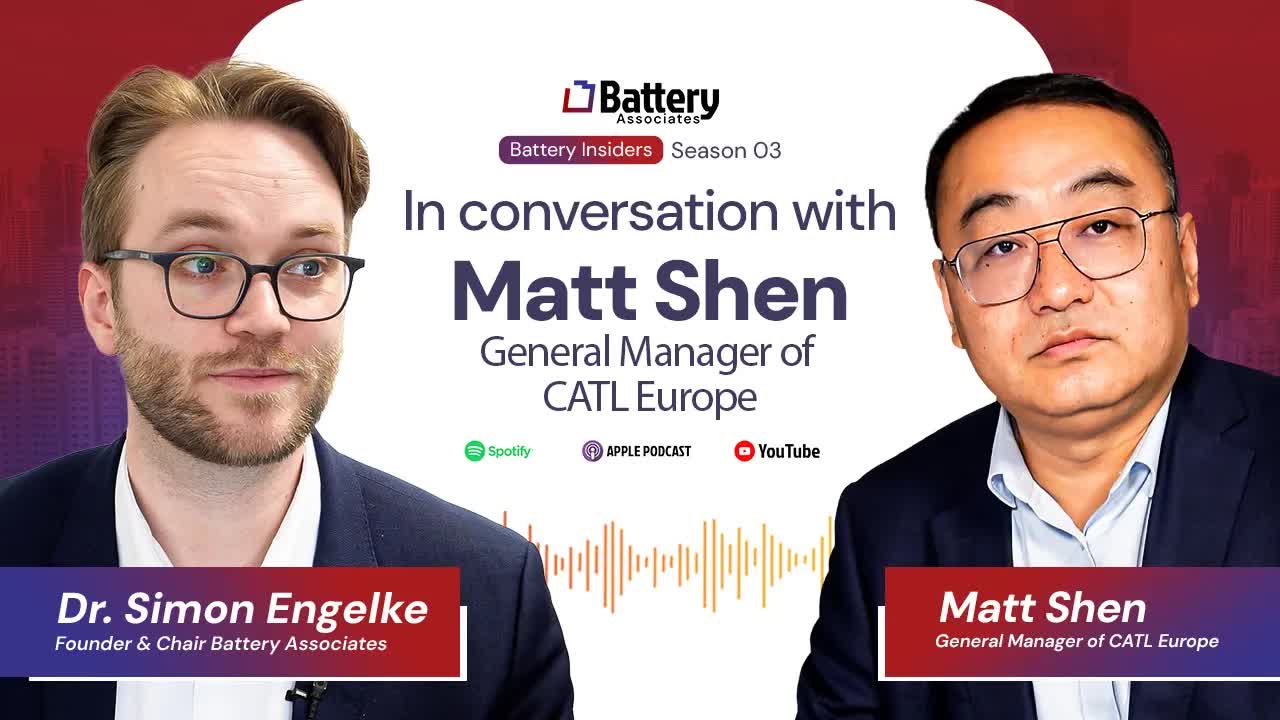
Matt Shen
General Manager, CATL Europe, and Executive President of CATL Overseas Car Business, CATL
CATL is the largest producer of lithium-ion batteries for electric vehicles and energy storage worldwide. In Europe it owns plants in Germany and Hungary and is building in Spain as a joint venture with Stellantis.
Recorded in Berlin, at the Future Battery Forum
What this episode covers
Asked what has been hardest about turning CATL's European strategy into reality, Shen does not hesitate: people. Process and equipment are findable. The industry has no history in Europe, so the workforce does not exist yet.
The numbers he gives are the interesting part. CATL first sent locally hired staff to China for two or three months of training and brought them back to run the process, and found that was not enough for the cases where something goes wrong. So it brought experts from China instead, whose job was as much knowledge transfer as production. At peak, 30 to 35% of the German workforce came from China. Today it is under 10%.
The gap those experts were closing is chemistry rather than mechanics. Shen's analogy: mechanical engineering is physical, chemistry is alive, and small variations in conditions change the product. You can have the recipe and still not cook the same dish. That is a feel built from experience, and it is why sending people to watch it being done worked better than documentation.
On structure, CATL now runs three models in parallel and Shen is explicit that it is not choosing between them. Wholly owned plants in Germany and Hungary. A joint venture with Stellantis in Spain, which brings a customer closer and brings in a partner who already knows European construction and permitting. And a licence, royalty and service model where the partner owns the plant outright and CATL supplies the technology and support.
The most concrete technical detail is that CATL designs differently for Europe. Charging infrastructure is thinner here, so range matters more and peak charging speed matters less beyond a threshold. Winters are colder than most of China. The Shenxing Pro cell shown at the IAA is built around that: fast charging that still works at minus 20 degrees. Shen also raises second-hand values as a live constraint, since 60 to 65% of German cars are leased and buyers price in battery degradation, which points at very long-life cells and at leasing the battery separately from the car.
On solid state he is measured. The scientific problems are largely solved, industrialisation is not. CATL plans small-scope production in 2027 in China, fitted to some cars, dependent on demand and on whether the technology is ready. His five-year forecast for European electrification is a 40 to 50% penetration rate, with the caveat that European battery capacity has come up slower than anyone expected two years ago.
Questions from this episode
- What has been the hardest part of CATL's European build-out?
- People, ahead of regulation, supply chains or market. Shen's reasoning is that process and equipment can be sourced, but Europe has no history in this industry so the experienced workforce does not exist. CATL now works with universities and vocational training centres, and used Chinese expats as a transfer mechanism rather than a permanent staffing solution.
- How did CATL get from a Chinese workforce to a local one?
- In three stages. First, local hires were sent to China for two or three months and brought back to run the process, which handled normal operation but not abnormal cases. Second, experts were brought from China to run the line and teach colleagues how to handle what goes wrong. At the peak that was 30 to 35% of the German workforce. Today it is under 10%, and Shen expects it to fall further.
- Why is the Spanish plant a joint venture when Germany and Hungary are not?
- Stellantis is a major customer, so the joint venture puts CATL closer to what the end driver actually wants, and Stellantis already knows how to run construction, permitting and approvals in Europe. Shen frames it as adding a model rather than replacing one: CATL also offers a licence, royalty and service arrangement where the customer owns 100% of the plant and CATL provides the technology and support.
- How is a battery designed for Europe different from one designed for China?
- Charging infrastructure is less developed in Europe, particularly very high power stations, so CATL judges that charging speed above a certain level is already enough and puts the effort into range instead. European winters are colder than most of China, so low-temperature performance matters more. The Shenxing Pro shown at the IAA is the result: it still charges fast at minus 20 degrees. Shen notes that innovation can travel back, since north-east China has the same cold-weather problem.
- When does CATL expect solid-state batteries at scale?
- Shen separates the science from the industrialisation. Many of the scientific problems are solved, which he describes as a big change from a few years ago, but commercialisation still needs time. The plan is small-scope production in 2027 in China, fitted to some cars, and whether that extends to Europe depends on demand and on the maturity of the technology.
- What does Europe need to do to build a competitive battery sector?
- Keep the policy stable for long enough. Shen's argument is that the industry needs enormous investment and a large number of skilled people, and both talent and capital are smart enough to want a visible future before committing. If the direction can be reversed in five years, neither shows up. He also lists energy cost and the availability of trained workers, and points out that these constraints apply equally to CATL and its competitors, which he considers fair and a reason to solve them jointly rather than separately.
Listen to this episodeWatch on YouTube
Part of Making cells at scale
Transcript
About this transcript. Generated automatically from the recording, then corrected against a glossary of company and guest names. It has not been checked line by line. Machine transcription mis-hears technical terms, numbers and names, so treat any figure here as a prompt to check the recording rather than a quotation of record. Spotted something wrong? Tell us.
0:00Introduction
Dr Simon Engelke
0:00Today, on Battery Insiders, we are joined by Matt Shen, General Manager of CATL Europe. CATL is the largest producer of lithium-ion batteries for electric vehicles and energy storage systems worldwide, and in recent years has held the biggest share of the global EV battery market. The company partners with automakers around the world to support the clean energy transition through sustained investment in technology, sustainability, and large-scale manufacturing. In this episode, we explore CATL's activities in Europe from its approach to market entry, joint venture models, and regulatory requirements to the practical challenges of supply chains and talent. We discuss Europeans' industrial ambitions, technology roadmaps, and how CATL works with local partners and policymakers. Matt also shares his perspective on cross-cultural leadership, personal motivation, and life beyond batteries. If you enjoy our podcast, make sure to subscribe so you never miss an episode. And if you're looking to take your knowledge even further, check out our BatteryMBA at battery.mba. It is our flagship program designed to help professionals upskill, connect with global experts, and stay ahead in the fast-moving battery sector. And with that, let's jump into today's conversation. Welcome, everyone. Thank you so much for joining us today for this really special episode of the Battery Insiders podcast of our CEO series. And I'm very delighted, Simon Engelke, founder and chair of Battery Associates, today to have Matt Shen with us, who is the general manager of CATL Europe and the executive president of CATL Oversea Car Business. And we are here in Berlin right now. We had a really engaging conversation just now at the Future Battery Forum. And I'm very delighted now that we can go on some of these topics in a bit more in depth. So, Matt, wonderful to have you.
Matt Shen
1:37Yeah, I'm very happy to be here. Very good discussion this morning.
Dr Simon Engelke
1:41Thank you. And I couldn't agree more. And I think now let's really start with some of your European strategy and vision. Because CATL has built quite a strong presence now in Europe with major operations in Germany, in Hungary, and in Spain in the future as well.
1:53In Europe, for Europe: the plants in Germany, Hungary and Spain
Dr Simon Engelke
1:54How would you describe CATL's overall strategy here? What makes Europe a unique market for you?
Matt Shen
2:00I think this is one of the most important is the customer demand. We are close to the customers. If we look at the investment in Europe, we already have the German, Hungary, and the Spain plant. It's ongoing. So, the German and Hungary are owned by CATL. But the Spain is working together with Stellantis for a joint venture. So, our strategy in Europe is in Europe for Europe. So, it means we will develop the things in Europe to produce the parts here and also very close to our customer. So, this is a general strategy.
Dr Simon Engelke
2:34Yes. And maybe another question then about some of the challenges in execution. We spoke about this today as well. What have been the biggest challenges in turning CATL's European strategy into reality? I see you already smiling. She has a couple. And is it more about regulation, supply chains, or market or people?
Matt Shen
2:53People. If you look at, if you ask me the priority, then the people is the most important thing. So, you can easily find the process, find the equipment to produce the battery. But you are not so easy to find the right people, especially in Europe. So, because we don't have this industry in Europe's history, so it's quite new. So, that's why we need to have the right people to do the right thing. This is the most important. And actually, we also do something here. We are cooperating with the universities, with some vocational training center to train the people to do this. And at the same time, we also find some expats from China working here to transfer this know-how to the local colleagues. Yes.
Dr Simon Engelke
3:42Yeah. And what I found quite interesting, you shared also during the panel, is, as you said in the beginning, you brought a lot of people over, right, to get the manufacturing started, to get the plan started.
3:51Why people, not process, was the hard part
Dr Simon Engelke
3:52But then you said now there's only about 7% or so? One digital, yes. Yeah, one digital from Chinese workforce here in Germany and others are from local. Yeah. So, how do you get there, right? Because I'm imagining a few years back, you came and then there wasn't really talent available. Like, where do you get the talent from? How do you get them ready from?
Matt Shen
4:13I give you a very good story for this. So, in the beginning, actually, we sent the local hired people back to China to train for two, three months. So, teaching all the process. They are working together with our colleagues in China. Then come back, they run the process. Then we realized that there was still a lot of things. We don't know how to handle that. So, that's why we have the idea to bring the experts from China to working here to run the process. But another very important task for them is transfer the know-how and teach the colleagues here how to run and how to handle the abnormal case. How to see if there were some special things happened. How could we cooperate? How could we handle that? So, this is after two years. So, you see, in the high peak time, we have around 30-35% of the employees coming from China to support. Today is only one digital or even less in the future. Yeah.
Dr Simon Engelke
5:13Yeah. And where do you think is maybe some of the biggest gaps in knowledge, right? So, what you had to teach in China, right? Like bringing the workforce over. Like, because I think process automation and things like this is quite, you know, there's local talent available. But maybe what are the specific topics?
Matt Shen
5:28This is chemistry. Chemistry is not like mechanical. Mechanical is physically. Chemistry is something like it's alive. So, it's a lot of conditions that can make a little bit difference on the product.
5:44Chemistry is alive: what could not be written down
Matt Shen
5:45So, that's why you need to have this kind of experience feeling like that. I give a maybe not so good example. It's like cooking. So, you have all the recipes, but you cannot cook exactly the same food. So, you need to really learn from some people.
Dr Simon Engelke
6:04Interesting. So, it's really about, again, the chemistry side of batteries. And I can see this as well. We have observed the same. So, that makes a lot of sense. You touched on kind of the approach of these different investments and projects. So, CATL started with a fully owned plant in Erfurt and Dippersna. But now you're partnering with Stellantis, as you shared earlier. So, why now a joint venture model? And what difference does this make to you?
Matt Shen
6:28This also brings a benefit. Right. So, we mentioned that it's market-driven. We come in here. So, this is a way close to the market. Of course, from the logistic view point, it's much easier for the transportation. But at the same time, we are very close to the customer. So, Stellantis is also one of our most important customers. Working together with them, we are much easier to know what is the end customer. I mean, the driver's thinking. So, this is the most important for us. And also, Stellantis has a lot of experience how to run a plant, how to do the construction, all kinds of permitting, permission, these kind of things they are very familiar with. So, we can cooperate together on that. Yeah.
Dr Simon Engelke
7:19And do you think this is then the model you think should be done more? As you said, I know also in China, it's all about being very close to the customer, right, on innovation, et cetera. Do you think then, I mean, like, do you think you have to create more of your own plants or more joint ventures or both?
Matt Shen
7:34This is, I use another word, is even more.
7:37Wholly owned, joint venture, or licence the technology
Matt Shen
7:38So, it means, of course, we already have the own plant. We have the joint venture with Stellantis. And also, if you look at our presentation, we will have this licensed royalty and service LRS mode. This will encourage our partner or our customer. They can 100% own the plant. We just provide the service and support. Make sure they can make the battery by themselves. This is, we are open for all kinds of possibility.
Dr Simon Engelke
8:10It's really about whatever is needed to make it work. Yes. Makes sense. I want to talk a bit about regulation and compliance, because Europeans' regulatory landscape is getting more complex, with the battery passport to come in 1997, the cycling targets, the local content requirements. How is CATL preparing for this? And do you see regulation as a challenge or more as an opportunity?
Matt Shen
8:32Both. Of course, nobody has this experience on hand. So, that's why it's a challenge. So, and also, you know, there was from the brine field, there's nothing here. So, we need to set up. So, this is a challenge. But at the same time, of course, it's also an opportunity, because finally, we go to this industry, or it's to support this green transportation. So, that's why we also need this circular of this system. So, one important thing I want to mention is, we need to step by step to have a solution. First, then step by step to finally achieve the regulation expectation.
Dr Simon Engelke
9:15Makes sense. And then, kind of, look at Europe again, and some of the challenges, right, also Europe is facing. Europe is investing really heavily now, right, to build its own battery industry.
9:27Regulation as both challenge and opportunity
Dr Simon Engelke
9:29Do you think Europe can succeed in creating a competitive, self-sustaining battery sector? And if so, what is needed to make the change happen?
Matt Shen
9:37I think the word is fair. So, all the challenges, we are similar. So, we talk about the high cost, I mean, the energy cost. Of course, there was some support from the government. We hopefully, this will happen soon. But, of course, there was also some other challenges. We talk about the right people, the right worker who can work in this industrial, and also the fluctuation of this regulation. So, we also, we need to have a consistent driven for this regulation. Otherwise, if somebody tells you five years later, we don't need this, then people will not go into this. So, this kind of challenge is not only for CATL, but also for the newcomers. I mean, the new companies who want to build this battery by their own. So, these kind of things, I think, important thing is for us, we can work in together to try to find a solution. Also, I mentioned, for example, the supply chain. So, we are working with also some local suppliers to find a solution here. But I think all these difficult things will also happen to our competitor. This is the same. This is fair. So, if you ask me, I will suggest, let's work in together to find a solution together. It's much easier than a single company to fight.
Dr Simon Engelke
11:00So, it's about having an equal playing field to make it work. Another technology people talk a lot about is solid-state. Yes. And everyone is watching solid-state batteries closely in the developments. What is your outlook on the commercialization? When do you expect we will see them at scale in China and in Europe?
11:18Can Europe build a self-sustaining battery sector?
Matt Shen
11:19So, this is a very hot topic. We talk this topic every year. So, from our perspective, we have also a very big team to develop this technology in our headquarter. So, I can give you some description of our current status. One is from the scientific problems. I think we already solved many of that. This is quite a big difference compared with several years ago. But if we look at the commercialization, industrialization, we think it still needs some time. So, regarding of the timeline, we have the plan to have a small scope production in 2027 to equip for some cars. But it's small scope.
Dr Simon Engelke
12:08And do you think this will be in China or also in Europe?
Matt Shen
12:11So, this is 2027 in China. But it depends on the demand as well as the maturity of this technology, if it's ready or not.
Dr Simon Engelke
12:24And then, kind of thinking about integration in the European battery ecosystem, CATL now has a strong footprint in Europe. How do you see CATL fitting into the broader European battery ecosystem alongside local players, policymakers, and research institutions?
Matt Shen
12:40So, this is also a very good question. So, we are in Europe. We want to also be a part of Europe. So, it means all these kinds of, I mentioned, all these kinds of difficulties, we are also raise hand to discuss with the government, to discuss with the university, to discuss with the vocational training center, to find a solution together. So, this is what we want to do. And also, we are also open to discuss with all the competitors.
13:09Solid state: the science against the industrialisation
Matt Shen
13:09If we want to work together to solve some common difficulties, we are also very happy to work together on these kinds of difficulties.
Dr Simon Engelke
13:22And then, maybe also a bit about you and yourself. Now, you have lived and worked in Hong Kong, California, and now Europe. What difference do you see working styles and decision-making, and how do you bridge those across CATL's global team?
Matt Shen
13:36So, first important thing is respect. So, we must respect each other. Second, important thing, we need to find the advantage, the good things for the local team. You will always find in the culture, there was something really good you never heard. So, this is extremely important. Then, you will find the very interesting thing to working here.
Dr Simon Engelke
14:02And maybe something, and you have seen like certain differences in these teams, or like kind of from your different working styles you've seen?
Matt Shen
14:11Yeah, this is also a very interesting topic. So, we talk about the working balance. For example, in Germany, the people is more balanced. Yes, in China, maybe they are working more hard on this, but both have other advantages. Of course, working hard, you can find more problems, you can solve it. But working balance, you can have more time to think. Maybe you can even have better ideas to solve it.
Dr Simon Engelke
14:40And maybe some of your personal motivation about this topic is, as you have been a trained chemical engineer, we've been part of the Global Battery Store for many years yourself. What personally keeps you motivated in this really fast-changing industry? What kind of impact do you want to make through your work?
Matt Shen
14:58This is, for me, the most important thing is fast-changing.
15:02Working across cultures, and what each side is better at
Matt Shen
15:03So, you see different every day. So, you see different technology every day, and you see a lot of new colleagues, new friends every day. For example, today, I meet a lot of new friends here. It's a fantastic life for me.
Dr Simon Engelke
15:18And maybe from a technology side, like, what are you personally most excited for, based on what you see right now, in batteries? Is there something which gets you most excited?
Matt Shen
15:27So, you have the difficulties. I give another example. I think it's 12 years ago, I drive my first electric car in China. The range is only 150 kilometers. Today, you can easily find a 700 kilometers range, and even 1,000. So, of course, 150 kilometers is not enough to support the daily life. But today, 700 is already enough. So, you see, there was a need. There was a solution. That's fantastic.
Dr Simon Engelke
15:58And I think that's something we often don't think about enough, right? There's a lot of challenges, implementation, et cetera. But the progress, which has been made from a cost, but also from a performance perspective, has been quite remarkable. Yes. As you think over the accumulating performance and cost improvements over the years.
Matt Shen
16:15Yes. This is most important. Otherwise, it's not possible to find the people to buy this car, electrical car. Yes.
Dr Simon Engelke
16:24And maybe also, I mean, you're focusing very much also on the automotive side. Yes. I guess it's a big driver. Of course, stationary is also a big driver as well as in CATL and other companies.
Matt Shen
16:33Yes. We are also the biggest supplier on this energy storage system. So, this is also one of the key possibilities, I mean, the solution to support this green transportation. I mean, green transition. For example, we make the battery.
16:55From 150 km of range to 700, in twelve years
Matt Shen
16:56So, if the electrical car cannot use green energy, that is only half of the journey. We need to 100% of this journey. So, this energy storage system makes this happen.
Dr Simon Engelke
17:09And maybe also kind of understanding a bit you as a person. I think people are very interested to understand who are the people behind these roles, especially on a C-level side. So, maybe if you could share a bit more like outside of work. I'm sure you're working a lot and keeping me rather busy. But how do you really unwind and stay grounded in giving the pace and the pressure, right? Especially now with the global battery industry.
Matt Shen
17:30I travel a lot. So, I think I travel around 200,000 kilometers per year. Every year. So, for the new place, I will try to have a walk there to see the people, to see a restaurant, to maybe have a drink or have some local food. So, then you see the difference. Then you try to find the difference and also the good things from this new culture. So, this is what I want to share. And also, in the work, I also want to find the people. What is a good act? He is good at. Then what is a good position for him? This is important. All the people can find the right position.
Dr Simon Engelke
18:17Maybe a question on this is how can we support more leaders in the battery industry, right? So, something with the BatteryMBA, the trainings we do, et cetera. We care a lot about building up these people taking leadership, especially now, and a bit more challenging. Times and times there's a lot of decisions to be made. Like, how can we support more leaders in the battery industry?
Matt Shen
18:37I give one suggestion. To ask the leader to really have experience in the production plant. Maybe two weeks or one month to really see how could we make a battery sale.
18:50Advice for battery leaders: spend a month on the line
Matt Shen
18:52This is extremely important. Then all the management topics, I think a lot of people, they know that.
Dr Simon Engelke
18:59And then do you think about also, because you talked about you're part of an ecosystem, right? So, you're making the sale. But, of course, you also work with automotive companies and you have to kind of work efficiently together. Maybe what are some of your learnings on working effectively together? You spoke about you want to be closer to your customer. You want to be closer to companies like CATL, et cetera. Anything beyond that you have found to be very important to work effectively together, that you have like a joint process between the customer and you as supplier of the batteries.
Matt Shen
19:30Most important is we know the needs from the customer. What's the difficulty? What's the problem for them? So, then we can find a solution together. In the panel discussion, we also touched this topic that to partner together to find a solution. This is extremely important. I mean, close to the customer is only physically. But the mind also needs to close. This is another important thing.
Dr Simon Engelke
19:56To work effectively together. Maybe another thing is just kind of some questions to add is we're looking now at like different battery chemistries. Yeah. Right? And I think it's, I mean, CATL is really at the forefront pushing these different technologies. I remember when CATL announced that we're now doing sodium-ion. Yes, yes. People really recognized, wow, this is kind of happening. I know you're also looking at like interesting applications such as aviation and others. And there's a lot kind of happening. Like, how do you navigate kind of, we spoke about this also in a panel like this, looking in the future and future technologies and balancing it with making sure that your current technology is kind of implemented widely and scaled up. Like, how do you balance this from a business perspective, from a focus? Is it based on your customers or you kind of see what they kind of need in different technologies?
20:45Balancing today's chemistry against tomorrow's
Dr Simon Engelke
20:45Or is it more about pushing the boundaries of what technology can do?
Matt Shen
20:49I think there is two directions. One direction, of course, we need to understand the real needs from the customer. You see in the IAA, we show the Shenxing Pro battery that is a specific design for Europe. So we have a quite good balance. We think about the fast charge, the low temperature performance, and also the range. It's a totally different setup compared with China. So this is one of one topic. Another thing also very important for us is to, to break the boundary. So it means for one chemistry, you have the advantage. Of course, you have the disadvantage. How could we enhance the advantage to eliminate or reduce the disadvantage? This is the engineer. They need to work on and find a solution. So finally, you will find, God, I have this LFP. It's a disadvantage, but we have a solution can improve this. I have something for NCM, also disadvantage, but we can improve. So this kind of thing is also very important.
Dr Simon Engelke
21:55Yeah. And I think you touched on a very interesting thing is about how a battery in Europe is different. And of course, people spoke about compared to a battery in China and some of the differences. So maybe, can you maybe explain a bit some of the differences you see?
Matt Shen
22:06Maybe, maybe I give one example is for example, in Europe, the infrastructure is still not so popular here. So for, especially for the very high power charging station. So that's why we think maybe the charging speed to a certain level is already enough. This is the first. Secondly, we think about them because of the, also because of the infrastructure, maybe the range we need a little bit more. And also, you see the wintertime is much cold compared with majority of China.
22:41Designing the Shenxing Pro for European conditions
Matt Shen
22:42So that's why to think about some benefit for the low temperature performance. For example, the Shenxing Pro, they can charge in minus 20 degree for still very fast charging speed. So these kind of things we are adopted to fit for the demand of Europe customers.
Dr Simon Engelke
22:59And that's interesting. So you have to kind of customize. And do you then think also about that you have to take back some of these innovations to China, for example, when you say now, okay, you know, different environments or different markets, or is this like a way for enabling innovation more by going overseas and have new problems to solve?
Matt Shen
23:19Yes. This is also depends on the customer needs. So if we talk about the low temperature performance in China, the northeast area is also very cold. So that's also possible to do some application there.
Dr Simon Engelke
23:32Yes. That's interesting. And then I think you talked about range. Yeah. It's very interesting. I've seen now also some of the other OEMs have had very long range vehicles, over a thousand kilometers. And now you have seen that maybe demand for this has been lower than people expected. Because of course, the longer the range, the more external cost, right? And how you kind of balance this, right? Like, do you think we will have more larger batteries in the future? Or do you think it's going to be more balancing to have smaller batteries and then might be faster recharge?
Matt Shen
24:02It depends. I think these two directions we are keeping. So of course, if the people need to have a very high performance car, the range is one of the most important factors they need to have. But for the daily use, if you drive only 10 kilometers a day, you don't need that. So the small battery may be also a good chance for. So even in China, we have this swapping technology. We use not so big a battery, but we swapping. So you can easily find a swapping station.
24:32Swapping, smaller packs, and renting the battery
Matt Shen
24:33Then you can also solve this energy problem for you. So then at that time, you don't need a very big battery. So you can reduce the cost. And you have a solution. You are even renting this battery. You don't need to own it. Yes. It's a lot of solutions.
Dr Simon Engelke
24:49Makes sense. And then I think battery swapping is said. So that's really about integration beyond the cell itself, really how you make the integration work. Any other thing you're thinking about right now, like needed for more efficient integration of your batteries? I just spoke about swapping can be one way to do it. Maybe faster charging. Anything else you require to make the ecosystem work? Because I think one thing you spoke about is the battery is not alone. It's really about the applications and the ecosystem, how it's integrated. What are other aspects we need to make it a success?
Matt Shen
25:22We see quite different marketing situation in China and Europe. Europe, most of the cars are leasing. So in Germany, maybe 60 or 65% of the cars are leasing. Then the second-hand car price is a very sensitive topic when you want to buy an electric car or not. So we see maybe one of the reasons is battery. Because, of course, I understand that the customer will worry about if the life of this battery will have the impact of my second-hand car price. So that's why we are also discussing with some partners to see if we can have extremely long-life product. This is also an idea in the IAA we promote that we are thinking that if we can have this kind of battery, then to make sure your car drives for three years, your battery still can support for another 10 years or something like that.
26:24Leasing, residual values and very long-life cells
Matt Shen
26:24So this can benefit for this. So this is also, on the other hand, maybe it's also you can think about renting only the battery. It means you're leasing the car, also you can be leasing the battery. So this kind of new business model is also a consideration.
Dr Simon Engelke
26:45So that's interesting what you say. It's all about new concepts, right? Like a new business model, which, of course, is very important to enforce that as well and support that industry in the future. Yeah, that makes sense. Maybe understanding also a bit for you, right? Like what do you think is ahead of you, right? I mean, Stellantis has been quite pushing some of these new factories in Europe. But if you now look five years ahead, what would success look like for CATL in Europe and for the European battery industry as a whole?
Matt Shen
27:13So we are fully committed to in Europe. So you see we have a very heavy investment in the three plant or even more. So we believe this direction. So for me, if you ask me what is the forecast for the future for the number of five years, I will think about maybe 40 to 50 percent of this penetration rate for this electrification rate.
Dr Simon Engelke
27:39And then do you have any ideas of like how big, because I know you're very passionate about growing the European business, that how big of a part this can be produced in Europe, for example, from a battery site, right? Like from a local market, but also internationally. Do you have any thoughts on this? Like how big it can become?
Matt Shen
27:56I don't have idea on this, but this is a threat. So it means more and more. This is my forecast. But it also depends on the readiness of the capacity. You see the speed, I mean the battery capacity in Europe is not as our expectation two years ago.
28:19A five-year view of European electrification
Matt Shen
28:20So I think it also very much depends on this. You mean from a demand side or from the readiness side of this local production capacity? Yeah.
Dr Simon Engelke
28:30And I heard like a big topic is raw materials and getting materials locally and getting the local ecosystem. Like you mentioned talent as a big topic, which is really, really important and makes a lot of sense. Any other topics where I think Europe has to do more to be more supportive of the battery industry to make it a better ecosystem?
Matt Shen
28:47I think it's also important that to keep the policy and keep the strategy for a longer time. So as I mentioned, so battery industry, you need to have a huge investment. You need very good talent, a huge number of talent. But if you want this talent, they are smart. So the money, they are also smart. Why do they want to join this business? You need to have a bright future for them. So that's why this long-term strategy, this direction need to push, need to keep. Otherwise, the people and money will not come. So this is the most important thing.
Dr Simon Engelke
29:31And I think it's very important what you said. We have seen studies in China. About 230 billion or so have been invested in the battery industry. There's big numbers going around, right? So it takes time and money to really build an asset sector.
Matt Shen
29:45Yes. And also the people is trained during this time. Yes.
Dr Simon Engelke
29:49Very good. Now, I very, very enjoyed this conversation, Matt. I think it's very important, right? As you said, build a local ecosystem with all our partnerships and bringing expertise over, but also train people up, which can then play an important part to really make this industry a success. I think you also touched on is about partnerships, right? You're now working more closely with some of your automotive partners to enjoy ventures. And then, of course, also work kind of effectively together from different kind of cultures and over international teams and really making sure that you have a longer term horizon perspective for these people to be successful in the industry as well.
30:23Why policy stability is what brings talent and capital
Dr Simon Engelke
30:23Yeah. Matt, absolute pleasure. Thank you so much for joining us today. Thank you. And then I also really want to thank all of you for listening today and for our conversation today with Matt Shen, General Manager for CATL. And yeah, my name is Simon Engelke, Founder and Chair of Battery Associates. If you're interested in more of these conversations with thought leaders and leaders in the battery industry, please make sure you subscribe to our podcast either on YouTube, Spotify or anywhere else you listen to our podcast. Thank you.