
Episode 46 · 3 September 2021 · 00:09:36
Five years to obsolete, and why circularity starts early
Tilmann Vahle from SYSTEMIQ on Sustainable EV batteries
SYSTEMIQ's Tilmann Vahle on why CATL's sodium battery announcement could make current resource projections obsolete within five years, why circularity has to be considered throughout the process rather than after end of life, and what he wants from the European Commission's draft battery regulation.
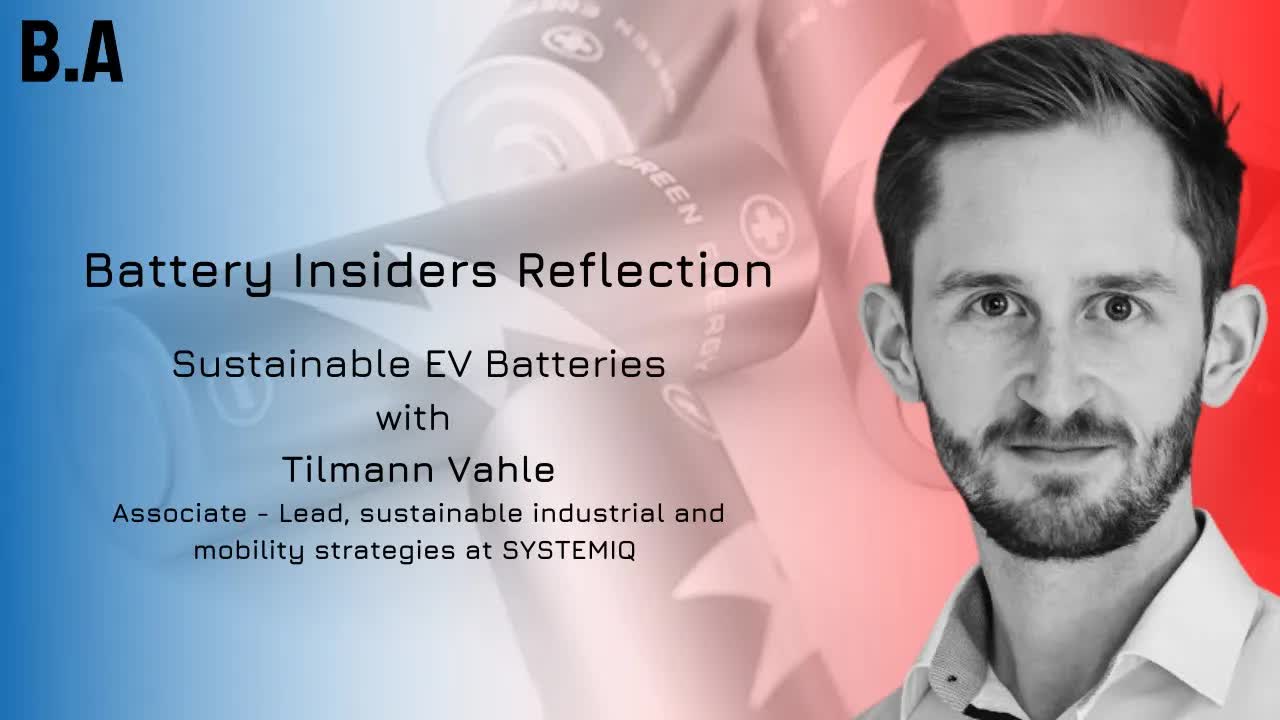
Tilmann Vahle
Associate-Lead for Sustainable Industrial and Mobility Strategies, SYSTEMIQ
Vahle leads work on sustainable industrial and mobility strategies at SYSTEMIQ and has worked on battery circularity and value chain reports. This episode is a debrief recorded immediately after a Battery Revolution Clubhouse session on sustainable EV batteries, with Bhavya Jha co-hosting alongside Simon Engelke.
What this episode covers
The announcement Vahle keeps returning to is CATL's sodium battery. Whether it gets commercialised he does not know, but CATL is a big company with big commercialisation abilities, and if it pulls that off in the next couple of years then much of what the session had just discussed, the projection of technologies, the resource needs, the case for circularity, could be obsolete within five years. He describes the feeling as humbling: you think you are quite an expert and have an idea of the world, then an announcement arrives and you revise it.
Speed cuts the other way too. Vahle points to the recent IPCC report as putting the position bluntly, that there is no time left at all, so the sector has to move fast. That creates an awkwardness around measures that only land in 15 years, which he answers by noting that in 15 years there will still be another 15-year horizon ahead, so preparing for it now obviously matters. What also matters is acting on what is in production and in application right now.
On circularity, the point Bhavya Jha picked out was that it does not start after a battery's end of life, or after recycling. Vahle wants it considered throughout the process, and she said that was the remark from the live session that stayed with her. He also ties battery life length directly to climate mitigation and to the case for investing in circular economy measures, because how long a pack lasts changes both. Simon Engelke's own takeaways ran to chemistry and memory effects, and to newer entrants in energy storage.
Asked who should come on next, Vahle gave three angles. Hardcore circularity, where he would like to hear from Redwood Materials on its push into high-quality battery recycling. The front end, meaning vehicle-to-grid and charging infrastructure integration, an ecosystem view of batteries he thinks is a huge topic, with companies such as Sonnen and Next Kraftwerke already integrating batteries and doing smart charging as we speak. And politics: the European Commission's draft battery regulation, which he calls a seminal piece of legislation.
Questions from this episode
- Could sodium-ion batteries make current battery resource projections obsolete?
- Vahle thinks it is possible. He points to CATL's announcement of a sodium battery and says he does not know whether it will be commercialised, but that CATL is a big company with big commercialisation abilities. If it actually pulls this off in the next couple of years, then much of what had just been discussed in the session, the projection of technologies, the resource needs and the case for circularity, may be obsolete in five years' time. He offers it as an example of how fast the field moves rather than as a prediction.
- Does circularity only apply once a battery reaches end of life?
- No. The point Vahle made in the live session, and the one Bhavya Jha picked up in the debrief, is that circularity should not be thought about only after a battery's end of life or after recycling, but throughout the process. He also connects battery life length to what follows from it: how long a pack lasts has implications for climate mitigation and for the case for investing in circular economy measures. He adds that these are things he is constantly learning and revising as the work goes on.
- How do circular economy measures fit with the urgency in the IPCC report?
- Vahle raises the tension himself. The recent IPCC report puts it bluntly, he says: there is no time left at all, so the sector needs to move fast. That makes it fair to ask why anyone is discussing measures that only take effect in 15 years. His answer is that in 15 years there will still be, or again be, a horizon of another 15 years, so preparing for it now clearly matters. At the same time, action is needed on what is happening right now in production and in the application of these innovations.
- Why is it hard to stay an expert in batteries?
- Because the ground keeps moving. Vahle calls it humbling: you think you are quite an expert and have an idea of the world, and then innovations and announcements arrive that change it. He describes his own work as constant learning, where innovation brings revised opinions and understandings. What he valued in the session was that the deep knowledge in the group moved the discussion away from what could be this or that and towards practical application, which is also the part he says makes the field a joy to work in.
- Which topics does Tilmann Vahle want covered next?
- He offers three angles. First, hardcore circularity, where he would like to hear from Redwood Materials about its push into high-quality battery recycling. Second, starting at the front: vehicle-to-grid and charging infrastructure integration, an ecosystem perspective on batteries that he calls deep and huge, naming companies such as Sonnen and Next Kraftwerke that are integrating batteries and doing smart charging already. Third, politics, specifically the European Commission's draft battery regulation, which he describes as a seminal piece of legislation and hopes will pass soon. Discussing its likely impact with industry, he says, would be enlightening.
- What stood out from the Clubhouse session on sustainable EV batteries?
- Vahle singles out the range in the room, from deep industry knowledge to people speaking straight from the ground, where the investments are happening and where the technology and innovation are happening. He was struck by the dedication in the discussion and by the emotional level of some of it, which he reads as a sign of how complex the sector is, how fast it is moving and how much is evolving all the time. That includes the challenges: the impact batteries will have on the environment and on local communities around the world.
Listen to this episodeWatch on YouTube
Part of Recycling and second life
Transcript
About this transcript. Generated automatically from the recording, then corrected against a glossary of company and guest names. It has not been checked line by line. Machine transcription mis-hears technical terms, numbers and names, so treat any figure here as a prompt to check the recording rather than a quotation of record. Spotted something wrong? Tell us.
0:00Introduction
0:00Welcome to Battery Insiders, your podcast providing you insights and the fascinating world of batteries. Hosted by Bhavya Jha and Simon Engelke. Good morning, everyone. Welcome back. We are here today with Simon and Tilmann Vahle from SYSTEMIQ. We had just had a wonderful conversation with him. And I'm excited to talk to you too about what you thought. Tilman, you dropped a lot of interesting bits of information, whether it was Second Life or Circulor Economies, all things that I'm ready to pick your brain on a little bit more. I think Simon is too, but we'd love to hear from you. What did you think about our conversation and some of the points that were brought up through the questions? Yeah. Yeah. Thanks, Pavia and Simon for reinviting me here on this reflection. I really also thoroughly enjoyed the conversation. I think it was a great group. Like the whole range of things, right? Like all the way from super deep industry knowledge and straight basically from the ground, you know, where the investments are happening, where the technology and the innovation is happening.
1:17So like there was an amazing group as well. Also, I was like really admiring the dedication of so many of our discussions, as well as the emotional level that, you know, it really showed the complexity of the whole sector and how fast it's moving, how much stuff is evolving all the time. And also the challenges associated with it, right?
1:41Chemistry, memory effects and new entrants in energy storage
1:42Including all the way to the impact that it will have on the environment and local communities around the world. Yeah. So that was really quite inspiring to me. Simon, any thoughts? Yeah. Thank you, Simon, also so much for being part of the session and sharing your insights, you know, especially on the circularity and, you know, the sustainability of EV batteries is a really important topic. And I really enjoyed also having your perspective as well from other participants. And I think two things which we'd also stood out for me, one was, you know, we nerded out a bit on like different chemistry, like NFP and memory effects. I remember we had like some things and we also had some afterwards discussions and some of these implications. So I really enjoyed that it also went really in depth in some of it. But then we also had really, you know, relevant discussions, which are very timely, for example, about energy storage, you know, through, or like, you know, like new players in the field like Tesla, this Octopus EV, something the story also you shared, you know, they're partnering now and offering here somewhere in Southern Germany right now, where we're both based.
2:40So I think it was also quite nice to have this kind of timely developments covered. And just like also really appreciating, right, the complexity of this topic. You know, I think, as you mentioned, there were some, you know, emotional contributions as well. And I think it's, it's justified, right? We're talking about more materials, talking about supply chains, things which still have to be figured out, especially some of them more than others. And, but also kind of really talk about, you know, all those amazing opportunities which are out there, right? Like all this progress happening, as you said, all this, you know, really great people enjoying this field and really trying to push it forward. So I really enjoyed it. Again, it was one of these sessions, which has so much, you know, just so much response from the audience. I think we had lots of, in the end, you know, it was so hard to close the session again. So I really enjoyed it as well.
3:23Second life, and circularity beyond end of life
3:24How about you, Bavia? Well, I, I mean, the things that stuck out to me were Second Life and Circular Economy is probably because that's where I've been working for the past year or so, and a bit more on the academic research side. And, you know, you tackled, you in a very large group setting, tackled the question of Second Life. So I appreciated that. I think whenever it comes up, it's always like, well, there's two groups. I mean, you know, there's a, you're on the fence. And it's, it was interesting to hear about systemics kind of solution-based approach to a lot of the problems that we were talking about. Um, I guess in particular, and then now I pivot. So again, in particular with circular economies, I think, um, where do we only think about, one thing you mentioned that I found interesting was not only thinking about the circular nature of, you know, after batteries end of life, like not just after recycling, but also like throughout the process, it was slipped in there.
4:27And I appreciated that. And that was something, um, that maybe I've thought of a little bit, but this really called my attention to it. Um, so I really, I appreciated some of those points, uh, that you mentioned. Yeah, that's, it's, um, I'm glad that that resonated with you. And to be honest, it's something that, you know, I'm, I'm constantly learning like every day and, and reflecting on also the work that we've been doing, right. And with innovation also that that comes is learning where you revise your opinions and understandings of the world. And especially in the battery field, I think, um, it's been such a joy also.
5:04CATL's sodium announcement and a fast-moving field
5:04It's, it's humbling how you think you're quite an expert and you have an idea of the world. And then, you know, there's innovations and announcements of, you know, stuff coming out where, you know, they know the announcement of CATL on that sodium battery. Will it be commercialized? You know, who knows, but it's, it's a big company with big commercialization abilities. And if that, if they actually pull it off in the next couple of years, like much of what we've been talking about, you know, the projection of technologies and the resource needs and circularity may be well obsolete in five years time. It's such a fast moving place. And at the same time, you pointed to the end of life or like say battery life length, um, issue and, and what, what that implies for be it climate mitigation, uh, be it for, for, um, investing into circular economy measure. It's, it's just in such a rapidly moving space. And at the same time, uh, the, the really urgent need for, you know, decarbonize with the recent IPCC report, putting that so bluntly, it's just like, we really have, we don't have time left at all anymore.
6:06Right. So we need to move fast. So measures that happen in 15 years time, in a way, you know, why are we talking about this? Well, in 15 years time, we're going to still have, or again, have a horizon of another 15 years time. And so obviously it's important now to, to prepare for it. At the same time, we need to act like what was happening right now in the production or right now in the application of these, uh, these, these innovations. And yeah, so I find that is the fascinating part about it. And I really loved the, uh, yeah, the discourse with the group, you know, um, the deep knowledge we mentioned it because it really moves away from this, you know, well, there could be this or that, but really goes into the practical application that we have.
6:46Learning from each other, and who to invite next
6:47Yeah. So amazing discussion. Thank you so much, Tom and Jan. Very much agree. And also thanks so much also, as you said, you know, because you have done quite a bit of work in this field already. We, you know, mentioned all battery lines and on other reports and circularities. And I think it's also really nice to, you know, it's, it's so important that we have these discussions, you know, and to learn it from each other, build on each other's work, you know, because on the other hand, it's moving so fast, but there's also a lot of really amazing things happening. And I think it's, it's so important that we have this dialogue that we're not trying to, as you say, speed up by learning from each other, building on each other. And, um, that's something I also really, really enjoy every single time. So thanks so much for, for doing that. And maybe also the one question would be from my side, looking at time, um, you know, that's our new favorite question.
7:28You know, maybe some of the other people you would love to hear from in a future session as well, because, you know, we're always looking for, for other, other thoughts. So if you have anyone you think, you know, you should try to bring on in a future episode. Um, so I'll give you three, three angles to that. Um, one on the inherent, like, like hardcore circularity, I'd be super keen to hear from, uh, Redwood materials, like Travis Straubel, like recent push on really driving, uh, high quality battery recycling. That would be really inspirational. Second, uh, on the, you know, starting at the front, I think vehicles to grid and charging infrastructure integration. Um, that is a, is a topic that, you know, that ecosystem perspective on batteries that I, uh, just so deep and such a huge topic that I'd be keen to hear of, uh, of, of experts in the field. I don't know, such as, uh, Sonnen or Next, uh, Next Kraftwerke, uh, people that are actually integrating batteries, uh, as we speak, do smart charging or from the OEM.
8:29EU battery regulation, and Battery Day
8:29And then thirdly, uh, the politics side of things, right? The commission, uh, battery, uh, regulation draft. I think that's such a seminal piece of legislation that hopefully going to pass in the next month and learning more about that and, and really discussing with industry, right? What impact that will have very, that would be enlightening. Very much agree. We will try our best. I was like, Simon, I think we have our work cut out for us. Wonderful. Thanks for sharing those names. Wonderful. Yeah. So I think, you know, with this, we probably going to, you know, maybe close today's session. I've got an outlook. We're going to have quite a few more. So stay tuned for, for the next ones. Maybe also one quick plug for our battery day, you know, where lots of us are going to be involved as well on the 23rd of September, because there again, we're going to summarize, you know, all these trends from the past year and relate to like, you know, industry, but research as well as policy.
9:23I think what you just described, I think these different perspectives, that's something we're also quite looking forward to have there. So if you're interested, look at that as well. Wonderful. See you then. See you then. Thank you. Bye-bye. Bye-bye. Bye-bye. Bye-bye.