
Episode 78 · 11 April 2022 · 00:19:31
Data in the DNA, and the case for sharing it
Dr Tim Holme from QuantumScape on Batteries, Data & Solid-State
QuantumScape's CTO on the database that captures every step a material takes through the lab, how publication and patent terms get settled with academic partners, and why battery news still has to start by explaining what an anode is.
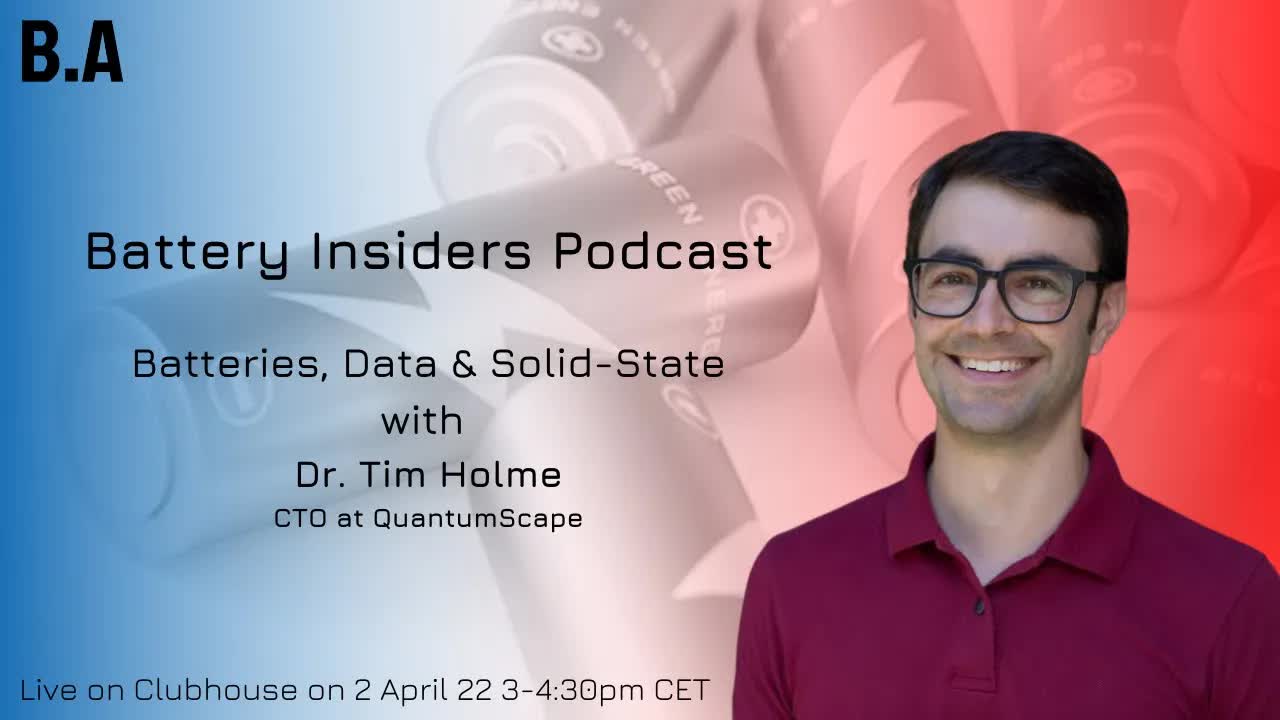
Tim Holme
Chief Technology Officer, QuantumScape
Holme is chief technology officer at QuantumScape, a solid-state battery developer, and began working on batteries at Stanford. This episode is a debrief recorded immediately after a Battery Revolution Clubhouse session on the same subject, with Mariam Awara co-hosting alongside Simon Engelke.
What this episode covers
QuantumScape built a database before it built much else. Holme says one of the first things the company did was construct something that could hold all the information gathered in the labs. That means more than current, voltage and time from cells on cycle. It means everything that went into them. Which batch of raw material was used, which tool processed it, what the conditions on that tool were, captured at every step so it can be mined later. He gives two uses and says both have worked. Root cause analysis when something goes wrong, and a search for the subtle signals the company would otherwise miss.
On sharing any of that outside the company, there is no formula. Holme is blunt: no rubric where you put in the inputs and get a deterministic output. QuantumScape runs collaborations in industry and academia, and each is a judgment call about how much the partner offers and whether both sides trust each other enough to share what matters. It has to be two-sided. Where the company funds sponsored research, publication and patent terms are agreed in advance. Investors have put in a lot of money over long horizons and expect a return, so some trade secrets stay proprietary. Academics need to publish, so the compromise is often a proxy system, or the techniques without the most sensitive results.
Simon Engelke uses the debrief to recap Battery Dev, the global battery developer hackathon run by Battery Associates, where QuantumScape was a data partner and provided an EIS data set. Some participants struggled with it. His wider point is that most battery data still sits in silos, some in academia and a lot in industry, with little exchange. Mariam Awara's takeaway from the live session is the volume of decisions a new technology forces: material selection, quality assurance, scale-up, testing, processing, cost and energy density, all at once. Holme agrees that the hardest and most important calls have to be made before the data arrives, so you run on hypotheses and try to validate them or back up quickly.
When Holme started on batteries at Stanford, no research group there was focused on them, and he points to the 1970s as the last time the field ran hot. It is hot again, and he thinks energy now draws the graduates finance drew in the early 2000s. The harder gap is experienced process engineers with a decade or more behind them, because mid-career professionals do not always pivot. He also wants reporting to improve: give temperature, pressure, depth of discharge and cathode loading alongside a cycling result, or nobody can judge it. Asked what batteries are doing to the world, he says saving it is too grandiose, but a digital future of robots and drones needs a mobile energy source.
Questions from this episode
- What data does QuantumScape capture in its labs, and what does it use it for?
- Holme says data was built into the DNA of the company from day one, and that one of the first things QuantumScape did was construct a database able to hold all the information gathered in the labs. That means more than current, voltage and time from cells that are cycling. Every step the materials take through the lab should get captured: which batch of raw material was used, which tool it was processed on, what the conditions of that tool were. The point is to be able to mine it later. He says it has been used successfully both for root cause analysis when something goes wrong and for finding subtle signals that pointed to opportunities.
- How does QuantumScape work with universities without giving away its IP?
- There is no formula, Holme says, and no rubric that takes inputs and returns a deterministic output. It is a judgment call each time: how much value the partner can offer, and whether the two sides trust each other enough to share the details that really matter, in both directions. Where QuantumScape funds sponsored research, how publications and patents will be handled is settled before the work starts. The company needs to protect key trade secrets, partly because investors have funded a lot of money over long horizons and expect a return. Academics need to publish. The usual resolution is a proxy or related system to publish on, or publishing the techniques without the most sensitive material.
- Is there a shortage of battery talent?
- Holme describes two different problems. New graduates are not the issue: batteries are a hot field again, and he thinks energy is now attracting the people finance attracted in the early 2000s. But competition for them is fierce, with incumbents, startups and companies that were never in batteries all hiring, many of the last group drawn in by mobile electronics. The real constraint is experience. The industry needs process engineers with a decade or more of running these systems so that everyone does not repeat the same mistakes, and that pipeline cannot be ramped like a university one. Getting established mid-career professionals to pivot is hard and sometimes not possible.
- What information should a battery cycling test report include?
- Holme says QuantumScape is trying to set a new standard for reporting battery data by giving all the relevant information rather than a headline number. For a cycling test that means the temperature, the pressure, the depth of discharge, the cathode loading and the other metrics someone would need to actually judge the performance. He connects it to the audience the company attracts: sharing technical detail about how the battery is constructed and how it performs tends to draw a more technically minded following. He contrasts it with news coverage, where an article about a battery historically had to start by explaining what an anode and a cathode are, using most of the word count before reaching new information.
- What happens to an EV battery at the end of its first life?
- Holme says QuantumScape will depend heavily on its suppliers upstream and needs to work out the end of use downstream, and that the answer is either a second life or recycling. Optimistically it is both: the battery goes on to be reused in a grid or stationary storage application after the car, and is then recycled afterwards. Reuse and recycle together would be the ideal. His caveat is that the industry to do this has to grow at the same time as everything else. He frames the scale by noting that in many countries the biggest company is an energy company, a utility or a car company, so change takes years or decades rather than happening overnight.
- Are batteries going to save the world?
- Saving is too grandiose a word, Holme says, but he hopes batteries can play a part in mitigating or addressing climate issues. His other answer is about direction of travel. The world is becoming increasingly mobile, digital and electronic, and a future of flying cars, robots and drones needs a mobile energy source, which to the best of his knowledge is a battery. For the long future, he says, the world is going to run on batteries, so developing better ones matters. He also thinks different markets have different requirements, and that many different technologies can be developed to address them rather than one winning outright.
Listen to this episodeWatch on YouTube
Part of The next chemistry
Transcript
About this transcript. Generated automatically from the recording, then corrected against a glossary of company and guest names. It has not been checked line by line. Machine transcription mis-hears technical terms, numbers and names, so treat any figure here as a prompt to check the recording rather than a quotation of record. Spotted something wrong? Tell us.
0:00Introduction
0:01And welcome back everyone to Battery Insiders. And we're really excited now to have Tim with us. We just, Tim Holme from QuantumScape, Dr. Tim Holme. We just finished a really exciting session over on Clubhouse, about one of ours, and we just discussed this time flew really by. And I'm sure we have a few things to say about this. And we are really delighted to have Mariam Awara with us, co-host of today's podcast. And maybe we can just, you know, start with maybe Tim, some of your first impressions from the last one of ours. Anything, you know, which stuck out to you, which you took away? Yeah, boy, it was great to have so many questions from a lot of different folks. It's probably a sign that the battery industry is really exploding. When I first started working on batteries, there was not this much interest. It was not a hot field. There wasn't a whole lot of activity going on. In fact, at my university at Stanford, when I started working on batteries, there wasn't really any research group there that was focused on batteries.
1:02That, of course, has changed since then. There are now many more folks working on batteries at many, many universities. Lots of interest in industry as well. But, you know, if you go back to the 70s, batteries were a hot topic then. And there was a lot of academic interest. So I think it went through a bit of a lull period, but it's coming roaring back now. So I think lots of great questions. Thanks. Thank you. And Mariam? Well, one thing that I think was definitely stressed tonight or today is something that a lot of people don't realize is just the sheer volume of decisions that have to be made when you're developing a new technology. And especially when you have to develop it at such a scale, such a cost, and such a short timeline. We talked today about all the decisions that have to be made about material selection, about quality assurance, about scale-up, about testing, about processing, about different catholyte advancements, about different cost, energy density considerations, and so on and so forth.
2:12So really, you know, at the center of all that is the availability of information to allow you to actually make decisions faster. And that all comes down to what Tim was saying, which is we can drastically reduce the costs by actually learning, by improving the learning curve. So that was really something that I would like to point out, that this is a main or a core learning from some of these discussions, is these things don't happen in a vacuum. Absolutely. Yeah, you're right. When you're starting a new venture, lots of decisions have to be made, and lots of them can be database decisions, but probably the hardest and most important decisions you have to make in advance of getting the data. So you go with hypotheses, and then you try as quickly as you can to generate data to validate the hypothesis or say, oh, should I back up and try a different branch? Absolutely. Yeah, especially when there's no previous, you know, benchmarks or things like that, you're developing all that from the ground up.
3:20And so what that means is you have to make every single decision, and even the decision relating to what is considered good and bad, a good and bad decision, even defining that decision itself.
3:35Optimising under constraints, and the Battery Dev hackathon
3:36Yeah. Understanding, you know, what am I optimizing for? What is that? What is the loss function that I'm operating under? What are the constraints that I'm operating under? Lots of very difficult decisions to be made. You're definitely right. Thank you. Maybe also one thing I really enjoyed also, Tim, I think you kept highlighting is why we're doing this all, right? talked about addressing climate change. And, you know, in this way, we really have to accelerate as much as we can to really, you know, push for the decarbonization. and of course application you mentioned from mobility, but we all spoke about stationary and also discussed today there's different applications you're pushing, which is I think really important. And what I find also quite interesting is we had a bit of course discussion about battery death and we also realized we might not, didn't talk about what this really has been. And maybe just as a quick recap, last week we ran a battery death, it's a hackathon, a global battery developer hackathon.
4:31We ran as battery associates, the organization I'm the founder of, was the host of this. We had incredible partners and one of our partners was QuantumScape. You were one of our data partners and QuantumScape provided a really exciting EIS data set. We also had in the call, some people were struggling, as they said, with the data, but also I know they did some really exciting work with it as well. And this I think was a really important step also kind of connect to what you said in the end is that we open up more data and we really exchange more and we kind of, we need the data essentially to learn from it. But now a lot of this data really exists in silos. There's quite a bit in academia, but also a lot in industry and there's not really too much sharing going on. That's really something, right? I think we, you know, we want to kind of push forward and kind of really, really support.
5:14And I'm also wondering maybe on this term, right? Like, I mean, you mentioned already a bit,
5:16Data built into the company from day one
5:17but maybe also people who only listen to the reflection, like your motivation again, you know, to say, look, we want to make more, you know, for example, here we give data to a competition like Battery Dev, but also in general, why do we work on all of these data projects? Why do we care about this so much? What's the motivation behind you, maybe, or as the organization? Yeah, well, we built data really into the DNA of the company from day one. One of the first things we did was construct a database that could hold all the information that we gather in labs. So that's not just current voltage and time from the batteries that are cycling, but everything that went into them. So every step of the materials as they flow through the lab should get captured. You know, what batch of raw material do we use? What tool does it process on? What are the conditions of that tool? All of that should get stored at every step so that we're able to mine.
6:07And we do that for both root cause analysis when something goes wrong so that we've got a big data set to go back and look at and see what was the anomaly, but also to look for opportunities to say what are the subtle signals that maybe we're not picking up on otherwise. We've developed, we've successfully used them in both cases, basically. We've used data plus some data science and algorithms to go back and look and solve some root cause analysis, but also to find a few opportunities that we could capitalize on. And how do you work with partners like academia, organizations, institutions, while still maintaining, of course, IP is very important, right? And so you're making available data. And so how do you make sure that you're collaborating while still maintaining competitiveness
6:59Collaborating with academia without giving up IP
6:59with your IP? Wow, you've asked one of the very, very tricky, challenging questions. You know, we don't have a formula. There's no rubric that we, you know, put in the inputs and it gives you a deterministic output. We use our judgment. So we do run some collaborations with outside partners, both in industry and academia. And each one, it comes down to a judgment call of how much value can they offer us? How much do we, you know, how much can we trust each other to engage closely enough that we're able to share the details that really matter both ways? It has to be two-sided. We also do collaborations with academia where sometimes we fund research groups to do some sponsored research. We always have to come to some agreement ahead of time about how publications will be handled, how patents will be handled, because what's important to us is being able to develop working technology and then also, you know, being able to pay our investors back for funding.
7:59They've had to fund a lot of money over a long time horizons. They're expecting some return. So we need to preserve the proprietary nature of some of the key trade secrets. But then what's important for the academics, of course, is to be able to publish. You know, the grad students wouldn't have bright career prospects if they weren't allowed to publish anything. So we always have to come up with, well, is there a proxy system or a related system that you're able to publish on? Or can you publish some of maybe the techniques that you develop without publishing quite all of the most sensitive stuff? Every time, you know, we have a discussion and many times we're able to come to an agreement that works for both sides, but it's always a tricky and interesting discussion. Yeah. Thank you. And maybe also just one thing I want to say on this one also, and a big thanks to do that, because I think it's really important to kind of push this forward.
8:57And I think we can really see, right? Like, I mean, when we brought on, for example, you're writing a lot of discussion about this, you know, QuantumScape, you know, bring us as a data sponsor. And, you know, in the meantime, we then got, you know, more and more organizations. And now we actually, for the next competition, a year's time, we already have, you know, a lot of different companies, organizations want to provide data. So I think it's also like, you know, it's a really important signal as well to an organization like yourself to really think about this, you know, how can we support the community? And I think that's just something, right? I mean, we're all here for, right? I mean, that's what we spend our Saturday, really early mornings, evenings, afternoons, all around the world, you know, to come together and have these important discussions, because I think, you know, that's the only way it gets done. And as you say, I think a big part of it is building trust with each other, like, you know, and then really providing each other, you know, the resource that we all can accelerate.
9:40Because that's in the end when it comes to write again, I think on the goal, you know, that we want to really move the entire industry forward. And that's, I think, we're all going to succeed. And I think one thing I really like what you said, Tim, was about there's probably all of these things mentioned, all these different technologies today, probably have some place if they work, you know, because there's enough need out there. But yeah, we really have to make sure, you know, we get it all to work. And I think we really have to work together as well. Yeah, that's right. I think the whole community is learning quite a bit. There's the number of publications that I see coming out on batteries is growing exponentially, no matter which way you look at it. So there's a lot more activity in this space and we're coming down
10:21Suppliers, second life and the scale of the industry
10:21the learning curve. So there's a lot of exciting developments to come. The thing that I noticed throughout the podcast today was actually the inter, the relationship between the different players or stakeholders in the supply chain. So you mentioned recycling of the batteries and you mentioned the supply chain in terms of availability of materials. And so this is also something I want to point out is that, again, information doesn't work in isolation. Decision making doesn't work in isolation. But it also seems like processes, building, you know, building a battery development company does not mean you're not building an entire ecosystem of all of the different stakeholders and players and processes that need to go into developing that economy for it. Yeah, that's right. We're going to depend heavily on our suppliers. So we need to build good relationships with them and then also downstream to figure out the end of use of the battery, whether it's a second life and the battery gets reused in a grid application, stationary storage, or whether that's recycling.
11:31Hopefully, optimistically, it's both. The battery goes on to have a second life outside of the car and then it gets recycled afterwards. You know, reuse and recycle all at once. That would be ideal. But that industry needs to grow at the same time. If you look at the energy and the transportation industry, it's just massive. One way to think about this, in many countries, the biggest company would be an energy company or a utility or a car company. If you look at the top 10 companies in the world by revenue, I think eight of them are either in energy or transportation. So it's, you know, maybe the world's biggest industry. By any measure, it's a gigantic industry and we're asking it to change. So that's why it's not going to change overnight. It takes years, even decades to change. But it's a very big problem, very big opportunity. So there's a lot of, a lot of different players that will come in in different parts of the value chain.
12:35So you mentioned that when you were, when you were graduating, that there weren't a lot of people talking about batteries or researching batteries. There wasn't even an R&D lab for batteries. This is something that we didn't get to discuss in the podcast, but you touched on very lightly, which is the people challenge. Are you, are you seeing an influx of talent or personnel that are specializing in battery science or any of the kind of areas of battery development? Yeah, that's a great question. Now, because it's, it's again, a hot field, there are a lot of young, talented people deciding to devote their lives to energy. So whereas maybe in 2000s or early 2000s, finance was what was drawing a lot of the best and brightest. Now I think energy is drawing a lot of the best and brightest, which is great in my opinion. At the same time, the competition for that talent is very hot. So all the battery companies and incumbents and startups are ramping up and looking to hire battery talent.
13:40A lot of companies that haven't traditionally
13:41Competing for battery talent
13:42been in batteries are getting into batteries because they, they do just do affect mobile electronics and mobile electronics are taking over the world in so many regards. So a lot of companies are looking to hire battery talent. And then at the, at the same time, the industry needs to be built, not just off of the people who are graduating from colleges and universities now, but we need a lot of experience folks, the process engineers with a decade or more of experience and running the systems so that we don't all make up all the same mistakes all over again. And that is not something that's as easy to ramp up as the pipeline of people coming through universities. It's not as easy to get established mid-career professionals to pivot and sometimes not even possible, right? If you're somebody who's been working in a different industry, then you just don't have the experience running a specialized battery equipment. So I think this is all a very long way to say that hiring is challenging, but of course, any company is going to be built on the people, the human capital there and it's a super important part of the puzzle to get right.
14:53Yeah, I've got two points. One is in today's podcast, I realized a lot of people were asking quite technical questions. People were asking about the catholyte, the volumetric shape of the batteries, the processes and so on. Are you seeing that this is something that is a mass shift in the sense that people are now getting more acquainted with battery
15:21A technical audience, and how battery data gets reported
15:21terminology or lingo or do you still see it's a specialized group of people that would be having these types of conversations? Boy, your guess is as good as mine there. I think definitely now that everybody uses a battery every day in their phone, people are becoming acquainted with batteries more and it's a big industry. Lots of news articles are being written about it. So it used to be the case that every news article about a battery had to start from what's an anode, what's a cathode and by the time you're done describing that you're 80% done with the word count that you have allotted to you so there's not much room to fit in any news, any new information. Hopefully that's starting to change but I think another one of the trends that I see is we typically draw a pretty technical audience and maybe that's because or hopefully that's because we do tend to share some of the technical details about the construction of our battery, about its performance.
16:21We are trying to sort of set a new standard for how to report battery data by giving all the relevant information, for example, on a cycling test, what was its temperature, pressure, depth of discharge, cathode loading and all the metrics that you would need to really judge the performance. And I think that by being so open with our data, maybe we do draw a more technically minded audience. That's a great point. So I know we should be wrapping up time-wise. So, you know, to wrap up the question I want to ask and Simon, please jump in as well, is if software is eating the world, what is batteries doing to the world?
17:02What batteries will do to the world
17:03Well, saving is maybe too grandiose, but hopefully they can play a part in, you know, mitigating or addressing the climate issues. It's, you know, another way to think about it, maybe the gerund will come to me later, is in terms of what batteries are doing to the world, but I think the world is becoming increasingly mobile and digital and electronic. So if you imagine the future of, you know, flying cars and robots and drones and it's all digital, it's all electronic, it's all mobile. They all need therefore a mobile energy source and that's going to be a battery to the best of my knowledge. For the long future, the world is going to run on batteries. So developing better batteries is important and like we were saying in the podcast, there are a whole bunch of different markets that have different requirements. I think lots of different technologies can be developed to address them all. But I see batteries enabling, maybe as another gerund there, batteries will be enabling a lot of the future, you know, especially when it comes to digital electronics like robots and drones and cars.
18:20Fantastic. Thank you so much again, Miriam and Tim. I think that's been an absolutely fascinating discussion and I can also just encourage everyone to also listen to the full one of ours. If you're interested, if this got you interested, please listen to the other thing. I think there's a lot of interesting discussions in there as well. Many of the topics we just addressed, but also many more. And I also really liked, you know, I think kind of a catchphrase, battery saving the world, question mark, exclamation point. I think it's a great title for today's discussion and I think also a bit of a glimpse into the future where things might go and I think we're definitely going to this mobile world. And that's, and also I think the one last thing I also mentioned about education. Hopefully, you know, this podcast can help a bit on this one. And as you said, I think hopefully some more people now have a bit of idea, you know, what's out there and, you know, what are these annals and cathodes and what is a solid-state battery?
19:07I think you did a great explanation of this today as well. So again, just a really massive thanks to you, Tim, for a wonderful session today. We're also excited for the future ones again every first Saturday of the month. So in a month's time, maybe see each other again. Great. Yeah, thanks a lot for the good questions and hopefully the audience was able to learn. Thank you. Thank you guys. Enjoy. Thank you.