
Episode 87 · 30 August 2022 · 00:14:19
Aviation needs a better battery, and a whole system
Richard Wang from Cuberg on Battery-powered aviation
Cuberg's CEO on why the weight of lithium-ion caps what an electric aircraft can do, why a cell company cannot hand integration to the aircraft OEM, and what joining Northvolt supplied that no startup could build alone.
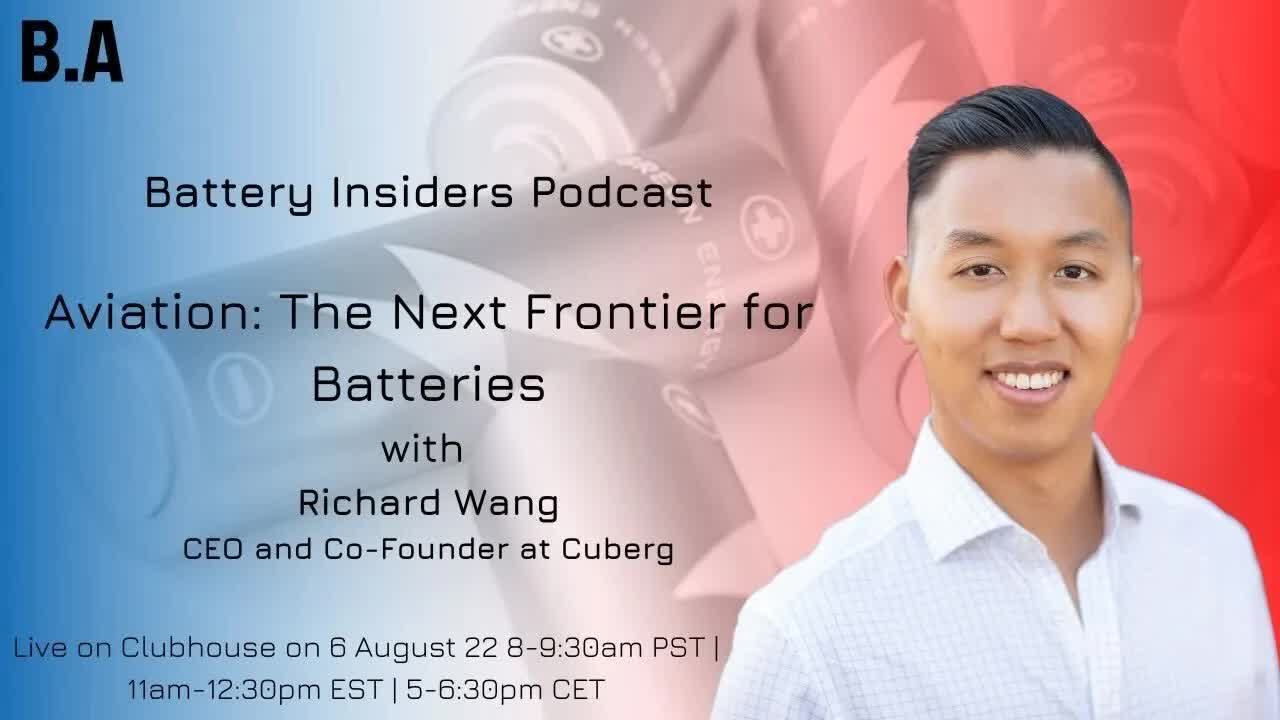
Richard Wang
CEO and co-founder, Cuberg
Wang is chief executive and co-founder of Cuberg, which develops advanced battery cells for aviation and was acquired by Northvolt. This episode is a debrief recorded immediately after a Battery Revolution Clubhouse session on the same subject, with Mariam Awara co-hosting alongside Simon Engelke.
What this episode covers
The weight of lithium-ion is what caps electric aviation, Wang says. Regulators at the FAA and EASA are tightening requirements on battery safety and aircraft reliability, a long list of uncertainties is still open, and mass remains the binding limit on what an electric aircraft can actually do. Getting past it depends on a next-generation chemistry working, whether that is lithium metal or another advanced approach. His framing of the sector cuts both ways. Aviation is an early adopter of higher-performance cells because it has no alternative, and its own success is unusually dependent on those cells arriving.
Higher energy density changes the integration problem as well as the cell. Wang says advanced chemistries bring different mechanical and electrical requirements and behave differently in thermal runaway, and large OEMs are not used to them. A company that plans to build a great cell and let the customer work out the rest will be handicapped, in his view, even in automotive. Aviation raises it further: weight margins are thin, certification is stringent and safety consciousness is high, so the cell, the chemistry and the module have to be designed together at once. Do it step by step and you get a cell that is the wrong size, or whose swelling or thermal runaway behaviour is wrong.
Wang's read on the incumbents is that they have widened what they do well far beyond making cells over the past five to 10 years: quality, traceability, the carbon impact of manufacturing, recycling, material sourcing. He calls those competitive advantages and moats, and says entrepreneurs should look at the competition with open eyes, because it is nearly impossible for a single startup, however well financed, to reach the supplier quality and reliability customers now expect. That was a main reason Cuberg chose to be acquired by Northvolt. The partnership supplied systems capability, traceability, digital systems, manufacturability, supply chain and recycling, plus the credibility that has helped Cuberg get designed into aircraft.
Mariam Awara pulls out the line that money does not change hands without execution, and Wang applies it to aircraft order books. Companies hold commitments for hundreds or thousands of aircraft and use them as a signal of market interest to raise finance, which is normal in aviation. What is new is that these are not another 737 variant Boeing already knows how to build. Demand is never the constraint, he argues: a better battery at cost would sell without limit, and the real question is whether anyone can manufacture it at scale while lithium-ion keeps moving the goalposts. His advice to founders starts there, with picking investors who will not push you into the wrong market.
Questions from this episode
- Why is battery weight such a problem for electric aviation?
- Wang says the weight of lithium-ion batteries will be a significant limitation on how far electric aviation can go. The industry is working through many uncertainties at once, and the FAA and EASA are tightening requirements on battery safety and aircraft reliability at the same time. His conclusion is that developing a next-generation chemistry successfully, whether based on lithium metal or another advanced approach, is critical if the industry is to thrive rather than merely exist. He frames aviation as both an early adopter of higher-performance cells and a sector unusually dependent on those cells working out.
- Why can't a cell company leave systems integration to the OEM?
- Because more advanced chemistries with higher energy densities carry different integration requirements, mechanically, electrically and in the way thermal runaway behaves, and large OEMs are not used to those cell designs. Wang says a company entering even the EV market on the assumption that it will make a great cell and hand it over for someone else to figure out will be handicapped by that approach. Working on systems integration does two things: it makes adoption easier for the customer, and it feeds back into how the cell and the chemistry get designed in the first place. Without that loop, the early design decisions are made blind.
- What makes aviation harder than automotive for a battery supplier?
- Aviation is extremely sensitive to performance and weight, with very little margin to give away, and it is safety conscious with stringent certification requirements. Wang says that combination pushes the need for vertical integration to a different level: the cell, the chemistry and the module have to be designed together and all at once rather than one after another. Sequential design risks a cell that turns out much too big to contain, or one whose swelling or thermal runaway characteristics are wrong, and both reduce the value of the offering at system level. He also notes that aircraft OEMs are less advanced in electrification competencies than automakers, who have had far longer to build them.
- Why did Cuberg join Northvolt?
- Wang says the battery industry has become far more sophisticated over the past five to 10 years, with the large cell manufacturers covering a much broader scope than cell production alone: quality, traceability, the carbon impact of manufacturing, recycling and material sourcing. Those are competitive advantages and moats, and he says it is nearly impossible for an individual startup, no matter how well financed, to build them all and meet the supplier quality and reliability customers expect. The partnership with Northvolt supplied systems capability, traceability, digital systems, manufacturability, supply chain and recycling. He credits it, alongside the technology, for Cuberg's credibility with customers and for getting designed into aircraft.
- How much should we read into electric aircraft order books?
- Carefully, on Wang's account. Aircraft companies have sold or won commitments for hundreds or thousands of aircraft and use those orders as a signal of market interest to generate financing, which he says is not unusual in aviation. What is new is what is being ordered. These are not new versions of the 737 that Boeing already knows how to build, but novel aircraft designs, novel applications and novel battery technology, so the execution itself is a large risk and unknown. His own view is that these companies will only get close to what they have promised by using batteries well beyond what lithium-ion currently offers.
- What advice does Richard Wang give battery founders?
- Three things. Pick your investors very carefully: his thesis is that the wrong ones, whether venture capitalists or automotive corporate investors, will push you towards a market that does not make sense for the business as a whole. Define what success means to you personally, because it does not have to mean an IPO or a SPAC, a billion-dollar company and gigafactories around the world. Keep that definition as your north star, since plenty of people will guide you in other directions. Third, build a strong network of mentors, advisors and friends, because the startup journey is long and arduous and often lonely, with sensitive problems a founder cannot share inside the company.
Listen to this episodeWatch on YouTube
Part of The next chemistry
Transcript
About this transcript. Generated automatically from the recording, then corrected against a glossary of company and guest names. It has not been checked line by line. Machine transcription mis-hears technical terms, numbers and names, so treat any figure here as a prompt to check the recording rather than a quotation of record. Spotted something wrong? Tell us.
0:00Introduction
0:00Welcome to Battery Insiders, your podcast providing you insights in the fascinating world of batteries. Hosted by Bhavya Jha and Simon Engelke. With today's co-host Mariam Awara. So thank you so much Richard for joining us on the Battery Insiders podcast with the topic of aviation, the next frontier for batteries. And what was interesting about our conversation and the points that you brought up is that it spanned everything not just from technology development, but also across the battery production, manufacturing and regulations, value chains, how development affects all of those things for the end user. And so today we're just going to be doing a recap of the points that were brought up during the podcast and the conversation. And to start, Richard, if you want to give a highlight essentially of the topic that you brought forth, and we can have a conversation on the topic points that were brought forth as well. Sure. Yeah. So I think the big theme of the day really is the unique role that aviation has to play in battery innovation and really being an early adopter for advanced new technologies with higher performance.
1:35And also conversely, how dependent the aviation industry success is on these new technologies working out.
1:43Weight, regulation and the limits of lithium-ion in flight
1:43I think the broad observation is that with so many uncertainties and tightening regulations from the FAA and EASA on battery safety and aircraft reliability and so forth, the weight of the weight of lithium-ion batteries is going to be a significant limitation for electric aviation to really see its full potential. And the ability to actually successfully develop a next-gen battery chemistry, whether based on lithium metal or another advanced chemistry, will be critical for this industry to truly succeed and to thrive. Fantastic. Yeah. Thank you so much for sharing that. And I think also one aspect, and again, we don't want to spoil some of the insights as well, but I think a few just, I think, are really fun and fascinating. So one is, I think, your approach of that you cannot take your cells in isolation anymore. And if you had like also other guests on this podcast as well, like, you know, from, you know, other battery industries who would kind of say, you know, it's, you know, we are the cell experts.
2:42We'd be thinking only about cell chemistry, let's say solid-state as an example. And that's like, you know, that's our specialty. And we're only going to focus on that and that integration you're going to leave to other players. Let's think about electric vehicles, right? And I think today you kind of, one thing you brought up is, and, you know, also I know a lot of people can watch this on LinkedIn, et cetera. They might also be wondering, you know, if I start like one of these technologies, how do I bring it to the market? And you kind of have been advocating on, you cannot look at it in isolation. You also have to look into kind of integration. Maybe you can share a bit more about this and your philosophy behind this. Yes, sure. I think generally more advanced chemistries with higher energy densities in particular will have different integration requirements, whether from a mechanical or electrical perspective or from a thermal runaway perspective.
3:28Designing the cell, chemistry and module together
3:29It'll just be different. And the reality is large OEMs are not used to these kinds of new cell designs and new chemistries. And so I think even if you were a company trying to enter the EV industry, you cannot just say, I will make this great cell and then give it to the company and they will figure it out. You know, you are ultimately going to be handicapped in that approach. You have to really think about the systems integration elements, partially to solve the system integration elements to make adoption easier, but also to also think about the impacts of system integration on how you design your cell and your chemistry in the first place and to have that feedback loop. In aviation, of course, everything goes to a whole different level in terms of the need for vertical integration and doing it together because it's such a performance and weight sensitive industry with very little despair in terms of weight margins. And it's also extremely safety conscious and has very stringent certification requirements.
4:26And that really leads you to need to design your cell and your chemistry and your module all together, all at once to really optimize that full system rather than doing it step by step. Because if you do it step by step, you may end up with a cell that's too small or usually much, much too big to contain. You might end up with a cell that doesn't have the right characteristics in terms of swelling or in terms of thermal runaway. And all of these impact ultimately the value of your offering at a systems level. It's also, I think, the reality that aircraft OEMs are not as advanced in electrification competencies as, let's say, the automakers are, who've had a much longer time to really build up that competence. And they're trying to integrate new chemistries that are not as well known and with a set of requirements that's much more difficult than automotive.
5:12Traceability, sourcing and the incumbents' moat
5:12And so for all these reasons, I think the battery industry should take it upon itself to really look to develop that full system solution because it will ultimately be a better solution compared to letting the OEMs try to figure it out on their own and better for the industry overall. And an interesting idea essentially that was put forth, Richard, also is that you can't bring innovation forth in isolation. It seems that manufacturing and even traceability of CO2 emissions and sources of materials seems to be a really integral part now of what you do at Cuberg, but also your role and how it's being established in the market now in terms of informing certification standards and requirements as well. Yep. So the reality of the battery industry is that the industry has become so much more sophisticated over the past five to 10 years with the large cell manufacturers really becoming extremely capable at what they do and really not only looking at cell manufacturing, but looking at a much broader scope of the value chain and also looking at all these other elements like quality and traceability and sort of carbon impact of their manufacturing and so forth, as well as recycling, material sourcing, all of these elements. And I mean, these are all essentially at the end of the day, competitive advantages that they have and moats that they build up that make it difficult to compete with the large cell manufacturers.
6:44And so I think for new technologies and for entrepreneurs that are trying to create their own startups, I think they should look at it with open eyes because the competition from the lithium-ion industry is at an extremely high level of competence and professionalism.
6:59Why Cuberg was acquired by Northvolt
6:59And it is not easy as a startup or maybe nearly impossible for any individual startup, no matter how well financed, to try to do it all on their own and to meet that level of supplier quality and reliability that customers have come to expect. And so with Cuberg, you know, one of the really main reasons we decided to join Northvolt and to be acquired is that this close partnership between Cuberg on the technology side and Northvolt as a large cell manufacturer gives us all those other elements on systems capabilities, on traceability, on digital systems, on manufacturability, supply chain, recycling. We certainly could not do even a portion of these ourselves effectively and credibly. And it's only with Northvolt that now I think we have gone to a different level in terms of our credibility as a battery supplier. And that's another main reason beyond our technology that we are able to really secure contracts with customers and get designed into aircraft is because they believe ultimately in this company because it has the backing of Northvolt and it has that full picture of sort of what a battery supplier really needs to offer to be competitive.
8:05Thank you for sharing. Thank you for sharing. Thank you for sharing. Also maybe a bit of a hint for anybody who wants to listen to the full recording because you also shared a bit more on your journey and also kind of what is the technology you looked at before and kind of also if you've been pivoted or adjusted your journey and then now, as you said, this acquisition also is Northvolt. So yeah, all things you want to maybe listen to for the full recording as well. Is there anything else, ma'am, you want to add? I do want to add one point that was important that I think Richard you had brought up, which is to understand the battery innovation space in terms of the value that's being created.
8:48Aircraft order books and the execution risk behind them
8:49You know, of course, we talked about value not being created in isolation, but also that money doesn't exchange hands without execution. So that's a really important point that we talked about and I think it's worth highlighting as well in the reflection. Yep, yep, absolutely. I think so. So this comment was on the a lot of aircraft companies that have, you know, technically sold or gotten commitments for hundreds or thousands of aircraft. And, you know, they're using these orders as a signal of market interest to then generate financing and interest in their companies. And this is not unusual in the aviation industry. But what is new at this moment is that it's not like these are orders for, you know, a new version of the 737 that Boeing already knows how to build. These are entirely novel aircraft designs, novel products, novel applications, novel technologies and batteries. And the execution of it itself is a huge risk and unknown. And I think this is true in the aviation industry where, you know, can the companies actually deliver something close to what they've promised?
9:57You know, and my view in the industry is that they will only be able to get close to that by using much more advanced batteries beyond what lithium-ion can currently offer. And I think there's there's you see the similar sort of analog in the battery industry play out where you have companies that have gone public, that have laid out these very ambitious business plans and say, you know, I'm going to get my battery manufacturing costs down to $50 a kilowatt hour with my new next gen chemistry in a few years time and build a gigafactory. And it's yes, you know, if you did that, obviously there would be infinite market interest for your product.
10:31Demand is not the constraint, and choosing investors
10:32But the key in the battery industry is not like how much market demand you have. If you have a better battery, you can make it a cost. There will be infinite demand for your battery. The question is, can you actually do it? And, you know, history shows us most of the time this is way, way more difficult than people anticipate, especially the manufacturing scale up aspect in batteries to become build a quality systems, build a supply chains and get to the power. And the goalposts are moving as well with lithium-ion industry becoming increasingly even more efficient and competitive. So it is sobering to really compete head to head with those kinds of companies and really why for us, we really took a different pathway with aviation to not have to compete head to head in that kind of industry. Fantastic. Thank you so much. Maybe just one last quick thing. I mean, you already mentioned it a bit, but also just think of all those people, you know, going to maybe watch this or listen to this and they're new to the industry.
11:25You know, they're really excited and inspired by your journey because you're one of, you know, the, you know, you kind of, you did it in some way, right? Like you started a startup, you know, spin it out and you got to an acquisition and right. So I think that's probably a lot of people's maybe dream or like, you know, people want, they want to achieve. So maybe anything, you know, you can pass on like, you know, any learnings and encouragements for anybody who's in for this journey in the battery space. Sure. I think, you know, few words of maybe guidance. One is to pick your investors very, very carefully. My thesis is if you get the wrong investors, whether they're venture capitalists or maybe automotive corporate investors, it will push you in a wrong direction because you'll be forced to pursue a market that may not make sense for your business as a whole. I think my second sort of piece of advice is to really define what you see as your personal definition of success and success does not need to mean going public in an IPO or a SPAC and being a billion dollar company and, you know, building gigafactories around the world.
12:24Defining success, and the loneliness of the founder journey
12:25There are many different models of success. Ultimately, I think it's about can you make an impact and actually have a product that gets successfully commercialized and solving a real problem. But everyone has their own definition and just to always keep honest and to keep that as your North star as you run your business because you'll have lots of diversions and lots of people guiding you in different directions that may or may not make sense for you personally. And then I think my third piece is is to really build up a very strong network of mentors and advisors and friends because the startup journey is long and arduous and often very lonely. You know, the problems that an entrepreneur faces are often ones that he or she has to face alone and often, you know, without even being able to share with the rest of your company because they're sensitive topics and you have to really do it yourself. There are very few that can really empathize with that.
13:20So building up a fellow community of entrepreneurs who have done it before and who can give counsel and then support is, I think, incredibly helpful. And I've been fortunate to to have some of those as well on my journey. That's like this. Just a massive thanks to you, Richard, to spend your time and, you know, share your insights. I think it was absolutely fascinating discussion. And yeah, if you're interested about this already, you probably don't want to miss out to the full thing. You know, the one half hours or so where we went in, you know, quite a bit of depth and love this topic. We just kind of just covered just really quickly right now. Yeah. But this just a big thanks and also really, you know, just invitation to join us for our next sessions. We always have some great speakers or to maybe also check out some of our previous sessions we had. Again, as you mentioned earlier, this is the 52nd session we have had in this Battery Revolution, Battery Insiders context.
14:06So, yeah, just can recommend you to check this out as well. Thank you so much. It was a pleasure to participate. Thank you so much, Richard. Thank you.