
Episode 119 · 10 January 2024 · 00:31:10
Twelve years of building solid-state cells
Insights on Solid-State Batteries
Blue Solutions on twelve years of serial production, what the Gen 4 cell has to deliver before 2029, and how they recover 90% of the lithium from a metal anode.
Read the article: Twelve years of building solid-state cells
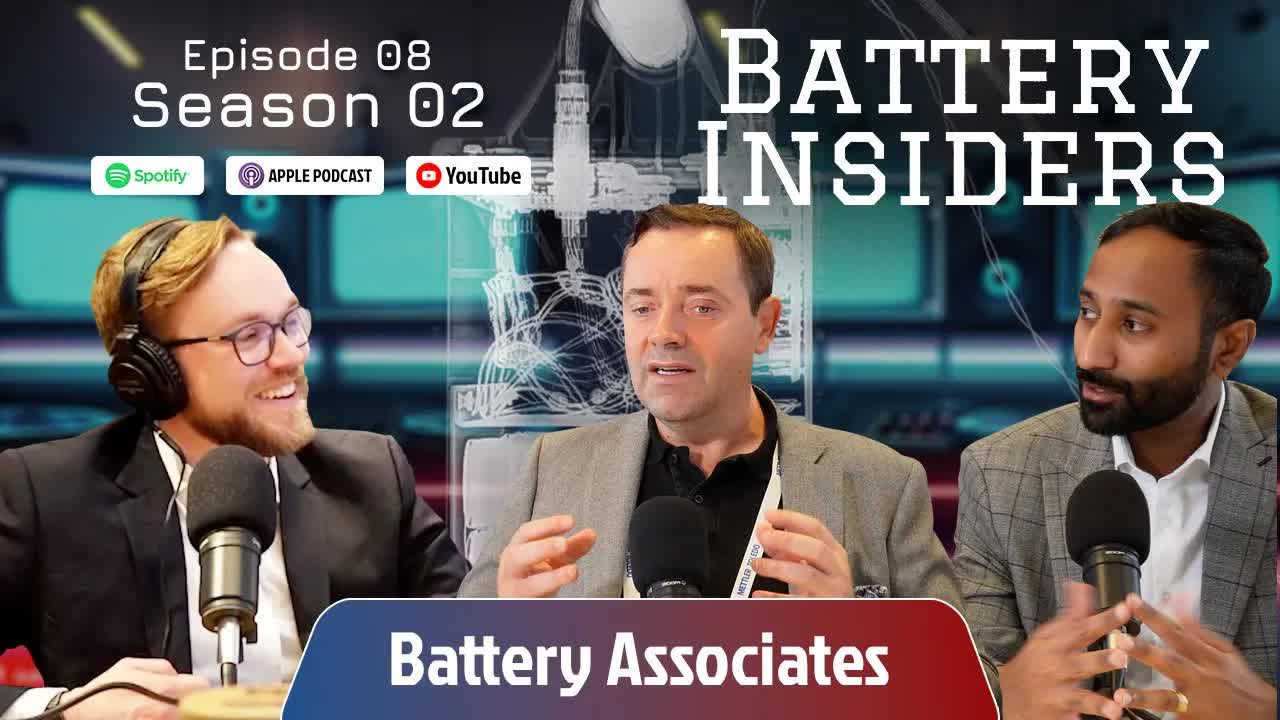
Richard Bouveret
Chief Executive Officer and Chairman, Blue Solutions
Blue Solutions makes solid-state cells with a lithium metal anode, with plants in Brittany, France and in Canada. The episode's on-screen credit spells the surname Bouueret; Bouveret is used here as the likelier form. Worth confirming.
Sriram Claude Ramanoudjame
Director of Strategic Marketing, Blue Solutions
Recorded in Berlin, at the Future Battery Forum
What this episode covers
Blue Solutions has been in serial production of solid-state cells for twelve years. Two plants run in parallel on two continents, one in Brittany in France supplying Europe and one in Canada supplying North America, and production started in 2011. More than three million cells have been built, most of them in Europe with some in Africa, Australia and North America. The third generation is the one currently in the plants. The research behind it goes back further: their previous CTO made his first solid polymer electrolyte in 1987. The definition they use is simple. The electrolyte in today's batteries is liquid, theirs is solid, and that makes the battery smaller for the same energy.
Gen 4 is the one they came to talk about. It runs at 20 degrees C, charges in about 20 minutes, and they put the nominal energy density at 450 Wh/kg, a figure their pre-samples are already reaching. It is due to market in 2029, which is also when their own gigafactory is meant to start. They have been saying 2029 for years, and that consistency is the point they keep returning to. Other solid-state companies announce start of production dates too early, they argue, often because they were spun out of a university or a research lab and have never taken a cell technology through a scale-up.
Having done it once shapes what they build. They also operate electric buses, so they see the batteries in the field and know how a pack behaves after ten years, which feeds back into design. The same instinct produced an unusual early move on recycling. Their anode is pure lithium metal, with no current collector on the anode side, and recycling companies had no route for that component. Blue Solutions can now recover 90% of the lithium, and says it could go further, though not under the same conditions. Cathode and electrolyte recycling can be done with existing partners; the metal anode had to be solved in house.
They are firm that solid state will be a share of the market, not the market. Lithium-ion stays for mass market vehicles at least to 2035. If solid state reaches 15% of world demand over 15 to 20 years, they consider that a good outcome. The applications they name are trucks, commercial vehicles, machines that run 24 hours a day, and premium and sports cars replacing internal combustion. On charging they refuse the specification race: some competitors chase 5C or 6C, but customers tell them 3C is fast enough, and what those customers actually want is quality, cost and proven delivery.
The commercial model is deliberately loose. No dogma, as they put it. A customer who wants a licence gets a licence, and can build Gen 4 in its own gigafactory rather than breaking an existing supplier relationship. A customer who wants cells gets cells, alone or with partners. A customer who wants a full pack with a BMS gets that. Foxconn is a partner for two-wheelers in Asia, BMW for premium cars, others for trucks, and more agreements they say will become public. They are also willing to sell their lithium metal anode as a component to rival cell makers, on the view that a stronger set of suppliers is what gets the technology into vehicles at all.
The constraint they worry about is upstream. A gigafactory takes five years to build and attracts government grants; a mine takes 15 to 20 years, sometimes with a 50% success rate, and gets nothing like the same support. They have signed partnerships with a mining company in Chile and with US, Canadian and European companies to make sure extraction and refining are done cleanly, refining included, because refining is energy hungry and should not run on coal. Lithium exists in Europe, in Serbia, Germany, France and Portugal, and whether to mine it is a political decision rather than an economic one. Asked what will decide the outcome, they name two things: raw material and talent.
Questions from this episode
- What is a solid-state battery?
- Blue Solutions keeps the definition short. A battery has a positive and a negative side with an electrolyte between them, and in today's cells that electrolyte is a liquid. In a solid-state cell it is solid. The practical consequence is that the battery gets smaller for the same amount of energy, which is why the whole industry is interested. For Blue Solutions this is not a future technology: they have been manufacturing cells with a solid electrolyte in serial production for twelve years, and are on their third generation.
- When will Blue Solutions' Gen 4 battery reach the market?
- 2029, which is also the planned start of their own gigafactory. They have used that date publicly for several years and say they intend to stick to it, with an industrial plan and automotive validation milestones behind it. The timing comes from OEM customers who share their platform roadmaps and want solid state on a few premium platforms by the end of the decade. Their criticism of the sector is that rivals announce start of production dates too early, often because they came out of universities or research labs without the industrial experience to see the scale-up problems coming.
- What performance is Gen 4 aiming for?
- It operates at 20 degrees C, charges in around 20 minutes, and carries a nominal energy density they give as 450 Wh/kg. Pre-samples are reaching those figures. On charge rate they are pointedly unambitious: several competitors are targeting 5C or 6C, but the OEMs Blue Solutions talks to say 3C is fast enough, and rank quality levels, cost performance and demonstrated delivery capability alongside it. Taking sensible compromises on the product, rather than maximising one specification, is how they describe their approach.
- How much of the lithium can Blue Solutions recycle?
- 90% today, and they say they could recover more, though not under the same conditions. The reason they worked on it early is that their anode is pure lithium metal with no current collector on the anode side, and no recycling company had a route for that part. Other components such as the cathode and the electrolyte can be handled with established partners. With more than three million cells built since 2011, the first packs are now reaching the end of their lives, so the recycling route is being used rather than planned.
- Who is Blue Solutions working with?
- Foxconn on a battery for two-wheelers in Asia, BMW on premium cars, and other partners on integrating batteries for trucks, with further agreements they say will be made public. Upstream they have signed with a mining company in Chile and with US, Canadian and European companies on clean extraction and refining. They are open on the commercial model: licensing the technology to manufacturers who want to build Gen 4 themselves, supplying cells, or supplying complete packs with a BMS. They will also sell their lithium metal anode to competing cell makers.
- How big will the solid-state battery market be?
- Blue Solutions is not targeting 100% market share. If solid state takes 15% of total world demand over the next 15 to 20 years, they say that is a very good result, and it still amounts to a large number of terawatt hours. Lithium-ion remains the mass market technology at least until 2035. Solid state gets used where energy density matters most: trucks and commercial vehicles, machines running around the clock, and premium and sports cars replacing internal combustion models.
Listen to this episodeWatch on YouTube
Part of The next chemistry
Transcript
About this transcript. Generated automatically from the recording, then corrected against a glossary of company and guest names. It has not been checked line by line. Machine transcription mis-hears technical terms, numbers and names, so treat any figure here as a prompt to check the recording rather than a quotation of record. Spotted something wrong? Tell us.
0:00Introduction
Dr Simon Engelke
0:00Welcome everyone. Thank you so much for joining for our Battery Insiders podcast. We're here live from Berlin, from the future Battery Forum. We're really delighted to be here. And I'm delighted to have two fantastic guests with us from Blue Solutions. We have Sriram and Richard. Hi, Simon. Hi, Simon. Good to see you. And you're well done already yesterday on the stage. So, you know, nice performance there. It was great to hear already a bit about the solid-state. But now for our listeners and people watching on YouTube and all these other platforms, we want to go a bit into the topic. Because solid-state is all the rage. It has been for some time. It keeps coming up. But, you know, it sounds like there are exciting developments. So, you want to go into them a bit more. So, maybe let's start very simple. What is solid-state?
Richard Bouveret
0:50It's a question that we can answer very, very simple matter. You know, what is a battery? You know, a battery is a body. It's something that has two components. A plus and minus.
Sriram Claude Ramanoudjame
1:05Because you generate, you know, electricity.
Richard Bouveret
1:08Everybody will think that you have a plus and minus. And in between, you have two electrons that have to move around. And in between, there is what we call electrolyte. And the battery of today, the electrolyte is liquid. In the future, the electrolyte will be solid. For us, the future is today. Because we are manufacturing those kind of technologies since 12 years. And the electrolyte is solid. It makes battery smaller with higher density of energy. Okay? This is, that's why we are talking about solid-state everywhere. We want box smaller, lighter, with a lot of energy. So, this is what we call solid-state battery.
Dr Simon Engelke
1:54Great. No, thanks.
1:55What a solid-state battery actually is
Dr Simon Engelke
1:55Thanks for providing this. And now let's talk a bit about how is the research progressing? How has been your journey? Because, again, solid-state, we know there has been a lot of startups. A lot of companies got into this also more recently in the U.S. Publicly traded. Some of them, you know, having some challenges. Something, I think. But you have been on this, I think, for quite some time. And maybe you can just share a bit of your, you know, your development on this. The different steps, the hurdles you took to really start scaling this more as a product.
Richard Bouveret
2:23Yeah, we are there since 12 years. 12 years of serial production of solid-state battery. So, we have learned a lot. We have two plants in two continents running in parallel. Producing battery for North of America from Canada. The one for Europe is in France, in Brittany. That's been a long, long road. A bit difficult. But we are today at the third generation in production. We have millions, more than three million sales here in the park, in Europe. And some of them are in Africa, in Australia, a bit in North of America. But majority is in Europe. And now we are at the stage that we are developing the Gen 4. What is the Gen 4? It's a battery that is running at 20 degrees C. It's a battery that has a fantastic, what we call C-rate, ability to charge in 20 minutes. It's a battery with high density. And when we speak about density, it means it's good to remember this nominal value, 450 watt hour per kilo. You know, it's very important data. People are talking about that. And we are there today. Our pre-samples are reaching those data. It's a fantastic move.
3:51Twelve years of serial production, and Gen 4
Sriram Claude Ramanoudjame
3:52You know, probably the thing that sets us apart from the other players is the fact that we started research a long time ago, in the 80s. You know, our previous CTO has made his first solid polymer electrolyte in 1987. You were not born. Actually, I was born in 1987. So it was actually a long time ago. And then, lots of research. Lots of trials. You know, we started production in 2011. And we produced 3 million cells as of now. That's a lot of learning opportunities for us. Field, we also make electric buses. So not only do we learn from the battery manufacturing, but since we exploit those vehicles, we have access to the data from those vehicles. We know how the batteries evolve over time. We know what happens after 10 years. And this gives us quite good intel on how to manufacture and design the batteries up front. That's very important as well.
Richard Bouveret
4:48And I would like to add that it's, of course, holistic understanding of the technology. You know, because the battery is not just, I mean, I would say material that you put together, electrochemistry. A battery is a smart system. A battery should have a lot of electronics embarked. A lot of brain into it. It should be fully connected. On top of that, you say that 3 million cells. But it means that today we are already launching what we call the recycling. Because those batteries now, after 10, 12 years, they arrive at the end of their life. And we need to, what we need to do? We need to recycle them. So today we are able to recycle 90% of the lithium. Our battery and lithium metal. And we are able to collect 90% today. We are already there. And we are planning, of course, to do more. But, you know, today I think with 90%, I think we could be quite happy.
Sriram Claude Ramanoudjame
5:45Now this is a fantastic number, 90%.
5:47Research from the 1980s, and data from buses
Sriram Claude Ramanoudjame
5:47You know, we have, we decided to do this because we have a quite unique technology. You know, we are the only producer of solid-state batteries today. And we have an anode with lithium metal. Pure lithium metal. Therefore, we don't have any current collector on the anode side, by the way. And it was very important for us to understand how to recycle this particular component. Because recycling companies, they have lots of expertise. Lots of companies we can work with for the rest of the parts, you know, cathode, electrolytes. But for us, it was very important to find how to recycle this lithium metal. And how we can anticipate, you know, all the regulation requirement in terms of re-injecting those raw materials in new batteries. And 90%, we could go actually a little bit more if we want to, but not in the same conditions. It's a fantastic number. And people are really happy. By people, I mean our customers, the ecosystem. It's very important to have a circular approach as of now. And we make sure we think about this up front. Gen 4 is due to the market in 2029. And we anticipate this product technology and how to manage the product at their end of life.
Richard Bouveret
6:59This is what I mean by the coherence. We have to be coherent on all the value chain. And I think the people that will succeed in the future, it will be a matter of coherence. Sustainability, yes, but coherence. From the mine till the recycling. If you are able to handle, maybe not control, but I would say influence in the positive way. All the actors to be clean when you are at the mine. The way you extract the material is as much as important the way you will recycle. Because if you make battery to be clean and you go take the ground somewhere, the lithium in a dirty way, what is the coherence? So we need to work. That's why we have signed a lot of partnership with a mining company in Chile.
7:46Recycling a lithium metal anode
Richard Bouveret
7:46We are working with a U.S. company. We are working with Canadian, with European company for the time being to be sure that the way we will extract the material we need is done in the clean way, in the sustainable. And technology is there for that. Because mining, they didn't slip. They are working on it. But of course today, it's a bit more expensive to do it. But at the end, we know by scaling up technology, we'll be okay to do that. And then we need to be sure that the refining after is clean. Using clean energy. You need a lot of energy to make refining of material. And you should not use coal. You should use that hydraulic energy. Clean energy. You know, to be sure that you are... And you should use less with new processes that are taking infinite, less growth and less, I would say, energy. The best way is to use nothing. But we cannot. Okay. So then we have to use less and in more respectful way.
Dr Simon Engelke
8:45And maybe two quick follow-ups on that one, right? Because I think you brought up a few interesting points. One, very impressive, you know, on your experience and your learning curves, right? Over the time and having the time. But of course, the industry also doesn't sleep, right? And there's a lot of... And even if you look at lithium-ion, like, you know, liquid base, et cetera, improvements, we see announcements. And so maybe just one question, how do you deal with that, right? As a company who's trying to establish, like, a newer technology. And you mentioned, like, Gen 4, which is very exciting. I want to see more about Gen 4. So you shared also in previous conversation of interesting, you know, aims and developments there. And I think, so one, like, you know, if you have, like, it's kind of felt sometimes for me from the outside also, but, like, a moving target. Because you mentioned 2029. And now you're saying that's what we currently see the market is doing. But who knows what the others are doing in 2029. So that's one, maybe, question. The second, you brought up these materials, which I think is super important, the holistic approach you mentioned. And chapeau to already think about recycling when you actually produce, because often here's an afterthought.
9:45Clean extraction and clean refining
Dr Simon Engelke
9:46So I think that's really good to see. But I guess also the question there about, because you're, like, still a smaller company compared to some other players. And we see it even OEMs now trying to, you know, virtually integrate. And even they have a challenge of this often, right? And I guess the question, how much do you think currently, like, as a company, you should really bother with everything? Like, or how can you really, not really bother, but can you actually go, how vertical can you get? Or how much should you maybe get? Because you can, of course, and you can spend the time. But what's kind of the balance you're trying to, you know, have here on that topic?
Richard Bouveret
10:21You raise a lot of very, very fundamental points for our, I would say, business. Battery is a complex and sophisticated product, right? Then, of course, we need raw material. We need to be able to make the assembly of it. We need to be able to put inside the car. We need to have the electronics then manage it. But you say something very important. You have other players with lithium-ion. They will be there. They are there and they will be there in the future. It's clear. For mass market, lithium-ion will be there for a long time. At least for 2035. After it will change. Because we are talking about Gen 4, which we are already launching the Gen 5. And even thinking about the Gen 6. Because the only way to be competitive is to be creative, innovative. You will not fight against the super mega champion of Asia with traditional battery. Okay? You have to come with something that is a breakthrough. This is what we are proposing. We are not targeting 100% market shares. You know, if solid-state is doing 15% market share of the total need in the world in the future, it will be very good. We will talk about several teras, I mean, waters. Then it will be fantastic.
11:42How vertically integrated should a cell maker be?
Richard Bouveret
11:42What per hour is. So then we will have a big diversity. I said that yesterday in my intervention. A lot of diversity will be there. solid-state. lithium-ion will live together. But the solid-state will be used for a specific purpose. Very high density. It will be used for trucks versus commercial vehicles. It's machines. You need a lot of energy. You need sometimes machines that run 24 hours a day. So you need those type of batteries. The sports car. You have a lot of premium vehicles in the future that will be replaced. Their ICE internal combustion engine will be replaced. So they will need to come with very sporty solutions. You will need to have a very fantastic battery inside. This is our batteries. We will not go to Mass Parket, I think, before 2035. I think maybe you can give your point of view.
Sriram Claude Ramanoudjame
12:37Yes, I think the point you raised, Simon. When we look at the different players on solid-state batteries, they announce too quickly a timing. They announce too quickly an SOP timing. What we try to do on our side, you know, we've been talking about 2029 for many years already. We have a clear industrial plan in front of us. We have key milestones for the automotive validations. And very importantly, we do work with OEMs. We do work with customers that share with us their roadmaps, that share with us their platform plans. And this timing is driven by their willingness to start by the end of this decade. Some platforms, a few volumes, starting by premium applications, solid-state batteries. Now, what you see, the delays that you see in the market with the other players, is related to the fact that either they are formed as a spin-off of previous universities or research labs,
13:37Why other solid-state timelines slip
Sriram Claude Ramanoudjame
13:38and they don't necessarily have all the industrial background to anticipate the difficulties and the roadblocks that you can see on a scale-up phase. We did this once. We did this in the past. We are currently producing the Gen 3 on Blue Solutions sites. And we know all the steps that are necessary so we can anticipate the roadblocks, and we can work on that. Having a good vision on the industrial difficulty that you will face is quite important. And secondly, we are pragmatic people. And we are not so small either. We have 450 people, 200 R&D, 50 PhDs, and 150, I think, process-dedicated people. It's a question of both product and process. And the chance that we have is that all those people are focused on Gen 4 as of today, but they brought the technology once to the market. And we are pragmatic people because we take the right compromises on the product. What some of the other players are looking into is either targeting too much in performances or too much in other specific requirements, such as fast charging. Some of them are looking for 5C, 6C charging rates. But when you talk to customers and the OEMs, this is not the only point that's important for them. Of course, they want fast charging, but 3C is fast enough for the market. What they also want is quality levels, cost performances, and they want delivery capabilities that we demonstrated once. So, what we announced, we plan to stick with this timing and the industrial plan that we have in front of us. And 2029 is the start of a Gigafactory for us that is aiming at delivering platforms and OEM cars.
Richard Bouveret
15:30And I would like to add something that we will stick to our DNA.
15:33Safe, sustainable and smart
Richard Bouveret
15:33The DNA of the company is to be able to make a battery that will be safe. First, you were mentioning safe, and it's becoming, of course, from the quality of the product, but the quality of your process. And believe me, the safety, a big part of the safety is coming from the ability to have a capable process, repetitive, reliable process. We need also to have a battery that will be, I spoke about that before, we need to be sustainable. And I come to my point, my obsession, to be able to be consistent, consistent, consistent. And also, we need to make smart product. And smart product is the product that we'll be able to recycle. It's the product that we'll be able to produce near the customers. With a small company that we will have a human-sized company that people, new generation of big talents will be happy to work with. And that is what I call the smart side. And also, we need very connected and powerful electronics with twin digital technology. The battery you will use, the lifetime of the battery you will have, will be reflected by a big part of it, not just by the electrochemistry, but with the way we are using it. So it means that we need to be smart. We need to know where are our batteries. So let's think about metaverse world. Why you see your battery? Why you see how they are used? That you can control and connect it and help the user in the smart way to use it in the best way. We need to go until there. So the battery is not just ground that we go dig for raw material. It's also a lot of world of virtual world. It looks very strange, but this is a big part of the future. And to add something, we need to develop battery, but we cannot develop alone.
17:34Partnerships with Foxconn and BMW
Richard Bouveret
17:34We have a partner. You have heard maybe that we are discussing with Foxconn. We have a GDA with a BMW. We have others that I cannot disclose today, but they will be soon public. And the idea is to work with automotive people, to work with them. Foxconn, the target is to develop together a battery for two wheelers in Asia. We have a BMW. It's for the premium cars. We have other partners that help us to integrate battery for the trucks. You see, we are not working alone. And we don't want to work alone. What we will develop is because there is a need, there is a customer behind, because they know the field. They know their customer and the end user as much as we know, but we will trust them much better than the others. So, everything we will do will be on our principle, safe, sustainable and smart, but working with a customer from A to Z.
Sriram Claude Ramanoudjame
18:33In terms of supply chain for the second part of your question, we are open to different business models. We are open to partners, partnerships. I think it's very important to mention that before. We cannot do everything by ourselves. Okay? So, we need to choose our battles. We know our competencies. We know where we can make a difference. And then the rest is choosing the right partners in the right locations, the right customers that will help us and help the industry bring solid-state batteries to a successful, like you mentioned, 15% of the total market. 15% is already potentially a great achievement for this technology. We talked probably in 15 to 20 years timeline. If we go further, of course, it will be a higher penetration, but 15% is good. And to make this happen, the right partners in the right locations.
Richard Bouveret
19:25And when you speak about the business model, we need to be nimble. Some of our customers, they will ask to license.
Richard Bouveret
19:36Others, they will ask cells, battery cells. Then let's produce battery cells. Alone or together or with other partners. No problem. Do you want battery pack with BMS, complete system, super BMS? Then we do it for you because we have done it and we will improve it. Then we will do. Alone or with partners. We are very open in that. No dogma. We will try to really adapt and to remain agile in this, you know, it's erratic, the business nowadays. Everybody is running to everything. So we cannot impose. We will adapt ourselves. This is our job to adapt to the customer needs. We will anticipate it every time because without anticipation, we have no, I would say, good execution of our strategy possible. But we will do in this way. And this is a part of all the employees. You mentioned 450 employees for the time being. But we will raise very quickly with a lot of engineers, technicians, PhDs, and brilliant people that maybe have no such diploma but are just brilliant. We need talents.
Sriram Claude Ramanoudjame
20:45It is very important what you say because we are battery manufacturers. And the timing we mentioned before, 2029, is to launch our own gigafactory. Now, you mentioned this before, we don't want to break all the relationships that exist today between OEMs and their suppliers, battery manufacturers. And we don't have the ambition to become the sole solid-state supplier of the complete automotive industry. So if there is a long relationship existing already in place between an OEM and a battery manufacturer, we are open to licensing our technology. And they can integrate Gen4 in their own gigafactory to deliver the OEMs. So this is kind of discussions and partnerships that we are already putting into place as of now because everybody is looking into solid-state batteries.
21:35Serving the market rather than dictating it
Sriram Claude Ramanoudjame
21:36And they are not expecting one guy to supply the complete market. They are expecting nimble approaches. They are expecting open-mindedness in the business models.
Dr Simon Engelke
21:46Thanks for sharing that. And also, I think it is exciting to hear these partnerships you mentioned. Also, looking at Tweet is, of course, one of the really big topics on decarbonization needed also on a global scale. Also, I think, you know, automotive OEMs have been a big push also in Europe, I think, for solid-state. And then some of them got a bit worried, right? Like a bit more concerned with timelines because risk averse, which is fair enough. And, you know, there is good reasons for everything there. But I think now we have seen a lot of solid-state was more for, like, electronic devices, smaller, smart watches and things, which, of course, is fair enough. But, of course, you want to go for the big things. So it's exciting to hear that you're pushing on this and you're getting these partnerships in place. Also, I think an interesting observation on that we have a lot of discussion at the moment, right? Like, as you mentioned, like, what are the real business models for the future for batteries? And, you know, companies like yours who might be, and there's other companies out there, right, who are very focused on the IP, on the development, and then maybe just become a bit like what we have seen for chips, right? Like FAPs and, like, you have other players developing for you. I guess one interesting topic will be, you mentioned, like, other people are going to build factories. There's always a discussion with retrofitting or that actually solid-state is one of the things where actually, and I know you have some very special processes there you cannot talk about. But, I mean, these things, of course, are a bit more, you know, unique, let's say, compared to others. So it's a bit harder. Maybe you actually have to then commit again. So you need, but this happened for chips as well, right, where companies are committing to develop and produce for you. So I think, but I like the openness, and I think that's important as well, and a bit of humbleness, which I think also speaks through this, right, to say we will see what makes sense in every day. Absolutely. We're not dictating the market. We're here to serve the market at the end of the day.
Sriram Claude Ramanoudjame
23:21You know, we speak with the industry, with the partners. And what they usually tell us is that it's important to understand the complete development phase, but also the industrialization phase, because everything is related.
23:35Why drop-in solutions do not work
Sriram Claude Ramanoudjame
23:36I told you we have as many process people than R&D research guys. And that's very important because when you hear that, for example, people have or technologies could be dropped in in an existing process or an existing gigafactory, this is not necessarily the feedback we get from those gigafactories. Even if you change the slightest part of your product in the manufacturing phases, this has a huge impact on the process, on the validations. And you need to spend so much time and money into re-adapting the manufacturing line that it's not very practical nor real to have a drop-in solution. You need to be dedicated to a product. Otherwise, you will not be able to, in our point of view, achieve all the key KPIs related to safety, quality, and delivery capabilities.
Dr Simon Engelke
24:31And I think also, I mean, of course, very much like what you also brought up about the talent and trainings. And that's one of, you know, as a veteran BA, I mean, we had these discussions and very fortunate you also have been in there. And I think also, as you said, like, you know, bringing other people from other industries in. I think getting this expertise, this sort of exchange happening, other process experience and bring this into the sector. And also having this holistic view, right, what you mentioned earlier, run the raw material through the production, through the use, through the recycling. Maybe one last kind of question just on the European perspective of a supply chain for solid-state, right? Because we spoke about this also yesterday and today on the gigafactories and how important these clusters can be. That you have things in proximity, there's co-development, there's innovation happening. For you as a player, right? So I guess for you, how would you see this? Like, how important is it to have, like, a local support of industry? And maybe also, you mentioned, you know, you don't have to be there and you don't plan even to be the only one, right, dominating a market. It's really about having different options.
25:31Building a European solid-state ecosystem
Dr Simon Engelke
25:32So how maybe important is it that there's also other successful solid-state players in Europe next to you? Absolutely. So you can really build a proper ecosystem.
Sriram Claude Ramanoudjame
25:41You know, we work with an OEM, German OEM. And they decided to start working with us, even if they have a first supplier that they invested in in the past. But this is a pure automotive approach and mindset where you need more than one supplier to make sure that you can have a backup in case of issue. But that you can also manage all the costs and roadmap development with this ecosystem. So we really want the competitive landscape to be more dynamic. We will try, actually, to raise the solid-state players by supplying one of our technological bricks, the lithium metal anode I talked about earlier. We will supply that to other battery manufacturers because we noticed that it is in their roadmap. They would like to have this brick in the future because it is the highest energy density gravimetric wise. So they would like to have that. And we'll provide this. By doing this, we help the competitive landscape to raise. And this will help our technology to get in the market. Because only if you have a strong supplier ecosystem can you make sure that the technology is going to come into reality in a vehicle. And then we try to work, for example, with the recycling companies. We try to work with the mining companies to make sure that when we start, the ecosystem is there. It's a huge question. It's a big point that you raise, the supply, the value chain on solid-state batteries. It's not in place today. It's not in place today. So what we want to do is to make sure that we put in place the right partnerships around us. And we think circular because only if you have the raw material on the one side and only if you can manage the products at the end of life, can you really bring something sustainable to the market?
27:33Five years for a factory, twenty for a mine
Richard Bouveret
27:34Yeah, and I would like to add that when you go to the supply chain, you have what we call strategic raw materials. Strategics. They are there. Lithium, lithium metal. Others are very important too. But phosphate, all this basic raw material that you can find normally everywhere. But you see, most of the battery makers in many countries are supported by the government with grants, super grants. To make a gigafactory, five years to make it, you know, when you decide to do it. And if you have the possibility to finance it, right?
Sriram Claude Ramanoudjame
28:11But to open a mine, it's 15 to 20 years.
Richard Bouveret
28:14And that is something that we have to work as industrial to make big partnership with minings. But I hope as well that as we are doing for battery, government in Europe will support that. They should have done that before. Because you see, 15 years, five years, really we should have started 10 years ago, you know, to be completely in line, to be sequenced. Today it's not the case. So for us, luckily we are using material that we can find quite everywhere. Even we are talking about lithium metal. Lithium metal is some, you know, lithium is everywhere. After, it's the problem of density. You know, you will not find a big quantity everywhere. In Europe, lithium exists. In Serbia, in Germany, in France, in Portugal, many places we have lithium. It's just a decision, are we okay to extract, to have mine in Europe? This is another political question. It's not just economic. So when we speak about holistic approach, battery is not just industrial. It's a way. It's a consistence. We want clean battery, but we will have to open clean mining, right? So that is something, it's a decision.
29:29Raw material and talent
Richard Bouveret
29:30It will be a decision per country, per region to do. Government will have to support that as well in terms of funding because a mine, it's a long-term investment. We've sometimes success rate that could be 50%. Okay? It's a big bet on the future. So, and Sriram says something. Yes, raw material will be the core of the battle in one way. The other will be the talent. Talent, raw material. Talent, raw material. And after you put that together, the ability to make a smart system, recycling, connected, usage with a safety mode. So we are there. You see, everything is global. You cannot just work on the silo. Silo should be broken. We should work together.
Dr Simon Engelke
30:19Fully agree. We will try our best to help on the talent side. Right here there. Thanks very much. We rely on you to build some great next-gen 4 batteries. So very much looking out for it to see that shaping and progressing. So I really want to thank you both, Sriram and Richard, to join me today. Thank you, Simon. For this insightful conversation. Thank you, Simon. And very excited to see your progress and see you to check in how it all develops. And excited to see these next announcements coming, you and partnerships, etc.
Richard Bouveret
30:44Thank you. It was a real pleasure to share with you today and with your YouTubers.
Dr Simon Engelke
30:50Thank you. And thank you everyone for listening in. For Battery Insiders, my name is Dr. Simon Engelke, founder and chair of Battery Associates. And hopefully see you very soon again on another one of these sessions. Thank you. Thank you, guys. See you.
Sriram Claude Ramanoudjame
31:00Thank you.