
Episode 135 · 20 July 2024 · 00:19:39
Lithium metal, without the solid-state detour
From Lab to Market: Cuberg's Journey with Northvolt
Cuberg's cell design and strategy leads on running lithium metal with a liquid electrolyte, a module that reached 692 cycles in third-party testing, and what Northvolt's supply chain gives a 200-person company.
Read the article: Lithium metal, without the solid-state detour
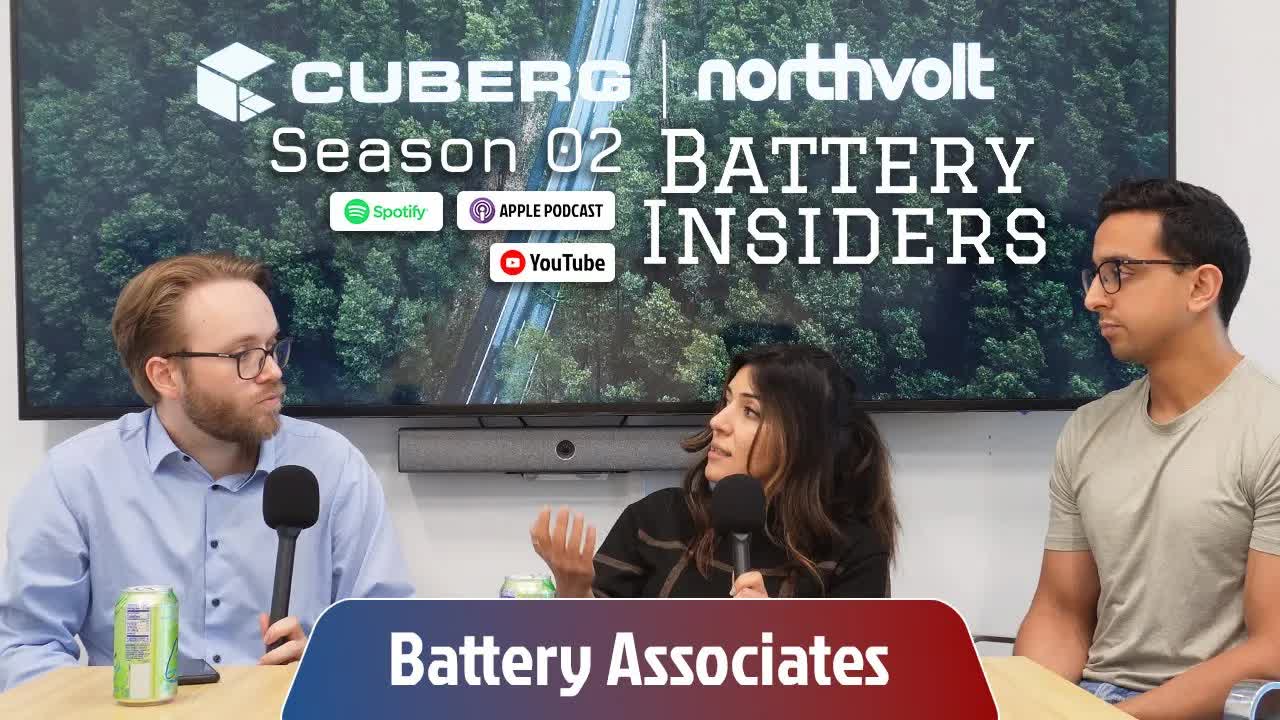
Asma Sharafi
Cell Design Manager, Cuberg
Cuberg develops lithium metal anode cells with a liquid electrolyte and integrates them into modules and systems for aviation, high-performance vehicles and EV markets. It was acquired by Northvolt in 2021.
Rizwan Dard
Senior Strategy Manager, Cuberg
Recorded in California, United States
What this episode covers
Asma Sharafi started her career on solid-state batteries, working on the lithium metal anode and trying to make solid electrolytes carry it. She lists the reasons that path is hard: material compatibility with different cathodes, compatibility between the solid electrolyte and lithium metal itself, short circuits and dendrite penetration, and above all the jump from lab scale to commercial production, where defect densities and manufacturing complexity bite. Cuberg runs the same anode with a specialised liquid electrolyte formulation instead. The point of that choice is equipment. Existing lithium-ion lines and the process knowledge built up over the last ten to twenty years still apply, where solid state asks for new equipment and a new supply chain, and the cost follows.
On silicon, which several solid-state developers have moved to, Sharafi is even-handed. Both silicon and lithium metal are chasing high energy density and both are aimed at similar markets: aviation, eVTOL and eCTOL, high-performance vehicles, with EVs behind them. Each has a different problem to solve. For lithium metal the issue is safety. For silicon it is volume change, considerably larger than lithium metal's, which has to be accommodated at module or pack level, alongside side reactions that eat into cycle life. Rizwan Dard frames it as a portfolio question rather than a fight: electrifying the hard segments will take several types of next-generation chemistry, each with its own trade-offs.
That is the argument for building modules and systems in-house rather than selling cells. Lithium metal behaves differently enough from lithium-ion that a lot of what matters cannot be settled at cell level. Propagation resistance and containment, needed for aviation certification, are system-level questions. So is stack pressure, and so is volume change. Sharafi's warning is concrete: design an excellent high energy density cell in isolation and the integration penalty pulls the system number back down. Cuberg runs cell design and system architecture close together so each can be adjusted against the other, and spends time showing automotive and aviation customers, whose modules were designed around lithium-ion, how the behaviour differs.
Electric aviation is the market Dard talks about most, because it is limited by the battery. Aircraft developers are focused on power and gravimetric energy density so they can carry more payload and fly further and longer, which lines up closely with what Cuberg's product does. High-performance automotive and motorsport are the other target, where the same properties translate into drivability, range and performance. The system layer is also where Dard sees commercial value beyond the know-how: energy management, thermal management, and eventually services at pack and system level that support the business case for the end customer.
On evidence, Cuberg's position is that the industry makes a lot of unbacked claims about energy density, power and cycle life, so it pays for outside testing. A cell-level validation report was published in 2022, two more were in progress at the time of recording, and a module validation report was close to release. In that external test the module reached 692 cycles at what Dard describes as a very high energy density at pack level. He declined to place the company on the automotive A-sample to D-sample scale, noting that aviation stage-gates development differently, and said only that cell and system maturity are both moving through generations of improvement.
The Northvolt relationship is the part both return to. A startup is resource constrained; a parent with infrastructure, expertise and a supply chain removes some of that, and Cuberg is still only around 200 people. Sharafi points to recycling work and to Northvolt's advanced battery technology platform. Dard puts it commercially: Northvolt's investment in renewable electricity, domestic supply deals and recycling gives Cuberg roadmaps to draw on rather than problems to solve twice, and an OEM signing with Cuberg is by default signing with a large Western manufacturer with sites in Sweden, Montreal, Germany and now the US.
Questions from this episode
- Why does Cuberg use a liquid electrolyte with a lithium metal anode instead of going solid state?
- Because the manufacturing base already exists. Sharafi says a specialised liquid electrolyte designed for lithium metal lets Cuberg use current lithium-ion equipment and processing, and draw on the knowledge built up over the past ten to twenty years, while solid state requires new equipment and a new supply chain. She also lists the technical difficulties that have held solid state back: material compatibility with different cathodes and with lithium metal, short circuits and dendrite penetration, and defect densities that appear when you scale from lab to commercial volumes. Complexity, in her account, ends up as cost.
- How do lithium metal and silicon anodes compare?
- Both are pursued for high energy density and both target similar segments: aviation, eVTOL and eCTOL, high-performance vehicles and eventually EVs. Sharafi says the problems differ. Lithium metal's is safety. Silicon's is volume change, which is much larger than lithium metal's and has to be absorbed in module or pack integration, plus side reactions that can shorten cycle life. Dard adds that he does not see the two as competitors. Electrifying hard-to-electrify segments will need several next-generation chemistries, each with its own advantages.
- Why does Cuberg build modules and systems rather than just selling cells?
- Lithium metal behaves differently from lithium-ion, and several of the consequences only show up at system level. Aviation regulation asks for propagation resistance and containment, which are system design problems. Stack pressure requirements and volume changes are the same. Sharafi warns that a very good cell designed in isolation can lose its advantage once integration is accounted for, so Cuberg keeps cell design and system architecture close together and adjusts each against the other. Doing it in-house also means the company learns faster.
- Which markets is Cuberg targeting?
- Electric aviation first, because the industry is limited by battery performance and is focused on power and gravimetric energy density in order to carry more payload and fly further and longer. Dard says that relationship between product performance and market need puts Cuberg in a strong position at both cell and system level. The second focus is high-performance automotive and motorsport, where the same properties convert into better drivability, longer range and increased performance. The broader EV market sits behind both.
- What has Cuberg's third-party testing shown?
- Dard says there are a lot of claims in the battery industry about energy density, power and cycle life that are not backed up, and that Cuberg's approach is to have outside parties test instead of asserting. A cell-level validation report was published in 2022. Two more were in progress at the time of recording, and a module validation report was close to release. In external testing, the module reached 692 cycles at what he describes as a very high energy density at pack level.
- What does Cuberg get from being owned by Northvolt?
- Resources it would not have at around 200 people: infrastructure, expertise, equipment and supply chain access, which Sharafi says compresses development time on the things Cuberg finds hard. There is recycling work with Northvolt, and the chance to contribute to its advanced battery technology platform. Dard adds the customer-facing side. Northvolt's spending on renewable electricity, domestic supply and recycling gives Cuberg a route to improve its own sustainability footprint, and an aviation or automotive OEM partnering with Cuberg is also partnering with a large, stable manufacturer with operations in Sweden, Montreal, Germany and the US.
Listen to this episodeWatch on YouTube
Part of The next chemistry
Transcript
About this transcript. Generated automatically from the recording, then corrected against a glossary of company and guest names. It has not been checked line by line. Machine transcription mis-hears technical terms, numbers and names, so treat any figure here as a prompt to check the recording rather than a quotation of record. Spotted something wrong? Tell us.
0:00Introduction
Dr Simon Engelke
0:00And welcome everyone. Thank you so much for joining us on the Battery Insiders podcast here currently live in California with Cuberg. Asma Riz, really good to see you.
Asma Sharafi
0:18Yeah, good to see you too. Thank you.
Dr Simon Engelke
0:21Thanks for listening in. As you know, in the Battery Insiders podcast, we cover a range of different battery topics. Actually, Cuberg is a company we've been with about a year ago. So it's really great to be here and talk to you and hear some of the updates as well. It's great to see it. I've seen Cuberg quite a few years ago when it was just a few people. I can see a bit more people now. And there has been quite a few developments. So maybe if you could just quickly introduce yourself to start with and let me go from there.
Asma Sharafi
0:46Definitely. I am Asma Sharafi. I have joined Cuberg last year in October. My role here is a cell design manager. Also, I have some activities around the road mapping and the product design. Very excited to join Cuberg and also Northvolt as a parent company. Amazing team that we're working amazing technology. And welcome.
Rizwan Dard
1:10Riz from the corporate strategy team here at Cuberg. So I joined the company about two years ago. Work on a variety of activities related to company strategy and vision. Very excited to have you here and host you again. Welcome back. And really looking forward to this.
Dr Simon Engelke
1:27Thanks so much. And yeah, you already mentioned Northvolt. We're definitely going to go into this as well and hear a bit more about that. And I think there's some exciting developments there. But maybe to start, if you could maybe just kick it off a bit, like where are we right now? Like if someone hears about Cuberg, Northvolt, you know, lithium metal cells.
Rizwan Dard
1:42Yeah, absolutely. So we were acquired back in 2021. Since then, Cuberg has really gone through a major change and scale up with Northvolt support and funding. And so today we are at the point at
1:58Scaling up after the Northvolt acquisition
Rizwan Dard
1:59which we're really thinking about how best can we scale up to get to large scale manufacturing volumes. And so we're focused on stabilizing the product, ensuring product development is on track to meet our internal milestones. We are gaining commercial momentum as we're working across a diversity of market segments. And we're really focused on leveraging as much of the scalability know-how and capability that Northvolt has to think about what it is that we should do in our next couple of years to sort of enable us to grow as rapidly as our parent company has.
Dr Simon Engelke
2:34Very cool. And maybe from a sales perspective as well, like where do we stand right now from, because I mean, we have seen a lot of debate, you know, on lithium metal, solid-state. It's one thing I really appreciate with Richard Wright when I spoke to him quite a few years ago, you know, and I think he's been quite vocal about this idea, you know, the holy grail is lithium metal. That's what we're in for. And now we have seen a lot of solid-state approaches actually started using silicon instead, because, you know, they realize it's very hard to work with lithium metal. So I'd be kind of curious to hear a bit from, you know, where you stand maybe on the cell perspective.
Asma Sharafi
3:04Yeah, definitely. Actually, my background and my career started with solid-state batteries, working on lithium metal anode and enabling that through solid-state batteries. But as a lot of us in this industry are aware, solid-state batteries are having some difficulties related to material compatibility with different cathode materials, as well as the solid-state with lithium metal, the potential short circuit and dendrite penetration that happens. But main one is really the scaling up from lab scale to commercialization. That has been one of the problems related to defect densities that happen, and also the complexity related to manufacturing. The benefit of us working on lithium metal anode with liquid electrolyte is the fact that we can utilize the current lithium-ion battery equipment and everything and tap into the knowledge that has
3:54Why solid state is hard, and what liquid electrolyte solves
Asma Sharafi
3:54been developed in the past 10, 20 years, while solid-state battery will require new equipment. And the viability of the solid-state battery for commercialization is really the cost. And this complexity will add to the cost of the solid-state battery, also the supply chain. So with all of those hurdles around, I would say, the benefit of the Cuberg utilizing liquid electrolyte and a specialized formulation of the liquid electrolyte design for lithium metal, will enable us to use the current equipment and current processing that has been developed for lithium-ion batteries. Of course, both lithium metal and silicon anode chemistries are used for their benefits of high energy density. Both of them are targeting similar market segment, like aviation, EVTOL, ECTOL, high-performance vehicle. And we can see, like, it is in the news that are popping up how there are being more partnership with customers and suppliers. But the problems each of these two are sort of dealing with is for lithium metal is related to safety, but at the same time for the silicon, it is experiencing a huge volume change beyond what lithium metal is experiencing. So it is twofold. One is going to be sort of for the silicon anode to how we can, in the module integration or pack integration, accommodate those huge volume changes that will happen, and also the side reaction that can impact the cycle life. Both of them have their own advantages and disadvantages, but the goal of both of them is really high-energy, high-power cells that will be accommodated for the very, like, unique market segment that they are going after, and also on blocking a lot in the EV market as well.
Dr Simon Engelke
5:38Great. Thanks. And I think you touched on some really interesting points there. And I listened to the podcast we did with, you know, Cuberg about a year ago. And one thing really, which I think really stood out to me back then, was this notion on you
5:51Lithium metal against silicon
Dr Simon Engelke
5:52have to actually, you cannot take a look at it in isolation. You actually have to look at it at the system level, right, and integration. I think this was a big topic then. And also, we just came back from a conference in Las Vegas where we had people from Amprius and Sela. I was moderating a panel with them, and also people actually from Lithium Metal as well. And part of the discussion was the approach from, like, we have, like, this Amprius, right, we have to build, like, a full system, right? And we have to offer because it's really hard for other people to produce it and integrate and things like that. But then Sela is like, we do a drop-in solution, right? We want to give you the material and you make yourselves and things like that. I guess you're going more on the system level approach and maybe you could share a bit, any updates on that as well. That'd be great.
Asma Sharafi
6:29So the benefit of having a system integration and vertical integration is that we can learn in a faster manner. And the fact that the Lithium Metal-based chemistries are having a completely different behavior than lithium-ion, some of it is related to safety concerns, some of it is the regulation that we have to adapt for aviation, for example. And that doesn't, like, happen in the cell level. It is at the system level, how you can go for, like, a propagation resistance as well as a containment. So that is when you have to tap into the system design and what you can do there. The other one is the stack pressure requirement, volume changes that I, like, mentioned previously. So with all of those, once you start learning about the performance of your cell in general, it is easier to look into what would be the best way to design it in a system, looking into integration. If you're going for higher volume changes or a stack pressure requirement, then you can design a very amazing high energy density cell, but then you're going to get hit with the integration factor that will bring you down at the system level. So in Cuberg, what we do, we are utilizing this very close relationship for system integration and the architecture of the system, so we know how we can change our cell design in order to adapt into what would be the most optimum design in the system, and vice versa.
7:53Designing the cell and the system together
Asma Sharafi
7:53There is a lot that we are learning together, and it is helping us to also educate the automotive or aviation or whoever has designed modules and packs around lithium-ion batteries to show them this is a different behavior and this is how you can accommodate these, like, level of changes that are happening when you're comparing these two different chemistries together.
Dr Simon Engelke
8:16Great, thanks. And you already touched on application, maybe also risk from a strategy perspective, if you could share a bit on that, right? Because I think, I mean, aviation is one which is quite prominent, right, in talking about and there's debate about this, right? I think it's something I'm personally excited about. I think it's really, really cool, but yeah, it's also maybe not one of the easiest applications, but also one which is excited for new solutions. So maybe if you could share a bit more on that and also other applications you might have looked at.
Rizwan Dard
8:39Yeah, no, absolutely. And I think I'll add just some commentary on thinking about lithium metal and silicon chemistries. I think, like, the thematic that probably rises that's most important is that for electrification to happen, especially in the hard-to-electrify segments, we'll need several types of solutions with its own various pros and cons when it comes to the type of chemistry that's approaching the problem. And so it's not necessarily that we're in competition with silicon or that there is some sort of animosity. The reality is you need a whole host of next-gen battery chemistries to help the world sort of electrify to meet carbon targets. And so when we think about Cuberg's positioning within our, from a business perspective, I think Osma noted a lot of really good reasons why we've decided to do system integration in-house because of the close technological relationship between the cells and the modules and systems that we produce. But from a business perspective, it's also so important for what we can offer to our customers and our market segments because it's not just the know-how, it's what that know-how enables for the long term. So what we can do at the system level from optimization of how the energy is managed, thermal management,
9:53Teaching pack designers how lithium metal behaves
Rizwan Dard
9:54and really future state thinking, you know, services at the pack and system level can really enable a lot of the business cases that are, you know, important for our end use case customers. And within those segments, as you duly noted, electric aviation is a big and growing industry that we are pursuing. Part of it is because that industry is really limited by the performance of the batteries. And so they are heavily focused on power and gravimetric energy density to allow their aircrafts to carry more payload, fly further, and fly longer ranges. And because of that relationship between the performance of our product as well as the needs of that market, I think Cuberg is in a really strong position both at the cell level and at the system level to offer a sort of a complete solution that enables the use case of our end customers. In similar fashion, we think of other high, you know, use cases that require incredible amounts of power, great weight savings, lower amounts of space consumption, right? VED, GED, and power density. You know, we are focused on also the high performance automotive space, motorsports. And really, when you think about, okay, what value does that add for that end use case? It's all about better drivability, longer range, increased performance. And those are the criteria by which that market segment is really looking to create value for its end customers. So aircraft is still flying longer, carrying more payload. And again, all that is really enabled down at the product level when it comes to the battery.
Dr Simon Engelke
11:30Cool. Maybe to touch a bit on this, and I'm not sure if that's something you can talk about, right? And more kind of like the stage, because I know from automotive, you're talking about A cells and B cells and C cells. And now, but I guess if you then talk about systems, right, like, is this the way you think and that you communicate with each other? Like, you know, now we've got a system which maybe has energy density, but maybe not the life cycle yet.
11:49Electric aviation and high-performance automotive
Dr Simon Engelke
11:49Or now we've got another one which can hit the life cycle, but there's something else you have to optimize the tone management. So kind of, yeah, maybe the way you think about it. I'm not sure if you can also share where you roughly are in this kind of...
Rizwan Dard
12:00Yep. So both at the system level and at the cell level, I won't, you know, associate where we are in the A sample to D sample. Let's call it phases from the automotive standpoint. It's a little bit different in the aviation standpoint around how they stage gate the development of the product. But with respect to the system and at the cell, I think we are, you know, rapidly increasing the maturity of both the cell level technology. So we're moving from multiple generations of improvements at the cell level and simultaneously as we're designing our modules and systems, we are hitting internal milestones for development as well as milestones for customers. I think probably hopefully soon we firmly believe in the value of third-party validations. We will be releasing a third-party validation report on our module. And that is, you know, there is in the battery industry generally a lot of claims around energy density, power, cycle life that are being made by a lot of players. I think Uber has taken the route to be as transparent as possible. And we do so not by just saying so, but by actually getting third-party validations to back it up. So we did a validation report at our cell level back in 2022. We have two more in flight for this year. And then we will be very shortly releasing a module validation report, which was tested in a external party. And our module at that time reached 692 cycles at a very high energy density at the pack level. So these are the milestones that we hit. And we sort of externalize them through external validation reports, which we sort of find a lot of value in.
Dr Simon Engelke
13:39Very cool. And maybe also a bit of, because again, looking out here, you know, fortunately you cannot all see it, right? But like, there's a few more people.
13:45Maturity, milestones and third-party validation
Dr Simon Engelke
13:46And I think you had a lot of growth as an organization. And now you also got acquired, right? By an even larger organization, which we know in Europe quite well. With Northvolt, right? Maybe some of your learnings there, like how is it to be part of like something bigger? I mean, I guess the pros, the cons, anything you can share on that? Yeah.
Asma Sharafi
14:02Well, one of the key points related to being a part of a startup company is the fact that you are resource constrained. But being a part of Northvolt, we have access to the resources that Northvolt can provide to us. Not only the infrastructure and also the resources and the expertise and like everything that we are finding challenging, we can really expedite those development times and really learn from the experts and facilitate all of the things that we need to do, not being resource constrained. The other one is really the fact that by being a part of Northvolt, we can really be impactful in a shorter amount of time. So again, we are around 200 people at the current stage, but everyone knows developing a new technology, taking it to the scale, hearing the voice of customers and making sure you're adapting your technology fast while you're also doing cell-to-system integration and testing and developing. Then there is a lot more aspect in the infrastructure and ecosystem that you have to live in. And we are very sort of happy to be a part of the entire ecosystem that Northvolt has, not only learning and working with their supply chain, but also having the infrastructure, like looking into what comes next, what would be the next innovative technology to work on that not only we can benefit from and all technology can benefit from, but also how we can support their advanced battery technology platform that they're going after. And a lot of cost reduction that will also, we can benefit from.
15:40What a 200-person company gets from a parent
Asma Sharafi
15:41There is recycling that we are working with them. We can already put a lot of focus on that part, but we can benefit from being a part of the bigger corporation that have all of that under their control and benefit from having those collaborations with them.
Rizwan Dard
15:57Yeah, I think that is probably the biggest differentiator Cuberg has, is our partnership with Northvolt. All the investment Northvolt has already made in making the greenest battery sort of on the planet through 100% renewable electricity, through their supply chain, with respect to the deals they create around domestic supply, and through the innovation and the development they've done on recycling, and then not only scaling it up, but then really driving innovations in improving recycling technology for lithium-ion. If you apply all those same principles, we have not only exposure to it, but we really have roadmaps to sort of integrate as best as we can across those capabilities. So let's take advantage of their equipment supply chain. Let's take advantage of their domestic supply base. Let's take advantage of the fact that they can get us to a path to not only create a high-performing product, but also drive the sustainability footprint of our product because they have all the expertise in it. And I think, you know, if you think of customers that are looking to partner with Cuberg, they're never just partnering with Cuberg, they're partnering with Northvolt as well. And so if you're an OEM in the aviation space and the automotive space, you are by default partnering with a very large, stable battery manufacturer based in the sort of Western hemisphere between Sweden, Montreal, Germany, and now also in the U.S. And I think that's something that sort of, you know, putting yourself in the shoes of the customer, it's such a big differentiator with having someone that's stable and bankable and a long-term partner that can sort of feel, that can survive kind of the ups and downs of the macroeconomic environment. And that's really where we see a ton of value.
17:36Recycling, sustainability and being bankable
Dr Simon Engelke
17:38I really appreciate you sharing that. And I think it's interesting as you say, I think in Northvolt case, we also have seen other partnerships like one of the sodium-ion space and bringing in different technologies, right? And I think becoming a platform. And one thing I'm personally quite curious to see is in the future as well, right? Because I think one thing startups really have is the speed, you know, and you're like small and you're like might, you know, like you're, as you say, much more constrained on how many people, but you can jump on these crazy ideas. And I guess now you have to kind of really build it up. And I guess that's also part of the new stage you're in, right? That you actually now have to really, you know, the expectations that you actually build real products rather than as a startup where it's about champing a new idea and bringing this up, which is for me exciting because it gives me hope that, you know, you're building something which we hopefully can all use.
Rizwan Dard
18:15Yep. No, absolutely. I think that that's another, you know, reason where Northvolt is taking a multi-pronged approach to the products that they're bringing to market, whether it's lithium-ion technology for energy storage systems and the EV market or investing in low cost solutions with sodium-ion or investing heavily in high performance products for hard to electro applications. It's not just, hey, we're a battery manufacturer. No, we're looking to electrify all mobility and all applications because, you know, I think a quote is, you know, batteries are really the new oil, right? It's a mode of transportation for energy and it's going to have all sorts of permutations to it. And I think we have to be forward leaning in investing in innovation so that we can sort of keep up with the mobility applications that are evolving.
Dr Simon Engelke
19:00Fantastic. I think with this, we're going to wrap it up. I really want to thank you both for coming on and sharing some of your exciting insights. And now I'm excited to actually see a new facility. So I think that's will be the next step. And unfortunately, we cannot bring you all with us, but maybe one day you can also do a visit here and see it for yourself. So really appreciate it for both of you. It's nice to come on. My name is Simon Engelke, founder and chair of Battery Associates. And yeah, please, if you're interested, go on batteryinsiders.com or look on Spotify, Apple Podcasts, YouTube or anywhere else you listen to your podcasts.
Rizwan Dard
19:27Thank you so much. Thank you. Appreciate it. Bye. Thank you.