
Episode 143 · 14 September 2024 · 00:08:30
The cathode material that costs twenty cents a kilo
Insights on Theion’s Lithium Sulfur Battery Technology
Theion's CEO on why sulfur waste from refineries costs 20 cents a kilogram, which 20% of a cell line has to change to use it, and why he thinks Europe chasing cheap LFP is the wrong bet.
Read the article: The cathode material that costs twenty cents a kilo
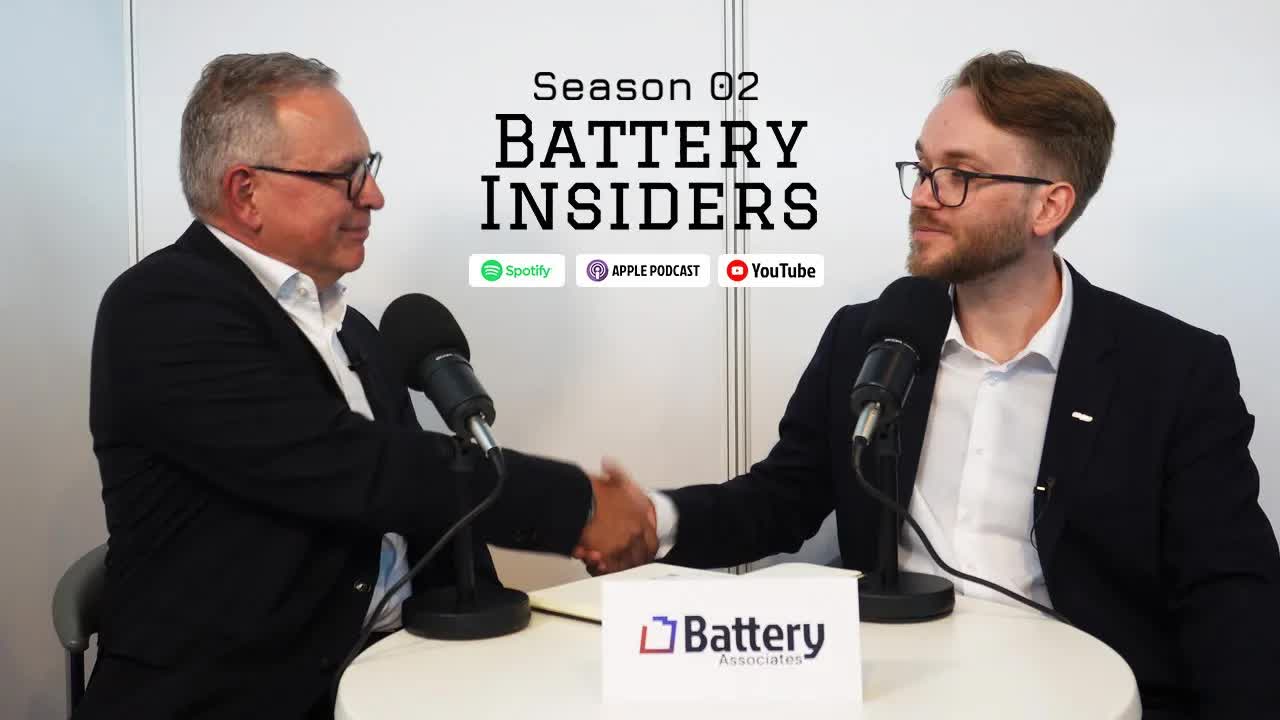
Dr Ing Ulrich Ehmes
Chief Executive Officer, Theion
Theion is developing lithium sulfur battery cells that use sulfur in place of nickel, manganese and cobalt in the cathode. The company makes its own cathode active material rather than buying it in.
Recorded in European Battery Show, Stuttgart
What this episode covers
Ulrich Ehmes makes the case for sulfur with one number: about 70% of what a battery cell costs is material, so cutting cost seriously means going after the cathode. Sulfur costs roughly 20 cents a kilogram, against about 20 euros a kilogram for state-of-the-art cathode material, and it arrives as a waste product of the oil industry rather than something that has to be mined. It also carries over 1,000 mAh per gram, which Ehmes says is five times what today's cathode materials manage. That combination is what one of Theion's co-founders landed on after starting to screen materials more than ten years ago.
The company's targets follow from the material. Triple gravimetric energy density, up to 1,000 Wh per kilogram. Cut cost by a factor of three, to 40 euros per kilowatt hour. And get down to a third of the CO2 footprint. That last one is mostly a supply chain argument. LFP and NMC begin in mines in South America, Australia or China, and around 90% of cathode material is processed in China, with NMC in particular needing a two-step calcination that eats energy. Sulfur, on Ehmes's account, starts from zero, because the material is already sitting there as waste.
He is deliberate about the word recycling. Theion does not recycle, he says, it upcycles: waste into value. Sulfur accumulates wherever there is a refinery, which makes it geographically neutral in a way that nickel, manganese and cobalt are not, and it removes the dependence on the supply chains he has just described. His scale check is worth repeating. If the whole 2030 battery market, which he puts at 8 TWh, were built on sulfur, it would use 6% of available sulfur waste. Theion's own process steps are short and low energy, in some cases 20 milliseconds.
On manufacturing, 80% of a standard cell assembly line stays as it is. The 20% that changes sits at the front: mixing, coating, drying and calendering, which Theion replaces, and which also means it can do without large coating and drying equipment. It makes the cathode active material in house, so nothing external has to purify the sulfur first, and Ehmes treats that independence as the real argument for reaching gigawatt hour and terawatt hour volumes. His warning for Europe is about where attention is going. Overcapacity has pushed material prices down and everyone is chasing cheap LFP, which he calls the wrong way.
Questions from this episode
- Why use sulfur in a battery cathode at all?
- Two reasons, on Ehmes's account: cost and capacity. Around 70% of a cell's cost is material, so the cathode is where meaningful savings sit. Sulfur costs about 20 cents a kilogram compared with roughly 20 euros a kilogram for current cathode material, and it comes as waste from the oil industry rather than from a mine. It also carries over 1,000 mAh per gram, which he puts at five times state-of-the-art cathode material. Using it removes nickel, manganese and cobalt from the cell entirely, along with the mining and sourcing problems attached to them.
- What is Theion targeting on energy density and cost?
- Three targets, all framed against today's cells. Triple the gravimetric energy density, up to 1,000 Wh per kilogram. Cut cost by a factor of three, down to 40 euros per kilowatt hour. And reach a third of the CO2 footprint. Ehmes frames the whole thing as what a carbon neutral, electric future needs from a sustainable battery, with Theion aiming to be a high volume producer of lithium sulfur cells rather than a materials licensor. The cost and CO2 figures both come back to sulfur being a waste stream that nobody currently has a use for.
- How does a lithium sulfur supply chain compare with LFP or NMC?
- LFP and NMC start in mines in South America, Australia or China, and the material is then shipped to China, where Ehmes says about 90% of cathode material is processed. NMC adds a two-step calcination that is very energy intensive. Sulfur skips all of that: it is already a waste product sitting at refineries, so from an energy point of view the starting point is zero rather than high. Sulfur is also available everywhere, which he frames as a geopolitical advantage, since it does not tie a producer to any single country's supply chain.
- Is there enough waste sulfur to supply the battery industry?
- Ehmes says yes, with room to spare. His figure: if every battery produced in 2030, which he puts at 8 TWh, were made with sulfur, that would consume 6% of sulfur waste. Refineries generate it continuously, and the large companies producing it do not know what to do with the material. He draws a distinction he clearly cares about: Theion does not need recycling, it upcycles, turning waste into value. Because sulfur exists wherever refining happens, he argues access is open to everyone rather than concentrated in a few countries.
- How much of a normal cell factory has to change?
- About 20%. Ehmes says 80% of state-of-the-art cell assembly is exactly the same for Theion's cells. What changes is the front end: mixing, coating, drying and calendering, which the company replaces with its own process. Those steps are short, in some cases 20 milliseconds, and use much less energy, so the large coating machines and dryers are not needed. Theion also produces its cathode active material in house, meaning it does not depend on an outside partner to purify sulfur before it enters the process. He treats that independence as what makes scaling to gigawatt hour and terawatt hour capacity realistic.
- What does Ehmes think Europe is getting wrong?
- He describes the battery industry as a material war, where whoever has access to the right materials on cost, supply chain and specific energy wins. His concern is that today's overcapacity has pushed material prices down, which he calls dangerous, because it has everyone focused on cheap LFP. That, in his view, is the wrong direction for Europe, and not something Europe can rely on. He compares the moment to the shift from nickel cadmium to lithium-ion thirty years ago, and argues the next step has to come from new materials that are accessible to everyone, which he sees as Europe's opening.
Listen to this episodeWatch on YouTube
Part of The next chemistry
Transcript
About this transcript. Generated automatically from the recording, then corrected against a glossary of company and guest names. It has not been checked line by line. Machine transcription mis-hears technical terms, numbers and names, so treat any figure here as a prompt to check the recording rather than a quotation of record. Spotted something wrong? Tell us.
0:00Introduction
Dr Simon Engelke
0:00And welcome everyone, thank you so much for joining us today at the Battery Insiders podcast. My name is Simon Engelke, I'm the founder and chair of Battery Associates and I'm very delighted to have here live from the European Battery Show in Stuttgart. We have the CEO of Theion with us, Dr. Ulrich Ehmes, really appreciate you being here.
Dr Ing Ulrich Ehmes
0:26Thank you very much Simon for the invitation.
Dr Simon Engelke
0:28Today we're going to talk about sulfur batteries, but maybe before we go into that, if you maybe could start a bit with the vision and the mission of Theion for our listeners.
Dr Ing Ulrich Ehmes
0:37We all want a carbon neutral future and this future will be electric and an electric future needs sustainable battery. And that is exactly what is our target, to be a world-class high mass production producer of lithium sulfur batteries. And our target is to triplicate the gravimetric energy density up to 1000 watt-hours per kg by at the same time cut the cost by factor 3 down to 40 euros per kilowatt-hours and at one third of the CO2 footprint.
Dr Simon Engelke
1:14Very good. I appreciate these numbers already. And then if we can talk a bit more about sulfur-based batteries. It's one of these technologies I think probably most have heard of it, but maybe don't know too much about. So maybe if we could introduce this topic a bit. Why do you care about this technology? Why are you trying to commercialize it?
Dr Ing Ulrich Ehmes
1:29Yeah. Disruption in battery technology goes through the materials. And if you look to the cost part of a battery, 70% is material cost. And if we want to cut the cost significantly, we have to attack the cathode material. And that is what our co-founder Marek started over 10 years ago to screen the materials. And he found very fast. Sulfur is a fantastic material.
1:55Sulfur's cost and capacity, against the LFP and NMC supply chain
Dr Ing Ulrich Ehmes
1:56We can get rid of all this difficult to mine and to source materials like nickel, manganese, cobalt. And sulfur is an abundantly available material worldwide. It's a waste material, mainly from the oil industry. It's cost nearly nothing. Only 20 cents per kg compared to 20 euros per kg of state-of-the-art cathode material. So very important for the cast cutting. Second advantage. It has a very high specific energy. of over 1,000 mAh per gram. This is five times more than state-of-the-art cathode material. And this is the key element for our batteries.
Dr Simon Engelke
2:37And of course, lifetime, etc. is also a topic there. You mentioned already earlier sustainability and like your sustainability and your cell chemistry. So maybe you could compare the bits of other chemistries people are familiar with, like LFP, NMC, etc.
Dr Ing Ulrich Ehmes
2:51If you compare the supply chain of LFP or NMC, you have always mines in South America, Australia or China. Then you transport these materials to China. Then 90% of this cathode material is processed there. Specifically, NMC, you need a two-step calcination, which is very energy intensive. You don't have that at all with sulfur because it's waste. It's there. And the big companies that don't know what to do with this material. So from an energy consumption perspective, the starting point is in our case zero compared to a very high energy consumption of all other raw materials. From a process perspective, our processes need very low amount of energy and very short process time. In some cases, only 20 milliseconds. And this means also we do not need big coating equipment, dryingers.
3:55Refinery waste, upcycling, and how much sulfur the industry would need
Dr Ing Ulrich Ehmes
3:56So we save a lot of energy also in the processing of the sulfur.
Dr Simon Engelke
4:00Interesting. And I think I was speaking on another podcast with Sebastian Wolf from PowerCo about this topic of how, you know, byproducts can be really important in the battery industry. We have seen this with LFP, for example, which uses byproducts on the manufacturing of the building industry in China. So that's why LFP also became very cheap in China because they had a lot of these cheap byproducts from construction industry. Maybe just a quick follow-up question on the sulfur. Is it a lot from the European sulfur-like body product? Is there a lot of waste in Europe or in other regions where you have a lot of these byproducts?
Dr Ing Ulrich Ehmes
4:31This is a nice thing. From a geopolitical, geodemocratic point of view, sulfur is available everywhere. So we don't depend on these supply chains I just mentioned. And everywhere where you have a refinery, you have mountains of sulfur waste. And so we do not need recycling. We are the upcyclers. We make waste to value. And this is a very important argument. If all the batteries in 2030, 8 terawatt hours, would be produced with sulfur, we would need 6% of sulfur waste. So there is still plenty of sulfur around and for everyone accessible.
Dr Simon Engelke
5:13And of course, you still have lithium and things like that as well. So we spoke a lot about the supply chain. Maybe we can go a bit more depth of the complexity of supply chain. Because I think that's really fascinating. And you already mentioned some things there. And also how quickly it could be scaled. You know, if you say it's successful and now you have a lot of sulfur batteries, how easy is it actually to scale it?
Dr Ing Ulrich Ehmes
5:34So let's have a look to the whole production technology to build a battery cell. 80% of the production processes of side of the art cell assembly is exactly the same in our case. What is different is the first part. The 20% of mixing, coding, drying, calendering.
5:54Replacing 20% of the line, and scaling to terawatt hours
Dr Ing Ulrich Ehmes
5:55This we replace. And now going one step further upscale. We don't need the processes to make out of the raw material a cathode active material. That's what we do in-house. So we are completely independent. And that means it is scalable. So we don't rely on external partner to make the sulfur prepared for our process, to make it purer. We can take it as it is, which is a big advantage to scale to giga or terawatt hour capacities.
Dr Simon Engelke
6:34Fascinating. And then maybe also as a final kind of question by being here at the European Battery Show. Look at this technology. What are some of the opportunities you see and maybe some challenges in Europe for this technology?
Dr Ing Ulrich Ehmes
6:48The whole battery industry is a material war. So who has access to the best materials and to the right materials from a cost perspective and supply chain perspective, but as well from a specific energy perspective, will be the winner in the future. What we see now today is a big overcapacity in the supply chain that brings the cost down, which is very, very dangerous because everyone is now focusing on cheap LFP materials. I think this is the wrong way for Europe. We cannot rely on these materials. We need, as it was done 30 years ago from nickel cadmium to lithium-ion to triplicate the capacity. We now need to be on the next step to the next disruption with new materials, which are accessible for all of us. And this is a big chance for us in Europe.
Dr Simon Engelke
7:42Fantastic. Ulrich, I really appreciate you taking your time, sharing some insights on SOFA, which I think is interesting technology. So we're excited to hear more with Theion. What are you going to develop based on that?
7:50Closing thoughts
Dr Simon Engelke
7:51And I really appreciate your time today. Thank you very much, Simon. Thank you. And then also thank you all for listening for the Battery Insiders podcast here live from the European Battery Show. If you're interested in more of these kind of episodes, please subscribe on our YouTube channel, Spotify, Apple Podcasts, or wherever you listen to any of your podcasts. And yeah, you can also go on batteryinsiders.com to kind of subscribe there to get notified about future episodes. If you're a incredible incredible incredible incredible incredible incredible incredible incredible Chair of Battery Associates. Thanks so much for joining us today. Thank you very much for having
Dr Ing Ulrich Ehmes
8:19us. Thanks, Ovis.