
Episode 154 · 24 December 2024 · 00:23:12
A polymer route to solid state, and why it scales
Exploring Hytzer solid-state batteries
The co-founder of Hytzer Energy on a 65 Ah cell at 315 Wh/kg, why polymer electrolytes suit existing production lines, and the chemistry that makes a lithium-ion battery burn.
Read the article: A polymer route to solid state, and why it scales
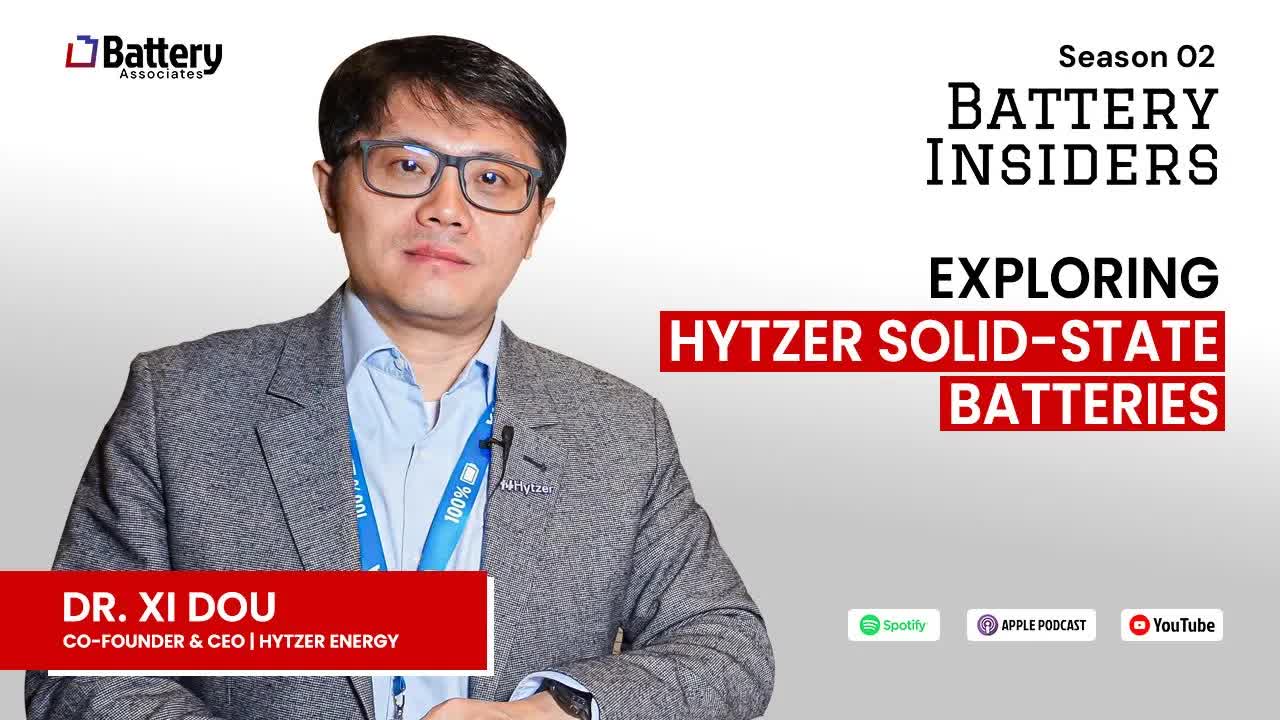
Dr. Xi Dou
Co-founder and Chief Executive Officer, Hytzer Energy
Hytzer Energy develops polymer-based solid-state cells made by in-situ polymerisation. Its batteries have powered deep sea landers, heavy-lift drones and an on-road EV research project.
Recorded in Berlin, at the Future Battery Forum
What this episode covers
Dou brought a cell to the interview: 65 ampere hours, pouch format, 315 watt hours per kilogram. What he wanted to talk about was what happens when you put two of them side by side with nothing between them but a very thin insulating layer and no further heat management. Heat one until it goes to explosion and the other stays intact. No thermal propagation. The same cell takes a 6C rate at 100% depth of discharge and charges from 10 to 80% in 15 to 16 minutes, which is unusual for a chemistry where ions have to move through solid phases.
The safety case rests on a mechanism he walks through step by step. In a liquid lithium-ion cell, lithium atoms at the anode react with the organic electrolyte to form lithium hydride, and that hydride behaves as a hydrogen reservoir. The electrolyte itself decomposes into carbon monoxide, methane, ethylene and acetylene during formation of the SEI layer. Once a cell self-heats to roughly 200 degrees Celsius, the cathode starts releasing oxygen. At that point the cell contains hydrogen, several explosive gases, oxygen and heat. An inorganic electrolyte contains no hydrogen, so the first step never happens. A polymer electrolyte can be designed with less proton content, and the solid-to-solid interface slows the side reaction down.
On cost, Dou separates the materials from the manufacturing. Oxide electrolytes need high temperatures to form the ceramic structure, which is energy intensive. Sulfides are sensitive to oxygen and moisture and need a clean room. Neither route has a supply chain built yet, and both need new equipment, so both are capital intensive. Polymers are organic, with no rare or expensive metals. He points to the liquid electrolyte as the precedent: its cost has fallen 97% in the 30 years since commercialisation, on economy of scale alone. Around 80% of Hytzer's manufacturing process is the same as a conventional liquid line.
The remaining 20% is one step. Instead of filling the cell with liquid electrolyte, Hytzer injects a precursor: the polymer precursor plus additives and lithium complex salts, as a eutectic liquid. Warmed to an elevated temperature, it polymerises in place. Dou is careful to separate a polymer from a gel. A gel traps solvent in an entangled network and releases it when heated or when the pH shifts. A polymer is simply soft, and stays solid when heated. The distinction matters because it decides whether there is still a liquid in the cell that can come out.
The technical claim underneath all of this is about interfaces. Inorganic electrolytes are rigid, and rigid meeting rigid at the electrode leaves contact problems, which is why people add other materials to mitigate them. Polymers are soft at their working temperature and make good contact, but lack mechanical strength, so a compressed cell can squeeze the electrolyte out from between the electrodes and short internally. Hytzer's answer is a rigid skeleton for stability, with the soft conductive polymer grown in place from the electrode surface. Volume change during cycling otherwise opens voids and cracks, and those voids are where dendrites grow.
Hytzer is now focused on getting the 65 Ah cell into mass production, aiming first at applications that pay for performance: flying taxis, where the safety and energy density requirements are severe, and premium EVs. Earlier generations have already been out in the field. One powered a lander at the bottom of a deep ocean trench, more than 10,000 metres down, running continuously for 26 days. An EV research project completed more than 11,000 kilometres of on-road testing. The third generation uses a lithium metal anode at 400 to 500 watt hours per kilogram, and flew a drone with a 25 kilogram payload for about an hour, against under 20 minutes on a standard pack.
Questions from this episode
- What actually causes a lithium-ion battery fire?
- Dou traces it to chemistry that starts on the first cycle. Lithium atoms forming at the anode react with the liquid organic electrolyte to produce lithium hydride, whose hydrogen is highly reactive and acts as a hydrogen reservoir. Forming the SEI layer decomposes the electrolyte into carbon monoxide, methane, ethylene and acetylene, all explosive. When the cell self-heats to around 200 degrees Celsius, the cathode releases oxygen. Hydrogen, fuel gases, oxygen and high temperature together are what make thermal runaway an explosive reaction rather than a slow failure.
- Are solid-state batteries a new idea?
- No. Polymer-based solid-state batteries were reported in scientific journals in the 1970s, and 50 years of improvement have followed. The inorganic route began more than 30 years ago, with Toyota starting research on oxide and sulfide electrolytes in the late 1990s. What changed recently is demand: the energy transition pushed people to look for storage with higher energy density and a better safety profile, which drew startups spinning out of research institutions in the US and Europe, and large Chinese players moving into semi-solid-state cells.
- Why do semi-solid-state batteries exist at all?
- They are a response to the interface problem. In a solid-state cell, lithium ions travel through three solid phases, cathode, anode and electrolyte, which adds two solid-to-solid interfaces. Dou lists several failure modes there, including space charge separation, element interdiffusion, interface reactions and electrochemical mechanical deformation. That last one behaves like thermal expansion: the electrolyte changes volume as the cell cycles, opening voids and cracks against the electrode surface, and dendrites grow in those voids. Adding nanoparticles, or in the semi-solid case some liquid electrolyte, is how people have tried to mitigate it.
- Will solid-state batteries be cheaper or more expensive?
- It depends on the technology route. Oxides need high-temperature processing, sulfides need a clean room, and neither has a supply chain or existing equipment base, so both are capital intensive. Polymers use organic materials with no rare or expensive metals, and Dou expects their cost to fall sharply once scale builds, the way liquid electrolyte fell 97% in 30 years. Manufacturing helps too: because the polymer is soft, roughly 80% of Hytzer's process is the same as a conventional liquid lithium-ion line, so the supply chain does not have to be rebuilt.
- What is different about how Hytzer makes its cells?
- One step. Where a conventional line fills the cell with liquid electrolyte, Hytzer injects a precursor of the polymer together with additives and lithium complex salts, as a eutectic liquid, then warms it to an elevated temperature so it polymerises in place. Because the soft part grows outward from the electrode, the contact between electrolyte and electrode is good from the start. A rigid skeleton built into the design supplies the mechanical strength that soft polymers lack, so the cell stays stable under compression instead of shorting internally.
- How far has Hytzer got with lithium metal and anode-free cells?
- The third generation uses a lithium metal anode and reaches 400 to 500 watt hours per kilogram. It flew a heavy-lift drone carrying a 25 kilogram payload for around an hour, compared with under 20 minutes on a standard battery. Dou is candid about the drawbacks: cycle life, and sensitivity to moisture and oxygen, which form lithium hydride again. The fourth generation is anode-free. There is no lithium metal foil, only a current collector; all the lithium comes from the cathode and is reduced in place as a thin layer during charging.
Listen to this episodeWatch on YouTube
Part of The next chemistry
Transcript
About this transcript. Generated automatically from the recording, then corrected against a glossary of company and guest names. It has not been checked line by line. Machine transcription mis-hears technical terms, numbers and names, so treat any figure here as a prompt to check the recording rather than a quotation of record. Spotted something wrong? Tell us.
Dr. Xi Dou
0:02How can solid-state address it?
Dr Simon Engelke
0:04Maybe what can it not address? In the past 50 years, there are lots of improvements. Well, the most important issue. Scientific challenges of the solid-state battery.
Dr. Xi Dou
0:15What will be the price point of that? How competitive will it be? Battery's performance and read performance. What's happening in this space right now? Before we get started with today's episode of this Battery Insiders podcast, I want to let you know that we have another BatteryMBA cohort starting in January. You can still apply for it till the 18th of December. Hopefully, see many of you there. Welcome, everyone. Thank you so much for joining us for the Battery Insiders podcast, here live from the Future Battery Forum in Berlin. And yeah, very excited today to have a discussion about solid-state batteries. And I have with me today Dr. Xi Dou, who is the co-founder and CEO of Hüther. And very excited to have you here. And we want to talk about the latest state of the art in solid-state and get a bit of an overview also, kind of what's happening in this space right now. So maybe to start, to kind of go right to it, kind of if you could start by giving us a bit of an overview of the current landscape of solid-state batteries and how this industry is evolving. Thank you, Simon.
Dr Simon Engelke
1:11And thank you for the Battery Associates for having me here to join this podcast. And for the solid-state battery, basically, this is not something new. Since the 1970s, there is already a polymer-based solid-state battery reported from scientific journals. And in the past 50 years, there are lots of improvements. And regarding the inorganic solid-state battery technology route, basically, it also started more than 30 years ago. And it started from Toyota. And in the late 90s, they started the research in the field of oxide and sulfide electrolytes. Until today, especially in the past couple of years, and given the energy transition mega-trend,
1:55Fifty years of solid state, and why attention arrived now
Dr Simon Engelke
1:56and the people are looking for more and more different energy storage solutions. And the solid-state battery, because it has its advantage in the energy density, as well as the safety profile, and they attract lots of attention. And for example, in the U.S. and in Europe, there are lots of startups from the spin-off of the research institution. And from, let's say, in China, and there are lots of big players in the recent years that started to make the semi-solid state batteries.
Dr. Xi Dou
2:27Great. And maybe we could share a bit more about now what's the difference, right? Because if you have liquid-based lithium-ion batteries and then solid-state batteries, so if you maybe can walk us a bit or through, like, what's the difference and maybe some of the similarities as well for these kind of different technologies from the structure, functionality, mechanisms, etc. Thank you.
Dr Simon Engelke
2:44Basically, the function of the solid-state battery and the liquid lithium-ion battery is the same. And both has an anode and cathode, and the electrolyte basically functions as a carrier of the lithium-ion to realize the charging and discharging. The main distinction between these two is that for the solid-state battery, because it's a material innovation, it could achieve potentially very high energy density, because you can design molecular structures and also make it to withstand much broader electrochemical windows, and so that you can have more active electrodes. And also, from the safety perspective, and because you are using the non-proton electrolyte, it could eliminate the root cause of the fire hazards of the liquid electrolytes. Basically, this is the main difference. Therefore, people regard solid-state battery as the next generation of battery technology, because it creates much higher energy density, and plus more safe.
Dr. Xi Dou
3:45Yeah. And also, kind of to distinguish, right, because I think you mentioned semi-solid-state before as well. Yeah. So there are some hybrids, because often people only talk about liquid, right?
3:53Interface failures and where semi-solid cells came from
Dr. Xi Dou
3:54Yes. And then they talk about solid, but there's actually also things in between. Yes. Maybe you could share a bit more about this?
Dr Simon Engelke
3:59Well, basically, this comes to, let's say, the scientific challenges of the solid-state battery. As I mentioned previously, from, let's say, early 70s, and people have already started to work on the solid-state battery. But why until today? And there is only, not too many, I would say only one, based on the poly-ethyl oxide material, which realized commercial, let's say, application. Yeah. And the challenge is that in the solid-state battery, the lithium ions transport through the three solid phases. It's cathode, anode, and electrolyte. Especially, there are another additional two solid-solid interfaces. So in the solid interface, there are lots of problems. Because there are mainly, let's say, four types of battery failures in the solid-state battery. For example, like charge, charge, charge, sorry, space charge separation, and element interfusion, and biointerface reaction, and plus the electrochemical mechanical deformation. Just take one example, the last one. The mechanical deformation is pretty similar to the thermo-expansion of the solid. When the temperature changes, its volume also changes. But in the battery, when the cycling starts, the volume of the electrolyte also changes. And this leads to lots of voids, cracks, between the electrode surface and the electrolyte. Electrolyte surface. And this voids will lead to the growth of dendrite. And in order to mitigate this problem, people are adding different materials. For example, in the early days, people add nanoparticles. And for the hybrid or semi-solid-state batteries, they are adding some liquid electrolytes. And in order to mitigate this issue, this is how and where the semi-solid-state battery,
Dr. Xi Dou
5:53Amazing. And then also to understand a bit about, because you already touched on this, right, also, I think the topic of safety, right? Yes. And again, if you could share a bit more about, like, you know, how can solid-state address it, or maybe what can it not address of the safety, maybe you can share a bit more about the opportunities in that regard.
Dr Simon Engelke
6:12My pleasure, yeah. Basically, regarding safety, I think this is, if this is not the only one most important, but it must be one of the most important issues regarding to underpin the energy transition. Because the battery itself is an electrochemical reaction. It happens always. And it carries energy. And, but when we use it in our daily life, and I think more and more, I say, fair hazards people see in the, in our days. And let's look at the intrinsic root cause of the thermal runaway, like the explosion of the liquid electrolyte. What happens there? Basically, from the very first cycling of the liquid lithium-ion battery, and in the anode, the lithium atoms will release one of the electrons, became lithium-ion. And then when it charged, and then the lithium ions get the electrons, became lithium atoms. Lithium atom is very, very active. It reacts with the liquid electrolyte to form lithium hydride. And this lithium hydride, the hydrogen, is very active. It's minus one valence. It reacts nearly everything containing hydrogen to, containing proton to form hydrogen. You can consider it as kind of a hydrogen reservoir. And also, in the battery industry, people know that it will, when our battery starts to work, before it works, it forms, deforms the SEI layers, interface layers. And this layer basically is the decomposition, and also the formation of the lithium salts. And our liquid electrolyte, organic liquid electrolyte, and will decompose.
7:46Removing the fire chemistry from the cell
Dr Simon Engelke
7:46It will decompose into carbon monoxide, methane, ethylene, ethylene, and all these are explosive substances. And therefore, when our battery gets self-heated to a certain temperature, normally around 200 Celsius degrees, the cathode material starts to release oxygen. Look what we have in our system. We have hydrogen, we have carbon monoxide, we have methane, ethylene, and acetylene, plus oxygen, and high temperature. And behind the stage, the thermal runaway, the fire hazards of the battery, that is an explosive reaction. This is what makes the lithium-ion battery dangerous. For the solar state battery, the advantage is that, for example, if we use an inorganic one, like oxide or sulfide, it does not contain hydrogen. Therefore the very first step to formation of lithium hydride, basically it is eliminated. In the polymer-based electrolyte, because the interface is solid and solid, this kind of side reaction happens very slow. We can also design the polymer electrolyte with containing less or even, I say, non-proton. Of course this is kind of a target in the future. This way, you improve the intrinsic safety of the battery. Very good.
Dr. Xi Dou
9:05And of course, on the other hand, though, I think one thing, it's still very energy dense, right? Like a battery. So I think there's still energy in there, which can be released. But I think, as you said, it's an interesting approach on the safety. Another topic which I think a lot of people think about is cost. Right? Especially for all kinds of applications. Again, having seen this drastic cost reduction of lithium-ion batteries or liquid-based lithium-ion batteries, really has enabled it for many applications. Right? And I think now the question has been with solid-state also, what will be the price point of that? How competitive will it be? Will it become cheaper? Will it be more expensive? Niche? Might I adopt that?
9:41Two cost drivers: materials and manufacturing
Dr. Xi Dou
9:42Maybe could share a bit more about some of your assumptions in that regard.
Dr Simon Engelke
9:45Basically, from the cost perspective, we can say, mainly two cost drivers. First is from the material itself. Second one is from the operation and manufacturing process. And if we look at it, this also depends on the battery, solid-state battery technology routes. For example, like the oxide and the sulfide one, and this kind of material. And normally, for example, like, take one example, like the oxide one, it requires normally high temperature in order to form this kind of ceramic inorganic structure. It's a very energy consumption, condensed one. For the sulfide one, it's very sensitive to the oxygen and moisture. You need a clean room. But for both the technology routes, there's no supply chain, let's say, built up yet. And all the manufacturing facility equipment needed to be rebuilt. This will be very capital intensive. But for the polymer one, this is, it has an advantage of the, in terms of the raw materials, because it's organic one. And there's no, that's a rare metal or as expensive materials. Pretty similar would be like in the liquid electrolyte, liquid lithium-ion battery, because for the liquid electrolyte in the past 30 years, since it's a commercialization, the cost of the liquid lithium-ion battery has, electrolyte, has dropped 97%. Yeah, could you imagine 97% thanks to the economy of scale. Therefore for the polymer ones, it does not have this kind of raw material as concerns. I believe that later on, when the scale builds up, and then the cost would be, let's say, dropped sharply, pretty much like the liquid electrolyte in the past. And in terms of the manufacturing process, the polymer, because it's soft, and therefore it's largely compatible with the conventional liquid lithium-ion battery. But we don't need to rebuild the overall supply chain. For example, in our technology, an 80% of manufacturing process is compatible, it's the same with the
11:40In-situ polymerisation, and polymer versus gel
Dr Simon Engelke
11:40conventional liquid one. And we only have, let's say, around 20%, which we apply the special step to make the polymer
Dr. Xi Dou
11:47electrolyte. Maybe you could share about these 20%. So what are the differences between another process?
Dr Simon Engelke
11:52This is, for example, in the liquid electrolyte, and they fill in the liquid electrolytes. But in our technology, and our technology is the in-situ polymerization. What we inject there, that is precursor of the polymer. In other words, that precursor plus these additives and also the lithium complex salts, and it's kind of eutectic liquid. We inject this one. And then we need to warm it up around, let's say, measure the temperature, elevated temperature, it will start polymerization. Yeah. Only this step is different. Okay.
Dr. Xi Dou
12:26And then this polymer you mentioned, because I mean, I guess some people maybe argue, like, is a polymer a solid? And it's not as liquid, right? But I think kind of like, so it's just kind of in between, right? And some say maybe ceramic only or this, but I think you, you say you get the best of both worlds, I assume, from this? Like you still don't have a liquid, but you still have semi-solid? Or what's the polymer for you? Is it?
Dr Simon Engelke
12:49I think this really depends on the molecular weight, right? And for the liquid one, it has a small molecular weight. And for the polymer one, when the, let's say, the small molecule grow up with a higher molecular weight, it became solid. I think there is a very, very important concept differentiating is that people sometimes regards the polymer with the gel. But it's different. The gel is that you have the polymer chains, which is long. It entangles each other to form a three-dimensional, like the voice. It tracks the solvents, the liquid inside. Therefore, when you heat it up, or let's adjust its pH value, acidity or acidity, and then it will release the liquid. But for polymer, it's just soft. Yeah. When you heat it up, it's still, I say, the solid.
13:35A 65 Ah cell at 315 Wh/kg with no thermal propagation
Dr Simon Engelke
13:36And it may be merged, but it's another story, right? But when you, there's no, like, small molecule to release from your system, yeah.
Dr. Xi Dou
13:42Okay. That's interesting. And then, kind of, a bit of market segmentation, right? Like, where do you think solid-state will come first, will be most important? Yeah, maybe we could segment the market a bit for solid-state.
Dr Simon Engelke
13:54Yeah, for the solid-state battery, this is a new technology. Any new technology at the beginning, and of course, without the scale, the price will be high. And also, I think the most distinctive part is about its performance. Yeah. For example, what we have here, that from our battery, and this is a 65 ampere hour of the solid-state battery, it has an energy density of 315 watt-hour per kilogram, and this battery, and this pouch format, realized no thermal propagation. In other words, that we put these two batteries next to each other, and in the middle, just with a very, very thin layer of the air cell for the insulation, no further, let's say, heat management. So, when we put it in the modular, we heat up one of the cells until it goes to explosion, and the other cell was kept intact. Yeah. This is a very, very special distinctive safety trick. The other one is that about this battery's performance, rate performance, because as you can imagine that these ions transport through the solid-state, and therefore the ions could not go that fast. This is also the reason people regard the sulfide as a very, very promising solid-state technology, because the sulfide transport is very fast. But in our case, and from our innovative material design, we realized the 6C rate of the 100% DOD discharge. And this cell could realize around 15, 16 minutes to charge the cell from 10 to 80%. So basically this is very unique.
15:31Flying taxis first, mass market later
Dr Simon Engelke
15:32Of course this comes with high cost. Therefore it will go to the high-end market. Take one example, for example like the flying taxi, where it has very, very high standards for safety and also the requirements, demands for the energy density. And for the high, let's say, premium EV cars. And this is also something we were targeted from right beginning. And when these scales build up and also, let's say, the deployment on more and more EVs, and the cost drives down, that will go to, let's say, the mass market.
Dr. Xi Dou
16:04Interesting. And maybe if you could compare now your, because you already had it showed there, like your solid-state, compared to other solid-states.
Dr Simon Engelke
16:12Yeah. As I mentioned that for the, let's say, the organic and inorganic one. Yeah. For the inorganic one, oxide and sulfide, in principle what happens, how it transports the lithium ions at elevated temperature for the oxide. All I say with the cold pressing process for the sulfide one, it forms inorganic structure. Yeah. There are crystalline structure. There are lots of voids. And basically, it's like the mesh. You can understand it like the mesh. Lithium ions have very small insides. It can go through these voids. And in this way, this is how it transports the lithium-ion. But the problem is that because it's inorganic, it's a rigid surface, and with the electrode, it's a rigid, rigid contact. And there are lots of interface issues. This is why people at the electrolyte, in order to minimize, mitigate this issue. And for the polymer ones, and you know, the good thing is that at the working temperature of the polymers, and it's very soft, it can, let's say, address this interface issue very well. It has very good contact. However, at this working temperature, this soft material polymer, it is lack of mechanical strength. It makes that the battery's surface is not stable.
17:27A rigid skeleton with a soft polymer
Dr Simon Engelke
17:27It's like the dodge between the electrode. Therefore, when the battery gets compressed, and you could, let's say, squeeze the electrode out of your electrodes. And then it's internal shortcuts. It would lead to the battery failure. But in our technology, what we have, the uniqueness of our technology is that we introduced a rigid skeleton. Skeleton. And then, this skeleton provides the stability of the cell. Yeah. And then we designed the molecular structure. We introduced the softer part, which is the polymer, the unconductive polymer part. And we do the in-situ polymerization. And when we fill in, what we do is that we fill in the precursor of our polymer, and then we do the polymerization. In so doing that, it's like you have this electrolyte, the softer part, is growing from the electrode. Yeah. Therefore, by this way, you solve the, this interfacial contact issue very well. At the same time, you have the rigid skeleton, and it provides the stability of the cell. Yeah. This is the uniqueness of our technology. Interesting.
Dr. Xi Dou
18:30And if I think about, so, you know, lithium metal anodes. Yes. There also has been this approach, right, that you kind of get the lithium metal build up in the cell, so you have like, first on your cathode, and then you bring it on the anode side. Is this also something you could do here as well, like, you know, add also lithium metal to that? Or?
Dr Simon Engelke
18:46In fact, we have lithium metal. And for example, in our laboratory, we have reached, let's say, four generations of, sorry, battery technology. The highest energy density from the laboratory, it goes to up to 700. Yeah. And with lithium metal one, it's our third generation one. Yeah. And we reached the energy density between 400 to 500 Watt per kilogram. And this battery has been used on a heavy, heavy load joints. The payload is 25 kilograms. And for that joints, it can power the joint to fly for around one hour. Yeah.
19:22Lithium metal and anode-free designs
Dr Simon Engelke
19:22But in the standard, that's battery, it only flies around 20 minutes, less than 20 minutes. Yeah. That is lithium metal. But lithium metal's issue is that it's a second life. And also lithium metal itself, and it's very sensitive to the moisture and oxygen. When it meets the moisture and oxygen, it forms lithium hydride again. There are more lithium, and it's very dangerous. Yeah.
Dr. Xi Dou
19:45But we have the technology in-house. Interesting. And so you're, because I think that's my last question, kind of where are you right now, and the progress, and maybe what you see in the future. So just to understand, the fourth generation, what do you use then as an anode? Anode lys. Anode lys. Anode lys. Yes. But then is it lithium metal in the end, or what's the...
Dr Simon Engelke
20:02No, lithium metal, there's no lithium metal even. Yeah. So what is the anode in the end? Anode lys. It's an anode. It's just like the collectors, and then basically all the lithium ions come from the cathode side.
Dr. Xi Dou
20:13But you have to bring it on the anode as well, right? Like you have to... Yes. It's building up on the anode?
Dr Simon Engelke
20:18No, you don't really need to build up the anode. What's happening there is that you have the lithium ions from the cathode, and then through, let's say, the charging process, and the lithium ions will go to the anode side, the anode lys, it's the collectors, and then it gets electrons, and then to be reduced into the lithium atom. Basically, this is... So it's lithium metal on the end, no? It doesn't form the large batch of the metal, but it's kind of lithium item, yeah.
Dr. Xi Dou
20:44Okay. But like a thin layer of... Thin layer. You can kind of... It's in-situ formation of the lithium metal. Okay. Because that's what I'm thinking. Yeah, that makes sense, because I... Just to kind of put into perspective. So now you've done a lot of work, I can hear, fourth generation already. Yes. So now you're working on probably the next generation already. Yeah. From a research perspective, yeah. So kind of what's like the roadmap you see maybe for your own company, and maybe also for people interested, like what do you see to happen in solid-state in the next couple of years, right? Like what do you think is the roadmap of you as well from the industry on solid-state?
Dr Simon Engelke
21:15At least I can talk from our perspective.
21:17Mass production, deep sea landers and road testing
Dr Simon Engelke
21:17Currently, we are focusing on the mass production of these cells, because you can see this is 65 ampere hour one, and this is ready for the commercial application, yeah. And for example, in the past, what we have that our technology was mainly used in the demonstrative project at the bottom of marina trenches, and under the water 10,000 meters more, and our battery powered the landers, and continuously working there for 26 days. It broke the world record, basically. Yeah. Under the water, it powered the AUV, autonomous underwater vehicles, and cruising there for 198 the waterways, and on the ground, and also we validated it, it's the application in the EV, and on the EV, and from the research project, and it finished more than 11,000 kilometers on-road test. And in the air, as I mentioned just now, our third generation of the battery powered drones to fly, and in the next step, we are basically optimizing our technology into this kind of commercial available product, and to serve for the different market. And of course, in our research activity roadmap, as you mentioned, and we have these metal batteries, which has energy density to 500. We have the fourth generation one with and reaches to more than 600 with an hour per kilogram, and these are the pipelines. Yeah.
Dr. Xi Dou
22:42Great. Well, really exciting. I appreciate you sharing your insights today, Chief, with us. I mean, exciting journey as a startup. I know you're making a lot of progress there, and I think that's exciting to see. So I'm excited to see some updates for the next generations. And we want to thank all of you listeners as well today to listen in to this podcast, again, to the Battery Insiders podcast. My name is Simon Engelke, founder and chair of Battery Associates. If you're interested for more of these kind of episodes, please make sure to subscribe on YouTube, Spotify, Apple Podcasts, or anywhere else you listen to your podcasts. Thanks again, everyone. Speak soon.