
Episode 162 · 3 August 2026 · 00:18:13
1,205 kilometres, and why the next cell does not go in a car
In conversation with Siyu Huang, Founder and CEO at Factorial Energy
The founder of Factorial Energy on the 1,205 km Mercedes record drive, why automotive is not the first market, and why the plan is to convert existing lithium-ion capacity rather than build gigafactories.
Read the article: 1,205 kilometres, and why the next cell does not go in a car
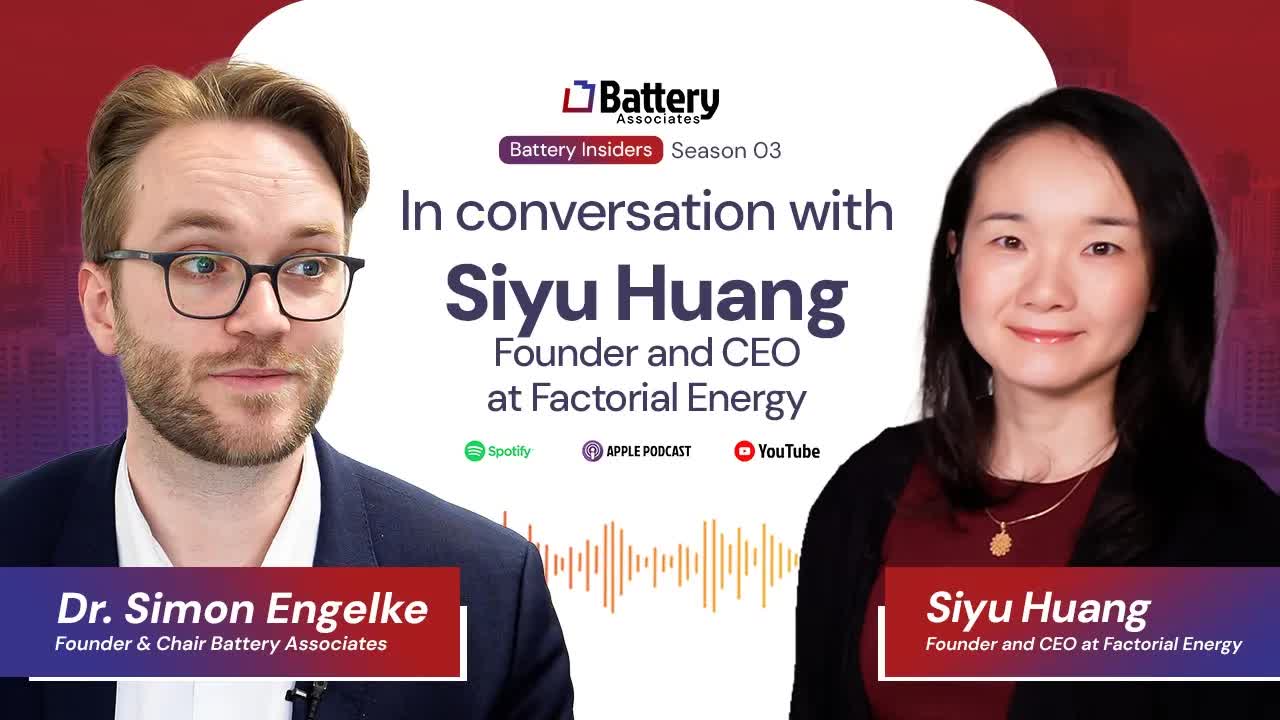
Siyu Huang
Founder and Chief Executive Officer, Factorial Energy
Factorial is a US battery technology company developing solid-state cells with higher energy density and improved safety. Investors include Hyundai, Kia, Mercedes-Benz and Stellantis.
Recorded in Berlin, at the Future Battery Forum
What this episode covers
Siyu Huang did a PhD in chemistry at Cornell, built a battery materials company during business school, and sold it. Her conclusion from that first business was that chasing incremental improvement in lithium-ion was the wrong problem, because lithium-ion is approaching its performance ceiling. Factorial started as a Friday afternoon project inside the first company and was spun out in 2019.
The milestones are specific. First 100 amp hour solid-state cell with lithium metal, launched with Stellantis at CES in 2023, at 390 Wh/kg. First B-sample shipped to Mercedes-Benz the following year at the same energy density. Thousands of cells shipped to global OEM customers since. Earlier this year, the first solid-state battery vehicle built with Mercedes, with Factorial supplying the cell and Mercedes building the module and pack. That car, an EQS, drove 1,205 kilometres from Stuttgart to Malmö and arrived with 137 kilometres left. Huang's claim about the field is blunt: she does not think anyone else has demonstrated ten.
Her most useful point is about which market comes first, and it is not automotive. Automotive volumes are large enough that reaching a gigafactory takes at least two to four years. A pilot line sized for automotive is already mass-production scale for a drone maker. So Factorial is going at aerospace, defence and consumer robotics first, where the volumes fit what exists and where each step surfaces quality, consistency and supply chain risks before the capital is committed. Building a gigafactory with one cell in hand, as she puts it, is a great deal of risk to take.
The drone angle has a policy edge. China has announced export controls on batteries above 300 Wh/kg, which covers high-end lithium-ion as well as solid state, and roughly 90% of US drone batteries come from China. Huang sees a vacuum there.
On strategy, Factorial is deliberately asset-light. Its manufacturing process is close enough to lithium-ion that existing lines can be converted with minimal capital, and there is a lot of idle lithium-ion capacity to convert. The model she describes is licensing plus technology services rather than licensing alone, on the grounds that in batteries the know-how, not the IP, determines yield, quality and cost. She is candid that other companies have cheaper capital and can absorb two billion dollars and a ten-year payback, and would rather partner with them than compete.
She credits the discipline to her board. Joe Taylor, Factorial's chairman and former chairman and CEO of Panasonic Americas, is the person who put two billion dollars into Gigafactory Nevada when batteries were hard rather than fashionable, and his advice was that overinvesting in yourself is difficult to reverse.
Questions from this episode
- How far has Factorial actually got with solid state?
- To a car that drove 1,205 kilometres. Factorial launched a 100 amp hour lithium-metal solid-state cell at 390 Wh/kg with Stellantis at CES in 2023, shipped a B-sample to Mercedes-Benz the following year at the same energy density, and has since shipped thousands of cells to OEM customers. Earlier this year Mercedes built those cells into a module and pack in an EQS and drove Stuttgart to Malmö, arriving with 137 kilometres remaining.
- Why is automotive not the first market for solid state?
- Volume. Reaching automotive gigafactory scale takes at least two to four years, whereas a facility sized as an automotive pilot line is already mass production for other markets. One of the largest US drone makers needs tens of megawatt hours. Going stepwise through aerospace, defence and consumer robotics lets Factorial find quality, consistency and supply-chain problems before committing gigafactory capital.
- What makes the drone market urgent right now?
- China has announced export controls on batteries above 300 Wh/kg, which restricts high-end lithium-ion as well as solid state. Roughly 90% of US drone batteries currently come from China. Huang describes the resulting gap in high-performance drone batteries as a vacuum.
- Does Factorial plan to build its own gigafactories?
- No, and deliberately. Factorial's process was designed to stay close to lithium-ion manufacturing so that existing lines can be converted with minimal capital, and there is substantial idle lithium-ion capacity available. The intended model is licensing combined with technology services, because in batteries the manufacturing know-how determines yield, quality and cost in a way that handing over IP alone does not. Huang is explicit that other companies have a lower cost of capital and are better placed to fund the plants.
- Is consistency the real problem with solid-state cells?
- Yes. Huang draws the distinction between one cell and a vehicle: a single hero cell can be made to last five or ten thousand cycles, but a car needs every cell to perform consistently, and that is not a trivial task. Factorial's first cells were not consistent, and closing that gap meant working with suppliers and equipment makers over time rather than changing the chemistry.
- What is her read on where Europe stands?
- That the Western hemisphere is a few years behind on lithium-ion, that European cell companies have visibly struggled, and that the opportunity is therefore not to catch up but to leapfrog. She also picked up a shift at the Future Battery Forum between her 2021 visit and this one: the emphasis on partnership, and specifically on a coalition across Western automotive rather than each manufacturer working alone.
Listen to this episodeWatch on YouTube
Part of The next chemistry
Transcript
About this transcript. Generated automatically from the recording, then corrected against a glossary of company and guest names. It has not been checked line by line. Machine transcription mis-hears technical terms, numbers and names, so treat any figure here as a prompt to check the recording rather than a quotation of record. Spotted something wrong? Tell us.
0:00Introduction
Dr Simon Engelke
0:00Today on Battery Insiders, we're joined by Siyu Huang, founder and CEO at Factorial Energy, US-based battery technology company, developing advanced solid-state batteries with higher energy density, improved safety and cost-competitive performance compared to conventional lithium-ion cells. In this episode, we explore Factorial's journey and its role in advancing solid-state batteries. We discuss milestones achieved, realistic timelines for solid-state commercialization, key technical challenges, and where the next biggest opportunities lie. This conversation also explores critical partnerships involving development tools, applications across automotive and drones, and what's next for Factorial, including insights from the Future Battery Forum. If you want insights into Factorial's role in advancing solid-state batteries, this episode is for you. If you enjoy our podcast, make sure to subscribe so you never miss an episode. And if you're looking to take your knowledge even further, check out our BatteryMBA at battery.mba. It is our flagship program designed to help professionals upskill, connect with global experts, and stay ahead in the fast-moving battery sector. And with that, let's jump into today's conversation with Siyu Huang from Factorial Energy. Welcome, everyone. This is Simon Engelke from Battery Associates, and I'm really excited today to have another conversation with a great guest here on the Battery Insiders podcast, one of our CEO series. And I'm really delighted to have CEO with us, Siyu Huang, who is the founder and CEO of Factorial, who is a major player in the solid-state space. And we've been following you for some time, and I'm really excited today to be here with her and ask her some questions about solid-state, as this is a topic a lot of you keep asking us for. So we want to make sure we get some good insights. So, see you. Really good to see you.
Siyu Huang
1:39Thank you, Simon. Great to meet you, and thank you for inviting me here today.
Dr Simon Engelke
1:43For sure. So maybe just to kind of kick it off a bit about people who don't know much about Factorial yet, and the German Fest, there's been quite some announcements.
1:50From a Cornell PhD to spinning Factorial out in 2019
Dr Simon Engelke
1:50There's new partnerships we want to talk about in a bit. But maybe if you can give us a bit of a background of the company and some of the milestones you have accomplished over the last decade or so.
Siyu Huang
2:00Yeah, absolutely. A quick background on myself. I got my PhD in chemistry from Cornell and built my first company during my business school time at Cornell in a battery material manufacturing space. We sold the business first, and then I realized that it doesn't make sense to continue chasing the battery material and chasing the lithium-ion battery, which is incremental improvement. However, we see that lithium-ion battery is hitting the ceiling of its performance. So we decided to build something that leapfrogged existing technology. That's why we started as a Friday afternoon project from our first business and really spun it out in 2019. But it's been 10 years of work and really building a foundational disruption into the space in solid-state. And we first came out of sales mode in 21, and we got a first investment from Hyundai and Kia as an investor for the company. And then later on, Mercedes and Stellantis, they led a $200 million round investment into the factorial. And since then, the roller coaster started with a lot of exciting developments in the space.
Dr Simon Engelke
3:10A really fascinating story on that. And, you know, can really tell how it takes some time to get to this point. But now maybe, again, a lot of people are asking us about solid-state batteries. It's a hot topic. You know, there's a lot of different opinions about it. Maybe from your perspective, it can give us a bit of an overview of where you think solid-state is right now and also a bit about the timelines you see for Europe and North America, but maybe also beyond in the solid-state space.
Siyu Huang
3:35Yeah, absolutely. I think for solid-state, especially in the Western Hemisphere, I would say it is ready to be launched in a commercial deployment.
3:44The milestones: 100 Ah, 390 Wh/kg, and a 1,205 km drive
Siyu Huang
3:44And this is exciting work that we have been doing over the last three years, starting from 23 when we launched the first 100-amp hour cell solid-state battery. That was a CES event with Stellantis. We built this first 100-amp hour solid-state with liquid metal in it. And that cell has 390 watt-hours per kilogram energy density. And we shipped the first B-sample to Mercedes last year, and that also with the same high energy density comparison to the lithium-ion batteries. And since then, we've shipped thousands of battery cells to our global OEM customers. As of earlier this year, we built, together with Mercedes, the first solid-state battery vehicle. And we contributed a cell, and they put it into the module and a pack into the vehicle. And we also delivered our first record drive together. So Mercedes actually drove the EQS, powered with our battery cells, and delivered the record drive of 1,205 kilometers. And when they drove it all the way to Malmö, Sweden, from Stuttgart, they still have 137 kilometers left in the vehicle. And this was remarkable in terms of the progress that we had made from the first small cell to the bigger cell. And from the first bigger cell that's barely moving and barely working to a working cell until the large volume that we have shipped over and delivered with consistency. So I would say this is where they speak to the fact that we're having a commercial-ready cell that potentially will be able to deploy in various applications. And I would say it doesn't have to start with automotive, but there are some really good high-spec applications, we call it. But it's really on the specialty applications when it comes to aerospace,
5:34Why automotive is not the first market
Siyu Huang
5:35and even like in the defense market, as well as some of the consumer robotics market, we can deploy this quickly.
Dr Simon Engelke
5:43Maybe a question also about this. You know, I mean, you mentioned we're going to go into some of these different sectors as well, which have been quite interesting. I mean, on the automotive, right, again, it was really interesting to see your demo car and these things with Mercedes. But there's still a lot of people questioning how quick solid-state will actually happen, right? And we asked some other stakeholders from some Asian battery companies, and they say maybe end of decade or something, or maybe next. I mean, there's still a lot of questions about when it's actually going to be at scale. So maybe from your learnings also working right on this demo car, what are some of your thoughts on how quick you'll actually be able to redevent something like this up? And maybe with some of your learnings working together, maybe some of the challenges you realize on the pack level or sell level, on the sell level, sorry.
Siyu Huang
6:28I would say learning is really about, we realize automotive is not going to be the first market we're stepping in commercially, because the volume for automotive is just so big. And in order to get to that gigafactory, it takes at least two to four years of work to run pumping that scale. However, when there is a production for pilot capacity available for automotive, it's almost largely the mass production volume for various other markets already. For example, drone, like one of the largest drone makers in the US have like about a few or tens of megawatt hour capacity. That's more than enough for a pilot facility for automotive, but it's far from enough being a mass production facility. That's why we think that scalating a prudent and also more stepwise approach will be healthier for technology. And you can also identify various risks in terms of the quality
7:24Drones, export controls and the gap in the US supply
Siyu Huang
7:25or like potential inconsistency, and also supply chain as well, to really be able to de-risk your product as your scale. So you wouldn't be like, oh, I'm building a gigafactory with only one cell in my hand. It's a huge amount of risk to take before you scale.
Dr Simon Engelke
7:43I think that's interesting. We hear similar stories from other stakeholders, right? You want to de-risk it, kind of find these niche markets where you kind of can grow. Maybe to ask a bit more about the applications, you already touched on it a bit. You said now maybe drones or other sectors, where do you see right now solid-state can have the biggest impact quickly?
Siyu Huang
8:02I would say number one is the dual market. That's what we believe is going to be the future, especially with all the geopolitical tensions right now. And China recently also announced across the border export control restrictions on all the high-energy density batteries beyond 300 watt-hour per kilogram. So there's not only a limit to the solid-state batteries, but also limits to even high-end lithium-ion batteries. And this creates a lot of issues because U.S., you know, right now we purchase drone batteries, like 90% from China. So there is a huge amount of arbitrage there. Like you create a vacuum for all the drone batteries, especially high-performance batteries.
Dr Simon Engelke
8:47And then maybe if you could explain a bit more about what sets your solid-state battery apart from other ones? Because there's quite a few players out there now. Like why is this one so special?
Siyu Huang
9:00I would say we were the first to build 100m-power solid-state battery with lithium metal. And we were the first to scale in large volume and also with high consistency.
9:15Consistency: one hero cell against a whole pack
Siyu Huang
9:15We were the first to build into a module, build into a pack, and into a vehicle. And we were the first one to really have this record drive of 1,205 kilometers. I don't think anyone else have demonstrated even 10 kilometers today. So it's not only just about being the first, but the only one in the market.
Dr Simon Engelke
9:35That's very cool. And what about one thing, reliability, right? And I think rechargeability and things, it's always a challenge, I think, with solid-state at the moment. How much progress are we able to make on that?
Siyu Huang
9:48Yeah, that's a very unique thing for demonstration in the real-world testing environments. Because if you build just one cell, you can always make a high-performance cell, have a super cell that can last for like 10,000 cycles, 5,000 cycles. But if you needed to build the vehicle, you not only just have to one cell perform, but every single cell has to perform consistently. And this is not a trivial task. And when we built our first cell, it wasn't very consistent. We have to spend a lot of effort in building the real good quality, and also working with even our suppliers and our equipment makers to really perfect it over time. And this is definitely not only because just the cell has good quality, but our battery manufacturing process is highly consistent with lithium-ion. So we were able to, by design, leverage a lot of existing know-how from lithium-ion manufacturing process to really build a battery that's manufacturable. And this is also by design to have our first-generation battery to be able to be more capital-like. And we don't have to really spend a lot of effort in scaling or putting capital expenditure to scale. Rather, we can utilize a lot of existing capacities out there, especially if there are a lot of overcapacity already.
11:06Converting lithium-ion lines instead of building new ones
Siyu Huang
11:07So we can utilize those overcapacity and with minimal investment to flip some of those lithium-ion batteries into solid-state batteries.
Dr Simon Engelke
11:15That's fascinating. And then, because also you said about asset light, right? And I think these days, there's a lot of discussion about that. So do you think maybe at some point you just become like an IP company and like a license, your technology and others can produce it? Or do you think you have to build, you know, these gigafactories for billions of dollars at some point to make a difference?
Siyu Huang
11:33Yeah, I would say license is definitely a possibility, but I don't think in a battery world, license just means, oh, this is the IP and good luck with the IP. It's not about tech or pharma, right? And the manufacturing process and know-how is incredibly important, not only just for the battery performance, but also for the quality, for the yield, for the cost, everything. So what we think is going to be a combination of licensing, but with technology services, and this will help the manufacturer no matter if it's a lithium-ion manufacturer or it's an emerging player in a space to quickly adopt this technology and build efficiency. On top of that, we do have a core material technologies. You know, we started as a cathode company and years ago for my first business. So we actually have a lot of great know-hows on the battery materials from cathode, anode, electrolyte separator. And we're there to perfect everything. And we optimize everything all at one time. And that's how we're able to really push the limit of this technology and in generation and generations to come. And we do think as a technology solution leader in a space, we're able to innovate quickly and iterate quickly. And that's why we think also it takes more than one company to really bring this technology to become a standard of industry. So having technology solution leader
12:57Licensing plus services, and who should own the capital
Siyu Huang
12:57is going to be really leveraging our core competency and core expertise. But there are also, a lot of other companies have a lot of capital. They have a lower cost of capital. And they can put in $2 billion. It takes 10 years to break even. So why not work together to really launch this and really bring it to the market and become a standard of industry?
Dr Simon Engelke
13:20And maybe before we wrap it up, maybe also on the personal side, right? So now you're CEO of a company, about 100 people or so. I've seen quite some growth, maybe well, some of your learnings, right? From a leadership perspective, as well, like how to manage the growth of a company like that.
Siyu Huang
13:33Absolutely. Definitely. I would say we have been one of the leanest in the space and has the most discipline of our growth strategy. This is a lot attributed to our founding team and early investors of the company. One of my favorites is Joe Taylor. He's our chairman. And he's the former chairman, CEO of Panasonic Americas. And he was the guy that, you know, when the battery is easy to build right now, everybody builds it. But when it was difficult, Elon Musk went to him to build batteries. That's how he invested that $2 billion into the Gigafactory Nevada for Tesla. And without him, Tesla wouldn't be possible today. And one thing he kept telling us is that you have to grow in a very prudent approach. If you overinvest in yourself, then it's really hard to redial back. So I think that's why it kept us very sober in this market. And also, our founding team is one of the founding teams that in this space, the only team have experiences in the battery material manufacturing before. So I think from that manufacturing experience, it's also a humbling experience for us.
14:48Growing prudently, and the advice from Joe Taylor
Siyu Huang
14:48And it builds a lot of gravitas in us to really show our conviction into both, but in a very prudent growth approach. And last but not least, I think Dieter Zetsche, who's our early investor and the former chairman and CEO of former cities. And he also has been very core to our strategy of the company to help us really branching out and grow as fast as we could, but also maintain a vision of the product. So we're not just over, have so much oversight about, oh, it's exciting to build a capacity. It's exciting to build and manufacturing. It's exciting to acquire another like 10 gigawatt hour capacity under our umbrella, but it's really focused on where your product is. Where is the latest and the greatest opportunity to tap into a positive cash flow?
Dr Simon Engelke
15:43I think that's the time right now, right? You say it's much more about cash flow than everybody has been before and also with investor sentiment to make sure that you really have more deliverables.
Siyu Huang
15:53Yeah, and it's not about how big a valuation that you are having. It's really about how much value we can deliver in the end of the day.
Dr Simon Engelke
16:02Maybe kind of last thing here is now we hear the Future Battery Forum in Berlin. I know you're giving a talk also rather soon. Maybe some of, what are some of the interesting conversations you had here? Anything which surprised you?
Siyu Huang
16:13I would say the emphasize and the partnership here is surreal. I was here actually in 2021. That was my first opportunity in the Future Battery Forum and this is my second time joining here. After four years, I did see a huge growth of this community and I was impressed about how tight the community is and everybody knows
16:38What changed in Berlin between 2021 and now
Siyu Huang
16:39each other. I even bumping to people I haven't talked for like three years but it seems like a very close-knit community and I do see there is an overarching emphasize about the partnership. It's not about one automotive to the other automotive but this is about the coalition of the Western Automotive. I think that's also becoming a theme for this global competition on batteries. You know, the Western Hemisphere are in general a few years behind lithium-ion battery right now and we also have seen a lot of pain with the growing battery company, battery cell companies in Europe as well. So, we do see that the opportunity is not about catching up lithium-ion anymore. This is the opportunity to leapfrog.
Dr Simon Engelke
17:29I think that's interesting as leapfrog topic we hear a lot about at the moment to really stay ahead. Siyu Huang, I absolutely enjoyed our conversation today. I really appreciate you coming on on the Battery Insiders podcast and I want to thank all of you listeners as well to join us today here on YouTube or Spotify or anywhere else you listen to your podcast and please subscribe if you haven't done yet to hear more great conversations in the future with fellow leaders in the battery space like Siyu Huang. Great to have you.
Siyu Huang
17:52Thank you, Simon. Thank you.
Dr Simon Engelke
17:55If you enjoy our podcast, make sure to subscribe so you never miss an episode. And if you're looking to take your knowledge even further, check out our BatteryMBA at battery.mba. It is our flagship program designed to help professionals upskill, connect with global experts and stay ahead in the fast-moving battery sector.